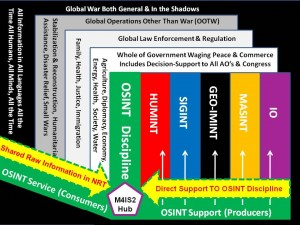
Definitions: M4IS2 (Multinational, Multiagency, Multidisciplinary, Multidomain Information-Sharing & Sense-Making

Definitions
16Shares
US$75B for Secret Sources, Virtually Nothing for Open Sources
US$75B for Secret, Loose Change for Open Sources

In 1988 a global campaign started at the Marine Corps Intelligence Center (MCIC) with the discovery that 80% or more of what the Marine Corps needed to do policy, acquisition, and operations support for this unique expeditionary and constabulary force, was not secret, not expensive, but also not known to anyone in Washington, D.C.  Thus was the modern discipline of Open Source Intelligence (OSINT) inspired.

This is year 21 in a 25 year fight for the public interest, and although the USA remains “severely deficient” (as stated by the Aspin-Brown Commission in 1996), the US secret world refuses to act on the findings that also called for OSINT to be a “top priority” for both funding and for DCI/DNA attention.  Neither of the last have been forthcoming, and it can be fairly said that until an Open Source Agency is established, as called for on pages 23 and 423 of the 9-11 Commission Report, the USA will continue to spend $75 billion a year on the 20% it can capture with secret sources and methods (less than 5% of which is actually processed, i.e. 1% of the totality), all to produce, “at best” 4% of what the President and many others now not served “need to know.”

The Nordic nations, and Sweden in particular through the Folke Bernadotte Academy, have led the way in conceptualizing M4IS operational and intelligence networks:

Continue reading “Definitions: M4IS2 (Multinational, Multiagency, Multidisciplinary, Multidomain Information-Sharing & Sense-Making”

Worth a Look: UN Spider for Space-Based Information Relevant to Disaster Relief

Tools, Worth A Look
0Shares

UN Space Information

UN-SPIDER aims at providing universal access to all types of space-based information and services relevant to disaster management by being a gateway to space information for disaster management support; serving as a bridge to connect the disaster management and space communities; and being a facilitator of capacity-building and institutional strengthening.

Tip of the hat to Chris Nicholas.

Found at iRevolution by Patrick Philippe Meier

EUCOM Week in Review Ending 30 September 2009

Uncategorized
0Shares

Hot Topics

AA: A breakdown of Iran's missile arsenal 09/28/09

AA: Dialogue urged for Nagorno-Karabakh 09/29/09

AA: Obstacles on the path to world peace – Russia Now 09/28/09

AL: Topi says Albania aware of NATO responsibilities 09/25/09

CY: Cyprus Negotiators Running Out Of Time – Report 09/29/09‎

GR: Growing support for Greece's far-right maverick party – Feature 09/30/09

HR: Croatia's EU bid set to advance 09/28/09

IL: Israel's Final Warning to the World? 09/25/09

IL: UN Report Accuses Israel of War Crimes 09/29/09

TR: Turkey, Pakistan enjoy unique ties 09/30/09

UA: Why does Ukraine need constitutional reform? By Viktor Yushchenko … 09/25/09

Below the fold: Instability, Special Operations, Security Forces, Foreign Affairs, Crime

Continue reading “EUCOM Week in Review Ending 30 September 2009”

Journal: Collaborative Innovation Networks (COINs)

Collaboration Zones, Communities of Practice, Real Time, Threats
0Shares

Original Source Online

Collaborative Innovation Networks (COIN) – Introduction

COINs are the most efficient social mechanisms to develop successful products in R&D, grow better customer relationships, establish better project management processes, and build higher-performing teams.

While it may appear that COINs seem to come to life serendipitously at the initiative of intrinsically motivated individuals without organizational blessing, the good news is that there are actual strategies an organization can employ to uncover, cultivate and nurture fledgling COINs to become more effective. In fact, there are even things individuals can do to become more productive COIN members.

Continue reading “Journal: Collaborative Innovation Networks (COINs)”

Journal: Top 25 CENSORED Stories in the USA

Collective Intelligence, Communities of Practice, Ethics, History
0Shares
Original Online Source

1. US Congress Sells Out to Wall Street
2. US Schools are More Segregated Today than in the 1950s
3. Toxic Waste Behind Somali Pirates
4. Nuclear Waste Pools in North Carolina
5. Europe Blocks US Toxic Products
6. Lobbyists Buy Congress
7. Obama’s Military Appointments Have Corrupt Past
8. Bailed out Banks and America’s Wealthiest Cheat IRS Out of Billions
9. US Arms Used for War Crimes in Gaza
10. Ecuador Declares Foreign Debt Illegitimate
11. Private Corporations Profit from the Occupation of Palestine
12. Mysterious Death of Mike Connell—Karl Rove’s Election Thief
13. Katrina’s Hidden Race War
14. Congress Invested in Defense Contracts
15. World Bank’s Carbon Trade Fiasco
16. US Repression of Haiti Continues
17. The ICC Facilitates US Covert War in Sudan
18. Ecuador’s Constitutional Rights of Nature
19. Bank Bailout Recipients Spent to Defeat Labor
20. Secret Control of the Presidential Debates
21. Recession Causes States to Cut Welfare
22. Obama’s Trilateral Commission Team
23. Activists Slam World Water Forum as a Corporate-Driven Fraud
24. Dollar Glut Finances US Military Expansion
25. Fast Track Oil Exploitation in Western Amazon

Journal: Tom Atlee on Engaging Real-World

Earth Intelligence
0Shares
Full Reflections Online

When you are standing on the edge of a cliff a step forward is not progress. — Anonymous

Our separation from nature — or should I say, our separation from reality as it really is, in all its fullness that is so hard for us to grasp — has now reached global proportions. Reality's feedback is now coming in the form of increasingly extreme weather, emptying oceans and aquifers, cancers arising from an environmental chemical soup so complex we can no longer track the causal links any more, new diseases that won't respond to antibiotics and can span continents and seas in hours on jets, and small groups and networks with increasingly powerful destructive technologies at their disposal.

We are rapidly moving into a realm where problem-solving becomes obsolete, if not downright dangerous — especially at the global level, especially when we are trying to preserve our systems, our habits, our identities, our protections and privileges. Because these challenges are not primarily problems to be solved. They are realities to engage with, to come to terms with, to learn something from about who we are in the world, to be humbled by and creatively joined. Yes, joined. Because inside the realities of today are profound lessons about who we need to be next, individually and collectively — about the cultures, technologies, stories, and social systems we need to create and move into.

Journal: Global Impact Vulnerability Alert System

Key Players, Non-Governmental, Policies, Real Time, Strategy, Threats, Tools, True Cost
0Shares
Full Text Online
Full Text Online

Extract from Secretary General Ban Ki-Moon Press Conference

“We are also creating a new Global Impact Vulnerability Alert System, giving us real-time data and analysis on the socio-economic picture around the world, so that governments can reach those who most need it.”

References:

GLOBAL IMPACT ANDVULNERABILITY ALERT SYSTEM BACKGROUND NOTE 6 July 2009

Briefing Press, Deputy Secretary-General Says Global Impact Vulnerability Alert System Promises to Be 21st Century Tool to Help Analyse Modern Global Problems, 18 September 2009

iRevolution, Global Impact and Vulnerability Alert System (GIVAS): A New Early Warning Initiative? July 2, 2009 Patrick Philippe Meier