Review: Resilience Thinking–Sustaining Ecosystems and People in a Changing World

5 Star, Complexity & Resilience, Environment (Solutions), Nature, Diet, Memetics, Design
0Shares
Resilience Thinking
Amazon Page

Gem of Useful Education, February 24, 2008

Brian Walker

This is a gem of an educational book. Mixing case studies with elaborating chapters on key concepts, it's as a good a volume as I have found for teaching undergraduates, graduates, and practitioners (farmers, factory managers, investors) the core ideas needed to restore a sustainable social-ecological system.

Highlights for me:

+ Optemization is a false premise, simplifies complex systems we do not understand, with the result that we end up causing long-term damage.

+ Resilience thinking is systems thinking. I cannot help but think back to all of the excellent work in the 1970's and 1980's–the authors were simply a quarter century ahead of their time.

+ In a nut-shell, resilient system can absorb severe disturbance.

+ System resilience is affected by context, connections across scales of time and space, and current system state in relations to threshholds.

+ Fresh water, fisheries, and topsoil depletion are major failures.

+ Drivers of environmental degradation are poverty, willful excessive consumption, and lack of knowledge (from another book, I recall that changes to the Earth that used to take 10,000 years now take three, one reason we need real-time science).

+ Key concepts are threshholds and adaptive cycles. Adaptive cycles have four phases: Rapid Growth; Conservation; Release; and Reorganization.

+ Redundancy is NOT a dirty word (just as intelligence–decision support–should not be a dirty word within the United Nations)

+ Ecological networks cannot be understood nor nurtured with a tight linking and understanding of the social networks that interact with the ecological networks.

+ Subsidies are a form of social denial, as they subsidize unsustainable practices and prevent adaptation and change.

+ Lovely–absolutely lovely–chart on page 89 about time-scales of climate and natural disasters like major fires.

+ One size does not fit all–solutions for one social-ecological network, e.g. in the USA, will not be the same as for another, e.g. in Norway.

+ Diversity is the key to regeneration.

+ Governances must be able to see and act upon key intervention points.

+ A Resilient world would be characterized by:

1. Diversity
2. Ecological variables
3. Modularity
4. Acknowledgement of slow variables
5. Tight feedbacks
6. Social capital
7. Innovation
8. Overlap in governance
9. Ecosystem services

Within this small and very easy to absorb book one finds a great annotated bibliography of recommended readings, a fine reference section, and a very solid index.

Other books that come to mind as complements to this one (limited to ten links by Amazon):
The leadership of civilization building: Administrative and civilization theory, symbolic dialogue, and citizen skills for the 21st century
Society's Breakthrough!: Releasing Essential Wisdom and Virtue in All the People
Ecological Economics: Principles And Applications
Natural Capitalism: Creating the Next Industrial Revolution
Green to Gold: How Smart Companies Use Environmental Strategy to Innovate, Create Value, and Build Competitive Advantage
Cradle to Cradle: Remaking the Way We Make Things
The HOK Guidebook to Sustainable Design
High Noon 20 Global Problems, 20 Years to Solve Them
Pandora's Poison: Chlorine, Health, and a New Environmental Strategy
The Blue Death: Disease, Disaster, and the Water We Drink


Vote on Review

Great Peacemakers: True Stories from Around the World

6 Star Top 10%, Peace, Poverty, & Middle Class
0Shares

PeacemakersBeyond 5 Stars–Marks Beginning of Era of Peace

February 23, 2008

Ken Beller

This book was brilliantly conceived and executed. I like it so much I am adding it to my travel series for recurring selective reading.

I am very impressed by the research and the creative analysis that paved the way for this book to be truly in a class of its own. Indeed, I think the authors are on to something that could and should be a multilingual series used in every classroom on the planet.

While the table of contents is impressive, with twenty great souls selected for concise review, what really got my attention was the Introduction, where the authors observe that after much research, they found five distinct groups or “paths to peace:”

choosing nonviolence,

living peace,

honoring diversity,

valuing all life, and

caring for the planet.

There is one other, public intelligence (a topic on which I have written four books, published a fifth, and have just commissioned three new edited works (Collective Intelligence: Creating a Prosperous World at Peace; Peace Intelligence: Assuring a Good Life for All; and Commercial Intelligence: From Moral Green to Golden Peace).

Each of the chapters is short, easy to read, relevant, and concluded by a page of thoughts from the person in their own words, and that is the primary reason this book made the extraordinary leap into permanent travel with me.

Two from Martin Luther King, Jr. represent all that I live to correct:

“The way of acquiescence leads to moral and spiritual suicide.”

“Our scientific power has outrun our spiritual power. We have guided missiles and misguided men.”

See my varied lists and my many non-fiction reviews for additional reading.

Amazon allows me to add ten links to any review. Here are nine more, six books and three DVDs, on the subject of Peace. I praise God every day for Dick Cheney–only the presence of such a nakedly amoral war criminal could have sparked the revolution in human affairs that is about to take place. Peace is the only winnable war, and the Earth Intelligence Networki, co-founded by 24 leading-edge minds, strives to empower every person on the planet with public intelligence in the public interests.

The Unconquerable World: Power, Nonviolence, and the Will of the People
A Power Governments Cannot Suppress
The Bottom Billion: Why the Poorest Countries are Failing and What Can Be Done About It
Peacekeeping Intelligence: Emerging Concepts for the Future
The New Craft of Intelligence: Personal, Public, & Political–Citizen's Action Handbook for Fighting Terrorism, Genocide, Disease, Toxic Bombs, & Corruption
Tibet – Cry of the Snow Lion
The Snow Walker
Peace One Day

I am *very* pleased to have read this book, and I do not plan to put it away. This volume is not just a keeper, it is a travel companion rich with good intentions that are contagious. Well done!

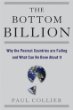
Review: The Bottom Billion–Why the Poorest Countries are Failing and What Can Be Done About It

5 Star, Capitalism (Good & Bad), Humanitarian Assistance, Intelligence (Wealth of Networks), Peace, Poverty, & Middle Class, Stabilization & Reconstruction
0Shares

Bottom BillionElegantly brilliant, incisive clarity, quite extraordinary, February 22, 2008

Paul Collier

I read a lot, almost entirely in non-fiction, and this book is easily one of the “top ten” on the future and one of the top three on extreme poverty, in my own limited reading.

The other three books that have inspired me in this specific area are:
The Fortune at the Bottom of the Pyramid
Creating a World Without Poverty: Social Business and the Future of Capitalism
The End of Poverty: Economic Possibilities for Our Time

There is an enormous amount of actionable wisdom in this book, which is deceptively easy to read and digest. The author's bottom line is clear early on:

A. The fifty failing states at the bottom, most in Africa, others in Central Asia, are a cesspool of misery that is terribly dangerous to all others, exporting disease, crime, and conflict.

B. The responsibility for peace to enable prosperity cannot be expected from within–it must be provided as a common good from outside. In support of this point, toward the end of the book, the author posits a 15:1 return on investment from $250M a year in investment and aid, mostly technical assistance.

This book is a superb guide for regional authorities and international coalitions with respect to the value of non-military interventions.
The author provides compelling yet concise overviews of the four traps that affect the billion at the bottom:

A. The Conflict Trap
B. The Natural Resource Export Trap
C. Landlocked in a Bad Neighbors Trap
D. Poor and Corrupt Governance

The author describes the need for a “whole of government” approach, both among those seeking to deliver assistance, and those receiving it.
I have a note, a new insight at least to me, that AIDs proliferated so quickly across Africa because of the combination of mass rape followed by mass migration. There are many other gifted turns of phrase throughout.
A study on the cost of a Kalashnikov is most helpful. The author tells us that the legacy of any war is the proliferation of inexpensive small arms into the open market.

Across the book the author points out that the gravest threat to governance and stability within any fragile economy is a standing army.
Each of the traps is discussed in depth.

The middle of the book outlines nine-strategies for the land-locked who suffer from being limited to their neighbors as a marketplace, rather than the world as a whole.

1. Work with neighbors to create cross-border transport infrastructure
2. Work to improve neighbors' economies for mutual benefit
3. Work to improve access to coastal areas (the author points out that the sea is so essential, that landlocked countries should not* be* countries, they should be part of a larger country that borders the sea)
4. Become a haven of peace, providing financial and other services.
5. Don't be air-locked or electronically-locked (the first study of the Marine Corps that I led in 1988-1989 found that half of the countries of concern did not have suitable ports but all had ample C-130 capable airfields).
6. Encourage remittances
7. Create transparent investment-friendly environment for resource prospecting
8. Focus on rural development
9. Attract aid

Toward the end of the book I am struck by the author's pointed (and documented) exclusion of democracy and civil rights as necessary conditions for reform. Instead, large populations, secondary education, and a recent civil war (opening paths to change), are key.
$64 billion is the cost to the region of a civil war, with $7 billion being the minimal expected return on investment for preventing a civil war in the country itself.

Bad policies come with a sixty year hang-over.

Asia is the solid middle and makes trade a marginal and unlikely option for rescuing Africa UNLESS there are a combination of trade barriers against imports from Asia, and unreciprocal trade preferences from richer countries. In the context of globalization, only capital and people offer hope.

In the author's view, capital is not going to the bottom billion because:

A. Bottom of the barrel risk
B. Too small to learn about
C. Genuinely fragile

In terms of human resources, after discussing capital flight, the author concludes that the educated leave as quickly as they can. I am inspired by this discussion to conclude that we need a Manhattan project for Africa, in which a Prosperity Corps of Gray Eagles is incentivized to adopt one of the 50 failed states, and provided with a semblance of normal living and working conditions along with bonuses for staying in-country for ten years or more. As I reflect on how the USA has spent $30 billion for “diplomacy” in 2007, and over $975 billion for waging war, (such that the Comptroller General just resigned from a fifteen year appointment after telling Congress the USA is “insolvent”) this begs public outrage and engagement.

As the book makes its way to the conclusion the author's prose grabs me:

“We should be helping the heroes” attempting reform

We are guilty in the West of “inertia, ignorance, and incompetence.”

The “cesspool of misery….is both terrible….and dangerous.”

Several other noteworthy highlights (no substitute for buying and reading the book in its entirety:

Aid does offer a 1% growth kick

Aid bureaucracy, despite horror stories, adds real value in contrast to funds that vanish into the corrupt local government

Misdirection of unrestricted funds leads to militarization and instability.

The author touches briefly on the enormous value that industry can offer when it is finally incentivized to do so. DeBeers and its certification process are cited with respect, perhaps saving diamonds from going the way of fur.

The author stresses that top-down transparency enables bottom-up public scrutiny and the two together help drive out corruption (something Lawrence Lessig has committed the remainder of his life to).

There is an excellent section on irresponsible NGOs, notably Christian Aid, feared by the government and not understood by the public.
I put the book down with a very strong feeling of hope.

Other books I recommend, in addition to the three above:
A More Secure World: Our Shared Responsibility–Report of the Secretary-General's High-level Panel on Threats, Challenges and Change
Deliver Us from Evil: Peacekeepers, Warlords and a World of Endless Conflict
Confessions of an Economic Hit Man
The Shock Doctrine: The Rise of Disaster Capitalism
The Unconquerable World: Power, Nonviolence, and the Will of the People
The leadership of civilization building: Administrative and civilization theory, symbolic dialogue, and citizen skills for the 21st century
Plan B 3.0: Mobilizing to Save Civilization, Third Edition

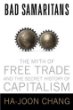
Review: Bad Samaritans–The Myth of Free Trade and the Secret History of Capitalism

5 Star, Capitalism (Good & Bad), Empire, Sorrows, Hubris, Blowback
0Shares

Bad SamaritansSpeaking truth to power, helpful revisionism, February 22, 2008

Ha-Joon Chang

While other books (linked below) have focused on the evils done in our name, this is the first book I have seen that dissects economic history in order to demonstrate the hypocrisy of the current regime that bullies lesser developed countries with the IMF-WTO-World Bank interlocking conditionalities.

The author comes down solidly in favor of protectionism, foreign investment controls, state-owned enterprises, avoidance of privatization, not allowing patents to clash with the public interest, the need to defy the marketplace and respect the role of manufacturing, and the influence of culture (and changing the culture through government direction).

This is a nuanced book that trashes the neo-liberals while speaking truth to power. On any given prescrption, the author will say “it depends” and avoid leaning to one extreme over another.

He touches on democracy as not necessarily good for developement, and corruption not necessarily bad.

Other books that I respect as much as this one:
The Bottom Billion: Why the Poorest Countries are Failing and What Can Be Done About It
The End of Poverty: Economic Possibilities for Our Time
The Fortune at the Bottom of the Pyramid: Eradicating Poverty Through Profits (Wharton School Publishing Paperbacks)
Confessions of an Economic Hit Man
The Shock Doctrine: The Rise of Disaster Capitalism
Manufacture of Evil: Ethics, Evolution, and the Industrial System
Open Society: Reforming Global Capitalism
The Pathology of Power – A Challenge to Human Freedom and Safety
Blessed Unrest: How the Largest Movement in the World Came into Being and Why No One Saw It Coming
The Unconquerable World: Power, Nonviolence, and the Will of the People

See also my varied lists.

Review: Microtrends–The Small Forces Behind Tomorrow’s Big Changes

3 Star, Future
0Shares

MicrotrendsEye-glazing trivia of limited value to seeing big changes, February 22, 2008

Mark Penn

Edit of 23 Feb 08 to reexamine conclusion of book and add context.

FOUR STARS for trivia buffs. Absolutely nothing wrong with the well-organized micro-trends, but they don't connect to “tomorrow's changes.”

I like books that pupport to discuss trends that reveal “tomorrow's big changes,” but this book, while clever, has been over-sold.

Rather than provide my usual summative review, I will describe this book with just one word: disappointing.

Below are books I pulled from my shelf that I have found to be much better, along with everything ever written by Alvin and Heidi Toffler.

What Kind of Nation: Thomas Jefferson, John Marshall, and the Epic Struggle to Create a United States
The Nine Nations of North America
How The World Really Works
The Clustering of America
The Clustered World : How We Live, What We Buy, and What It All Means About Who We Are
Tribes: How Race, Religion and Identity Determine Success in the New Global Economy
New Rules Searching for Self Fulfillment in a World Turned up Side Down
The Cultural Creatives: How 50 Million People Are Changing the World
The Battle for the Soul of Capitalism
Vice: Dick Cheney and the Hijacking of the American Presidency

On the latter book, I have to ask myself how is it possible for the two Democratic contenders to campaign for the Presidency without once mentioning Dick Cheney and the documented high crimes and misdemeanors he is alleged to have committed? I place the last two books at the opposite extreme from this book on microtrends. The book lacks any semblance of a “so what” and it certainly does not portend, as its subtitle claims, “tomorrow's big changes.”

Out of respect for the early negative comment, I reread the conclusion and reconfirmed that while it lays claim to predicting increased fragmentation in the future and a heavy Internet play such as Internet marriages, this is much too facile and presumptuous. My reading focuses on the collapse of complex societies, the desperate straits of the five billion at the bottom, one billion of them in extreme poverty that produces wars, crime, and disease without borders. It is in that light that I find this book to be disappointing. This is a rich boy's tour of his own (expanded neighborhood) and has no connection to the reality that I follow on a daily basis via Earth Intelligence Network.

Definitely FOUR STARS for mega-trivia, but only three, at best, for serious students of how we might shape our future to create a prosperous world at peace.

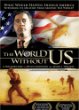
Review DVD: The World Without US – With Niall Ferguson

3 Star, America (Anti-America), Empire, Sorrows, Hubris, Blowback, Reviews (DVD Only)
0Shares

World Without UsClever in a sophmoric way–selective, Inconclusive, and naive, February 14, 2008

Mitch Anderson

I have been going blind the past two weeks doing the index to the new edited work by Mark Tovey, COLLECTIVE INTELLIGENCE: Creating a Prosperous World at Peace, playing DVDs in the background.

This one fooled me right up to the end with its able review of the disconnect between most Arab oil going to China and Europe (so why should the US protect it), the great strengths of the German and Japanese economies, the great wealth of the Arab countries to whom we give most of our foreign military assistance….

I was especially intregued by his use of putative candidates for president promising to pull all our troops back and reinvest in the homeland, something Mayor Mike Bloomberg has been harping on.

Then he pulled the plug with, as I say, a clever but sophmoric conclusion that is NOT, as one “official” review would have it, conclusive at all–the DVD ends with a nuclear explosion and a replay of Hiroshima, with one Asian mother in the rubble asking another to tell her daughter (who is assuredly vaporized) that she loves here. Then she dies and the movie dies with her.

This happens to be my lifetime focus, so here are a few thoughts:

1) For what we spend on war all over the world, $1.3 trillion a year, we could use one third of it to retain essential military and law enforcement capabilites, one third of it to completely rebuild our homeland, and one third of it to invest in massive undersea, outerspace, paranormal, and inter-cultural innovation.

2) Washington DC is run by four crime families: the Clintons, the Bushes, the Republicans and the Democrats. They specialize in picking the taxpayers' pocket, robbing the many to enrich the few. At the same time, Wall Street has migrated from being a fiduciary trust to being a financial intermediary, and as John Bogle spells out in his most recent book, these asset managers have skimmed off one fifth of the wealth as “fees” without any of the “owners” being any the wiser.

3) The ten high level threats to mankind have now been definitively established, and they are poverty, infectious disease, environmental degradation, inter-state conflict, civil war, genocide, other atrocities, proliferation (which is best practiced by the arms mongering of the five permanent members of the Security Council), terrorism (note how this is NINTH yet consuming the current White House), and transnational crime (the latter a $2 trillion a year endeavor, against $7 trillion in the “legal” economy and an almost certain $1 trillion in corporate fraud and tax avoidance and another $1 trillion in barter and intangible exchange.

The USA needs the following:

1) Electoral reform and a citizenship mindful of its civic duties.

2) Honest politicians committed to transparent open government and no legislation without pre-publication in detail.

3) A strategy that commits to eradicating the ten high level threats, and buy-outs or force-oputs for the 44 dictators, 42 of whom we love to love, two of whom we love to hate (one being Cuba, which has the best health care in the world, the only sustainable agricultural model without pesticide and with full employment, and oh yes, they can send 10,000 doctors to Venezuela without blinking.

4) Recognition that all ten threats, poverty for example, require the harmonization of twelve policis from Agriculture to Water (for example, US wastes roughly a third of the food it grows, which consumed water we cannot afford to lose).

5) Recognize that nothing the US or EUR do will matter unless we can create an EarthGame that serves as the Operating Manual for Spaceship Earth, and presents in compelling terms sustainable architectures that can be adopted by the eight demographic giants who–if they repeat our mistakes–will consume the entire planet within 3 to five generations.

Enough. This is an annoying movie for its lack of nuance and serious understanding of the complexities as well as the opportunities that lie before us.

Better DVDs:
The Fog of War – Eleven Lessons from the Life of Robert S. McNamara
Why We Fight
Tibet – Cry of the Snow Lion
Gandhi (Widescreen Two-Disc Special Edition)
The Snow Walker

Better Books:
The Unconquerable World: Power, Nonviolence, and the Will of the People
Breaking the Real Axis of Evil: How to Oust the World's Last Dictators by 2025
The leadership of civilization building: Administrative and civilization theory, symbolic dialogue, and citizen skills for the 21st century
A Power Governments Cannot Suppress
The Battle for the Soul of Capitalism

Afterthought: anyone can search on the terms in brackets for more:
[Chinese Irregular Warfare Memorandum oss.net]
[Steele Joint Forces Quarterly Asymmetric]
[Steele Alternative Paradigm for National Security]
[Steele Presidential Leadership oss.net]

And of course there are the books I have written and the ones we are publishing and providing free online at Earth Intelligence Network.

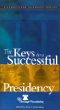
Review: The Keys to a Successful Presidency

4 Star, Executive (Partisan Failure, Reform), Leadership
0Shares

PresidencyPublished in 2000, Essential Reference but Outdated and Incomplete, February 13, 2008

Alvin Felzenberg

I am spending most of my time, in the course of publishing three edited works and my own on “War & Peace: Seventh Generation Intelligence,” thinking about how to radically redirect the organization of both the Presidency and Congressional jurisdictions. I consider David Abshire to be one of the top thinkers on this subject.

The book covers, in fast easy to read fashion:

1) Achieving a Successful Transition

2) Running the White House

3) Staffing a New Administration

4) Turning the President's Agenda into Administration Policy

5) Enacting a National Security Agenda

6) Working with Congress to Enact an Agenda

7) Managing the Largest Corporation in the World

8) Building Public Support for the President's Agenda

Each of the above chapters has between three and five sub-chapters, none long, all drawing on substantive past performers.

Now here is what is NOT in this book:

1) How to achieve a deep understanding of a complex world in which nation-states are devolving and new assemblages including social business, social entrepreneurship, and bottom-up citizen social networks are self-governing, creating wealth, and policing corporations. In other words, there is not INTELLIGENCE chapter in this book. (search for <New Rules of the New Craft of Intelligence Chapter 15> for a free answer.

2) Chapter 4 neglects to discuss the role of the Office of Management and Budget, which dropped the Management part of its role sometime back in the 1970's as best I can tell. Since the Comptroller General has declared the US insolvent as of 2007, and the Bush-Cheney regime has put the country into a 9 trillion debt and a 40 trillion future unobligated deficiency, this should be the most important part of the next President's staff, and it better have someone at the top that understands the ten threats, twelve policies, and eight challengers, and the spine to redirect money from secret satellites to open education; from a heavy metal military to waging peace; and from corporate subsidies to infrastructure and other homefront priorities. I recommend Colin Gray's book (or see my review), Modern Strategy and Tony Zinni's latest book, The Battle for Peace: A Frontline Vision of America's Power and Purpose. Free online are my Army War College presentations and chapters on “Presidential Leadership” and “An Alternative Paradigm for National Security.”

3) The national security chapter is very disappointing. I will just list a handful of books that must be already in the mind of the National Security Advisor before Inauguration:

The Unconquerable World: Power, Nonviolence, and the Will of the People

The Search for Security: A U.S. Grand Strategy for the Twenty-First Century

The Paradox of American Power: Why the World's Only Superpower Can't Go It Alone

The leadership of civilization building: Administrative and civilization theory, symbolic dialogue, and citizen skills for the 21st century

How to Change the World: Social Entrepreneurs and the Power of New Ideas, Updated Edition

The Wealth of Networks: How Social Production Transforms Markets and Freedom

There are so many other books that could be usefully distilled for a new president. Only Mike Huckabee and Barack Obama, in my personal judgement, have minds open enough, and willing to consider that national security is, as Thomas Jefferson taught us, to be found in an educated citizenry. We need a transpartisan sunshine cabinet NOW, one that can propose a balanced national budget by 4 July 2008, and from there, We the People can have a national conversation about restoring America the Beautiful

I will, on the basis of all I have read, put this bluntly: McCain and Clinton are the last vestiges of the industrial-era spoils system that makes decisions in backrooms, by, of, and for the elite. The only way this country is going to resurrect itself is if we get a President who knows how to harness the collective intelligence of We the People, how to uncomplicate and sharply reduce the federal government, and how to create a national strategy that eradicates the ten threats within ten years (including an end to all dictators and our support for them( by harmonizing the twelve policies. This is not rocket science. All it requires is the framework, integrity, an open mind, and an ability to listen. We do NOT need a “war leader.” We need an Epoch B Swarm Leader.

None of that is in this book. What is in the book is first class. What is not in the book is fatally absent.

Two DVDs just for grins:
Why We Fight
The Fog of War: Lessons from the Life of Robert S. McNamara

Vote on Review