Review: When Corporations Rule the World

5 Star, Banks, Fed, Money, & Concentrated Wealth, Capitalism (Good & Bad)
0Shares

Corporations RulePinnacle of the Negative Consequences of Corporate Impunity,

January 28, 2007

David C Korten

Others have done well at addressing the strengths of this book, what I can do is bring to bear a few links to other books that deeply support this author and his views.

We must begin in the 1970's, when Richard Barnett in Global Reach and others first began to understand that corporations were amoral, disconnected from communities, and beyond what Kirkpatrick called “human scale.” Joining the authors focusing on multinationals as a unique new breed of corporation were authors such as Lionel Tiger, whose book Manufacture of Evil: Ethics, Evolution, and the Industrial System remains a standard. The industrial era disconnected kinship and community from the manufacturing process, and trust was a casualty (a thesis confirmed in the 1990's when a Nobel Prize was awarded for a man who proved that trust lowers the cost of doing business).

Now we have an entire new literature on how corporations have abused the personality status intended for freed slaves, and been largely freed from all accountability and transparency. Books like The Informant: A True Story and Conspiracy of Fools: A True Story and the books about Wal-Mart, Enron, and Exxon, all support the concerned premise of this author.

Corporations have created a global class war (see the books by that title), and have compromised virtually all governments. Corporations have bought the US Congress (see Breach of Trust: How Washington Turns Outsiders Into Insiders and The Broken Branch: How Congress Is Failing America and How to Get It Back on Track (Institutions of American Democracy); they have compromised national, state, and local social safety networks and standards, they have enhanced the power for 45 dictators world-wide, and they have bribed or created and then bribed elites in virtually every country on the planet so as to loot the commonwealths of those nations with the permission of the elites and against the public interest of the larger population.

Corporations do not rule the world, they are killing the world, and as one wag whose name I cannot recall has said, those doing the killing have names and addresses. Hence this book is a natural lead in to the author's latest work, The Great Turning: From Empire to Earth Community (Bk Currents) which I am also reviewing today.

There are *many* books on the evil of unfettered corporations, if I were to recommend only two, they would be Barnett's “Global Reach” for historical context, and this one for the current threat. I also recommend the DVD, The Corporation

AA Mind the GapClick Here to Vote on Review at Amazon,

on Cover Above to Buy or Read Other Reviews,

I Respond to Comments Here or There

Review: After Iraq–The Imperiled American Imperium

5 Star, Empire, Sorrows, Hubris, Blowback, Iraq
0Shares

Amazon Page
Amazon Page

Ethical Sanity, Sensible Guidelines,

January 23, 2007
Charles W. Kegley Jr.
I am in Boise, Idaho, where I came to hear Al Gore deliver the single most sensational and sensible lecture I have ever heard in my lifetime. The DVD and the book titled “Inconvenient Truth” do not do him or his message justice.

It was in this context that I discovered that Boise, Idaho is a hotbed of ethical sanity. The Frank Church Institute (sponsor of Al Gore's visit to Boise) and these two authors, one of whom is the Frank Church Professor of International Relations, the other the Corporate Secretary of the Carnegie Council for Ethics in International Affairs, have all of the moral credibility and legitimacy that the Bush-Cheney regime lacks.

I bought this book while visiting Boise State University, and I believe it may well be one of the most important works relevant to recovering from the enormously mis-guided, inept, and corrupt practices that Bush-Cheney have forced upon all of us. As a moderate but estranged Republican, I heartily embrace the solid reasoning of these two authors.

The most important part of the book is the final section that I have marked very heavily. The authors highlight the number of military interventions the US has undertaken, making the important point that Bush-Cheney are not the first to abuse military power, but perhaps the first to do so in such an outrageously ill-conceived manner.

They draw respectfully on historian Niall Fergusson's summary of American interventions and this is worth repeating here:

1. Impressive initial military success
2. Flawed assessment of indigenous sentiments
3. Strategy of limited war and gradual escalation of forces
4. Domestic disillusionment in the face of protracted and nasty conflict
5. Premature democratization
6. Ascendancy of domestic economic considerations
7. Ultimate withdrawal

There you have it. The authors go on to outline “Rules for Rivals” and I will not summarize those–buy the book. The most important observation made by the authors is that if one pays attention to an idea new to me, the Composite Index of National Capabilities (CINC), then one can quickly see that the US pales in comparison to China, and simply does not have the capacity for sustained global warfare in the conventional sense.

The authors outline several characteristics of the emerging collapse of US foreign policy and credibility and effectiveness, not least of which is their proper emphasis on the failure of American education.

This is a very important book, and it deserves to be noticed by the varied book sections, especially the Boston Globe, the New York Times, and the Los Angeles Times.

As one who can be bombastic at times, I especially admired the manner in which the authors made their case in an even-handed relatively neutral manner. Boise, Idaho is a very sensible place! America would do well to absorb and act on the common sense thinking they are doing here.

Blessed Unrest: How the Largest Movement in the World Came into Being and Why No One Saw It Coming
Ecological Economics: Principles And Applications
Plan B 2.0: Rescuing a Planet Under Stress and a Civilization in Trouble

Vote on Review
Vote on Review

Review: Handbook of Intelligence Studies

5 Star, Intelligence (Government/Secret)
0Shares
Amazon Page
Amazon Page
5.0 out of 5 stars Extraordinary Perfection Properly Priced
January 25, 2007
Loch Johsnon

This is without question the single most important book at the operational level for the study of intelligence. It is not possible to be fully appraised without this book in your library.

It includes my own chapter on Open Source Intelligence (OSINT) at the operational level, available free at Phi Beta Iota the Public Intelligence Blog, as with all my work in the public service.

Vote on Review
Vote on Review

Review: Plan B 2.0–Rescuing a Planet Under Stress and a Civilization in Trouble

5 Star, Environment (Problems), Environment (Solutions)
0Shares

Plan B 2.0Best Single Book for Both General Public and Broadly Read Specialists,

January 25, 2007
Lester R. Brown
It's a real shame that the publisher did not take the trouble to load the table of contents into the product information section provided by Amazon, because that alone should persuade anyone that gets to this page that the book is a MUST BUY MUST READ MUST SHARE.

Each of the following section titles has six sub-titles that I will not repeat here:
1. Entering a New World
2. Beyond the Oil Peak
3. Emerging Water Shortages
4. Rising Temperatures & Rising Seas
5. Natural Systems Under Stress
6. Early Signs of Decline
7. Eradicating Poverty, Stabilizing Populations
8. Restoring the Earth
9. Feeding Seven Billion Well
10. Stabilizing Climate
11. Designing Sustainable Cities
12. Building a New Economy
13. Plan B: Building a New Future.

Although an updated version of the first edition published in 2003, this version can be said to be both completely new, and finally ready for public consumption now that Al Gore has put Global Warming on the public mind.

I still prefer J. F. Rischard's High Noon 20 Global Problems, 20 Years to Solve Them for the general reader, and I still think E. O. Wilson's The Future of Life is one of the top three in this area, but this book by Lester Brown has the merit of consolidating and structuring detail in a manner I have not seen elsewhere.

I recommend the book be ready in conjunction with books by Herman Daly's Valuing the Earth: Economics, Ecology, Ethics and Paul Hawken's Natural Capitalism: Creating the Next Industrial Revolution, in part because everyone is now starting to realize that green sustainability is in fact the non-negotiable first step for any business to survive into the next decade–natural capitalism.

Most intriguing to me, and the heart of the book on page 257, is the consolidated Plan B budget totallying $161 billion a year needed to meet all of the goals the author postulates.
BASIC SOCIAL GOALS
12B Universal primary education
04B Adult literacy
06B School lunch in 44 poorest countries
04B Assistant to pregnant women and preschool childen in 44 poorest
07B Reproductive health and family planning
33B Universal health care
02B Closing the condom gap (Bill & Melinda Gates can have this one)

EARTH RESTORATION GOALS
06B Reforesting the earth
24B Protecting topsoil on cropland
09B Restoring rangelands
10B Stabilizing water tables
13B Restoring fisheries
31B Protecting biological diversity

As the author points out on the next page, world military expenditures total $975B a year, with the US alone responsible for $492B (this was published before we all knew of the half trillion dollar cost of the Iraq invasion and occupation). Hence, the $161B a year total is a fraction of the total spent on out-dated military systems, and could be funded by the US alone if we had the right leadership and public consensus.

Personally, and based on other readings, I believe that the author is under-estimating the costs, and avoiding a focus on many other factors including the urgent need to eradicate transnational crime and end inter-state and civil war. This is, however, a superb start and ideally suited as a primer for any level of learning.

Readers interested in seeing a broader perspective that places the ten high-level threats (poverty, infectuous disease, environmental degradation, inter-state conflict, civil war, genocide, other atrocities, proliferation, terrorism and transnational crime) in the context of the twelve policies that must be managed as a whole by all nations (agriculture, debt, diplomacy, economy, education, energy, family, immigration, justice, security, society, and water), and that in turn oriented toward the urgency of keeping the eight challengers (Brazil, China, Indonesia, India, Iran, Russia, Venezuela, Wild Cards) from repeating our mistakes, can check in at Earth Intelligence Network.

Rescuing are planet and our civilization is going to be a great deal harder than the author suggests, and is going to need a massive awakening by the public as to the “true cost” of all that we are doing wrong. I expect that we will succeed, in part from top down efforts by Al Gore and this author among others, and in part by bottom up efforts where individuals can get from the Internet the “true cost” of any good or service in terms of water content, fuel content, sweatshop labor content, and tax avoidance status. Noami Klein's books, No Logo: No Space, No Choice, No Jobs and The Shock Doctrine: The Rise of Disaster Capitalism are recommended in this regard.

Over-all an absolutely superb piece of work that caps the author's decades of advocacy on behalf of the planet. There is no other person that has been focused on this topic with due diligence year after year.

I believe this author should be recognized, along with Herman Daly and Paul Hawken and Anthony Lovins and others, for their total commitment over decades.

Vote on Review
Vote on Review

Click Here to Vote on Review at Amazon,

on Cover Above to Buy or Read Other Reviews,

I Respond to Comments Here or There

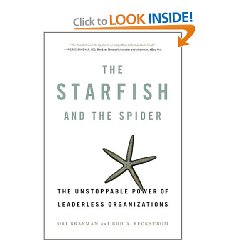
Review: The Starfish and the Spider–The Unstoppable Power of Leaderless Organizations

5 Star, Best Practices in Management, Change & Innovation, Civil Society, Consciousness & Social IQ, Democracy, Intelligence (Public), Intelligence (Wealth of Networks)
0Shares

Amazon Page
Amazon Page

Compelling and Sensible, Offers Hope in Face of High-Level Threats,

January 23, 2007
Ori Brafman
I like this book very much and recommend that it be read in conjunction with “Wikinomics” and “Infotopia,” or at least read my reviews there. Each of these three books has its own perspective and the combine well. There are other books, such as Kevin Kelly's and Howard Rheingold's that were ten to fifteen years ahead of what is now “conventional wisdom” and it is important to give credit to the true pioneers.

From a business and governance perspective, the book is valuable in emphasizing that any endeavor based on information will improve with decentralization–more dots will be captured, shared, understood, and acted on in a timely fashion. I have been saying for over a decade that in the age of distributed information, central intelligence is an oxymoron, something the Central Intelligence Agency, my former employer, simply refuses to believe.

I listened to Al Gore last night on Global Warming, in Boise, Idaho–10,000 people who gave him multiple standing ovations, and I plan to listen to George Bush on Iraq tonight. Al gets it, George does not. Centralized systems cannot defeat decentralized systems. Al Gore is leading a massive global campaign to get all of us to change the planet from the bottom up, while George (or Dick Cheney, depending on who you think actually runs the place) is deepening America's loss of global standing and moral stature at the same time that he is bankrupting the treasury and destroying the Armed Forces–and planning a conventional attack on Iran at the same time. One of these guys is sane, the other is a nutcase. The good news is that decentralized morality can triumph over centralized corruption, and that is the back story on Al Gore's emergence as a virtual Earth Leader.

The authors offer us a number of gems and conclude with ten rules I will list below.

The key point is that a distributed brain or organization is more resilient and more likely to pick up weak signals. Distributed consensus is both scalable and sustainable, while centralized coercion is neither.

The authors place great emphasis on the importance of a spiritually-compelling ide[a]ology as the glue that helps decentralized organizations adjust to external and internal challenges much faster and with greater precision (as well as fewer resources) that any centralized system can manage. The “catalyst” model (Al Gore) is compared with the “commander in chief” model (George Bush) and there is no doubt at all which is the superior model for addressing today's complex high-level threats.

Indeed, it may be that between state secessions and popular boycotts of corporations using the federal government to pick people's pockets, that the Internet could create a form of global self-governance that makes the Federal government largely irrelevant, while re-directing funds from waging war to waging peace. That is the next big step. The authors specifically say that the price of software is declining toward zero. It will be content, sense-making, and what IBM calls “services science” that will add value and be marketable.

The authors describe Amazon and E-Bay in very favorable terms, and as hybrids with a centralized infrastructure for delivering services, but a vast decentralized network of customers who are also “prosumers” (Alvin Toffler's term) creating value on the network with their reviews and buying patterns. The authors' phrase “decentralized creativity and centralized consistency” jumped out at me.

The ten “rules” (better described as guidelines) are:

01 Diseconomies of scale
02 Network effect
03 Power of chaos
04 Knowledge at the edge
05 Everyone wants to contribute
06 Beware the hydra response
07 Catalysts rule
08 *Values* are the heart of any organization or network
09 Measure, monitor, and manage
10 Flatten or be flattened

Overall, this is a very fine book. I also recommend the emerging literature on the “true cost” meme and on natural capitalism, demonstrating that a proper understanding of the true and long-term costs of any product or service actually makes businesses more profitable and more sustainable.

I have added an image I created in the 1990's when I first started advocating Open Source Intelligence (OSINT), today I am focused on a non-profit, the Earth Intelligence Network, whose objective is to empower individuals and communities with public intelligence in the public interest. This book gave me hope, gave me a sense that we can indeed come together as a global network, and displace the authoritarian and corrupt governments that have been bribed by corporations to loot our commonwealth.

Vote on Review
Vote on Review

Review: Hannibal Rising

5 Star, Atrocities & Genocide, Philosophy
0Shares

Amazon Page
Amazon Page

More than Satisfies, Ignore the Nit-Pickers,

January 23, 2007
Thomas Harris
Having read “Silence of the Lambs” first, and then the other two books by this author, I was skeptical but interested when I saw this book at an airport. It is excellent. Having fully engaged me with his earlier books, I was absolutely delighted to have this book fully occupy my flight from Denver to Dulles. It is carefully crafted and completely credible.

Future readers will benefit from being able to read the Hannibal series from start to finish. I am quite eager to see the author craft a book in which Hannibal takes on Wall Street and selectively culls the herd of greedy lying cheats that manage the Enron clones so proud of “exploding the client” (see my review of Michael Lewis' “Liar's Poker” and also “Confessions of an Economic Hit Man,” as well as “Cheating Culture” and “The Manufacture of Evil.”

Although I normally do not read or review fiction, this author has joined John Le Carre (the George Smiley series) and is one of handful of “must read” authors of fiction that is to my personal taste as a former spy and infantry officer.

This author has found his niche. Hannibal must live and love and kill with elegance. Bring on the next one!!!

Vote on Review
Vote on Review

Click Here to Vote on Review at Amazon,

on Cover Above to Buy or Read Other Reviews,

I Respond to Comments Here or There
Reference: How Not to Study the World-Wide Web (WWW)

Advanced Cyber/IO, Articles & Chapters, Cultural Intelligence
0Shares

ABSTRACT:Ā  In his book, Linked: How Everything is Connected to Everything Else and What it Means for Business, Science, and Everyday Life, Albert-Laszlo Barabasi gives us a detailed analysis of the typology of the WWW.Ā  In so doing, he makes many errors from which we can derive important lessons about ways not to study the WWW or complex networks in general.Ā  These lessons are crucial from the point of view of the philosophy of science, and suggest that more care and reflecivity is called for in pursuing WWW research.Ā  This paper is intended to provided imputus for meaningful thought and further discussion.

CONTENTS:

Introduction: Quality and Quantity

Network Analysis (Analytical Dimensioins of Networks, Robot Typology, Network Density, Assessing the Value of Hubs and Non-Hubs, The Effect of Search Engines on Typology)

Static Quality (Proportional Linkage, Website Design, Valuable Referrers, The Effect of Closeness)

Dynamic Quality (The Myth of Fitness, Competition is Cooperation, Survival of the Fitters, Innovation Changes the Landscape, Limits to Growth, Alternative Norms to Preferential Treatment

Conclusion: Getting It Right

33 Page PDF