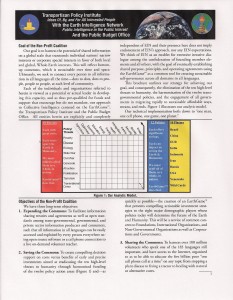
Reference: 21st Century Governance as a Complex Adaptive System

Advanced Cyber/IO, Articles & Chapters, Cultural Intelligence
0Shares

ABSTRACT:  The Information Revolution combined with connective technologies creates a unique global social network.  This network is vulnerable to cascades of information, norms, and coordinated action.  The inherent unpredictability of the information society demands new kinds of governance that focus on rapid network-coordinated response over centralized predictive planning.

CORE QUOTE:  “Power, as the capacity to impose behavior, lies in the networks of information exchange and symbol manipulation, which relate social actors, institutions, and cultural movements.”  Citing M. Castells, End of Millenium (Oxford, UK: Blackwell Publishers, 2000), p. 379.

Six Page PDF

Review: Infotopia–How Many Minds Produce Knowledge

4 Star, Change & Innovation, Democracy, Education (General), Future, Information Society, Intelligence (Collective & Quantum), Intelligence (Public), Intelligence (Wealth of Networks)
0Shares

Amazon Page
Amazon Page

Complements Wikinomics, Solid but Incomplete,

January 17, 2007
Cass Sunstein
I was initially disappointed, but adjusted my expectations when I reminded myself that the author is at root a lawyer. The bottom line on this book is that it provided a very educated and well-footnoted discourse the nature and prospects for group deliberation, but there are three *huge* missing pieces:

1) Education as the necessary continuous foundation for deliberation

2) Collective Intelligence as an emerging discipline (see the Innovators spread sheet at Earth Intelligence Network); and

3) No reference to Serious Games/Games for Change or budgets as a foundation for planning the future rather than predicting it.

In the general overview the author discusses information cocoons (self-segregation and myopia) and information influences/social pressures that can repress free thinking and sharing.

The four big problems that he finds in the history of deliberation are amplifying errors; hidden profiles & favoring common or “familiar” knowledge; cascades & polarization; and negative reinforements from being within a narrow group.

Today I am missing a meeting on Predictive Markets in DC (AEI-Brookings) and while I regret that, I have thoroughly enjoyed the author's deep look at Prediction Markets, with special reference to Google and Microsoft use of these internally. This book, at a minimum, provides the very best overview of prediction markets that I have come across. At the end of the book is an appendix listing 18 specific predictions markets with their URLs.

The author goes on to provide an overview of the Wiki world, and is generally very kind to Jimbo Wales and Wikipedia, and less focused on the many altneratives and enhancements of the open Wiki. It would have been helpful here to have some insights for the general reader on Doug Englebart's Open Hypertextdocument System (OHS) and Pierre Levy's Information Economy Meta Language (IEML), both of which may well leave the mob-like open wiki's in the dust.

Worthy of note: Soar Technology is quoted as saying that Wikis cut project development time in half.

The book draws to a close with further discussion of the challenges of self-segregation, the options for aggregating views and knowledge and for encouraging feedback, and the urgency of finding incentives to induce full disclosure and full participation from all who have something to contribute.

This book excels in its own narrowly-chosen domain, but it is isolated from the larger scheme of things including needed educational changes, the importance of belief systems as the objective of Intelligence and Information Operations (I2O), the role of Serious Games/Games for Change, and the considerable work that has been done by Collective Intelligence pioneers, who just held their first convergence conference call on 15 January 2007.

Final note: the author uses NASA and the Columbia disaster, and CIA and the Iraq disaster, as examples, but does not adequately discuss the pathologies of bureaucracy and the politicization of intelligence and space. As a former CIA employee who also reads a great deal, I can assert with confidence that CIA has no trouble aggregating all that it knew, including the reports of the 30 line crossers who went in and then came back to report there were no Weapons of Mass Destruction. CIA has two problems: 1) Dick Cheney refused to listen; and 2) George Tenet lacked the integrity to go public and go to Congress to challenge Dick Cheney's malicious and impeachable offenses against America (see my reviews of “VICE” and of “One Percent Doctrine” on Cheney, and my many reviews on the mistakes leading up to and within the Iraq war). See also my reviews of “Fog Facts” and “Lost History” and Gaddis' “The Landscape of History.”

To end on an upbeat note, what I see in this book, and “Wikinomics” and “Collective Intelligence” and “Tao of Democracy” and my own “The New Craft of Intelligence: Personal, Public, & Political,” is a desperate need for Amazon to take on the task of aggregating books and building out from books to create social communities where all these books can be “seen” and “read” and “understood” as a whole. We remain fragmented in the production and dissemination of information, and consequently, in our own mind-sets and world-views. Time to change that, perhaps with Wiki-books that lock-down the original and then give free license to apply OHS linkages at the paragraph level, and unlimited wike build-outs. That's what I am in Seattle to discuss this week.

Vote for Review
Vote for Review

Click Here to Vote on Review at Amazon,

on Cover Above to Buy or Read Other Reviews,

I Respond to Comments Here or There

Review: Wikinomics–How Mass Collaboration Changes Everything

5 Star, Economics, Information Society, Intelligence (Collective & Quantum), Intelligence (Public)
0Shares

Amazon Page
Amazon Page

Solid FOUR, Some Preening, Double-Spaced Overview,

January 16, 2007
Don Tapscott
Out of respect for Laura K. Turner's deeper knowledge of this author, I am integrating some of her observations and correcting myself where appropriate. The edit below raising the book to a four was done immediately after publishing the original review.

EDIT: After reading Cass Sunstein's book, which earned a four, I feel compelled to raise this to a four but Amazon does not allow me to change star ratings. This is a solid four, the preening not-withstanding.

There are a *lot* of platitudes in this double-spaced book, to the point that I felt I was reading a very simplified version of more complex ideas (which is of course a plus when dealing with ill-informed corporate chiefs and policy-makers (see Ben Gilad, “Blindspots” from Infonortics UK, not available via Amazon).

I've read stuff by this primary author (Tapscott) before and he has certainly made sustained contributions to our understanding, am just wondering if this book was a bit too quickly done–it struck me as more simplistic and shallower than I expected. Although Ms. Turner refers to seven distinct business models, neither “model” nor “business model” appear in the book's index, and my original impression, after a second look at the book and my notes, stands: the subtitle says it all: this is about mass collaboration.

There are a few flaws with this book that would normally take it down to three stars, but given the importance of the topic, the quick read, and the known serious past of the author, I have brought it back up to four after comparing it with “Infotopia.” It is double-spaced with a heavy dose of jargon, with a very over-simplified and uncritical view of the unfettered joys of globalization. This author has evidently never heard of “true cost” or “natural capitalism.”

In light of Ms. Turner's comments, I freely admit to lacking the deeper understanding of past books by the primary author, and I suspect that her spirited defense of this book rests more on substance from the past that a reader of this book cannot fathom.

As one who was first educated in the 1970's, I found it a real irritant to have the author appear to invent and be the catalyst for ideas like prosumer (Alvin Toffler, first used in his keynote speech to my annual conference in 1993), importance of external knowledge (Peter Drucker), and the paradigm shift (Thomas Kuhn in “The Structure of Scientific Revolution”). The author says that he “Don” wrote the book on paradigm shifts. Although the author footnotes the first two, not the third, this is in the end-notes and the sense of preening and exaggeration is distinctly annoying, especially when combined with the almost total lack of recognition of any of the 300 or so books by others about wealth of knowledge, infinite wealth, forbidden knowledge, Voltaire's bastards, etc. This struck me as a very self-centered book in more ways than one.

Now, Ms. Turner says a book should be judged on its rigor, coherence, creativity, and readability. B for the first two, A for the second two.

Although the author mentions GoogleEarth on more than one occasion, there is not real development in this book of the importance of the geospatial foundation for sharing all information in historical and cultural context.

A few minor thoughts worth noting:

–Well-done Wikis (the author makes no mention of trolls or all the other problems associated with Wikipedia) cut email by 75% and meetings by 50%. Would that this were so, and properly documented, but it's a start.

–90% of most R&D is internal and therefore lacking in the diversity that might come from the larger open network. This is *very* important. We need to build the World Brain and machine-speed translation and integration. Singapore, the Nordic nations, and even Estonia are ahead of the USA in this area.

–top billion people are believed by some to have 2-6 spare hours a day during which they could be contributing knowledge and mentoring to the larger group. [Bottom five billion desperately need to be connected to the Net for free, and if we did that–for what we have spent on Iraq we could have given out 5 billion free cell phones–they would create infinite wealthy.]

–Bill Gates thinks that Free/Open Source Software is communist. I guess that's the equivalent of me thinking Microsoft is fascist.

–Four things I had *not* heard of: CollabNet, Scorecard, InnoCentive, and TakingITGlobal.

I am posting two customer images here to try to make the point that the world of mass collaboration is a great deal more complicated and also a great deal more exciting, than the author communicates.

Bottom line: if you are not immersed in this topic, and want one book to partly understand your kids and the emerging, this one will do nicely. It was not deep enough to fully occupy me during a five hour trip from coast to coast–take a second book as back-up.

In addition to acknowledging Ms. Turner's helpful and professionally presented observations, I am using the new feature to add links to other books I recommend. You can see my many lists (especially the one on creating infinite wealth and the other on cheating the 90% that do the real work) for many other recommendations, and if you want to see my reviews easily when books have tens or hundreds of reviews, use the selection box in the upper right of your Amazon profile page. I do not list the author's books because of the limit to 10, but certainly Paradigm Shift and The Digital Economy as well as Digital Capital can be considered.

I conclude that I read broadly and Ms. Turner reads deeply, and I hope this review is a useful intersection of our combined paths.

The Structure of Scientific Revolutions
Introduction to Paradigms: Overview, Definitions, Categories, Basics, Optimizing Paradigms & Paradigm Engines
Out of Control: The New Biology of Machines, Social Systems and the Economic World
Powershift: Knowledge, Wealth, and Power at the Edge of the 21st Century
Smart Mobs: The Next Social Revolution
The Wealth of Networks: How Social Production Transforms Markets and Freedom
Infotopia: How Many Minds Produce Knowledge

Three new references (10 May 2008):
Society's Breakthrough!: Releasing Essential Wisdom and Virtue in All the People
Group Genius: The Creative Power of Collaboration
Collective Intelligence: Creating a Prosperous World at Peace


Vote on Review
Vote on Review

Review: Palestine–Peace Not Apartheid

5 Star, Atrocities & Genocide, Empire, Sorrows, Hubris, Blowback, Peace, Poverty, & Middle Class, Politics, Power (Pathologies & Utilization), Religion & Politics of Religion, Truth & Reconciliation
0Shares

Amazon Page
Amazon Page

Truth is the only thing that will save us,

January 13, 2007
Jimmy Carter
President Jimmy Carter does not have a malicious bone in his body, and is one of the most intelligent Presidents we have ever had. His scholarship is NOT off the mark. What is off the mark is the dogmatic refusal of Zionist Jews to listen to reason.

See my reviews of Fog Facts : Searching for Truth in the Land of Spin (Nation Books) and Lost History: Contras, Cocaine, the Press & ‘Project Truth' for a sense of just how crazy all these people are that are claiming anti-semitism. I have nothing but disdain for the Jews that resigned, for they are disgracing themselves and America by showing so vividly their monstrous disrespect for the truth, for dialog, and for one of the finest Presidents this Nation has ever had (I say this as an estranged moderate Republican).

Reality is not easy. Reality is constantly obscured by corporate media owned by the corporations whose mis-deeds they dare not report, and whose relations with the 45 dictators of the world are beyond cozy–they are self-serving partnerships to loot the commonwealth of nations and leave all publics, not just the Palestinians, in the dirt. See Breaking the Real Axis of Evil: How to Oust the World's Last Dictators by 2025

Reality is also obscured by a US Congress that now has 43 Jews and only 1 Muslim, a Congress that until very recently abdicated its role as the FIRST branch of government and failed to balance the powers of an imperial presidency run amok (see my reviews of The Broken Branch: How Congress Is Failing America and How to Get It Back on Track (Institutions of American Democracy) and Breach of Trust: How Washington Turns Outsiders Into Insiders. America must be very alert to the dual hijacking of its government by corporations and by Zionist Jews who forget that they used terrorism to win their freedom from England, just as our American founders used terrorism to win the War of Independence.

Terrorism is a tactic. Anyone that does not understand that is either stupid (less likely) or maliciously deceptive (more likely).

It is my rare privilege to be the #1 Amazon reviewer for non-fiction (#48 over-all), and it is on that foundation that I stand today in praise of Jimmy Carter, and in demand of the immediate resignation of Dick Cheney, or his impeachment (see my list on books relevant to evaluating Dick Cheney, and on impeachment for those who cannot wait).

Reality is tough. Lying to ourselves is as good as bullet in our heads. See my varied lists for the reality that is the context for this good book by a good man.

Note: the Arabs are just as despicable as the Jews, for they have treated the Palestinians the way India and Japan treat their untouchables. Nothing in this book, or in my review, should be contrued as forgiving of the Arabs. It is my personal view that the US should disengage from the Middle East and also withhold our support to Israel until such time as it will listen to Jimmy Carter's sound advice, and agree to a shared state without walls–partition, as with India and Pakistan, breeds on-going violence. It is only tolerance and a common commitment to creating shared wealth that works. The Saudi ruling royalty are EVIL. See See No Evil: The True Story of a Ground Soldier in the CIA's War on Terrorism and Sleeping with the Devil: How Washington Sold Our Soul for Saudi Crude. For a more elegant view, see Leap of Faith: Memoirs of an Unexpected Life

Gandhi (Widescreen Two-Disc Special Edition) had it right: Palestine is to the Palestinians as France is to the French. Contrary to the dogma and lies that the rabid Jews (as opposed to rational Jews taking the long view) spread, the land *was* occupied by the Palestinians, and the Jews are genociding them the way the early American settlers genocides the Native Americans. No one has clean hands here, but it helps no one at all to demean an honest author and good man, and to falsely claim that this book is anti-semitic. This book is anti-stupid, and I am anti-stupid.

Vote on Review
Vote on Review

Click Here to Vote on Review at Amazon,

on Cover Above to Buy or Read Other Reviews,

I Respond to Comments Here or There

Review: The Myth of Progress–Toward a Sustainable Future

Atlases & State of the World, Capitalism (Good & Bad), Complexity & Catastrophe, Complexity & Resilience, Disaster Relief, Economics, Science & Politics of Science, Strategy, Survival & Sustainment, Values, Ethics, Sustainable Evolution
0Shares

Amazon Page
Amazon Page

End of Immoral Capitalism, Rise of Sustainable Societies,

January 10, 2007
Tom Wessels
I pulled this book from my waiting stack after reviewing Vice: Dick Cheney and the Hijacking of the American Presidency While all that we do wrong is rooted in corrupt politics such as Dick Cheney represents so well, I wanted to get away from the personalities and focus on the underlying truths of the greatest challenge facing all of us, preserving the planet for future generations.

This thoughtful careful author from New Hampshire has created a really special book, small, readable, and packed with fact (superb footnotes). He gives all due credit to his predecessors in the field–Georgescu-Roegen, Meadows, Dalay, Hawken et al.

He brings out the nuances of complex systems and how our linear reductionist thinking, and our false assumption that technology will resolve our waste creation and earth consumption issues, combine to place all that we love at risk. I was personally surprised to learn that even if we fund 100 water desalination or decontamination plants, and resolve our shortfalls of clean water, that the energy required to do so would result in entropy and further losses.

The author brings up the need for better metrics (see my reviews of “Ecology of Commerce” and “Natural Capitalism” as well as my list on “True Cost” readings. He points out that the GDP does not reflect the non-cash economy or the degree of equality/inequality in the distribution of new wealth. I would add to that the importance of counting prisons and hospitals as negatives rather than positives.

A good portion of the book (a chapter for each) is spent discussion the three fundamentals: the limits to growth; the second law of thermodynamics (entropy); and the nuances of self-organization and what happens when you reduce diversity.

The author lists the attributes of complex systems as being emergent properties that arise from the interactions (i.e. the space between the objects); self-organization, nestedness, and bifurcation into either positive or negative consequences.

The bottom line for the first part of the book is that in complex systems, especially complex systems for which we have a very incomplete and imperfect understanding, “control” is a myth, just as “progress” is a myth if you are consuming your seed corn.

The author excels at a review of the literature and demonstrating the flaws of economic theories that are divorced from reality and the “true cost” of goods and services (e.g. a T-shirt holds 4000 liters of virtual water, a chesseburger 6.5 gallons of fuel).

I have reviewed a number of books on climate change, in this book the author makes the very important point that the annual cost of weather disasters has been steadily increasing, and is the annual hidden “tax” on our reductionist approach to clearing the earth, losing the forests and mashlands, and so on.

He points out that concealing or ignoring true cost does not make it any less true, it simply passes the cost on to future generations. In the same vein he is optemistic in that he believes that if we take positive action now, however small, the benefits of that action as the years scale out, will be enormous.

This is actually an upbeat book for two reasons: first, it makes it crystal clear that the classical economics that have allowed corporations to pilage the world, bribe dictators and other elites, and generally harvest profit at the expense of the commonwealth; and second, it ends on a note of hope, on the belief that we may be approaching a dramatic cultural shift that embraces reciprocal altruism, true cost calculations, equitable wealth distribution, and so on.

He cites other authors but gives very positive insights into public ownership (by stakeholders, not the government), essentially repealing the flawed court-awarded “personality” of corporations, and re-connecting every entity to its land-base and the people it serves. He recommends, and I am buying, David Korten's “Post-Corporate World.” By restoring the populace to the decision process, we stamp down the greed that can flourish in isolation.

The book ends hoping for a cultural shift from consumption to connection. I believe it is coming. Serious games/games for change, fed by real-world real-time content from public intelligence providers including the vast social networks from Wikipedia to MeetOn to the Moral Majority, could great a wonderfully distributed system of informed democratic governance that implements what I call “reality-based budgeting,” budgeting that is transparent, accountable, and balanced.

This is a much more important book than its size and length might suggest. It is beikng read by and was recommended to me by some heavy hitters in the strategic thinking realm, and I am disappointed at the lack of reviews thus far. This book merits broad reading and discussion.

See also:
A Power Governments Cannot Suppress
The Unconquerable World: Power, Nonviolence, and the Will of the People
Society's Breakthrough!: Releasing Essential Wisdom and Virtue in All the People
Escaping the Matrix: How We the People can change the world
All Rise: Somebodies, Nobodies, and the Politics of Dignity (BK Currents)
Imagine: What America Could Be in the 21st Century
The Cultural Creatives: How 50 Million People Are Changing the World
The Average American: The Extraordinary Search for the Nation's Most Ordinary Citizen

Vote on Review
Vote on Review

Review: VICE–Dick Cheney and the Hijacking of the American Presidency

7 Star Top 1%, Atrocities & Genocide, Banks, Fed, Money, & Concentrated Wealth, Biography & Memoirs, Censorship & Denial of Access, Congress (Failure, Reform), Corruption, Crime (Corporate), Crime (Government), Democracy, Empire, Sorrows, Hubris, Blowback, Environment (Problems), Executive (Partisan Failure, Reform), Impeachment & Treason, Intelligence (Government/Secret), Iraq, Politics, Power (Pathologies & Utilization), Priorities, Privacy, Public Administration, Secrecy & Politics of Secrecy
52Shares

Amazon Page7 Star Life Transformative Showing True Perfidy in White House = 23 Documented High Crimes That Should Put Cheney in Irons Immediately,

January 9, 2007
Lou Dubose

EDITED 5 September 2007 to add ten links to other related books.

This book is vastly more detailed, and covers more high crimes and misdemeanors, than either State of Denial, which misunderstands Bush as being in charge, or Crossing the Rubicon, which focuses primarily on Cheney's role in first permitting 9-11, and then working assiduously to cover up his malicious malfeasance. See also Ron Susskind's book, “One Percent Doctrine,” which crucifies Cheney, Rumseld, and Rice.

I take this book so seriously that I urge everyone to get the “Do It Yourself Impeachment” kit. He should be required to immediately resign or be impeached. He should not be allowed to serve another month in office.

For the sake of brevity, here is a list of impeachable offenses documented by this book:

1) Secret meetings in violation of the law to include exclusion of government experts
2) Refusal to honor demand from Congress for a list of participants
3) Lies to the public about Iraq, while holding maps of oil fields and already having in mind a US-only domination of those oilfields (he first focused on Iraqi oil while serving Secretary of Defense Brown)
4) Over-ruling of the Environmental Protection Agency on very important matters including its concern over Halliburton's reliance on hydraulic fracturing that uses chemicals that contaminate aquifers–Cheney personally ensured that the EPA's wording was replaced with Halliburton's wording.
5) Consistent and pervasive usurpation of Congressional authorities and consistent and maliciously deliberate avoidance of appropriate disclosure.
6) Fostered attacks on Sy Hersh, and considered authorizing a break-in on his home.
7) From the 1970's, see also Ron Susskind's One-Percent Doctrine, subverted the authority of the Vice President, Nelson Rockefeller, and teams with Justice Scalia (then an assistant attorney general) to increase executive privileges and push back reforms.
8) As a Congressman personally blew off Russian offer in 1983 for arms cuts, and subverted the authority of the President and the Secretary of State then serving.
9) As an extremist Republican, supported Ollie North and the White House in violating the Congressional prohibitions on aid to the Contras, and obstructed justice thereafter.
10) Page 78 has a lovely discussion of how Cheney and North were “in the zone” in deceiving the public and Congress during the televised hearings.
11) Adopted as his own the lunatic report by Khalizad (who is a very lazy scholar, see my review of his rotten RAND book on revolution) and Libby, on how the US as a superpower should be able to do ANYTHING.
12) Attempted to undermine due process and keep tactical nuclear weapons in the Army inventory.
13) Subverted the authority of the Secretary of State (Colin Powell) by allowing his daughter to overrule Ambassadors and meet privately with various heads of state.
13) Lied repeatedly to the public about his continuing financial equities with Halliburton, and was so involved in giving Halliburton up to 16 billion in no bid contracts.
14) Shut both foreign competitors and more cost-effective indigenous contracting solutions, severely harming the national security of the United States by fostering an environment of unproductive looting by Halliburton, Bechtel, and others.
15) Ignored his dual mandates on terrorism and intelligence. The book suggests that Bush was not briefed on Al Qaeda for the first eight months he was in office (the Vice President's priorities were energy and missile defense).
16) Personally impeded negotiations with North Korea after they proved amenable to diplomatic engagement.
17) Personally rejected Iranian overtures for negotiation conveyed by the Swiss in 2003
18) Personally reinforced Rumsfeld on use of torture, by-passing the President's more measured restrictions.
19) Conspired with Speaker Hastert to subordinate the House of Representatives, using a special office of his own (first time in history) so that Representatives could be brought to him rather than his calling on them.
20) Manipulated the President into numerous “signing statements” inconsistent with the will of Congress that ignored legislation then in force.
21) “Bureaucratically emasculated” the President (page 177–if the President has a friend that reads this review, PLEASE get the book and the review to the President–he really may have no idea his balls have been cut off)
22) Contemptuous and manipulative of the CIA, refusing to accept their best professional judgments based not only all source intelligence, but on a extraordinary effort by Charlie Allen in running line crossers into Iraq to document beyond a shadow of a doubt that there were no weapons of mass destruction there.
23) Lied repeatedly, over and over, to the public, to Congress, to the President, to foreign leaders, even after the lies were exposed he continued to repeat them.

The book does not discuss the 9-11 situation and emerging findings that place the Vice President at the center of our deliberately inept response.

Two gems apart from the impeachable offenses:

1) The search for a Vice President was a complete fraud, he was picked from day one, and made a fool of every serious candidate, while also personally leaking to destroy Keating just to ensure the only real rival would not be considered at the last minute.

2) The discussion of Joe Lieberman's refusal to confront Cheney with all that was known to be wrong with him was explained at the time as “taking the high moral road.” I am not so sure. I speculate that Lieberman is actually a neo-con and has been playing the Democrats for fools while minding the interests of his Wall Street masters.

On page 147 the authors discuss how Cheney accused Clinton and Gore of “extend[ing] our military commitments while depleting our military power.” Lovely. And now?

The authors conclude that Dick Cheney is “nakedly amoral.” I agree.

One final scary note: in the many doomsday drills that Cheney participated in across his career and inclusive of his Vice Presidency, they always failed to reconstitute Congress.

Dick Cheney has done more damage and is a greater threat to our Republic and others, than Bin Laden and Saddam Hussein combined.

The One Percent Doctrine: Deep Inside America's Pursuit of Its Enemies Since 9/11
Crossing the Rubicon: The Decline of the American Empire at the End of the Age of Oil
Weapons of Mass Deception: The Uses of Propaganda in Bush's War on Iraq
Debunking 9/11 Debunking: An Answer to Popular Mechanics and Other Defenders of the Official Conspiracy Theory
9/11 Synthetic Terror: Made in USA, Fourth Edition
State of Denial: Bush at War, Part III
The Road to 9/11: Wealth, Empire, and the Future of America
9/11 Mysteries Part 1: Demolitions
9/11: Press For Truth
9/11 – The Myth and the Reality
Aftermath: Unanswered Questions from 9/11

For those wondering why Congress failed to do its Article 1 job (hence all Members are impeachable for dereliction of duty as well):
Running on Empty: How the Democratic and Republican Parties Are Bankrupting Our Future and What Americans Can Do About It
The Broken Branch: How Congress Is Failing America and How to Get It Back on Track (Institutions of American Democracy)
Breach of Trust: How Washington Turns Outsiders Into Insiders

Vote on Review
Vote on Review