Review: Never Quit the Fight (Hardcover)

5 Star, Biography & Memoirs, Philosophy, Religion & Politics of Religion, Values, Ethics, Sustainable Evolution
0Shares

Amazon Page
Amazon Page

THE best combination of strategy, psychology, & intelligence about REALITY,

July 12, 2006
Ralph Peters
This is without question one of the finest and most ably organized collections of commentaries it has been my privilege to read in all these years. It suffers from one major flaw, not the author's fault: the publisher failed to include an index. The oversight should be corrected in the next printing, and ideally included as an Errata with the books now going out to bookstores.

The author is a world-class strategist, warrior, psychologist, intelligence professional, and writer.

He returns to four familiar themes, with all new refreshing insights:

1. America has no strategy and no official means of getting there. He ends the book by pointing out that drawing lines between the US, Spain, and Portugal to African and Latin American countries with colonial ties to these countries, and then lines of modern immigration and kinship back to the US, would be a de facto strategic network worthy of consideration.

2. America has the wrong military, with too few infantry, military police, and even truck drivers. He is brutally on the mark when he concludes that the current Administration's efforts to out-source everything led to the out-sourcing of America's honor. The author is on target when he revisits his long-standing beef with the U.S. Navy, which is still trying to build to “four carriers on the Kamchatka peninsula” and the rest on China. We need a 450-ship Navy capable of executing peace from the sea, and we need an Air Force capable of two Berlin Airlifts at once, with a budget for the peace goods they will need to carry to the 30+ failed states that spawn terrorism, infectious disease, poverty, environmental degradation, civil war and genocide, and of course crime.

3. Even with the right military–that is to say, a military able to dispatch single terrorists with a single bullet, able to mount punitive “in and out” expeditionary operations, and–where called for–invade and occupy for extended periods, but with proper planning for the post-war transition to peace–military intelligence is completely broken. It cannot find the targets known to exist at the individual and tribal levels, and it cannot anticipate emerging threats. I would add that civilian intelligence is just as broken. The current Director of National Intelligence and his senior agency heads are continuing the Cold War systems that are “inside out and upside down” and have no idea how to create a modern intelligence capability that is founded on multinational and inter-agency information sharing, and on making the most of what can be known from open sources of information in all languages.

4. Faith is a strategic factor. The author is compelling when he slams not just the radical Islamic terrorists, but the ideologically insane evangelical Christians in America, for religious degradation rather than religious charity. David Johnston, author of the very influential book on “Faith-Based Diplomacy” would certainly agree. The author excels at criticism of our mis-placed faith in technology and “precision munitions” while ignoring what Army War College strategist Steve Metz calls “precision psychology.” In this vein the author points out that the fastest way to calm the Earth and increase productivity while reducing poverty is to focus on human capital and the education of the poor. Michael O'Hanlon has pointed out that the single greatest return on investment comes from a dollar spent on the education of women. This is where Google.org might usefully apply it extraordinary capabilities. Free online education in all languages, and donated Internet access centers and study computers in every village across Africa.

There are two portions of the book that are priceless gems worthy of inclusion in the welcoming kits of every War College student: the ten lessons of Iraq, and Occupation 101. Buy the book for these alone, and enjoy the rest as context.

Ralph Peters is a patriot. Occasionally he will rant, occasionally he will be belligerent and unwilling to entertain the reasonable claims and concerns of the enemy, but on balance, there is no other author that I would rather read in the domain of national security, than Ralph Peters. For complementary and sometimes opposing views, I recommend Colin Gray's “Modern Strategy,” Jonathan Schell's “Unconquerable World,” Joe Nye's “Paradox of American Power,” William Shawcross, “Deliver Us From Evil,” and C. K. Prahalad's “The Fortune at the Bottom of the Pyramid,” but see my lists for many other suggested top-notch books in the field of non-fiction about reality.

Vote on Review
Vote on Review

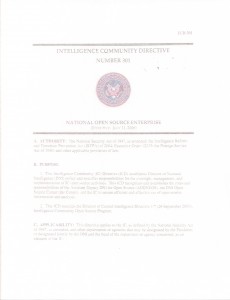
Reference: Intelligence Community Directive (ICD) Number 301: National Open Source Enterprise

Director of National Intelligence et al (IC)
0Shares
ICD 301
ICD 301

Phi Beta Iota Editorial Comment (DOI: 11 August 2009)

This well-intentioned document is the sole surviving legacy of the first ADDNI/OS who was destined to fail for multiple reasons, not least of which was the lack of seriousness with which all three DNI's have chosen to treat OSINT.  As best we can tell OSINT is a side-show delegated by the DDNI/C to the National Intelligence Council, which lacks the gravitas as well as the knowledge to do anything constructive with an IC OSINT capability that exists in name only, the scattered kludge of activities not-with-standing (and less that of the U.S. Special Operations Command J-23, which is the only serious OSINT capability now operational in the USG).

We like this document.  It is a good foundation for further deliberation.  Right now it is best used to catalog what is NOT happening, for example:

POLICY 1b.  Leverage burden sharing, partnerships, and outside capabilities.

POLICY 1c  Organizations will share their information and capabilities to the fullest extent

The ADDNI/OS is in violation of this ICD as well as ICD 300 in delegating chairmanship of the National Open Source Council (NOSC) to the Director of the Open Source Council.  That was ill-advised and that delegation should be immediately rescinded.

The NOSC portion of this ICD is useful, and inspires the logical follow-on need for similar capabilities for the US consumers of OSINT (state and local as well as private sector) who also have much to contribute but no place to send it; and for multinational consumers and producers of OSINT, both governmental and non-governmental.

The ICD calls for the NOSC to provide evaluations of the IC's open source gaps and capabilities.  To our knowledge this has not happened, no doubt the result of a) virtually all of the NOSC members are not OSINT specialists, just bureaucrats handling OSINT as an additional duty; and b) they don't know what they don't know.

The ICD is flawed in allowing the OSC to report to a Deputy Director of the CIA.  We strongly recommend that the Foreign Broadcast Information Service be reconstituted, that the CIA version of the OSC be disbanded, and that the Department of Defense be tasked with both creating a proper DNI OSC, and funding, on a non-reimbursable basis, the Open Source Agency recommended by the 9-11 Commission (pages 23 and 413) but under diplomatic auspices to better interact with all who have OSINT to contribute that do not wish to deal directly with an intelligence entity.

The ICD is flawed in allowing contractual obligations to prevent instant sharing of all OSINT acquired from outsourced means.  This must be changed to demand immediate Modifications to all contracts so constrained, on penalty of losing all option years if not done.  The ICD does not understand that contractors can keep original copyright but must be forced to provide the USG with an unlimited unrestricted license that includes public access to the information, as the National Institute of Health (NIH) is has been pioneering for over a decade.

The ICD tasks the IC element alone, not the consumers, with designating a primary open source coordinator, but fails to demand that this be a full-time job held by an OSINT specialists with competencies and qualifications such as need to be established by the DDNI/C and DDNI/M.  Put bluntly, with the exception of CIA and DIA, none of the NOSC members are qualified for their role within the NOSC.

The DEFINITIONS that conclude this ICD can be improved upon.  Virtually all of what is called OSINT today, except within the US Special Operations Command, is nothing more than Open Source Information.  OSINT is tailored and actionable intelligence, not the New York Times or the daily OSC report.  OSIF that is classified, as the OSC is prone to do, is neither OSIF nor OSINT.

Review: Nature’s Extremes–Inside the Great Natural Disasters That Shape Life on Earth (Time Magazine Hardcover)

5 Star, Nature, Diet, Memetics, Design
0Shares

Amazon Page
Amazon Page

Better than Inconvenient Truth, A Tremendous Contribution,

July 8, 2006
Editors Of Time Magazine
The ideal combination for anyone seeking to understand what Al Gore calls An Inconvenient Truth is the video by Gore and this book. I would supplement that with J. F. Richard's High Noon 20 Global Problems, 20 Years to Solve Them and E. O. Wilson's The Future of Life.

Unlike the Gore book, which is admirable in its content and purpose, but got lost with an explosion of varying font sizes and color schemes that block knowledge transmission rather than aid it, this book by TIME has the investigative journalistic rigor and the editorial maturity that I look for in Open Source Intelligence (OSINT) products–tailored knowledge helpful in making major public policy decisions.

The structure of this book is perfect: Inside the Planet; The Water Planet; The Land Planet; and Above the Planet. There is an index and the maps and graphics are world-class. The content is presented in a straight-forward analytic fashion. CIA should do work this good.

I have often wished that TIME might adjust its editorial mind-set to be the de facto Public Intelligence Agency for the planet. This book addresses threat number three of the ten threats identified by the High Level Threat Panel of the United Nations. The other threats, in order, are poverty, infectuous disease, [environmental degradation], inter-state war, civil war, genocide, other atrocities (e.g. trade in women and children, kidnapping for body parts or forced labor including prostitution), proliferation of weapons of mass destruction, terrorism, and crime. I would be quite thrilled if TIME committed to doing books on each of these threats, and creating an interactive Public Intelligence Website that tied the books together and to the actual budgets of the United States and other nations, in that way showing how our USA national budget is badly mis-directed, and perhaps inspiring other nations once we get our priorities right ourselves.

This book is a joy to read, intelligent, a real keeper.

Vote on Review
Vote on Review

Review: The Transparent Society–Will Technology Force Us to Choose Between Privacy and Freedom? (Paperback)

5 Star, Civil Society, Information Society
0Shares

Amazon Page
Amazon Page

Puts NSA Wiretapping in Context,

July 8, 2006
David Brin
It is helpful to return to this book, from 1998, and to a follow on book, “the digital person” published in 2004, as context for the recent bru-ha-ha over NSA wiretapping without a warrant, and the loss to theft of tens of thousands of social security number and other personal information of veterans. Oh yes, somewhere in there, the FBI was hacked and companies like First Data are making fortunes compiling actionable profiles of individuals from disparate sources that were never approved for sharing.

This book focuses on the value of transparency and considers the key issue to be the war between secrecy versus accountability. The author directly confronts the issue of “who controls” information about YOU.

The author draws a useful comparison between the Internet, which sacrificed security for robust sharing, and the intelligence community, which chose security over sharing as its primordal principal.

The author observes that the Internet is having one undesireable effect, that of fragmenting communities that become less amenable to compromise and consensus. He points out that reality and locationally based discussion can lead to more effective consensus and compromise.

There is a useful discussion of “tagging” and how citizen truth squads and public commentary can serve as a useful antidote to corporate messages. The idea of “culture jamming” is picked up and treated at length by another excellent book, “NO LOGO.”

Overall this book remains a standard in providing a detailed revoew of the issues and the capabilities surrounding digitial information about individuals. It is the author's view that WHO controls information, rather than WHO is elected, will determine the future of democracy.

In passing the author makes two points that I find important:

1) A liberal education, rather than the current trends toward immediate specialization, is essential if the public is to be able to think critically.

2) Law enforcement under the current government model, does not work. The author gives the example of 100 felonies, of which only 33 are reported. Of the 33, 6 are caught, 3 are convicted, and 1 goes to prison.

The author ends with a reference to genius savant John Perry Barlow, one of America's more notable commentators, and suggests that we are entering an era of individual collective intelligence against organized government intelligence (and secrecy).

I recommend this book be read together with “the digital person” because the latter book focuses on the degree to which government and corporate mistakes–“careless unconcerned bureaucratic processes” can undermine privacy and good order.

Vote on Review
Vote on Review

Review: With All Our Might–A Progressive Strategy for Defeating Jihadism and Defending Liberty (Paperback)

4 Star, Strategy, Survival & Sustainment, Terrorism & Jihad, Values, Ethics, Sustainable Evolution
0Shares

Amazon Page
Amazon Page

Super on Law and Accountability, Read with “The Transparent Society”,

July 8, 2006
Daniel Solove
4 of 4 people found the following review helpful:
5.0 out of 5 stars Super on Law and Accountability, Read with “The Transparent Society”, July 8, 2006
There are some great reviews below, so I will not repeat them. Amazon is getting to the point now where it is almost essential to read all of the reviews as a pre-cursor to buying and reading the book.

This book was instrumental, after I bought it, in pointing me to the preceding work by David Brin, “The Transparent Society,” and I found it useful to read that book first.

The two key points in this book that make it a notable contribution are:

1. Best available review of applicable laws; and

2. Superb expansive discussion of privacy violation that emerge not just for deliberate abuse and invasion, but from “careless unconcerned bureaucracies” with little judgement or accountability.

IDEA for Amazon: connect with the Institute of Scientific Information, and start showing us new books that cite existing books. I would love to be able to “fast forward” from this book to the “best in class” books that cite this book so that I could buy the best most recent book (I buy and read in threes on most topics). Amazon has become a major intellectual force, and is my starting point for every issue (Google is for fast looks, Amazon is for deep looks; I hope that one day they merge with Wikipedia).

Vote on Review
Vote on Review

Review: The Digital Person–Technology And Privacy In The Information Age (Hardcover)

4 Star, Privacy
0Shares

Amazon Page
Amazon Page

Super on Law and Accountability, Read with “The Transparent Society”,

July 8, 2006
Daniel Solove
There are some great reviews below, so I will not repeat them. Amazon is getting to the point now where it is almost essential to read all of the reviews as a pre-cursor to buying and reading the book.

This book was instrumental, after I bought it, in pointing me to the preceding work by David Brin, “The Transparent Society,” and I found it useful to read that book first.

The two key points in this book that make it a notable contribution are:

1. Best available review of applicable laws; and

2. Superb expansive discussion of privacy violation that emerge not just for deliberate abuse and invasion, but from “careless unconcerned bureaucracies” with little judgement or accountability.

IDEA for Amazon: connect with the Institute of Scientific Information, and start showing us new books that cite existing books. I would love to be able to “fast forward” from this book to the “best in class” books that cite this book so that I could buy the best most recent book (I buy and read in threes on most topics). Amazon has become a major intellectual force, and is my starting point for every issue (Google is for fast looks, Amazon is for deep looks; I hope that one day they merge with Wikipedia).

Vote on Review
Vote on Review

2006 Forbes Blank Slate On Education

Articles & Chapters, Education (General), Education (Universities), Information Society, Intelligence (Public)
0Shares
2006 Forbes Blank Slate

Although I had long recognized that intelligence at the national level is remedial education for policy-makers and their staff who live in a “closed circle,” it was the juxtaposition of Derek Bok's review of education with my own on intelligence in the same issue that made me realize we need a Deputy Vice President for Education, Intelligence, and Research.  I tried to get Colin Powell interested in the idea, to no avail.  In my view, we will always need spies and secrets, but they must be cast in the context of a Smart Nation, and our secret intelligence budget is so large now that it can safely afford to become a modest bill-payer for advances in education and research that are part of the Smart Nation triad.

It is not for me to do anything other than champion the idea–others actually manage the money and it is they who decide how the taxpayer dollar is spent.