Review: Information Architecture for the World Wide Web: Designing Large-Scale Web Sites, 2nd Edition (Paperback)

5 Star, Information Technology
0Shares

Amazon Page
Amazon Page

5.0 out of 5 stars Sensible, Scalable, Essential, Valuable,

October 25, 2005
Louis Rosenfeld
I read “Ambient Findability” first, and then bought this book. Both are excellent. This one is more focused on carefully orchestrating an approach to an enterprise architecture that makes content usable to end-users in context.

As the world gets ready to move toward exobyte scales of information sharing, at machine speed, this book becomes very relevant. While the authors are careful to point out the fallacies in cost calculations for informaiton access design flaws, I for one find the factors compelling–the cost of finding information, of not finding information, the value of rapid access, visualization and integration, the value of ease of use. I find the rough figure of $100 per employee per year to be a conservative estimate of opportunity costs–I think it is close to $1000 and in some instances $10,000.

Over-all I found this to be a superb reference for self-study, one that breaks down complex issues like different kinds of navigation systems, and one that also shows the value of offering end-users multiple means of access, both search and browsing.

Chapter 19 was especially valuable to me, since I am not even close to being a technical person or even a librarian–the itemization of the functions associated with information architecture and implementation, and why they might benefit from centralization, was a very helpful vehicle for getting a sense of the challenge when thinking of the scale of say Google, where thousands of hits are returned and thousands of relevant documents are NOT found. Google is great, but in this context, Google is in the second or third grade, at best.

I like this book, which does not claim to make anyone an information architect, because it helped me see, in a logical easy to read manner, just how *much* is involved in making tons of information accessible and usaable in time lapses and at costs that both people and organizations can afford.

Vote on Review
Vote on Review

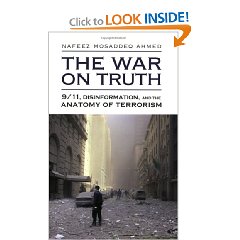
Review: The War On Truth–9/11, Disinformation And The Anatomy Of Terrorism (Paperback)

5 Star, 9-11 Truth Books & DVDs, Censorship & Denial of Access, Misinformation & Propaganda
0Shares

Amazon Page
Amazon Page

5.0 out of 5 stars Tars CIA & FBI, US, UK, France, with Supporting Terrorists, 9-11 a Pretext,

October 25, 2005
Nafeez Mosaddeq Ahmed
While there is certainly something to be said for this book painting a “worst case” conspiracy theory scenario, I have to say that it is consistent with both my years of experience as a clandestine case officer, anad my extensive reading on national security misadventures. I do agree with one reviewer's observation that we should not over-estimate the competence of the U.S. Government, but I also believe that we cannot under-estimate the incompetence of the bureaucracy nor the lack of ethics of the political ideologues.

Academically, objectively, this book is about as carefully laid out and sourced as one could want. The quotes that it offe

rs from official State Department officers complaining they were ordered to give visas to clearly unqualified terrorists being trained and supported by CIA stand out, as do the retrospective quotes on everything the FBI failed to do against the first World Trade Center bombing. This book is, in brief, everything the 9/11 Commission was not. The two taken together, along with the Aspin-Brown Commission, give us a good sense for reality.

Having been a part of the CIA when it was committing high crimes and misdemeanors in Central America, and having been a youth in Viet-Nam when CIA was in charge of the Phoenix assassination program and learning how to fly drugs and launder money for its warlords, and based on my extensive reading, I am persuaded of the three core propositions in this book:

1) That CIA and FBI managed clandestine relations with those who blew up the World Trade Center for years, and generally concealed and obstructed Justice investigations after 9/11 because of their antecedent mis-behavior;

2) That both the Clinton and Bush White Houses actively supported the Taliban and the secret Enron negotiations with the Taliban to build energy pipelines, not realizing at the time (as we know today) that the extraction and transportation of the energy as envisioned then is actually not supportable; and

3) That the Bush White House was already planning to invade Afghanistan, with all of the operational plans drawn up as early as July 2001, and 9/11 was treated as a Pearl Harbor pretext.

Having read most of what has been written by Brzezinski, Kissinger, and others I find the author's speculation that the U.S., the U.K., and France, among others, have been actively using terrorists, nurturing terrorists, as part of a geopolitical and economic strategy, and that in their naivete, they nurtured a force they cannot control today, to be completely credible.

I recommend this book be read together with Fog Facts: Searching for Truth in the Land of Spin by Larry Beinhart, and The Long Emergency: Surviving the End of Oil, Climate Change, and Other Converging Catastrophes of the Twenty-First Century by James Kuntsler. The first examines information that can be known, as in this book, but that is ignored if not over-shadowed by “spin”; while the second examines the pathological implications of cheap oil and all that cheap oil has made possible, including the creation of huge cities that are unsustainable into the future; the transport of vast quantities of water over long distances to places that will be dry in the near term; and the shipping of very cheap goods over very long distances from China by Wal-Mart.

Bottom line: cheap oil is the fool's gold of this century, only it is toxic and radioactive. The White House, Enron, and a cast of rather poorly-read bureaucrats came together to create a toxic mold called sub-state terrorism. The bureaucrats were following orders or had good intentions–the politicans and their corporate cronies were and are out and out thieves who are looting the Republic for their own selfish gains, firm in the belief that enough people will be fooled until they are out of office and laughing all the way to the Cayman Islands. They are probably right.

EDIT of 11 Dec 07: See also, with reviews:
Vice: Dick Cheney and the Hijacking of the American Presidency
A Pretext for War: 9/11, Iraq, and the Abuse of America's Intelligence Agencies
State of War: The Secret History of the CIA and the Bush Administration
Web of Deceit: The History of Western Complicity in Iraq, from Churchill to Kennedy to George W. Bush
The Looming Tower: Al Qaeda and the Road to 9/11 (Vintage)
Legacy of Ashes: The History of the CIA
Dark Alliance: The CIA, the Contras, and the Crack Cocaine Explosion
9/11 Synthetic Terror: Made in USA, Fourth Edition
Crossing the Rubicon: The Decline of the American Empire at the End of the Age of Oil

and of course the 9-11 DVDs, which I find compelling.

Vote on Review
Vote on Review

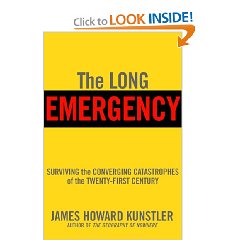
Review: The Long Emergency–Surviving the Converging Catastrophes of the Twenty-First Century (Hardcover)

4 Star, Survival & Sustainment, Values, Ethics, Sustainable Evolution, Water, Energy, Oil, Scarcity
0Shares

Amazon Page
Amazon Page

4.0 out of 5 stars Fuel Drop + Climate Change + Disease + Water Drop = Great Depression. ,

October 24, 2005
James Howard Kunstler
This is a brilliant piece of work, indeed so compelling that after glancing at it over morning coffee I set aside a work day and simply read the book. I take away one star because there is no index, no bibliography, and the author is very poor about crediting his sources. On page 163, for example, his observations about 300 Chinese cities being water-stressed, and about the Aral Sea disappearing, appear to have come directly from Marq de Villier's superb book on Water: The Fate of Our Most Precious Resource but without attribution. This should have been footnoted.

Having said that, I consider the book itself, despite its run-on Op-Ed character, to be a tour de force that is very logically put forward. Indeed, although I have seen allusions elsewhere, this is the first place that I have seen such a thorough denunciation of how cheap oil underlies everything else including suburbia and Wal-Mart cf. Wal-Mart: The High Cost of Low Price. I am also quite impressed by the author's logical discourse on how communities have sacrificed their future coherence and sustainability for the sake of a few dollars savings on Wal-Mart products.

There is a great deal in the book that is covered more ably and in more detail by the other 600+ books I have reviewed at Amazon, and indeed, replicates much of what I write about in The New Craft of Intelligence: Personal, Public, & Political–Citizen's Action Handbook for Fighting Terrorism, Genocide, Disease, Toxic Bombs, & Corruption but, I have to say, with a different twist that I admire very much.

I find the author's exploration of how cheap fuel led to wasted water, helping create cities and mega-agricultural endeavors that reduced our water at the same time that we consumed centuries worth of unrenewable fossil fuel, quite alarming.

I sum the book up on page 180 by writing in the bottom margin: “Fuel Drop + Climate Change + Disease + Water Drop = Great Depression.”

I disagree with those that consider the book excessively alarmist, and agree with those that find fault with the author's documentation. An index and an annotated bibliography would have doubled the value of this book. The author is clearly well read, logical, and articulate–an unkind person would say that he has also been lazy in not substantiating his arguments with what intelligence readers value most: an index and a good bibliography that respects the contributions of others to the argument.

The author in passing makes a good argument against our current educational system, and I for one believe that we need to get back to a system of life-long education accompanied by early apprenticeship and real-world employment and grounding for our young people. What passes for education today is actually child care, and the smartest young people, like my teen-ager, consider it to be nothing more than a prison.

On balance, a solid 4, a solid buy, and worth its weight in gold if you act on his advice and begin planning an exit strategy from those places likely to run out of water, fuel, and transport options in the next 20 years.

Vote on Review
Vote on Review

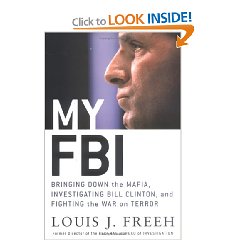
Review: My FBI–Bringing Down the Mafia, Investigating Bill Clinton, and Fighting the War on Terror (Hardcover)

4 Star, Biography & Memoirs
0Shares

Amazon Page
Amazon Page

4.0 out of 5 stars 5 for Khobar, 3 for Omissions or Misdirection, 4 on Balance,

October 23, 2005
Louis J. Freeh
This book needs to be taken with a heavy dose of salts, for there are portions that are misleading. I refer particularly to the statements with respect to computing power. What the author does not tell us is that Congress *did* give the FBI a ton of money for computer upgrades, but he allowed his Assistant Directors to steal most of it for other projects, and then failed miserably in contracts management with beltway bandits who knew they would not be held accountable for failure. Freeh also avoids telling us that during most of his tenure, and up until very recently (this is less his personal problem than an inherent pathology in the FBI culture) more intelligence people QUIT every month than could be hired. The FBI environments are not well-suited for objective intelligence analysis or counter-intelligence, and certainly not for counter-terrorism either.

The books gets four stars over-all because of one exceptional aspect: the authoritative account of what we knew about the Iranian responsibility for Khobar Towers, when we knew it, when the President (Clinton) knew it, and when Lake and the others knew it. For this alone Clinton, Albright, and Lake, in particular, should be held accountable, for that specific attack on U.S. soldiers was the opening shot in the Iranian covert war against the United States. The Clinton team chose to focus on Saudi contributions to the Clinton library rather than defending America, setting the stage for equal dereliction of duty by the Bush team.

Freeh's book does earn four stars from me, and merits special recognition as a small part of the mosaic of truth that is emerging long after the 9-11 cover-ups and the complete refusal of Washington stake-holders to acknowledge any of the recommendations of either the Aspin-Brown Commission or the 9-11 Commission or the Weapons of Mass Destruction Commission. In the former case (Aspin-Brown) legitimate and heavy recommendations were made and ignored. In the latter cases, the recommended reforms are lipstick on the pig. Nothing has changed, we will get hit again.

I recommend that Freeh's book be read together with Stansfield Turner's very new publication, “BURN BEFORE READING,” because the two together persuade me that intelligence, like Justice, needs a Supreme Court and leaders appointed for life that are beyond the manipulative powers of the White House or the pork barrel politics of Congress. The Bush White House, like the Clinton White House, but for different reasons, chose to betray all Americans and ignore the clear and present danger of the Iranian attacks on the U.S., the Saudi support for global radicalization of Islam, and the Pakistani nuclear program. Today, Hamas and Hezbollah–creatures of the Iranians–not Al Qaeda–are the greatest threats to the destabilization of South Asia, Latin America, and portions of Africa, and despite the heroic efforts of the Special Operations community, it is not possible for them to be successful in the absence of honest adult leadership in Washington that demands a 24/7 full court press from ALL the instruments of national power.

Vote on Review
Vote on Review

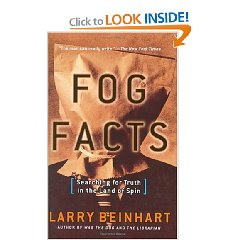
Review: Fog Facts –Searching for Truth in the Land of Spin (Nation Books) (Hardcover)

5 Star, Censorship & Denial of Access, Education (General), Education (Universities), Information Operations, Information Society, Media, Misinformation & Propaganda
0Shares

Amazon Page
Amazon Page

5.0 out of 5 stars Makes the case for a People's Bank-Union-Intelligence Agency,

October 23, 2005
Larry Beinhart
This is quite an extraordinary book, one of five I picked up while browsing at Barnes & Noble today. It gets a full five stars for elegant writing, logical presentation, and a lovely index. I read it together with Noam Chomsky's Imperial Ambitions: Conversations on the Post-9/11 World (American Empire Project) interviews, and the two complement one another.

“Fog facts” are facts that are out in the open, but “invisible” in the sense that no one acts on them. The stolen Florida election–30,000 plus disenfranchised blacks *and* “overcount” votes where Al Gore was both checked and written, rejected as invalid instead of returned for verification–the specious claims against Iraq; the 9-11 Commission apologia; the list goes on. For myself, the most interesting fog facts dealt with the number of terrorists caught and jailed by France and other nations, as a tiny fraction of the cost of invading Afghanistan and Iraq, and with little to show for it excepts casualties, including significant numbers of US amputations being concealed from the public.

The author “outs” Judith Miller as an agent of Karl Rove in the run-up to the war in Iraq, earnestly selling the Administration's line on weapons of mass destruction, and perhaps one reason she was both favored by Rove in the current Valerie Plume case, and also sought to protect Rove.

THe author gets the jump on the current scandal of the disappearing billions in Iraq–not just the billions for Halliburton in sole source contracts, but the outright theft and squandering of the $19 billion in Iraqi bank credits that Paul Bremer managed to fritter away–and they still do not have running water or electricity.

THe author quotes several times from Mein Kamph in discussing the extremist Republican use of “the big lie” and the comparisons are disconcertingly clear. He weaves a tale of draft-dodging hypocrisy among the Bush Junior and Cheney gang that is all too distasteful when combined with their corruption in favoring Halliburton–his listing of Cheney's ignominious failures as CEO of HAlliburton are fun–and also a sign that Halliburton knew what it was doing in suffering the fool that would deliver the people's treasure. His accounting of Bush Juniors many failures in business, each time living on his father's name and getting bailed out by the forgiving rich that he has repaid many times over with tax cuts and exemptions from asbestos claims, among other loopholes, is dismaying in the extreme. We “know” these things, but we do not act.

On page 82 he repeats what is now perhaps the most famous quote to come out of the Bush Junior White House, where an arrogant aide dismisses a “reality-based” person and says that the U.S. is an empire now, and makes its own reality. That the reality we are making is one of our own destruction escapes this witless aide to the President, so full of himself is he.

The books adds to my understanding of the current Social Security arrangements as a pass through system (each generation funds the next) as opposed to the Administration's proposal for privatization, which converts it to a pension fund that dies with each generation. I am persuaded that we must defend Social Security, it is present form, to the death, and that we must remove the caps and make the wealthy contribute for every dollar, not just up to $90,000.

The author concludes that there is a war today, not between civilizations, but between faith-based and reality-based communities.

I put the book down reflecting to myself that it is time for the American labor union pension funds to lead a revolution. It is time for the people to form their own bank, their own credit card company, their own intelligence agency, and their own media. Although this is happening in fits and starts with the Internet, it is disjointed. We need to marry up money, willpower, and honest information, and we need to out these carpetbaggers and regain control of the commonwealth.

Truth and morality are here to be found, but the question that remains is: will the people act? This is a very fine book for anyone who cares about future generations and resents being robbed.

Ten Other Recommended Books (Five Bad News, Five Good News):
Vice: Dick Cheney and the Hijacking of the American Presidency
Running on Empty: How the Democratic and Republican Parties Are Bankrupting Our Future and What Americans Can Do About It
The Global Class War: How America's Bipartisan Elite Lost Our Future – and What It Will Take to Win It Back
The Working Poor: Invisible in America
American Fascists: The Christian Right and the War On America
A Power Governments Cannot Suppress
The Tao of Democracy: Using Co-Intelligence to Create a World That Works for All
Society's Breakthrough!: Releasing Essential Wisdom and Virtue in All the People
Escaping the Matrix: How We the People can change the world
The Wealth of Networks: How Social Production Transforms Markets and Freedom

Vote on Review
Vote on Review

Review: Imperial Ambitions–Conversations on the Post-9/11 World (American Empire Project) (Paperback)

4 Star, Empire, Sorrows, Hubris, Blowback
0Shares

Amazon Page
Amazon Page

4.0 out of 5 stars Call to arms for We the People (Intellectual Self-Defense),

October 23, 2005
Noam Chomsky
There are always gems to be found in anything that Chomsky offers (I agree with the Boston Globe's assessment of him as “America's most useful citizen”) but one can always be warned when the offering is interviews, double-spaced, over time.

In this instance, the Introduction is actually useful and I agree with David Barsamian when he describes Chomsky as an extraordinary distiller and interpreter of information, who represents all that intellectuals *should* be.

One aspect of the book that is new to Chomsky's writing is his clear and distinct appreciation for the freedom's that we enjoy in America. While we are all subject to the arbitrary declaration by the government that we are an “enemy combatant” with no rights, on balance Chomsky goes out of his way in this series of interviews to articulate his love for America and his appreciation of the privileges that attend one who is both a citizen and a tenured (now retired) professor.

As a long-time reader of Chomsky, I found some delight in his recollection of the beginnings of propaganda (in England, with the stated intent “to direct the thought of most of the world”) and I learned for the first time that Chomsky credits Walter Lippman with the phrase “manufacturing consent” that Chomsky used as the title of his most famous co-authored work.

Chomsky offers some fascinating geopolitical insights with his suggestion that the Trans-Siberian Railway might be extended to run down through North Korean into South Korea, and his views that ASEAN plus 3 (China, Korea, Japan) might rise to super-power status. I am especially taken with his view that China might be the power that saves America from itself, orchestrating a balance of power and sanity arrangement from that side of the world.

Chomsky returns to a familiar theme in this book, that of war crimes and the US being a very guilty party, but for the first time, I see Chomsky forgiving of the soldiers on the front lines, and even of their general officers, and placing all of the blame on the civilians that direct the military from the White House and the Office of the Secretary of Defense. This is new. I fully expect Americans to be brought up on war crime charges in the next ten years, and I expect the American public to support this when the evidence is presented in graphic terms.

Chomsky also returns to his theme of the US harboring terrorists and hence not being able to claim the high ground against other nations. I was impressed by how the Cubans gathered evidence on the Florida-based assassins and violators of US law, and how elegantly the Cubans presented this evidence to the FBI. I was dismayed but not surprised to find the FBI arresting the Cuban infiltrators rather than the assasins–this is the same FBI that has convicted fewer than five actual terrorists, each with an average jail sentence of 14 days, from thousands of arrests. So much for intelligent effective federal investigations.

The book concludes with a fascinating discussion of “intellectual self-defense” that is a call to arms for every intelligent American (we need to be concerned–that may only be about one fifth of us).

This is something of a quickie book, not at all as substantive as Chomsky's usual works, but with many gems never-the-less. Certainly worth buying and reading.

Vote on Review
Vote on Review

Reference: National Plan to Achieve Maritime Domain Awareness (October 2005)

Director of National Intelligence et al (IC), DoD
0Shares
Maritime Domain Awareness

This is a good plan, a model for others to follow, as far as it goes.Ā  It is an Industrial-Era plan that focuses on the man-made and ignores the “Sea State” that should be our larger concern.Ā  Noteworthy is the emphasis on information-sharing andd sense-making.Ā  Also noteworthy is the specific attention to international and domestic outreach.

That having been said, this is a 50% plan.Ā  The U.S. Navy needs to dig deep, find its soul, and expand the plan to monitor, understand, and preserve Mother Sea in partnership with all those listed in the Concept of Operations for the Maritime Intelligence Center promulgated on 19 August 2009.Ā  And for vision, 450-Ship Navy Peace from the Sea.