Summary: The rigid hierarchy that characterizes state bureaucracies has also been embedded into internaitonal institutions, and it is this architecture that can be vastly improved by restructuring it into a multiscale network. There are both descriptive and prescriptive reasons for doing so: 1) increases in functional efficiency and robustness, and 2) improvements from a normative perspective. As we enter the 21st century, the international system already exhibits many aspects of multiscale networks, but there are typically seen as liabilities and not assets. By providing a richer understanding of multiscale networks, this paper proposes an alternative to Cox's “with them or against them” ultimatum.
Adequate Airplane Book, Not Top-Notch Fictional History,
February 29, 2004
Daniel Silva
There is a great deal of potential in fictional history books, such as the Da Vinci Code, and there is no more exciting topic for such books than the cross-over between espionage, religious conspiracy, and genocide.Unfortunately, while this book is adequate to an airplane ride, it is not as good as the author's stunningly good earlier work, “The Unlikely Spy”, and it is disappointing in terms of its coverage of the Israeli Mossad, the Catholic Church (for a better non-fiction read, see “The Keys of This Blood”), and its over-all lack of critical detail.One small example: intelligence professionals do not throw radios (usually with embedded encryption) into the ocean because their subordinates have annoyed them. This was just one of several details that were off-putting, and that made it clear the author was rushing a book out and not doing the homework–nor being held accountable by the publisher for being serious.
Vote on Review
I have read virtually all of the books on extreme rightist and Bush deception (from the serious “Weapons of Mass Deception” and “Secrets and Lies” to the satirical and polemical by Hightower, Moore, Franken, Conason, and Carville), and I was hoping that this book would finally be “the” book, a systematic issue by issue outline of what Bush Administration officials have said, when–and then the truth of the matter, well documents.I find this book disappointing. It is written as if the authors have packed together a whole bunch of Op-Eds, it is hard to read, and it is not coherent. The publisher and editor should be spanked for allowing such an undisciplined work out the door.
Although the book excels at detail and focus from issue to issue, the authors fail to do the side-by-side presentation in a manner that satisfies. This book could have been glorious if they had taken the US budget, done down the 30 agencies with discretionary funds, the relevant program lines, and then had three columns: what Bush (and his aides, most of whom do the talking and thinking) said, what they did, and what science and intelligence and real-world experts recommend be done.
The index stinks (names, not issues), and there is no bibliography. The footnotes are acceptable, but even more interesting would have been profiles with related bibliographies of how the right-wing think tanks and key personalities like Bill Kristol have shaped the debate, from the early days when Dick Cheney was saying Kristol was a moron (he is not) who could be ignored, to the later days when Cheney discovered that there are a lot of wealthy patrons who put their money where Kristol's mouth is….
In brief, then, the authors appear to have tried, and failed, to deliver the definitive book cataloging, on an issue by issue basis in a manner easily used by a Challenger for the Presidency, the many specific ways in which this Administration is lying, switching and baiting, saying one thing and doing the other, or allowing destruction through malicious neglect.
If I were guiding an opposition research team today, I would tell them to take this book, and all the others I have cited above, cut the spines off, digitize everything, index everything, create a visualization link-chart using any one of several automated programs, and from that, create 100 one-page memos that consist of a nuclear sound-bit, a one-paragraph executive summary of Bush versus reality versus the opposing proposition, and a half page of detail and references. Neither the Democratic Leadership Council nor the leading challengers for the Democratic nomination appear to be doing their homework. Kerry's math does not add up, Edward's issues are simplistic, and both Sharpton and Kucinich are absolutely right: the Democrats are not talking substance yet.
This book is as close as I have seen to an issue-by-issue review, but if this is the best we can do, the Democrats will lose in 2004, not least because issue discussion is the non-negotiable first step toward outreach and creating a coalition of moderate Republicans, Independents, and Green-Reform-Libertarian allies without whom no one can beat Bush.
I do not normally buy what I think of as “coffee table” books, but something moved me to buy this, despite my intent to see the movie, and I am glad I did. My 14-year old found it absorbing, and I myself was glad to have such an elegant piece of work, with the scripture text, available for review in a time and place of my choosing, in quiet.The movie is very disturbing and for many will be shocking in the extreme. The book is a “soft” alternative to the movie, more likely to provoke thought without disturbing, but by no means a substitute for full immersion in the overwhelming power of the movie. The book is also a fanstastic keepsake. I look forward to the release of the video, which I will surely buy, for this movie is likely to replace all other movies that in the past have been the staple of the Easter broadcast schedule.
One note of concern: I am sick and tired of having “anti-semitic” accusations hurled by defenders of Jewish sanctity. “Anti-semitic” has become a censorship phrase. I myself was disinvited from National Public Radio (NPR) in Chicago because I spoke in a balanced and fair fashion about the Palestinian casualities that the US media never covers, and the need to both guarantee a Palestinian state alongside a Jewish state, and the need to provide US foreign aid to both sides equally while we build two new generations from kindergarten up, generations that know how to live in peace from birth. Neither the movie nor the book merit this Stalinist-like censorship, and I hope that non-Catholics will keep in open mind and not be scared away–as the Jews intend–from seeing the movie or buying the book. [I was most moved when Arab callers made the point that I was the first person on NPR Chicago to have been fair and balanced.]
To end on a fair and balanced note: the Catholic Church is guilty of great crimes–the crusades against Islam, the murder of millions of women unfairly cursed as witches, the Inquisition, the abuse of hundreds of thousands of children, and finally, aid to the Nazis during the Holocaust and in the aftermath of the war as some escaped through Church auspices. We would be fortunate indeed if there were movies and books that explored these historical aspects of Catholism, as well as the growing body of literature on Jesus having been married and having had children whose offspring survive today. Open mindedness, not censorship, is the path to understanding. This applies to Catholics as well as Jews and others of any faith.
Edit of 20 Dec 07 to state that this is a book of lasting value that must be kept in print, and to add links.
This book complements Barbara Ehrenreich's book Nickel and Dimed: On (Not) Getting By in America Ehrenreich's is much easier to read and makes the same broader points. Where this book excels is in the details that in turn lead to policy solutions. I will go so far as to say that if John Kerry and John Edwards do not get hold of an executive summary of this book, and integrate its findings into their campaign as a means of mobilizing the working poor in the forthcoming election, then they will have failed to both excite and serve what the author, David Shipler, calls the “invisible.”
Invisible indeed. How America treats its working poor–people working *very* hard and being kept in conditions that border on genocidal labor camps, is our greatest shame.
The most important point made in this book, a point made over and over in relation to a wide variety of “case studies”, is that one cannot break out of poverty unless the **entire** system works flawlessly. To hard work one must add public transportation, safe public housing, adequate schooling and child care, effective parenting, effective job training, fundamental budgeting and arithmetic skills, and honest banks, credit card companies and tax preparation brokers, as well as sympathetic or at least observant employers. The author is coherent and compelling in making the point that a break or flaw in any one of these key links in the chain can break a family.
I am personally appalled at the manner in which H&R Block, to name the largest within an industry, and Western Union, to name another, are ripping off the working poor with a wide variety of “surcharges” such that they end up paying 25% of their tax return or their funds transfer back to Mexico. This is both usury and treason if you want to look at it in the largest sense. They are sabotaging the American economy in a time of war.
It surprised me to learn that while hospitals are forced to treat the poor in an emergency, they are also allowed to bill them, and these bills, for an ambulance ride or emergency treatment, often are the straw that breaks a family into destitution. This is outrageous and should not be permitted. Then the author tells us that it costs as much as $900 for a working poor family to declare bankruptcy and obtain the protection of the law from creditors, many of whom are cheats in the larger sense of the world. How can this be?!?!
It did not surprise me, but continues to distress me, to learn that the laws are not enforced. Although laws exist about minimum wage, humane working conditions (and humane living conditions for migrant workers), they are not enforced. The working poor are treated as less than slaves, for they are “used up and thrown out” with no defense against unfair firing. They are forced to work “off the books”, to do piece rate work at below minimum wage, this list goes on. In essence, our politicians have passed laws that make us feel good, and then failed to enforce them so as to achieve the desired effects.
The author documents both the jobs leaving the US, and the fact that new jobs pay less. As Paul O'Neil, former Secretary of the Treasury has noted, we have two economies in America: one embraces automation (and kills jobs), the other requires expert labor (not the working poor). We have a double-whammy here that is totally against the lower half of the economic spectrum, and it is being aggravated by an incoherent immigration policy that feeds the beast.
On page 139 the author just blew me away with documentation to the effect that 37 percent of American adults cannot figure a 10% discount on a price, even with a calculator, nor can this same percentage read a bus schedule or write a letter about a credit card error. He goes on, citing the National Adult Literacy Survey from the Department of Education, to note that 14% of adult Americans cannot total a deposit slip, locate an intersection on a map, understand an appliance warranty, or determine the correct dosage of a medicine. I had no idea!!! This reality comprises a “sucking chest wound” in the economic body of America, and it is not a chest wound that can be healed as things now stand.
There are many other daunting “facts of life” in this book about the working poor, and they all add up to a complete failure of both the national and state leaderships to be serious about long-term sustainable economic prosperity.
The author concludes with some suggestions for reform, and here I wish he had actually gone to the trouble of creating a one-page policy paper summing it all up. His most obvious suggestion is wage reform, not just at the bottom, but also at the top. As I read and hear about executives making $5 million to $80 million a year, the norm seeming to be around $20 million, I have to ask myself, have we gone nuts? Are stockholders so stupid as to overlook the fact that capping executive compensation at 100X the pay of the lowest employee ($20,000 low end, $2,000,000 high end) would do *huge* good at the bottom and in the lower middle ranks? The extreme wealthy in America are playing a short-term game that must be brought to an abrupt halt because it is killing the people, the seed corn of the future.
The Earned Income Tax Credit *works* but most of the working poor are afraid to file income tax returns.
The author ends, quite correctly, by pointing out that the ideological debate, removed from the facts, will not alleviate nor eliminate the suffering of the working poor. Right on. It's time for the facts, for a public debate about the facts, and for public policy (and enforcement) based on the facts. This author, already a Pulitzer Prize winner, has rendered a great national service.
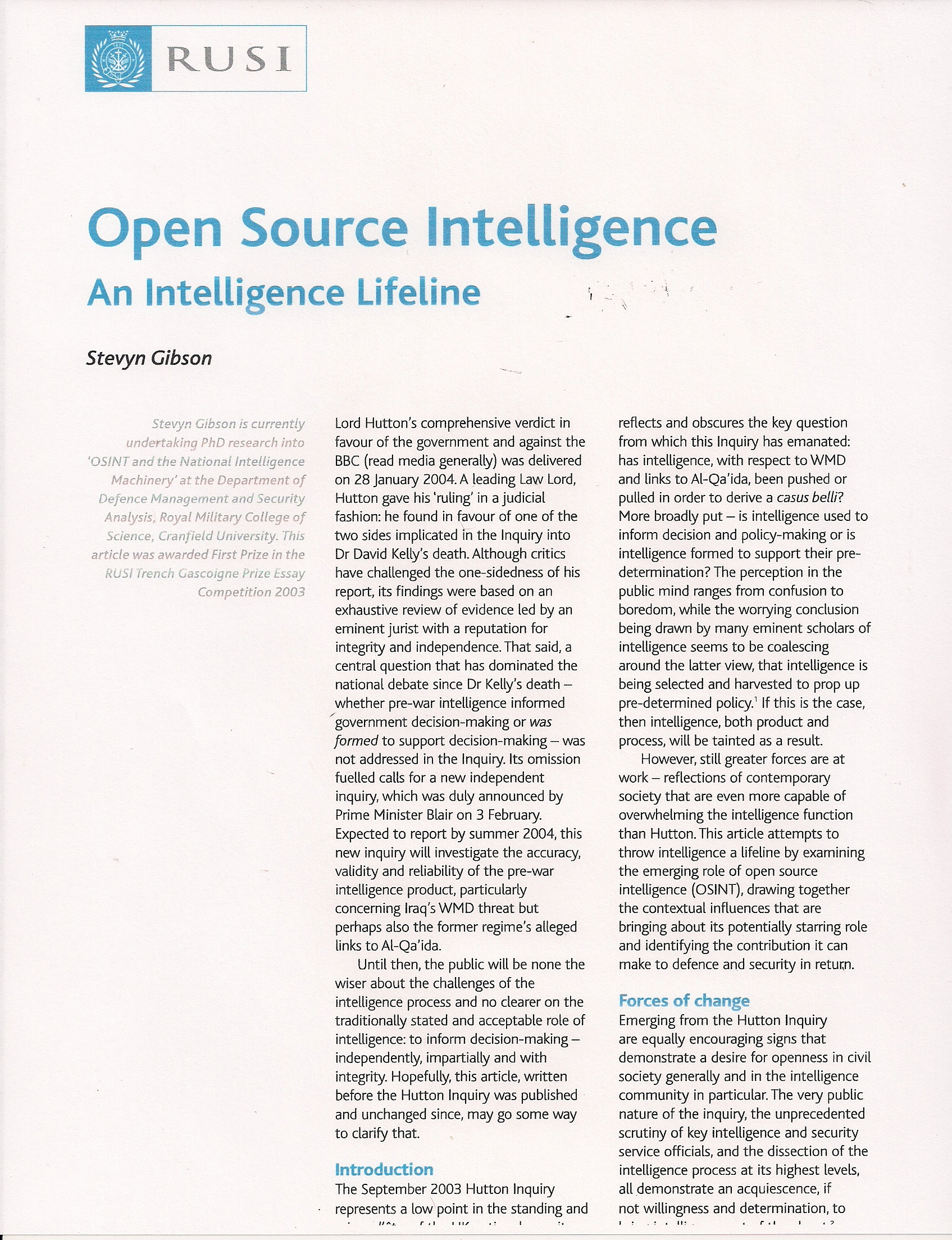
Phi Beta Iota: This is the first Open Source Intelligence (OSINT) overview we have seen, by someone other than one of the OSINT Masters from 1992-2006, that is fully competent.