Review: The New Face of War–How War Will Be Fought in the 21st Century

3 Star, War & Face of Battle
0Shares

Amazon Page
Amazon Page

3.0 out of 5 stars Quickie Book, Misleading Title, On Balance Disappointing,

November 30, 2003
Bruce D. Berkowitz
Edit of 21 Dec 07 to add links.

I know and admire the author of this book very much, and consider his and Allan Goodman's book on “Best Truth” to be among the top ten books on the topic of intelligence.

This book, unfortunately–and I am dismayed because I was really hoping for some new thoughts and stimulation that the author is certainly capable of–is what I would call a “quickie” book. It is also very misleadingly titled. In brief, this is the book Tom Clancy would write if a) he worked for RAND and b) did not care about making money.

It is not completely superficial–what is there is valid, documented, and for someone that does not read in this field, satisfactory. But to take just one example where my own work is dominant, that of open source intelligence: the author, who knows better, covers the topic with a trashy vignette of his visit to Margot Williams at the Washington Post and the result is, to me at least, quite annoying in its glibness and ignorance of all else that is going on in the open source world.

This book is also not about the future of war, unless one is a prisoner of (or funded sycophant to) the morons in the Pentagon that think that “information superiority” is still about expensive secret intelligence satellites, expensive unilateral secret communications links, and using very very expensive B-2 bombers to go after guys in caves. There are four future wars that will be fought over 100 years on six fronts: big wars with conventional armies (e.g. between India and Pakistan), small wars and criminal man-hunts around the world; nature wars including the wars against disease, water scarcity, mass migration, and trade in women and children as well as piracy and ethnic crime; and electronic wars, where states, corporations, and individuals will all vie for some form of advantage in the electronic environment that we have created and that is, because of Microsoft, a national catastrophe waiting to happen.

On the latter, the author gets 4 stars. On the former, zero. I hold the author blameless for the lousy title. This is about not how war is going to be fought in the 21st Century–it is about what the beltway bureaucracy is trying to sell to the Pentagon, at taxpayer expense, and it covers just 10% of the future needs and capabilities.

Recommended, with reviews:
The Unconquerable World: Power, Nonviolence, and the Will of the People
The Fifty-Year Wound: How America's Cold War Victory Has Shaped Our World
War Is a Racket: The Anti-War Classic by America's Most Decorated General, Two Other Anti=Interventionist Tracts, and Photographs from the Horror of It
The Paradox of American Power: Why the World's Only Superpower Can't Go It Alone
Race to the Swift: Thoughts on Twenty-First Century Warfare (International Series on Materials Science and Technology)
Wilson's Ghost: Reducing the Risk of Conflict, Killing, and Catastrophe in the 21st Century
Why We Fight
The Fog of War – Eleven Lessons from the Life of Robert S. McNamara

Vote on Review
Vote on Review

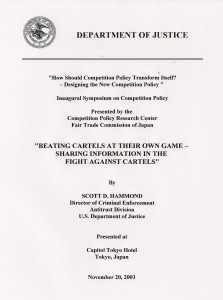
2003 “BEATING CARTELS AT THEIR OWN GAME – SHARING INFORMATION IN THE FIGHT AGAINST CARTELS”

Director of National Intelligence et al (IC)
0Shares
DoJ on Sharing
DoJ on Sharing

There are two important aspects to this 2003 report as this is written (11 August 2009).

1.  This is a top ten refereence for a search of <international information-sharing> which suggests that not much has happened in the last few years, which coincides with our own appreciation.

2.  The speaker lists a number of myths and discusses each briefly.  They are worth noting.

Myth I: Information Sharing In The Investigation Of Hardcore Cartels Should Be Treated Differently Than Other Financial Offenses

Myth II: Increased Information Sharing Will Lead To The Rampant, Uncontrolled Exchange Of Sensitive Confidential Business Secrets

Myth III. Strict Protections On Information Sharing Must Be Imposed Because There Is A High Risk of Misuse Or Leaks Of Shared Information

Myth IV: Unchecked Information Sharing Threatens The Continued Success Of Leniency Programs

Myth V. Business And Trade Groups Do Not Support Enhanced Cooperation Between Foreign Governments Because They Fear Vigorous And Effective Enforcement Of The Antitrust Laws

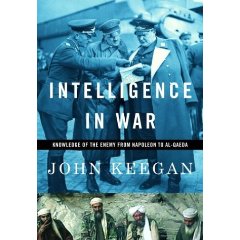
Review: Intelligence in War–Knowledge of the Enemy from Napoleon to Al-Qaeda

4 Star, Intelligence (Government/Secret), Military & Pentagon Power, War & Face of Battle
0Shares

Amazon Page
Amazon Page

4.0 out of 5 stars 5 for Scholarship, 3 for Missing the Point, 4 on Balance,

November 16, 2003
John Keegan
Edit of 21 Dec 07 to add comment and links.

New Comment: America is mired in Iraq today because US and UK intelligence lacked integrity and failed to publicly challenge the constant lies of Bush, Cheney, and Blair. I have made it my personal goal to reduce the US secret intelligence budget by 80%, to $12 billion a year, within ten years. The UK should consider doing the same.

I feel so strongly about the misdirection of this book, its eminent author not-withstanding, that I actually did a press release responding to the early publicity. I hope you find it interesting, because we will lose many more lives and pay much migher costs in damages if we fail to reform national, military, and law enforcement intelligence at the strategic, operational, tactical, and technical levels. Send me an email if you would like to have a list of 20 really great books on intelligence.

FORMER SPY AND NATIONAL SECURITY EXPERT RESPONDS TO SIR JOHN KEEGAN'S NEW BOOK TO THE EFFECT THAT INTELLIGENCE DOES NOT WIN WARS

Washington, D.C., October 23/PRNEWSWIRE/ — Robert David Steele, a former spy and founder of the Marine Corps Intelligence Command, applauds Sir John Keegan's commentary “Forget about James Bond -intelligence never wins wars” as filed on 22/10/2003. However, Steele says, “As a long-time admirer of Sir John's prowess in understanding warfare, I must respectfully say that in this instance, he stands with the American Colonel who plaintively observed to the North Vietnamese Colonel that America won all the battles in Viet-Nam-to which the man replied, as recounted by Harry Summers, with (and I paraphrase), `So what? That is irrelevant to the outcome.'”

Steele goes on, “Where Sir John misses the point is with respect to the distinct role of intelligence at the strategic level. As Sun Tsu (and perhaps even Colin Gray) would no doubt observe to Sir John, `If you've gotten yourself into a war at all, then you have failed to win by other means, and it is this that is the larger intelligence failure.'”

Steele concludes, “It is my own experience that 80% of the American national security budget is wastefully expended on a heavy metal military that is useless 90% of the time. Indeed, of the $500 billion a year we spend today, we should reduce the amount spent on conventional and nuclear forces by half, while re-directing the savings toward special operations, gendarme, peace, and homeland security intelligence and counterintelligence. America has begun a hundred-year war on six different fronts precisely because the President lacked intelligence in every sense of the word, and because he and his ideologically-motivated handlers also lacked the kind of long-term diverse strategy for securing a sustainable long-term peace that can only come from a full understanding of diverse threats and circumstances. Yes, soldiers win wars. Intelligence professionals prevent wars by being prescient, clever, and covertly effective.”

Mr. Steele is the author of On Intelligence: Spies and Secrecy in an Open World (2001); The New Craft of Intelligence: Personal, Public, & Political–Citizen's Action Handbook for Fighting Terrorism, Genocide, Disease, Toxic Bombs, & Corruption (2002); Information Operations: All Information, All Languages, All the Time; and THE SMART NATION ACT: Public Intelligence in the Public Interest; and a contributing editor of Peacekeeping Intelligence: Emerging Concepts for the Future (2003). All can be purchased at Amazon.

In 2008 I will publish the following titles, each them the epitaph of the secret intelligence and heavy metal military worlds:

COLLECTIVE INTELLIGENCE: Creating a Prosperous World at Peace (edited)
PEACE INTELLIGENCE: Assuring a Good Life for All (edited)
COMMERCIAL INTELLIGENCE: From Moral Green to Golden Peace (edited)
WAR & PEACE: The Seventh Generation

Five great books on intelligence:
Intelligence Power in Peace and War
Strategic Intelligence & Statecraft: Selected Essays (Brassey's Intelligence and National Security Library)
Who the Hell Are We Fighting?: The Story of Sam Adams and the Vietnam Intelligence Wars
None So Blind: A Personal Account of the Intelligence Failure in Vietnam
Legacy of Ashes: The History of the CIA

My two seminal chapters, one on strategic open source intelligence, the other on operational open source intelligence, are free on online at OSS.Net/OSINT-S and OSS.Net/OSINT-O. Just insert the three w's.

Vote on Review
Vote on Review

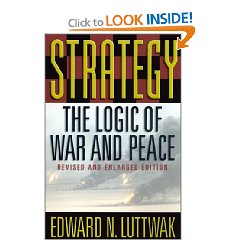
Review: Strategy–The Logic of War and Peace, Revised and Enlarged Edition

5 Star, Strategy
0Shares

Amazon Page
Amazon Page

5.0 out of 5 stars Ignore the Detractors, This Book is Brilliant,

November 14, 2003
Edward N. Luttwak
Edit of 21 Dec 07 to add links.

My own discovery of how the threat changes depending on the levels of analysis would not have occurred without this brilliant book by Edward Luttwak. It was his careful and reasoned discussion of how specific capabilities and policies might not make sense at one level of analysis, but do when combined with others, that helped me understand why US (and other) intelligence communities continue to get so much wrong.

First to credit Luttwak: anti-tank weapons make no sense in isolation (tactical level), but if they slow the tank down enough to allow artillery and close air support to have an impact (operational level), they might close gaps and win victories (strategic level). Bottom line: nothing in war can be considered in isolation (including, one might add, the post-war needs that enable an exit strategy).

It was from Luttwak's work that the Marine Corps Intelligence Center (today the Marine Corps Intelligence Command) developed the new model for analysis that distinguished between the four levels of analysis (strategic, operational, tactical, and technical), combined that with the three major domains (military, geographic, and civil), and then cross-walked that against every single mission area (infantry, artillery, tanks, aviation, etcetera).

One simple example of the importance of Luttwak's work to intelligence: at the time (1990) the Libyan T-72 tank was considered by the US Intelligence Community to be a very high threat because it was the best tank that money could then buy–but on reflection, we found this was true only at the technical level of optimal lethality. At the tactical level the tank was being stored in the open, poorly maintained by poorly trained crews, parts cannibalization occurring regularly, this dropped the threat to low. At the operational level there were a significant number of the tanks scattered around and available, this raised it to a medium threat at that level. At the strategic level, the tanks could not be sustained in battle for more than two weeks, and dropped again to low.

Edward Luttwak, in company with Colin Gray, Martin van Creveld, Ralph Peters, and Steve Metz, is one of the most brilliant and clear-spoken of the strategists writing in English, and this book will remain–for years to come–a fundamental building block in the learning and maturation of national security strategy.

Other recommended books at this level:
Modern Strategy
Transformation of War
The Changing Face of War: Lessons of Combat, from the Marne to Iraq
Wars of Blood and Faith: The Conflicts That Will Shape the 21st Century
Security Studies for the 21st Century
Strategy: Process, Content, Context–An International Perspective
The Search for Security: A U.S. Grand Strategy for the Twenty-First Century
The Sword and The Pen – Selections From The World's Greatest Military Writings
War and Peace and War: The Rise and Fall of Empires

Vote on Review
Vote on Review

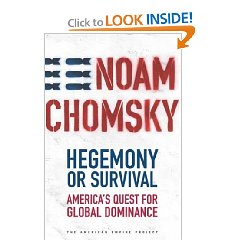
Review: Hegemony or Survival–America’s Quest for Global Dominance (The American Empire Project)

4 Star, America (Founders, Current Situation), Congress (Failure, Reform), Empire, Sorrows, Hubris, Blowback, Executive (Partisan Failure, Reform)
0Shares

Amazon Page
Amazon Page

4.0 out of 5 stars Apex of Moral Critical Thinking,

November 14, 2003
Noam Chomsky
Edit of 21 Dec 07 to restate importance of this work and add links.

UPDATED to comment on Hugo Chavez at UN.

Hugo Chavez and his Iranian counterpart, together with the leaders of Brazil, China, India, and Indonesia, among others, brought reality to America with the United Nations presentations. It is noteworthy that not a single member of the General Assembly disagreed with their harsh assessments of the Bush-Cheney regime. I reviewed this book before it was made popular by Chavez, and I will say just two things: 1) order it now, it is worth the wait; and 2) Bush-Cheney may not be interested in reality, but reality is assuredly interested in us. It's time the public realized that Chomsky, not Bush, is the real deal.

Yes, Chomsky tends to be repetitive and to rehash old stuff, so take away one-star. However, and I say this as the #1 Amazon reviewer of non-fiction about national security, to suggest that Chomsky is ever anything less than four stars is to betray one's ignorance and bias. He adds new material in this book, and perhaps even more importantly, he delivers this book at a time when America is faced with what may well be its sixth most important turning point in history (after independence, the civil war, two world wars, and the cold war). How America behaves in the 2004 election is going to determine whether the Republic deteriorates into a quasi-totalitarian and bunkered society with a lost middle class and a gated elite, or whether we restore the world's faith in American goodness, moral capitalism, and inclusive democracy.

Chomsky brilliantly brings forth a theme first articulated in recent times by Jonathan Schell (The Unconquerable World: Power, Nonviolence, and the Will of the People) by pointing out that the *only* “superpower” capable of containing the neo-conservative, neo-totalitarian, neo-Nazi militarism and unilateralism of the current Bush Administration is “the planet's public.”

Chomsky updates his work with both excellent and well-balanced footnotes and an orderly itemization of the arrogance, militarism, contempt for international law, arbitrary aggression, and–Bible thumpers take note–proven track record for supporting dictators, Israeli genocide against Palestinians, and US troop participation in–directly as well as indirectly–what will inevitably be judged by history to be a continuing pattern of war crimes.

Chomsky, past master of the topic of “manufacturing consent” now turns his attention to the manner in which the Bush Administration is attempting to establish “new norms” that, if permitted to stand, will reverse 50 years of human progress in seeking the legitimization of governance, respect for human rights, and collective decision-making and security.

He is especially strong on documenting the manner in which US aid grows in direct relation to the degree to which the recipient country is guilty of genocidal atrocities, with Colombia and Turkey being prime examples. The case can be made, and Chomsky makes it, that the US arms industry, and US policies on the selling and granting of arms world-wide, are in fact a direct US commitment to repression, genocide, and terrorism sponsored by one big state: the US. He is most interesting when he discusses the new US approach to repression, the privatization of actions against the underclasses of the world.

Morality plays big with Chomsky, who brings new ideas in with his discussion of moral asymmetry and the lack of moral integrity in US decision-making. Sadly, the US public is too busy trying to survive the abuses of the Bush-Cheney regime, and do not realize the crass immorality of all that is being done “in their name.”

Chomsky reminds us that George Bush the Second pardoned a known international terrorist, Luis Posada Carriles, because of his ties to the extremist Cuban-American community that his brother Jeb Bush is so dependent upon for support.

Over the course of the middle of the book Chomsky addresses the competing models for national development, with Cuba prominent as an alternative model that the US has sought to destroy, as the US worked very hard to destroy Catholic “liberation theology” because of its temerity in believing that the poor should be protected against repressive governments and their American corporate paymasters. Chomsky is correct, I believe, when he states and documents that the US model of capitalism has pathologically high rates of inequality and poverty (even CNN has noticed–as I waited for an airplane in Salt Lake City, a bastion of common sense, the lead story was the collapse of the US middle class).

Chomsky moves from his discussion of exceptions to US capitalism to a discussion of the importance of regional differentiation, and this is of course in direct competition with the US view that the world should be a homogenized generic variation of the US culture, with one big difference: 80% of the benefits for the US, while the rest of the world shares the left-overs.

Chomsky agrees with Dr. Col Max Manwaring and other mainstream strategists (see my review of The Search for Security: A U.S. Grand Strategy for the Twenty-First Century when he identifies the legitimacy of governments, and the sanctity of human and civil rights, as the two litmus tests for determining if balance and fairness exist in a society. By this measure, the US is now failing.

The book begins to conclude with a semantic discussion of terrorism, what is terror, who sponsors terror, and here Chomsky draws on both his linguistic and historical background to make the case that the US is the primary sponsor of terrorism in the world (something both the Indonesian and Malaysian leadership would tend to agree with), and he notes that the US, in a bi-partisan manner among the elite, has consistently been hypocritical about terrorism. Nelson Mandela, and his resistance party, were labeled terrorists by the US for many years.

Are we in a passing nightmare, or the beginning of a renaissance? The jury is still out. I personally believe that John McCain would have been a vastly superior president that this lightweight bully that we have now, with his out-of-control neo-conservatives, none of whom ever served in uniform and some of whom–as with Dick Cheney–were active draft dodgers. However, I also believe that both John McCain, and Dick Gephardt if he were to be elected, are too close to the “business as usual” crowd of beltway politicians capitalized by beltway bandits. In other words, Howard Dean would not have been possible without the excesses of George Bush Junior. God does indeed work in mysterious ways, and I pray that the American public will both read Chomsky, and understand that they represent the only super-power that can restore legitimacy, sanity, comity, and prosperity to the American Republic. Down with the carpetbaggers–El Pueblo Avansa–EPA!.

Recent books supporting the moral intelligence of Noam Chomsky:
Vice: Dick Cheney and the Hijacking of the American Presidency
Blood Money: Wasted Billions, Lost Lives, and Corporate Greed in Iraq
American Fascists: The Christian Right and the War On America
American Theocracy: The Peril and Politics of Radical Religion, Oil, and Borrowed Money in the 21stCentury
The Sorrows of Empire: Militarism, Secrecy, and the End of the Republic (The American Empire Project)
Fiasco: The American Military Adventure in Iraq
Independents Day: Awakening the American Spirit
Day of Reckoning: How Hubris, Ideology, and Greed Are Tearing America Apart

Vote on Review
Vote on Review

Review: The Clustered World –How We Live, What We Buy, and What It All Means About Who We Are

4 Star, Culture, Research, Democracy, Politics
0Shares

Amazon Page
Amazon Page

4.0 out of 5 stars Powerful with Global Implications, Needs a Third Transformative Work,

November 8, 2003
Michael J. Weiss
Edit of 21 Dec 07 to add links.

When Howard Dean used the shorthand expression “guys with confederate flags on their pick-ups” he was actually talking about what some call “NASCAR dads” and Michael Weiss calls the “Shotguns & Pickups” cluster (number 29 in his first book, number 43 in this advanced and improved edition).

Although others have written about the nine nations of North America (Joel Garreau), various “tribes” across the nation, and demographics in general, Michael Weiss stands head and shoulders above all of them in providing the definitive reference work that is also a form of novel about America.

With this book he also begins the process of extending his ideas to he world, showing how neighborhoods in 19 countries can be classified into 14 common lifestyles, the bottom three being Lower Income Elderly, Hardened Dependency, and Shack & Shanty….billions of people disenfranchised by amoral capitalism, whose desperate circumstances have not quite made themselves felt, yet, in America.

I have only one major criticism of this book, apart from its obsession with understanding people in order to sell to them–it fails to go the extra mile in understanding the future consequences of each group's economic status and consumer preferences. Although the book very specifically addresses the politics of each group (predominant ideology, 1996 presidential vote, key issues), it lacks the transformation analysis that might be helpful in understanding the political economy dynamics of each group, and what might be required to craft a new national progressive consensus that reduces materialism, corruption, waste, and restores democracy, community, and sustainable national security and prosperity.

Regardless of this modest shortfall, this is an extraordinary book, as was the first that I also own (The Clustering of America). Those interested in how these clusters are coalescing into a new progressive movement that is in-front, deep green, against big business, big money in politics, and amoral globalization, might wish to read Paul Ray and Sherry Ruth Anderson The Cultural Creatives: How 50 Million People Are Changing the World, Search for “Cultural Creatives” or visit culturalcreatives.org. America is changing. This book by Michael Weiss is a brilliant snapshot of where we are today.

I want to save America from its craven politically corupt and economically bankrupt systems. This book is a first step in understanding who we are so we can transform ourselves, and our world, to create a prosperous world at peace.

Other books I recommend, with reviews:
A Power Governments Cannot Suppress
Society's Breakthrough!: Releasing Essential Wisdom and Virtue in All the People
The Tao of Democracy: Using Co-Intelligence to Create a World That Works for All
Group Genius: The Creative Power of Collaboration
Five Minds for the Future
THE SMART NATION ACT: Public Intelligence in the Public Interest
One from Many: VISA and the Rise of Chaordic Organization
The World Cafe: Shaping Our Futures Through Conversations That Matter

Vote on Review
Vote on Review

Review: Lost History–Contras, Cocaine, the Press & ‘Project Truth’

4 Star, Censorship & Denial of Access, Congress (Failure, Reform), Empire, Sorrows, Hubris, Blowback, Executive (Partisan Failure, Reform), History, Misinformation & Propaganda
0Shares

Amazon Page
Amazon Page

4.0 out of 5 stars Corruption & Mendacity of White House, CIA Failures in Central America,

November 8, 2003
Robert Parry
Edit of 21 Dec 07 to add links.

This book is a real gem. It outlines a tale of both corruption and ideological mendacity within the White House, and of ignorance and unprofessionalism with the Directorate of Operations in the Central Intelligence Agency. As one who served on the Central American Task Force at the time, and as a clandestine case officer focused on these matters, I find it especially fascinating that I, from the inside, was truly unaware of the degree to which we were engaged in direct support to a band of contras characterized by drug-running, money-laundering, corruption, rape, torture, routine murders, and perhaps worse of all, total incompetence and ineffectiveness.

There are two aspects of this book that truly stand out for anyone who is committed, as I and most CIA employees are, to the concept that “the truth shall make you free.”

First, as the title suggests, there is a “lost history” that is unavailable to the American people. The author is not alone in making this charge. The editors of the history of the Department of State have on several occasions complained, both publicly and privately, that an accurate history of the foreign relations of the United States of America cannot be written without more complete disclosure of our various covert operations. Indeed, Derek Leebaert's book The Fifty-Year Wound: How America's Cold War Victory Has Shaped Our World, Jim Bamford's book Body of Secrets: Anatomy of the Ultra-Secret National Security Agency, and Sterling and Peggy Sterling's book Gold Warriors: America's Secret Recovery of Yamashita's Gold, among a number of others books but these three reviewed by me on Amazon and being the most recent and best documentary efforts, all show that America has paid a *huge* cost, a cost running to trillions of dollars in deceitfully mis-spent dollars and lives, for clandestine and covert activities that have inspired enmity, often nurtured environments of genocide and war crimes (Sudan today, for example, given a “bye” for its nominal counter-terrorism support), and spawned vast war profiteering enterprises at the same time that we nurture and encourage dictatorships such as those in Saudi Arabia and Pakistan, both of which are protecting Bin Laden, his family (which we allowed to escape from the US rather than taking them hostage–a White House accommodation to its Saudi paymasters), and other terrorists. America needs to understand the truth about such matters, and this book helps.

The other major value of this book is its examination of how the White House, first under Reagan and now under Bush junior, and personified in the activities of one Otto Reich (Reich and Rove are exemplar representatives of the neo-Nazi and neo-conservative aspects of the Cheney-Bush regime), has violated various US laws and values by running psychological operations and media campaigns against its own public. Especially distressing has been the manner in which the National Public Radio (NPR) has been “brought to heel” by threats to cut off its federal subsidies if it fails to accept the lies of the Administration and actually reports truthfully to the public. The Associated Press (AP) is also shown in this book to have subverted the truth and conformed to the falsehoods and propaganda line being purveyed by the Reagan Administration against the American people. The New York Times is specifically cited, on several occasions, and publishing false and misleading information, not because its employees lack ethics (as has recently been the case) but because the NYT is part of the “establishment” and all too eager to betray its readers by publishing the party line from a corrupt White House.

Usefully, the author documents a General Account Office decision on 30 September 1987 that the “white propaganda” of Otto Reich and the Public Diplomacy Office in the Department of State amounted to “prohibited covert propaganda activities” against the US media and the US public. Under Bush Junior the Administration has added blatant lies and manipulated intelligence to its repetoir, and continues to manage covert propaganda against the American people.

Among the most interesting sub-themes the author documents are how Richard Nixon undermined the Vietnam peace talks in order to prevent Johnson from successful resolution, and how Reagan's team undermined the Iran hostage negotiations to prevent Jimmy Carter's ability to resolve that in time for the election. In both cases the Republicans violated the law and engaged in actions that amount to treason–to a betrayal of the public trust. Now fast forward to the recent stories about how Richard Perle was a principal in the Bush Administration's refusal to accept an offer from Saddam Hussein to help in the war on terrorism, allow full US inspection teams, and otherwise give us everything we wanted except his head and the right to loot Iraq. American soldiers are dying today–and a bill we cannot pay is being run up–in Iraq because of Republican treason and Republican lies and Republican propaganda against the American people.

Another important point that this book documents is the sorry reality that CIA analysts cannot trust the CIA clandestine operators to tell them the full truth, and that the US public cannot trust the White House to tell it the full truth (apart from blatant propaganda). The truth in America has been subverted, distorted, and *buried*. As others have documented (see my review of Sheldon Rampton & John Stauber, Weapons of Mass Deception: The Uses of Propaganda in Bush's War on Iraq), the American people are, if they are avid searchers for the truth, able to see only 10% of the facts and undistorted information available to Europeans and Asians.

The book has some flaws–a rotten index, some repetition caused by integrating old and new material–but I rank it as essential reading for anyone who would like to understand how we got ourselves into an unjust war with Iraq, how an extremist Republican Administration was able to do Goering proud by manipulating the American Congress and the American people and the United Nations with a “platform of lies.” We have lost history, we have lost ethics, and we are on the verge of losing America and that for which it stands.

Other recommended books, with reviews:
Legacy of Ashes: The History of the CIA
Dark Alliance: The CIA, the Contras, and the Crack Cocaine Explosion
The Crimes of Patriots: A True Tale of Dope, Dirty Money, and the CIA (Touchstone Books (Paperback))
Vice: Dick Cheney and the Hijacking of the American Presidency
A Pretext for War: 9/11, Iraq, and the Abuse of America's Intelligence Agencies
9/11 Synthetic Terror: Made in USA, Fourth Edition

Vote on Review
Vote on Review