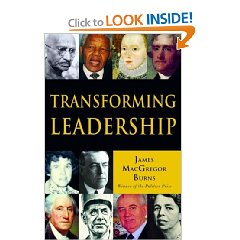
Review: Transforming Leadership–The Pursuit of Happiness

5 Star, Leadership
0Shares

Amazon Page
Amazon Page

5.0 out of 5 stars Good News: It's Possible; Bad News: Not With Today's Lot,

July 26, 2003
James MacGregor Burns
Edit of 22 Dec 07 to add links.

This is quite a fine book. It will be especially valuable to that very rare breed of all-source intelligence analyst, those responsible for analyzing foreign leaders, and completely fed up with the sterile “biographic” analysis that lists job titles and honors. The author expands substantially on the very immature but promising field leadership analysis by discussing in detail the concepts and practices of “traits-based” or “value” leadership.

The author, himself already established as one of the best writers about leaders and leadership, breaks new ground in exploring the psychology of leadership, and creating a new inter-disciplinary and psychologically-rooted approach to understanding leadership at the national, organizational, and personal levels. He concludes that transformative leadership is all too rare; that it can redirect the fate of nations (Ghandi stands out as an exemplar), and that nurturing true transformative leadership rather than mere industrial-era task-mandating and monitoring leadership, is the core competency for navigating into the 21st Century.

The author is especially brutal when his idea are applied to the charismatic or ideologically-purified forms of leadership that pass for Presidential politics today. “At best, charisma is a confusing and undemocratic form of leadership. At worst, it is a form of tyranny.”

He spends a great deal of time examining the founding fathers of America and the process by which they defined both the Declaration of Independence and the Constitute, and his findings are quite remarkable (especially in light of recent attempts by Republicans in Texas and in the House of Representives to totally silence Democrats and override dissenting votes without voice):

1) The minority is an absolutely essential part of collective learning and the great dialog that leads to sound decisions. Repressing the minority is a prescription for disaster.

2) The pursuit of happiness, rather than property, was very deliberately selected by the founding fathers in order to focus on human values and collective learning, rather than property rights.

3) Rebellion from time to time is a feature, not a fault. “…the tree of liberty must be refreshed from time to time with the blood of patriots and tyrants” per John Adams. He specifically focuses on the importance of the loyal opposition as a means of enabling principled change by the majority in the cauldron of informed debate.

4) The right to abolish the U.S. Government is specifically reserved to the American people. The author notes that absolutist ideas inspire revolt, crowds have immeasurable power, and narrow ideologies with ritual tests of orthodoxy are an invitation to popular revolution.

After reviewing a number of leaders across history, the author quotes Roosevelt, who said “Government by organized money is just as dangerous as Government by organized mob” and then sets the stage for his concluding section, which suggests that leaders must embrace deep values that accept the happiness of the people as the ultimate challenge for the community, that they must empower followers rather than merely engage them, and that the ultimate challenge for all leaders of all nations and organizations is global poverty and the need to eradicate global poverty if billions are to find some semblance of happiness (and implicitly, stability that reduces the threat to the United States and Europe).

He quotes others in emphasizing that men in fear or want are not free men; that technology and money is not the answer to poverty, only values and liberation from fear and want, and–his final word, it the end it must be a “great people” rather than a “great man” that rises to the global challenge.

America! A Whole Earth. We can only imagine…

Bad Leadership:
Vice: Dick Cheney and the Hijacking of the American Presidency
Running on Empty: How the Democratic and Republican Parties Are Bankrupting Our Future and What Americans Can Do About It
Breach of Trust: How Washington Turns Outsiders Into Insiders
Sleeping with the Devil: How Washington Sold Our Soul for Saudi Crude

Good Leadership:
A Power Governments Cannot Suppress
One from Many: VISA and the Rise of Chaordic Organization
Leadership and the New Science: Discovering Order in a Chaotic World
The Tao of Democracy: Using Co-Intelligence to Create a World That Works for All
Society's Breakthrough!: Releasing Essential Wisdom and Virtue in All the People
THE SMART NATION ACT: Public Intelligence in the Public Interest


Vote on Review
Vote on Review

Review: Spies in the Vatican–Espionage & Intrigue from Napoleon to the Holocaust (Modern War Studies)

4 Star, Intelligence (Government/Secret), Religion & Politics of Religion
0Shares

Amazon Page
Amazon Page

4.0 out of 5 stars Breaks with Conventional Wisdom; Provocative; Incomplete,

July 26, 2003
David Alvarez
This is quite an extraordinary work. It seeks to correct the impression, held by Allen Dulles, many world leaders, and myself, that the Vatican, as with other select religious organizations like B'Nai Brith, is a world-class intelligence network.Although the book spends as much time discussing efforts by the Italians, Germans, and others to penetrate the Vatican, as it does discussing the Vatican's mixed and often non-existent intelligence and counterintelligence capabilities, on balance this is an extremely good personal effort, based on some unique documents and research, and it can be regarded as a cornerstone for any future research into Vatican intelligence.

The book suggested to me three “big” ideas that need to be considered by every national intelligence service:

1) Structure and capabilties are needed to study religious intelligence and counterintelligence. Renegade mid-level drop-outs from the specified religious order should be identified and leveraged as required. Taking the Muslim brotherhood as an example (see Robert Baer's new book, SLEEPING WITH THE DEVIL), it is absolutely unforgivable and unprofessional of both the US Department of State and the Central Intelligence Agency to have been prevented from studying the fundementalist and extremist religious movements in Arabia from the 1970's forward. Bottom line: we need to have relgious “orders of battle” and a clear understanding of what this important international player has in the way of capabilities and perceptions.

2) Secure communications make a very important contribution to candor and accuracy. Perhaps the most interesting part of the author's story can be found in his many annecdotes about how lack of a secure communications system led to self-deception, fantasy, conspiracy, and inaccuracy. The author is also quite credible in discussing the mediocrity of most Papal cryptographic systems, the lack of manpower and resources for improving this, and the negative results that came about because of a lack of a reliable and truly trusted communications system.

3)Finally, while the author does not cover Vatican betrayals of its own people through the Inquisition, of Muslims through the Crusades, and of Jews during the Holocaust, it is clear from this book that for all its limitations, the Catholic Church is an important global player whose local nuncios and bishops and priests and lay personnel can and should be legally and ethically leveraged for sounder understandings across many cultural divides. I would go so far as to resurface Richard Falk's 1970's idea about a world council of peoples and religions, with a twist: each Foreign Ministry must establish a separate Bureau of Religious Understanding, and devote considerable resources to studying and interacting with religious organizations (and cults, although these can be dealt with on a confrontational law enforcement basis).

Religons are one of the seven tribes of intelligence (the others are national, military, law enforcement, business, academic, and NGO-media). The author has made a very important contribution here (albeit with no help from the publisher–the index *stinks*). This book is highly recommended for adult students of intelligence, for policy makers, for religous leaders, and for citizens interested in how their religious affiliation could be legally employed (or illegally abused) in the pursuit of a global information society.

Vote on Review
Vote on Review

Review: Power Trip (Open Media Series)

4 Star, Corruption, Power (Pathologies & Utilization)
0Shares

Amazon Page
Amazon Page

4.0 out of 5 stars Predictable, Useful, Lacks Real Structure,

July 25, 2003
John Feffer
Edit of 22 Dec 07 to add links.

I am a big fan of Seven Stories Press and their important work in bringing alternative views to the public. Unfortunately, they also tend to be somewhat predictable and repetitive, so minus one star.

Having said that, I rate this as a very important book that is worth buying, along with “Why People Hate America”, “The Fifty Year Wound”, and the books by Joe Nye. [See my reviews for a summative evaluation of each book.]

The book explores the mis-direction of US foreign policy, with sections on resources, military, international law, foreign economic policy, intelligence, and culture.

The book discusses the specifics of Central Asia, the Middle East, Africa, Latin America, and Asia.

The book attempts, but does not succeed, to present a chapter on “how things should change.” This chapter, while well-intentioned and undoubtedly sound in its specifics, misses the mark in terms of presenting a comprehensive alternative foreign policy that supports both American security and sustainable global prosperity. Indeed, I recommend my review of the Boren and Perkins book on foreign policy in the 21st Century, which includes 18 key points made by their distinguished authors, as a superior listing of key points to consider.

US unilaterilism is making the world less safe for our children. Everything being today “in our name” is reducing both security and prosperity in the long run. This book is an important secondary reference, well worth buying, but it does not quite hit the home run that a winning Presidential candidate can use in 2004 to oppose the current program.

Bad Leadership:
Vice: Dick Cheney and the Hijacking of the American Presidency
Running on Empty: How the Democratic and Republican Parties Are Bankrupting Our Future and What Americans Can Do About It
Breach of Trust: How Washington Turns Outsiders Into Insiders

Good Leadership:
The Battle for the Soul of Capitalism: How the Financial System Underminded Social Ideals, Damaged Trust in the Markets, Robbed Investors of Trillions – and What to Do About It
One from Many: VISA and the Rise of Chaordic Organization
The Tao of Democracy: Using Co-Intelligence to Create a World That Works for All
Society's Breakthrough!: Releasing Essential Wisdom and Virtue in All the People
Day of Reckoning: How Hubris, Ideology, and Greed Are Tearing America Apart
Independents Day: Awakening the American Spirit

Vote on Review
Vote on Review

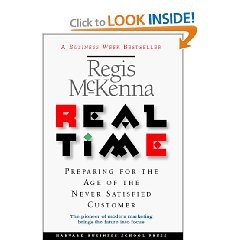
Review: Real Time–Preparing for the Age of the Never Satisfied Customer

5 Star, Best Practices in Management, Change & Innovation, Complexity & Resilience, Information Society, Intelligence (Public)
0Shares

Amazon Page
Amazon Page

5.0 out of 5 stars Not Pedestrian at All–Packed with Insights,

July 10, 2003
Regis McKenna
Edit of 22 Dec 07 to add links.

Below is my review as planned before reading all the negative reviews….everyone brings their own baggage to any book. Following this short review, which was originally written for national intelligence professionals, I have added an addendum with a specific experience in France that illustrates why this book is valuable to anyone willing to take the time to reflect on its fundamentals.

————————

This may be one of the top three books I've read in the last couple of years. It is simply packed with insights that are applicable to both the classified intelligence community as well as the larger national information community. The following is a tiny taste from this very deep pool: “Instead of fruitlessly trying to predict the future course of a competitive or market trend, customer behavior or demand, managers should be trying to find and deploy all the tools that will enable them, in some sense, to be ever-present, ever-vigilant, and ever-ready in the brave new marketplace in gestation, where information and knowledge are ceaselessly exchanged.”

———————–

ADDENDUM: In coming to post the above review I noted a number of negative reviews along the lines of “so 1970's”, “no new ideas”, etc. Naturally any book is going to strike people with different levels of intelligence and experience differently. Our advice to intelligence professionals and managers at any level is to dismiss those other opinions, spend $20 and 1-2 hours with this book, and judge for yourself. Among many reasons why we found this book meaningful, given our focus on global coverage, weak signals, and being effective in 29+ languages, is the following experience:

In 1994, attending the French national conference on information, we heard one of the leaders of the French steel industry discussing a multi-million dollar business intelligence endeavor (in France this includes business espionage and government espionage in support of business) against steel industries around the world. The punch line, however, was stunning. At the end of it all, he said, they failed because they focused only on the steel industry. In the end, the plastics industry ate their lunch because it was able to develop very good plastic substitutes for automobile parts, including automobile under-carriage parts, and this hurt the French steel industry badly. It was from this occasion that we crafted Rule 003 (Book 2, Chapter 15) on the importance of Global Coverage, whose sub-title could be “cast a wide net.” McKenna has the basics right.

Fast forward to:
The Age of Speed: Learning to Thrive in a More-Faster-Now World
The Wealth of Networks: How Social Production Transforms Markets and Freedom

Vote on Review
Vote on Review

Review (Guest): Liar’s Poker–Rising Through the Wreckage on Wall Street

5 Star, Banks, Fed, Money, & Concentrated Wealth, Biography & Memoirs, Corruption
0Shares
Amazon Page

5.0 out of 5 stars One hand, one million dollars, no tears.

July 15, 2003

john purcell “johneric99” (Purcellville, VA USA)

In the 1980's, Michael Lewis was a neophyte bond salesman for Salomon Brothers in New York and London for four years. Liar's Poker is a high-stakes game the traders, salesmen, and executives play each afternoon, but it is also a metaphor for the Salomon culture of extreme risk-taking with immediate payoffs and clear winners and losers.

This is the story of how Lewis survived the training program, inept but mean-spirited management, an aborted take-over even featuring a white knight, layoffs and the 1987 market crash before quitting to find his real calling as a business journalist. While Lewis's career did not take off quickly, he eventually became a highly paid producer, although not in the league of the true top dogs.

Lewis tells the real story of Wall Street in both go-go and crash days with self-deprecating humor enlivened with his ecletic wit. Colorful and well-known Wall Street characters appear such as Michael Milken, Lazlo Birini, Warren Buffett, Bill Simon, Sr. and John Guetfruend. All business students need to read this as even those with advanced degrees in finance such as myself, will learn how things really work. The story of how the junk bond and collateralized mortgage backed security markets emerge is told to fill in a chapter in financial history. Perhaps most interesting is some of the political machinations, rampant at Salomon, which lead for example for Salomon to ignore the junk bond market, allowing others to flourish and eventually attempt to take-over Salomon using junk bonds.

Lewis also describes for all investors the conflicts of interest and lack of governance on Wall Street long before Eliot Spitzer and Arthur Levitt became the champions of the little guy. My next step is to read Lewis's later books.

Vote on Review