Last year we had some exceptional works on water scarcity (de Villier), resource wars (Klare), corporate razing of the environment (Czech), among many others that I reviewed here on Amazon. This year we have two extraordinary books, this is the second of the two in my estimation (the other being Andrew Price-Smith's “The Health of Nations: Infectious Disease, Environmental Change, and Their Effects on National Security and Development”- as both authors are from the University of Toronto, one can only applaud the collection of talent this organization seems to nurture).The author is brilliant and has a longer track record than most for being both prescient and meticulous about in the arena of environmental scarcity.
His book is effective in making the point, but very candidly, did not go the full distance that I was hoping for–he is, in a word, too general and the book lacks a single chapter that pulls it all together with very specific rankings of both the variables and the countries.
The general proposition is clear-cut: environmental scarcity has social effects that lead to violent conflict. However, the author takes a side road in exploring “human ingenuity” as an ameliorating factor, and while he makes reference to crass corporate and elitist carpet-bagging and the social structures of repression, he fails to draw out more fully and explicitly the inherent association between repressive corrupt regimes with extreme concentrations of wealth and power, scarcity, and violence.
For myself, I found two gems within this book: the first, a passing comment on the crucial role that unfettered urbanization plays in exacerbating scarcity and all that comes with it (migration, disease, crime); the second, the author's prescriptive emphasis, extremely importance, on the prevention of scarcity rather than adaptation or amelioration of scarcity.
The endnotes would have been more useful as footnotes but are quite good. The bibliography and index are four star rather than five star, and I was quite disappointed to not have a single page about the author, nor a consolidated bibliography of his many signal contribution over time in the form of articles and lectures.
Great details but ends with a sigh of *resignation*,
October 10, 2002
John S. McCain
I bought this book hoping to be inspired by some manifestation of John McCain's commitment to coming back, again and again, as a candidate for President of the United States.Instead, the book ends with what appears to me to be a sigh of *resignation*, a clear statement that he's had his run and will not run again. At a time when most of America is either Independent or opting out of politics, nothing could be more disappointing. This man has the power to lead, a fire in the belly, an intellect, a seasoning under pressure, and a compassion, that are too lacking in others.
This American hero survived North Vietnamese prison camps, but he evidently has been worn down by his own Republican bureaucracy and aristocracy. It is sad to see a hero triumph over foreign adversity only to be worn down by “friendly fire.”
As both a reader and a citizen, I would suggest that a better ending to the book, and the story, would be Winston Churchill's most famous (and shortest) speech to a university, the repetition, three times, each time with a smack of his cane against the podium: “NEVER GIVE UP.”
The author is the student who excelled at the University of Toronto, where Thomas F. Homer-Dixon is a professor (and himself author of “Environment, Scarcity, and Violence”), and is now a professor at the University of Southern Florida.Although the Central Intelligence Agency got this right in the 1970's, clearly warning U.S. policymakers that AIDS and related diseases were “the” catastrophic threat to national security and regional stability in the closing quarter of the 20th century, and although the United Nations and its various agencies have clearly understood the relationship between disease, environmental degradation, and instability–with all that instability brings in terms of crime, forced migration, and so on, the author gets five stars for doing an absolutely brilliant job of putting all of this knowledge–and his own original contributions–into a readable volume that can be understood by the most loosely-educated policymakers we have, as well as the voting public.
The author does a superb job of both crediting others (e.g. Laurie Garrett, whose stunning book “BETRAYAL OF TRUST: The Collapse of Global Public Health” we reviewed last year) while weaving his own insights into the story. ERIDs are “emerging and re-emerging infectious diseases.” They matter more now because, as the author summarizes it, modern man is in a very different situation today: “individuals can travel around the world rapidly by airplane, and overpopulation and the growth of megacities have created entirely new ‘disease pools' that will allow new pathogens to emerge and flourish.”
The author has done a fine job of documenting how “human-induced worldwide environmental destruction” is both releasing pathogens from their hiding places in rain forests, launching new microbes that wreak havoc on aquatic life, and proliferating resistant strains of micobial terrorists we do not understand. Bacteria, in brief, are a thousand to a million times more deadly that any terrorist gang, and we would be wise to get our priorities straight as we set about pretending to govern.
As a general statement, the author appears to have done very very well as identifying intervening variables that could be analyzed, and his conclusions on what needs to be done are “President ready.” He not only makes his case, he ends by calling for a massive increase in “health intelligence,” and thereby demonstrates a wit lacking in most academics.
The notes are excellent, there is no bibliography, and the index is so mediocre it might as well not have been included–there is also no biography of this talented author, a grevious lack. The book should be reissued with this deficiencies being corrected.
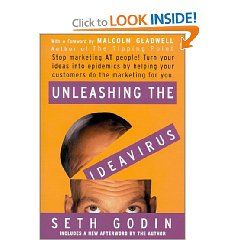
Bottom line on this book is clear: the path to fame and fortune for “gold collar workers” (a term I first saw used by Robert Carkhuff in “The Exemplar: The Exemplary Performer in an Age of Productivity (Human Resource Development Press, 1994) consists of four parts: 1) establish a personal brand name by placing before the marketplace a *free* capstone idea, “manifesto” or other form of self-expression; 2) have a web-site with forwarding email that allows anyone who likes your idea to download it, read it, share it; 3) work hard at getting your idea to a few powerful “sneezers” (the author has an alliance with Malcolm Gladwell, author of “The Tipping Point” and also of the foreword to this book)–pay them if you have to; and 4) let the money flow in from the post-branding offers for speeches, consulting, and new books.I was initially inclined to give this book only 4 stars because it is not a traditional book with a lot of references (it does have an acceptable index) but I realized that the author not only accomplishes all he sets out to do, but the book is a real value in terms of both its financial cost, and time cost–reading this book certainly suggested to me several actionable ideas that will make my web site and my efforts to spread the idea of intelligence reform better. While the author is enamoured of “Fast Company” (the magazine) and works hard to pay back some favors in his text, the various web sites that he mentions, including Epinions, Planetfeedback, and Enfish, are generally relevant and therefore not objectionable.
There are two competing ideas in the book, both worthy of note–first, that the public attention span is so limited that most of the money is made in the first release/first sales period, and then one should move on; and second, that persistence pays and the real money is to be had from the post-branding streams of revenue. I believe this stems from the juxtaposition of how companies make money if they have the wherewithall to to churn the market with a lot of new offerings; and how individuals make money by establishing personal brand names–in general the author is strongest when dealing with what single individuals can and should do to take what they are really good at, package it, put it out (free), and then systematically reap residual financial benefits.
The New Craft of Intelligence: Personal, Public, & Political—Chapter 15
Robert David Steele (OSS International Press, 2002)
The new craft of intelligence is the operational manifestation of the American way of “netwar,” and can provide a decisive asymmetric advantage from the neighborhood level to the national level, against non-traditional threats.
New Rules for the New Craft of Intelligence
001 Decision-Support is the Raison D'être 002 Value-Added Comes from Analysis, Not Secret Sources 003 Global Coverage Matters More 004 Non-Traditional Threats Are of Paramount Importance 005 Intelligence without Translation is Ignorant 006 Source Balance Matters More 007 “Two Levels Down” 008 Processing Matters More, Becomes Core Competency 009 Cultural Intelligence is Fundamental 010 Geospatial and Time Tagging is Vital 011 Global Open Source Benchmarking 012 Counterintelligence Matters More 013 Cross-Fertilization Matters More 014 Decentralized Intelligence Matters More 015 Collaborative Work and Informal Communications Rise 016 New Value is in Content + Context + Speed 017 Collection Based on Gaps versus Priorities 018 Collection Doctrine Grows in Sophistication 019 Citizen “Intelligence Minutemen” are Vital 020 Production Based on Needs versus Capabilities 021 Strategic Intelligence Matters More 022 Budget Intelligence Is Mandatory 023 Public Intelligence Drives Public Policy 024 Analysts are Managers 025 New Measures of Merit 026 Multi-Lateral Burden-Sharing is Vital
Truly Extraordinary–Core Reading for Future of Earth- Man,
September 29, 2002
Stewart Brand
I confess to being dumb. Although I know and admire the author, who has spoken at my conference, when the book came out I thought–really dumb, but I mention it because others may have made the same mistake–that it was about building a cute clock in the middle of the desert.Wrong, wrong, wrong (I was). Now, three years late but better late than never, on the recommendation of a very dear person I have read this book in detail and I find it to be one of the most extraordinary books–easily in the top ten of the 300+ books I have reviewed on Amazon.
At it's heart, this book, which reflects the cummulative commitment of not only the author but some other brilliant avant guarde mind including Danny Hillis, Kevin Kelly (WIRED, Out of Control, the Rise of Neo-Biological Civilization), Esther Dyson, Mitch Kapor (Lotus, Electronic Frontier Foundation) and a few others, is about reframing the way people–the entire population of the Earth–think, moving them from the big now toward the Long Here, taking responsibility for acting as it every behavior will impact on the 10,000 year long timeframe.
This book is in the best traditions of our native American forebears (as well as other cultures with a long view), always promoting a feedback-decision loop that carefully considered the impact on the “seventh generation.” That's 235 years or so, or more.
The author has done a superb job of drawing on the thinking of others (e.g. Freeman Dyson, Esther's father) in considering the deep deep implications for mankind of thinking in time (a title popularized, brilliantly, by Ernest May and Richard Neustadt of Harvard), while adding his own integrative and expanding ideas.
He joints Lee Kuan Yew, brilliant and decades-long grand-father of Asian prosperity and cohesiveness, in focusing on culture and the long-term importance of culture as the glue for patience and sound long-term decision-making. His focus on the key principles of longevity, maintainability, transparency, evolvability, and scalability harken back to his early days as the editor of the Whole Earth Review (and Catalog) and one comes away from this book feeling that Stewart Brand is indeed the “first pilot” of Spaceship Earth.
It is not possible and would be inappropriate to try to summarize all the brilliant insights in this work. From the ideas of others to his own, from the “Responsibility Record” to using history as a foundation for dealing with rapid change, to the ideas for a millenium library to the experienced comments on how to use scenarios to reach consensus among conflicted parties as to mutual interests in the longer-term future, this is–the word cannot be overused in this case–an extraordinary book from an extraordinary mind.
This book is essential reading for every citizen-voter-taxpayer, and ends with an idea for holding politicians accountable for the impact of their decisions on the future. First class, world class. This is the book that sets the stage for the history of the future.
Great Raw Material, Helpful Commentary, Missing Closure,
September 21, 2002
Ali Ahmad Jalali
It may not be obvious to the hurried shopper, so it is worth emphasizing up front that this book not only has the full support of the Foreign Military Studies Office of the U.S. Army, but is provided courtesy of the United States Marine Corps Studies and Analysis Division.The selection of stories may have been done by the Soviets from whom the work is borrowed, but in any event is quite good–16 vignettes on ambushes, 10 on raids, 2 on shelling attacks, 6 on attacking strong points, 2 on mine warfare, 6 on blocking enemy lines of communication, 2 on siege warfare, 4 on defending against raids, 3 on fighting heliborne insertions, 5 on defending against cordon and search, 14 on defending base camps, 6 on counterambushes, 3 on fighting an encirclement, and 14 on urban combat. One wonders if those responsible for inserting our forces into Afghanistan in the failed effort to capture the Taliban and Al Qaeda leadership intact, ever read this book. It is quite good.
Although it provides very professional U.S. commentary after each vignette, commenting on both Soviet and Mujahideen behavior in the combat situations, it fails on two counts: the index is terrible (mostly an index of names, rather than combat lessons), and the final chapter is a whimper rather than a sonic boom–this book should be re-issued immediately with a proper index and a concluding chapter that pulls together the concise troop leading “bullets” for each of the 14 combat situations depicted by the vignettes ennumerated above.
One final note: the availability of this book via Amazon.com deserves special commendation. I have been trying for years to get the U.S. Army's Strategic Studies Institute to get all of its very superior and valuable publications made available via Amazon.com so that its taxpayer-funded knowledge would be more widely available, and have simply not been able to get them off the dime. As 9-11 demonstrates, knowledge that is not shared can ultimately exact a great price–what our war colleges produce, at taxpayer expense, needs to be given broader dissemination, and Amazon.com is “the” portal for monograph and book form knowledge.