Brilliant and Valuable, Missing the Presidential Trade-Offs,
December 6, 2000
Henry J. Aaron
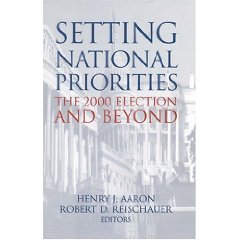
The public policy overviews by Brookings are always among the best, and they are even more valuable this year when several think tanks appear to have defaulted on their traditional role in offering up reviews for consideration by the transition team. Across the various issue areas, including international, social, domestic, and governance policy domains, they present thoughtful recommendations.
Unfortunately, despite their deep understanding of the dilemmas facing the next President, the book does not provide the two things I would most like to have seen: one or two page “decision-papers” that set out the choices to be made within each issue area, and the specific budget costs and timelines for those choices; and a larger over-all budget choice document in no more than 2 pages that outlines what changes might be made in both the budget construction already underway in CY 2001 that the new President can influence, and the budget to be prepared from scratch in CY 2002 that should reflect the vital trade-offs as well as the vital plus-ups that need to be made in defense, intelligence, public health, and education, to name just my top four. In defense and intelligence, my specific area of interest, I would have liked to see some specific recommendations, and their costs, for restoring the 450 ship Navy, creating the contingency and peacekeeping force as well as the humanitarian assistance and disaster relief forces, and some specifics on considerably reinforcing diplomatic, peace corps, and economic assistance operations including a Digital Marshall Plan. This is not to quarrel with findings and views of the authors, all of whom merit very serious consideration, but rather to note that the book does not go far enough, either in specific programmatic terms, or in politically useful presentation terms.
This is an excellent book, but it is also a classic example of unfettered brilliance-without the concise decision papers and the over-all budget numbers, this book will only be read by staffers, not by principals, and that is a shame, because on balance I think there is a great deal to be learned from each of the authors contributing to this work.
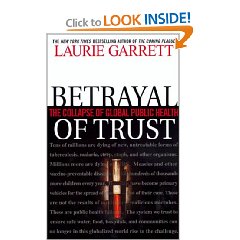
It took me over a month to do justice to this book, and I have taken into account the thoughts of other reviewers. A book of this importance would indeed have benefited from an international advisory board of public health, medical, insurance, and policy experts; it would certainly have benefited from greater structure, firmer editing, and a foreword by someone like a former Surgeon General of the United States. As it is, it appears to have overcome these deficiencies with hyped-up marketing and sweetheart reviews, and this in some ways counterproductive because this book could have, should have, become a mainstream topic in the Presidential campaign. It failed to do so for several reasons, not least of which is the propensity of both candidates and their advisors to avoid serious thinking, but also because the book is not helpful to a popular understanding of the very real global and domestic threats to the health of our children today and in future generations. Having said all this, I commend the book for its content and do not recommend it as avocational reading. There are some very important points that the book brings out, and I will itemize these in order of importance: 1) Public health is about detection and prevention, medicine is about remediation. In the long run, investments in public health are vastly cheaper and more effective than after-the-fact medical intervention; 2) The insurance industry in the developing world has failed to support public health investments, and in a remarkable collusion with the pharmaceutical, hospital and managed health care industries, has created a very expensive and increasingly ineffective system focused on drugs (to which diseases are increasingly resistant) and hospitals; 3) Hospitals are no longer reliable in terms of protecting patients from both error and secondary infection from other patients. People are coming out of hospitals, in many cases, with more diseases than when they went in; 4) The health of our nation depends on the health of all other nations-not only does a collapse of public health in Africa lead to failed states and forced migrations, but it also is but an airline flight away from infecting Kansas; 5) Clean drinking water, uninfected food, and good environmental and occupational health conditions are at risk in many parts of the United States and Europe, not only in Russia and the rest of the world; 6) The United Nations, and the World Health Organization in particular, are in disarray and ineffective-in large part because of a lack of support from member nations-at dealing with the public health commons. There is no question but that the author has hit a “home run” in terms of describing the harsh reality of epidemics in India and Africa, the collapse of public health in Russia, the rapid migration of many diseases from Russia through Germany to the rest of Europe and the U.S., and the severe costs in the U.S. of a retreat from the collective good with respect to public health. Unfortunately, it is a home run hit in isolation, not a game-winning home run, because it fails to drive home, to the only audience that matters-the U.S. voter-exactly what political and economic initiatives are required to achieve three simple objectives: 1) re-establish the public health infrastructure in the U.S.; 2) redirect the entire health care industry toward preventive measures-including water and food quality controls-instead of remedial prescriptions; and 3) provide compelling incentives to the rest of the world for cleaning their own house (this presumes that we are able to clean our own first, a very questionable assumption at this point in time). This is a valuable book, a five in terms of intent, a three in terms of execution, and I am glad that I took the time to read it. It provides a wonderful foundation for enjoying, at an intellectual and policy level, the medical and public health novels by Robin Cook.
Unconventional Wisdom Triumphs in Unconventional Times,
November 16, 2000
Bob Woodward
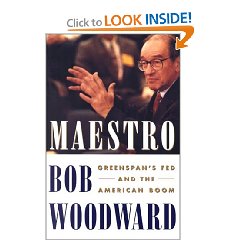
I am quite taken with this book, which at 234 pages is “just right” and well crafted and edited to tell an important story. This is a story about applied intelligence in the finest sense of the word. It is a story about a man well-versed in traditional economic research, traditional models, traditional assumptions about the marketplace, who was put into the most important position in the global financial system at just the right time. His intuition allowed him to detect unexplained changes in productivity and to direct new lines of research that helped persuade more conventional authorities to follow his strategy. This is also a story about a uniquely successful partnership between a Republican central banker and a Democratic President-the very heart of the story centers around Greenspan's ability to persuade a very smart President that deficit reduction was the critical ingredient for a long-term restoration of American prosperity. Aided by an equally smart Secretary of the Treasury, Rubin, it was the President's initiative to reduce the deficit by over $140 billion dollars that allowed all else to follow. There is a clear message here for those who would reduce taxes before finishing the job of eliminating the deficit. As a professional intelligence officer, I am very very impressed by the author's recounting of how Greenspan actually “does” the job of intelligence collection and analysis at his level-the Central Intelligence Agency could learn a great deal from this man. The integration of constant (every fifteen minutes) monitoring of key indicators, the preparation of detailed research and statistics reports, and-by far the most important element-the continuous cycle of direct telephone calls and personal meetings across all sectors of the economy and around the globe, define what must be the most efficient and effective and valuable directed intelligence operation in the world-and one that does not steal the information it needs! There are a number of observations throughout the book that are helpful at a strategic level: 1) deficit reduction is the single best thing any President can do-that enables the Fed to be effective; 2) we forget so quickly how desperate the American economy was in the late 1980's-in a volatile world it would be all too easy to enter a recession or have a major financial panic; 3) structured decision-making is extremely dependent on the models and the data-Greenspan's place in history is assured because he had the intellect and the patience and the gut instincts to realize that the data was incomplete or too aggregated and the modeling assumptions were dated and no longer sufficient to plot the course of the new economy; 4) the psychology of the marketplace is at least as important as the reality, and is likely to be hurt by loose-cannon White House elements with good intentions but out of bounds; 5) even the so-called best and brightest in any Presidential administration will categorize new ideas they do not understand as “incoherent if not idiotic”, as Greenspan's emerging new ideas were labeled by the top Treasury economists; 6) the concept of wealth redistribution fails to understand that even if $1 trillion from the 225 richest people in the world were redistributed to the poorest of the earth, this would only give them $1 a day for a year-Greenspan's focus is on underlying structural changes and the advancement of capitalism such that wealth can be created for the poor on a sustained basis; and 7) there will always be wild cards, such as the Savings & Loan crisis, the LTCM (Long Term Capital Management) crisis, and the Mexico crisis, that require a financial management or central banking network able to capitalize on personal relationships and deep knowledge to find impromptu solutions. On the latter note, it makes one realize that in an increasingly volatile marketplace, there should probably be much stricter limits on “leveraged” actions, where the majority of the money for gambling on the stock market or in the bond market-as much as 95% of the money-is borrowed and therefore likely to be defaulted if the wrong bet is placed. There is nothing in the book regarding any steps that Greenspan has taken or is considering in order to bring added stability to the marketplace. If I have one criticism of this otherwise superb book, a book that sheds light on many aspects of the Fed and its Chairman, it is that there is no hint here of what Greenspan has learned that might lead him to suggest legislative or regulatory changes intended to improve public transparency of key economic transactions, limitations on risk intended to prevent one rogue elephant (e.g. LTCM) from bringing down the market, and so on. I would have liked to see a summation, even a two-page appendix, on the “before” and “after” economic models that Greenspan helped to change, and also some sense in the conclusion of what needs to be changed to keep future market crises within the bounds that can be managed by the Fed-Greenspan clearly has broad shoulders and a broad mind, but he can't carry the load forever and this book fails to focus on what changes are needed to institutionalize the Greenspan wisdom.
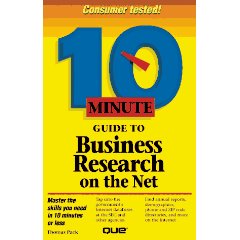
The bottom line on this little book is that it merits buying and throwing in your suitcase if you are the kind of person that needs to do your own research from the road. In a nutshell, it is: 1) valuable because it brings together in one place a very easy to read and use guide to a wide range of Internet-based resources; 2) dangerous because it may tempt business managers to do their own research from a hotel room rather than rely on real information professionals; 3) incomplete in many ways–two obvious ones are its neglect of the meta-search engines such as Compernic and its oversights of the Burwell Worldwide Directory of Information Brokers; and 4) worth buying as a light-weight (double entrendre intended) reference. I like it, it is worth the price and still relevant today.
Excellent Overview with Plenty of Useful Information,
November 11, 2000
Ruthann Quindlen
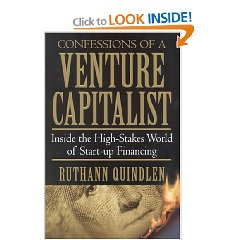
I've been down this road, including competive selection to present my company and vision to three venture capital fairs. This book, which was bought as a quick-read airplane book, has become a fundamental reference. It is heavily marked up, has three paper clips (very unusual) as I look at it, and has had a very constructive impact on both my thinking and my attitude. This book has not only helped me refine our business plan, but when I feel like we are straying, I can pull it down and do a quick revisitation of “the fundamentals”. This is a serious helpful book–do not be put off by shallow reviews.
A Gem of Lasting Value, Especially Relevant Today,
November 11, 2000
James F. Jr. Hoge
This compilation of the “best of the best” articles from the journal Foreign Affairs is a real gem that is especially relevant today as America continues to neglect its international responsibilities and certain Senators and Congressman have the ignorant temerity to brag that they don't own nor need an American passport. The conclusion of the July 1932 article by Edwin F. Gay, “The Great Depression”, is instructive: “The world war affirmed the international political responsibilities of the United States; the world depression demonstrates the economic interdependence of the United States with other states. It cannot be a hermit nation.” With four seminal articles from each decade (1920's forward), including just about every great name in the international discussions of the century, this book is a fundamental reference point for those who would dare to craft a vibrant foreign policy for the United States in the 21st Century. The book ends with several thoughtful pieces including, most fittingly, an interview with Lee Kuan Yew of Singapore on culture as destiny, an article whose subtitle might have been “How extended families and the collective good still matter.”
Lightweight, Ignores History, Without Useful Sources,
October 13, 2000
Ashley J. Tellis
his is a simple-minded book that manages to obscure the basics with convoluted language. It also achieves a remarkable feat, failing to mention history as a relevant factor in understanding and anticipating ethnic conflict in the 21st Century. It does nothing whatsover to suggest to the interested analyst, for whom this “template” was designed, how to operationalize the few relevant factors the book identifies, and does not provide any discussion at all of sources and methods helpful to studying ethnic conflict. There is no bibliography and no index. The footnotes are lightweight.