
Journal: Comment on DIA Potential

Ethics, Key Players, Methods & Process, Military, Mobile, Officers Call, Peace Intelligence, Policies, Real Time, Reform, Strategy, Threats
Richard Wright

The QDR slides got me thinking about the fact that DIA could be a really first rate intelligence agency and an effective counter to ODNI and CIA for the SecDef, JCS, and the military services, especially field commanders.

Although badly executed, DIA has two vitally important missions: support to military operations; and support to military strategy formulation. Unfortunately, DIA has always suffered from unimaginative senior leadership and the worst form of military thinking whereby rank trumps truth and an incompetent major trumps a competent lieutenant.

If DIA is going to achieve its potential and rally to provide the best intelligence possible to the SecDef, JCS, and service field commanders it needs to break free from the military hierarchical thinking and its influences on intelligence judgments.

In point of fact DIA has and has always had an excellent group of military and civilian analysts working there although there is a constant churn due to service requirements and limited prospects for civilians.

So what does DIA need? It needs an influx of original (out of the box) strategists who can visualize and articulate the multi-level threats to U.S. National Security, who understand the phenomenon of globalization and its effect on DOD strategic thinking, and can effectively relate such 21st Century phenomenon as trans-national asymmetric warfare to U.S. force and command structures.

Perhaps most importantly, DIA needs to build a capability to exploit the fact that increasing amounts of information relative to DOD concerns that are actually available from open sources. At the same time DIA needs to introduce much more effective information management systems to support its intelligence production.

Phi Beta Iota: This  comment is repeated from the QDR OSINT thread.  We've been saying this for 21 years.  Perhaps we should have shouted.   The two DoD OSINT briefings and the future of OSINT material are now circulating among presidential staffs of a handful of other countries.  They get it, we don't.  How sad is that?
Reference: UN Checklist for Small Arms

04 Inter-State Conflict, 05 Civil War, 10 Security, Key Players, Non-Governmental, Peace Intelligence
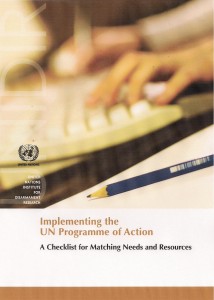
UN Small Arms Checklist

UNIDIR (United Nations Institute for Disarmament Research) has produced a superb checklist approach to the mission of reducing the proliferation of small arms, which kill and maim and orphan tens of millions at a time.  The Director of UNIDIR at the time, Dr. Patricia Lewis, was the first UN official in modern times to contemplate the need for a UN-sponosred World Brain.  2003 Lewis (UNIDIR) Creating the Global Brain: The United Nations.

Continue reading “Reference: UN Checklist for Small Arms”

Journal: MILNET Headlines

Peace Intelligence

Interview With Admiral Mullen by Fareed Zakaria, CNN   Transcript and YouTube

Interview with General Patraeus by Christine Amanpour, CNN  Story

There's ‘Work To Be Done,' 9/11 Commission Chairs Say (Lee Hamilton, Thomas Kean)

The war of new words: Why military history trumps buzzwords (Willam F. Own)

Let's Take Bureaucracy Out Of Intelligence (John Bolton)

Beating the Dead Terrorist Horse (Victor Davis Hanson)

Continue reading “Journal: MILNET Headlines”

Journal: What Al Qaeda Et Al Can and Cannot Do

08 Wild Cards, 09 Terrorism, Cultural Intelligence, Government, Military, Peace Intelligence

[gerecht]The Meaning Of Al Qaeda's Double Agent:  The jihadists are showing impressive counterintelligence ability that the CIA seems to have underestimated.

Wall Street Journal Reuel Marc Gerecht January 8, 2010  [safety copy of entire piece below the fold]

Amid the Hysteria, A Look at What al-Qaeda Can't Do

TIME Magazine By Peter Beinart Monday, Jan. 18, 2010

Wanted: Dead': With little public debate or notice, the Obama administration has significantly stepped up its targeted assassinations.

National Journal By James Kitfield Saturday, Jan. 9, 2010 [Subscription]

Hidden behind walls of top-secret classification, senior U.S. government officials meet in what is essentially a star chamber to decide which enemies of the state to target for assassination. There is no single master list, but all names pass through an elaborate, multi-agency vetting process that ends at the level of the National Security Council and ultimately requires presidential approval.

Overwhelm. Divide. Spread. Bankrupt. Diversify: Al Qaeda's new grand strategy

Washington Post By Bruce Hoffman  January 10, 2010

Human Rights Gagged MI5 Over Abdulmutallab: Intelligence on Muslim radicals cannot be passed to the US because of privacy fears

London Sunday Times By David Leppard and Hala Jaber January 10, 2010

Continue reading “Journal: What Al Qaeda Et Al Can and Cannot Do”

Journal: CIA as Poster Child For Dull US Intelligence

08 Wild Cards, 09 Terrorism, 10 Security, Cultural Intelligence, Ethics, Government, Law Enforcement, Military, Peace Intelligence

Terrorism Fight Requires Intelligence Accountability (Senator John Kerry)

Frankly, we don’t need more commissions or bureaucracies. We do need intelligence professionals and their managers who are committed to a new culture of quality, cooperation, and accountability.

Two attacks highlight counterterrorism's bureaucratic bog (David Ignatius)

Talking to veteran counterterrorism officers, I hear a common theme that unites these two disastrous lapses: The CIA has adopted bureaucratic procedures that, while intended to avoid mistakes, may actually heighten the risks. In the words of one CIA veteran, “You have a system that is overwhelmed.”

But those standard agent-handling rules have been violated routinely, in Iraq and now Afghanistan, because senior officials have concluded it's too dangerous outside the wire. “At least 90 percent of all agent meetings are conducted on bases,” estimates one CIA veteran. The agency wants to protect its people, understandably — but the system actually works to increase vulnerability.

The Khost tragedy shows that the CIA needs to take the counterintelligence threat from al-Qaeda more seriously. Intelligence reports over the past year have warned that groups linked with al-Qaeda were sending double agents to penetrate CIA bases in Afghanistan.

The brave CIA officers serving overseas deserve a better system than this.

CIA Director Leon Panetta should use these searing events to foster a culture of initiative and accountability at a CIA that wants to do the job — but that needs leadership and reform.

Holes For The CIA To Close (David Ignatius)

A replay of long-standing criticisms of CIA's short-tours, lack of memory, refusal to take counterintelligence seriously, and general ineptitude outside the Embassy cocktail circuits.

Confusion Grows Over How Bomber Infiltrated CIA Base (Los Angeles Times)

A CIA inquiry is focused on two main questions: why the bomber was not more thoroughly screened and where he received the training and explosives used in the attack.

Deja Vu Stories

U.S. Saw A Path To Qaeda Chiefs Before Bombing

Suicide bomber who attacked CIA post in Afghanistan was trusted informant from Jordan

Journal: The Chinese Crash or the Chinese Solution?

Cultural Intelligence, Gift Intelligence, Key Players, Peace Intelligence
The New York Times
Full Story Online

Contrarian Investor Sees Economic Crash in China

by David Barboza   Friday, January 8, 2010

James S. Chanos built one of the largest fortunes on Wall Street by foreseeing the collapse of Enron and other highflying companies whose stories were too good to be true.

Now Mr. Chanos, a wealthy hedge fund investor, is working to bust the myth of the biggest conglomerate of all: China Inc.

As most of the world bets on China to help lift the global economy out of recession, Mr. Chanos is warning that China's hyperstimulated economy is headed for a crash, rather than the sustained boom that most economists predict. Its surging real estate sector, buoyed by a flood of speculative capital, looks like “Dubai times 1,000 — or worse,” he frets. He even suspects that Beijing is cooking its books, faking, among other things, its eye-popping growth rates of more than 8 percent.

Phi Beta Iota: We agree with Minister Mentor Lee Kuan Yew of Singapore when he says that demography, not democracy, will shape the future.  While the other seven demographic powers (Brazil, India, Indonesia, Iran, Russia, Venezuela, and Wild Cards such as Turkey) will be extraordinarily influential as well, China is the only one that is:

Continue reading “Journal: The Chinese Crash or the Chinese Solution?”

Journal: Open Source Vignette From Cuban Missile Crisis

04 Inter-State Conflict, 05 Civil War, 10 Security, Communities of Practice, Methods & Process, Peace Intelligence

Robert, I had lunch with an old friend, Herb REDACTED, a retired intelligence officer and military judge (Air Force). The subject of OSS and your role in the IC came about, and my friend sent me a very interesting, brief, story about the open source back channel in the Cuban Missile Crisis I want to share with you. You may well be aware of this, given your knowledge of history, but I wanted you to have this in case it, or my friend Herb, has potential utility to your initiatives. Perhaps the current environment, in DC, will result in a change in policy and effectiveness in the IC. In his note to me, he is commenting about the paper I presented at OSS '94, as a result of your gracious invite. I still tell people about the role you have played in bringing the intelligence community into the limelight, open source into greater adaptation. – REDACTED

Great to visit with you in Tampa-

Your OSS presentation is not simply impressive, it recognizes and highlights a very real and valuable component of intelligence currently as well as in those long distance days when I was immersed in the discipline. It was an open intelligence source that was the first indication that the Cuban Missile Crisis of October 1962 was resolved.

It's a rather long story but to offer a brief synopsis: A Reuters News Service correspondent posted to The Kremlin was close to Khrushchev (Big K), close enough to be the only correspondent to gain a private audience during the crisis. On Oct. 27th (I think it was) Big K. told the Reuters' fellow that: “I will do anything to prevent the world's destruction over Cuba.” The reporter then asked incredulously: “Mr. President, do you really mean ‘anything?”  The reply was: “Yes, I will not be the cause of the death of millions of Soviet citizens and radiating the world.”

In the USAFE Command Room in Wiesbaden, we intelligence wennies had every news service and major newspaper teletype machine known to mankind for open source material. Apparently the reported took a fast cab ride back to his office and put the conversation on the wire.  We had a method of verification, used it and confirmed the fact that he had placed the story on the wire.  Presuming it accuracy, we passed it on the Situation Room at the White House. In mere moments we (in the intel. Secure office) received a secure red phone (secure with those punched IBM cards) call from the WH (MacGeorge Bundy on the other end) asking me (since I picked up the phone) was the wire story accurate. I answered yes and handed the phone to Brig. General Julius Gibbons ( CoS for Intel. USAFE) and he spoke to RFK.

Within minutes the deal between JFK and Big K made in Washington was announced. But they knew the deal was to get closed by the USAFE report a few  minutes earlier. And don't overlook the excellent ploy hatched by RFK to ignore Big K's second letter that he was forced to write by his military goons.

The play-by-play version is suitable for a beer or two, it's a little longer.

Thus, your open source presentation was well appreciated as an old intel wennie.

Continue reading “Journal: Open Source Vignette From Cuban Missile Crisis”

noble gold