Where the crypto rubber meets the Road of Finance…
December 11, 2011
Why (my, all) financial systems fail — information complexity
I spent over a decade building the snappiest financial system around. In that time I pursued one goal of efficiency: reduction of complexity. This wasn't only goodness in an angelic sense, it was a pragmatic goal to reduce my own costs in building systems.
The result was pretty spectacular: we were settling trades in seconds and doing so with every leg firmly fastened to the ground. That is, the whole thing was running with direct concrete ties to assets.
But, the big players weren't interested. Indeed they were more than uninterested, they were highly interested in making sure this would never ever happen. Time after time, the message was delivered: Never. Other companies received the same message, so after a few years, I started to take it seriously.
At the time I hypothesised that the reason for this was insider fraud, or at least profits capture. The complexities were endemic and there were very few people who could see the whole picture. So, I theorised that those who could understand the complexities were cashing in on their advantage; from the inside. And some very few who cashed in were also driving the information agenda, as their success made them both wealthy and influential: more complexity.
Of course such a hypothesis is unlikely to find proof. By its very nature, how do you prove such a tendency towards chaos? Here comes an alternate perspective from ZeroHedge, citing two papers (1, 2):
And the punchline: “Liquidity requires symmetric information, which is easiest to achieve when everyone is ignorant. This determines the design of many securities, including the design of debt and securitization.” Reread the last statement as it explains perhaps better than anything, the true functioning of modern capital markets and why they are terminally broken: in order to preserve the system, the banking cartel need to make everything of virtually infinite complexity so that no one has a clear understanding of what is going on!
Phi Beta Iota: In brief, finance is fraud. As William Greider documents in his book, The Soul of Capitalism, financial instruments (incomprehensible to their own vendors) appreciated seventeen times while real assets appreciated five times. Twelve is the fraud-complexity-corruption delta.
The question has to be asked: “Why shouldn't we default and let the banks fry?”
What possible benefit it there to the people of a nation whose previous leaders “sold out” the entire country on the basis of lies from the banks, notably Goldman Sachs?
Why not default and focus on full employment and resilience at home? Why rescue German banks?
If a new financial system is emerging, anchored by the BRICS [Brazil, Russia, India, China, South Africa], why not focus on being attractive that that new ethical financial system instead of giving up what is left in the way of seed corn to the old predatory unethical system?
Many European Lenders Have Sold Sovereign-Default Protection to One Another
EXTRACT:
Of the total protection that European banks have written on government bonds in Europe's five most-stressed countries, nearly one-third originated from German banks.
Isn't this what is supposed to happen in a Free Market System? What is wrong with comparison shopping? Taking advantage of technology by a nimble company versus a staid old one is the essence of entrepreneurship And now a Senator is getting involved? Looks like more of the same, no integrity…
Retailers and a senator denounce a one-day promotional offer that will give discounts to Amazon customers who use the Price Check app while browsing at physical stores.
Phi Beta Iota: Amazon has gotten inside the OODA Loop of the small retailers. If they were adept, which they are not, they would return the favor by focusing on “true cost” to the consumer of all the externalities, and restructure their businesses to emphasize local employment, customer-driven inventory, etcetera, etcetera.
While much of the world is in crisis and protests are erupting throughout Europe and the United States, Latin American and Caribbean nations are building consensus, advancing social justice and increasing positive cooperation in the region. Social, political and economic transformations have been taking place through democratic processes in countries such as Venezuela, Bolivia, Ecuador, Nicaragua, Uruguay, Argentina and Brazil throughout the past decade, leading to a massive reduction in poverty and income disparity in the region, and a substantial increase in social services, quality of life and direct participation in political process.
One of the major initiatives of progressive Latin American governments this century has been the creation of new regional organizations that promote integration, cooperation and solidarity amongst neighboring nations. Cuba and Venezuela began this process in 2004 with the founding of the Bolivarian Alliance for the Peoples of Our America (ALBA), that now includes Bolivia, Ecuador, Nicaragua, Dominica, St. Vincent’s and the Grenadines and Antigua and Barbuda. ALBA was initially launched in response to the US government’s failed attempt to impose its Free Trade Agreement of the Americas (FTAA) throughout the region.
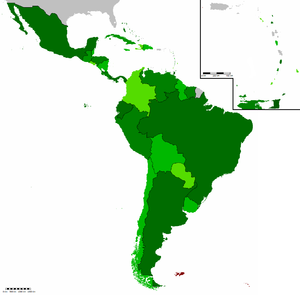
Click on Image to Enlarge
Today ALBA is a thriving multilateral organization with member nations that share similar political visions for their countries and for the region, and includes numerous cooperation agreements in economic, social and cultural areas. The fundamental basis of trade amongst ALBA nations is solidarity and mutual benefit. There is no competition, exploitation or attempt to dominate amongst ALBA states. ALBA even counts on its own currency, the SUCRE, which allows for trade between member nations without dependence on the US dollar.
In 2008, the Union of South American Nations (UNASUR) was formally established as a regional body representing South American states. While ALBA is much more consolidated as a unified political voice, UNASUR represents a diversity of political positions, economic models and visions for the region. But UNASUR members share the common goal of working towards regional unity and guaranteeing the resolution of conflicts through peaceful and diplomatic means. UNASUR has already played a key role in peacefully resolving disputes in Bolivia, particularly during an attempted coup against the government of Evo Morales in 2008, and has also successfully moderated a severe conflict between Colombia and Venezuela, leading to the reestablishment of relations in 2010.
Two hundred years ago, South American Independence hero Simon Bolivar, a native of Venezuela, dreamed of building regional unity and creating a “Patria Grande” (Grand Homeland) in Latin America. After achieving independence for Venezuela, Bolivia, Ecuador and Colombia, and fighting colonialists in several Caribbean nations, Bolivar attempted to turn this dream of Latin American unity into reality. His efforts were sabotaged by powerful interests opposing the creation of a solid regional bloc, and eventually, with the aid of the United States, Bolivar was ousted from his rule in Venezuela and died isolated in Colombia several years later. Meanwhile, the US government had proceeded to implement its Monroe Doctrine, a decree first declared by President James Monroe in 1823 to ensure US domination and control over the newly-freed nations in Latin America and the Caribbean.
Nearly two hundred years of invasions, interventions, aggressions, coup d’etats and hostilities led by the US government against Latin American nations shadowed the 19th and 20th centuries. By the end of the 20th century, Washington had successfully imposed governments in every Latin American and Caribbean nation that were subordinate to its agenda, with the exception of Cuba. The Monroe Doctrine had been achieved, and the US felt confident in its control over its “backyard”.
The unexpected turn at the beginning of the 21st century in Venezuela, formerly one of Washington’s most stable and subservient partners, came as a shock to the US. Hugo Chavez had been elected President and a Revolution had begun. A coup d’etat attempt in 2002 failed to subvert the advancement of the Bolivarian Revolution and the spread of revolutionary fever throughout the region. Soon Bolivia followed, then Nicaragua and Ecuador. Argentina, Brazil and Uruguay elected socialist presidents, two of them former guerrilla fighters. Major changes began to occur throughout the region as the peoples of this vast, diverse and rich continent assumed power and made their voices heard.
Social transformations in Venezuela that gave voice to people’s power became exemplary for others in the region, as did President Chavez’s defiance of US imperialism. A powerful sentiment of Latin American sovereignty and independence grew stronger, even reaching those with governments aligned with US interests and multinational control.
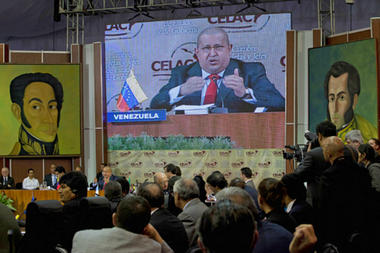
On December 2-3, 2011, the Community of Latin American and Caribbean States (CELAC) was born and the overwhelming force of a continent nearly 600 million strong, achieved a 200-year dream of unity. The 33 member nations of CELAC all agree on the unquestionable necessity to build a regional organization that represents their interests, and that excludes the overbearing presence of the US and Canada. While CELAC will take time to consolidate, the exceptional commitment evidenced by the 33 states present at its launching in Caracas, Venezuela, cannot be underestimated.
CELAC will have to overcome attempts to sabotage and neutralize its expansion and endurance, and the threats against it and intents to divide member nations will be numerous and frequent. But the resistance of the peoples of Latin America and the Caribbean who have resumed this path of unity and independence after nearly two hundred years of imperialist aggression, demonstrates the powerful force that has led this region to become an inspiration for those seeking social justice and true freedom around the world.
Phi Beta Iota: Emphasis added. This is largely a Cuban G-2 puff-piece, but it also represents real potential. A great deal will depend on whether Cuba and Venezuela get serious about creating the M4IS2 capabilities needed to harmonize internal spending while shutting out predatory external influences. We would not be surprised to find CIA Stations shut down across Central and South America in the next few years, as these governments stop tolerating incompetent but active spy units operating from official installations.
In 1971, Lewis Powell, a mild-mannered, courtly, and shrewd corporate lawyer in Richmond, Virginia, soon to be appointed to the United States Supreme Court, wrote a memorandum to his client, the United States Chamber of Commerce. He outlined a critique and a plan that changed America.
Complete excerpt below the line — real history killing real people.
Berlin, 1 December 2011 – Corruption continues to plague too many countries around the world, according to Transparency International’s 2011 Corruption Perceptions Index released today. It shows some governments failing to protect citizens from corruption, be it abuse of public resources, bribery or secretive decision-making.
Transparency International warned that protests around the world, often fuelled by corruption and economic instability, clearly show citizens feel their leaders and public institutions are neither transparent nor accountable enough.
The United States Report summarizes and analyzes 73 bribery demands in the U.S. reported anonymously to TRACE’s online Business Registry for International Bribery and Extortion (BRIBEline) between July 11, 2007 and November 15, 2011.
A key finding from the United States report is the prevalence of bribe solicitations made in exchange for an undue advantage. Over one-third of bribe demands in the United States – the highest rate among countries studied to date by BRIBEline – are premised on an improper quid pro quo, such as winning new business (25% of all reported demands), agreeing to attempt to influence a government official in exchange for a bribe (5%) or receiving inappropriate favorable treatment, such as a favorable court ruling (4%).
Phi Beta Iota: Both recommended for a full reading (neither is very long).
“A new concept is coming out from the fogs of the present situation: a right to insolvency. We’ll not pay the debt.
The European countries have been obliged to accept the blackmail of debt, but people are refusing the concept that we have to pay for a debt that we have not taken. Anthropologist David Graeber, in his book Debt the first 5000 years, (Melville House, 2011), and philosopher Maurizio Lazzarato, in La fabrique de l’homme endetté (editions Amsterdam, 2011), have started an interesting reflection on the cultural origin of the notion of debt, and the psychic implications of the sense of guilt that the notion of debt brings in itself. And, in his essay, Recurring Dreams The Red Heart of Fascism, the Anglo-Italian young thinker Federico Campagna locates the analogy between the post Versailles Congress years and the present in the debt-obsession:
Phi Beta Iota: Gripping. Mankind is at a philosophical turning point. Organized people are confronting organized money, and the integrity of humanity is in the balance.