NIGHTWATCH: Financial Crisis Now a Crisis of Fundamentals

03 Economy, 07 Other Atrocities, 10 Transnational Crime, 11 Society, Budgets & Funding, Civil Society, Collective Intelligence, Commerce, Commercial Intelligence, Corporations, Corruption, Cultural Intelligence, General Accountability Office, Government, Key Players, Law Enforcement, Misinformation & Propaganda, Money, Banks & Concentrated Wealth, Office of Management and Budget, Power Behind-the-Scenes/Special Interests, Secrecy & Politics of Secrecy

Europe:  Updates. In an interview with a French daily on 25 December, International Monetary Fund (IMF) Managing Director Christine Lagarde stressed that Europe's financial crisis is turning into “a crisis of confidence in public debt and the solidity of the financial system.

Greece: According to an IMF source involved in discussions with Greece, the situation in Athens is “deteriorating” and “a further 10-15 billion euros ($13.1-19.6 billion) still needs to be found.” Banks may be asked to agree to write off 65 % instead of 50% of Greece's debt.

France: The French National Institute for Statistics and Economic Studies (INSEE) said on 26 December that there were 29,000 new job seekers “without any occupation” in November, up 1.1% over October. The year-on-year increase reached 5.2%. In total, 2,844,800 people did not have any occupation, the highest such figure since November 1999.

An economist at the French Observatory of Economic Conditions speculated that France's unemployment rate — which currently stands at 9.3% — will reach 10.7% by the end of 2012, and predicted that Paris will not succeed in bringing the deficit down to 3% of GDP by 2013.

Spain: At a news conference on 26 December, Spanish Economy Minister Luis De Guindos said that the Spanish economy had suffered a “relapse” and would record negative growth in the fourth quarter of 2011. De Guindos warned that “the next two months are not going to be easy, neither from a growth nor a jobs point of view.”

Comment: According to the Financial Times and multiple economists the fate of the euro depends on what happens in Italy. This week Italy intends to auction bonds worth Euros 20 billion. The market reaction to the auction will be an important indicator of whether the central bankers have found a way to stabilize the financial crisis, or have just made it worse.

All analysts of European economics predict a recession in 2012. They differ only about how severe it will be. In an integrated global economy, the ripple effects from Europe will drag the US and the Chinese economies, among all others.

Phi Beta Iota:  Christine Lagarde, perhaps because she is a woman with a smaller ego and larger intuition than most men, appears to be the first Epoch A leader to “get” that we are all calling into question the very existence of the Western financial system that is rooted in fraud, waste, and abuse.  When she begins to point to Iceland as an example, and to demand that Western countries arrest and try Goldman Sachs, Morgan, Citi-Bank, Bank of America, and other officials for high crimes against the public, the healing can begin.  Until then, the West is avoiding the fundamentals.

NIGHTWATCH KGS Home

See Also:

Mini-Me: Iceland Breaks the Back of Western Banking

Chuck Spinney: Financial Coups Destroying Europe
Michel Bauwens: Human Evolution – Who Are We Becoming?

Mini-Me: European-US Banking–Tangled Web — Tell Me Again, Why Shouldn’t We Default and Let the Banks Fry? + Financial Terrorism RECAP

John Bogle: ENOUGH – Speculation Bad Investment Good

03 Economy, 07 Other Atrocities, 09 Justice, 10 Transnational Crime, Civil Society, Commerce, Commercial Intelligence, Corporations, Corruption, Government, Money, Banks & Concentrated Wealth, Power Behind-the-Scenes/Special Interests

MARK JEWELL

Associated Press, 22 December 2011

EXTRACTS:

Bogle says he's paying close attention to tax policies he considers unfair, including one that's favorable to the fund industry and investors with taxable accounts. The top rate for dividends and long-term capital gains is historically low at 15 percent, as a result of the extension of Bush era tax cuts that Congress and President Barack Obama agreed to a year ago. In contrast, top earners pay 35 percent on regular income. He doesn't like that disparity.

. . . . . . .

As for capital gains, there ought to be some distinction between capital made by people who start businesses, and contribute value to society, and capital made by gamblers on Wall Street, some of whom win. Earned capital income should carry the regular dividend rate, but capital income gains by trading, and particularly short-term trading, should pay a higher tax, even than the present ordinary income rate.

. . . . . . .

Q: What's your take on the Occupy movement?

A: I'm happy to say that my current income puts me in the 99 percent group. So maybe I'm not so happy, I don't know.

This movement has brought to the surface some very serious problems in our country about disparities in opportunity and income. So many young people are having a terrible time getting a job.

Young people have great idealism, and the Occupy movement has been a bit unrealistic at times. So what? I can't imagine a worse America if our younger generation didn't have great idealism. I salute them for their enthusiasm, and their mission.

The negative side is that they just pushed too hard for too long. It's very difficult for any movement without any seeming leadership — other than a good idea — to have any sense of taste or judgment. Who's to say, ‘This is going too far'? In some places, it's just gone on too long, and it's been too disruptive. So I think it's good that we've been cleaning up the plazas where the Occupy movement set up.

Read full interview.

See Also (Steele Reviews in Each Case):

John Bogle, The Battle for the Soul of Capitalism

William Greider, The Soul of Capitalism: Opening Paths to a Moral Economy

Matt Taibbi, Griftopia: A Story of Bankers, Politicians, and the Most Audacious Power Grab in American History

Chuck Spinney: Europe in Crisis Rule by Troika Spain and Hungary Next

03 Economy, 06 Russia, 08 Wild Cards, 11 Society, Commerce, Commercial Intelligence, Corruption, Government
Chuck Spinney

Rule by troika

by Serge Halimi
Le Monde Diplomatique, December 2011

Former bankers Lucas Papademos and Mario Monti have taken over in Athens and Rome, exploiting the threat of bankruptcy and the fear of chaos. They are not apolitical technicians but men of the right, members of the Trilateral Commission that blamed western societies for being too democratic.

In November, the Franco-German directorate of the European Union, the European Central Bank and the International Monetary Fund — the “troika” — were furious when the Greek prime minister, George Papandreou, announced plans to hold a referendum. This, they said, would call into question an agreement reached in October to strengthen the economic policy that had brought the country to its knees. Summoned to Cannes for an interview during a summit that his country was too small to attend, kept waiting, and publicly upbraided by Angela Merkel and Nicolas Sarkozy (who were responsible for exacerbating the crisis), Papandreou was forced to abandon the plan for a referendum and resign. His successor, a former vice-president of the ECB, promptly decided to include in the Athens government a far-right organisation banned since the Greek colonels lost power in 1974. (The troika expressed no views on this.)

The European project was supposed to secure prosperity, strengthen democracy in states formerly ruled by juntas (Greece, Spain, Portugal), and defuse “nationalism as a source of war”. But it is having the opposite effect, with drastic cuts, puppet governments at the call of the brokers, and renewed strife between nations. A young Spaniard voiced his anger at having to go to Berlin or Hamburg to find work: “We can’t go on being Germany’s slaves.” The Italians find the French president’s high and mighty attitude offensive and wonder, rightly, what exceptional talents might justify this.  Some Greeks are complaining about the “occupation” of Greece, with cartoons depicting the German chancellor in Nazi uniform.

For people in countries suffering under austerity measures, the history of Europe provides some outstanding examples. In some ways, recent events in Athens recall Czechoslovakia in 1968: the crushing of the Prague Spring and the removal of the Communist leader Alexander Dubcek. The troika has played the same part in reducing Greece to a protectorate as the Warsaw Pact did in Czechoslovakia, with Papandreou in the role of Dubcek, but a Dubcek who would never have dared to resist. The doctrine of limited sovereignty has been applied, though admittedly it is preferable and less immediately lethal to have its parameters set by rating agencies rather than by Russian tanks rolling over the borders.

Having crushed Greece and Italy, the EU and the IMF have now set their sights on Hungary and Spain.

See Also:

Mini-Me: Iceland Breaks the Back of Western Banking

Mini-Me: European-US Banking–Tangled Web — Tell Me Again, Why Shouldn’t We Default and Let the Banks Fry? + Financial Terrorism RECAP

John Steiner: Who Is the Government “For”?

03 Economy, 09 Justice, 11 Society, Civil Society, Commerce, Commercial Intelligence, Corruption, Cultural Intelligence, Government
John Steiner

The Defining Issue: Not Government's Size, But Who It's For

Robert Reich

Huffington Post, 19 December 2011

The defining political issue of 2012 won't be the government's size. It will be who government is for.

Americans have never much liked government. After all, the nation was conceived in a revolution against government.

But the surge of cynicism now engulfing America isn't about government's size. It's the growing perception that government isn't working for average people. It's for big business, Wall Street, and the very rich instead.

In a recent Pew Foundation poll, 77 percent of respondents said too much power is in the hands of a few rich people and corporations.

Read rest of article.

Michael Ostrolenk: Should Corporations Have People Rights?

03 Economy, 07 Other Atrocities, 09 Justice, 10 Transnational Crime, 11 Society, Civil Society, Commerce, Commercial Intelligence, Corruption, Counter-Oppression/Counter-Dictatorship Practices, Government, IO Deeds of War, Law Enforcement
Michael Ostrolenk

Corporations are artificial creations of the state and receive special protections from the state. Thus, claims attorney and author Jeff Clements, corporations should not have the same Constitutional rights as individuals even though some argue that they are simply organized associations of individuals.

In this interview with Michael Ostrolenk, Mr. Clements outlines his belief that many of the abuses of crony capitalism are allowed by corporations exploiting these illegitimate “rights.”

He also exposes how tobacco industry attorney turned Supreme Court Justice, Lewis Powell, helped to spearhead the creation of a constitutional right to corporate “speech” which was recently strengthened by theCitizens United decision.  Read more about this issue (and buy his new book Corporations Are Not People) at Mr. Clement’s website.

Listen to Interview

Mini-Me: WWIII, from Gold Circles, A Whiff of…? + RECAP

07 Other Atrocities, 10 Transnational Crime, Analysis, Commerce, Commercial Intelligence, Corruption, Cultural Intelligence, Government, Key Players, Money, Banks & Concentrated Wealth, Officers Call, Policies, Power Behind-the-Scenes/Special Interests
Who? Mini-Me?

Sometimes lunatics see stuff the rest of us miss. The trick is knowing when to listen and which pieces to pull out for closer examination.  This is from Benjamin Fulford, reprinted in full at Spiritual Truth Blog, and circulating in Gold Warrior / Gold Lily / Black Eagle Trust circles.  Phi Beta Iota comments and more links below the full piece.

– – – – – – –

North Korean dictator Kim Jong Il was murdered Saturday as part of a major power struggle in East Asia, according to Asian secret society sources and Japanese military intelligence.

The murder of Kim was followed by a series of arrests of senior police officials in Japan linked to North Korea as well as the ouster of six CIA agents, the Japanese sources say.

The death has left Yasuhiro Nakasone, the top North Korean and Rothschild agent in Japan, without a power base, Japanese underworld sources say. In North Korea, meanwhile, there is now a succession battle taking place between the Rothschild faction, who want to place their trained stooge Kim Jong Un in power and set up a Rothschild central bank versus a military clique that wants independence from Rothschild control, Rothschild and Japanese underworld sources say. The action is Asia is linked to a worldwide takedown of the satanic cabal that has been trying to create a global dictatorship.

Continue reading “Mini-Me: WWIII, from Gold Circles, A Whiff of…? + RECAP”

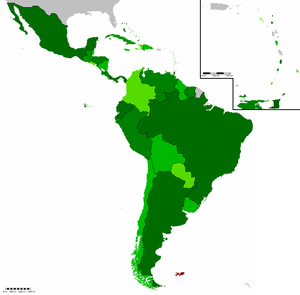
Mini-Me: Comunidad de Estados Latinoamericanos y Caribeños (CELAC)

01 Brazil, 03 Economy, 08 Wild Cards, 09 Justice, 10 Security, 11 Society, Advanced Cyber/IO, Commerce, Commercial Intelligence, Counter-Oppression/Counter-Dictatorship Practices, Cultural Intelligence, Government
Click on Image to Enlarge

The Community of Latin American and Caribbean States (Spanish: Comunidad de Estados Latinoamericanos y Caribeños, CELAC, Portuguese: Comunidade de Estados Latino-Americanos e Caribenhos, French: Communauté des États Latino-Américains et Caribéens, Dutch: Gemeenschap van de Latijns-Amerikaanse en Caribische landen) is the tentative name[1] of a regional bloc of Latin American and Caribbean nations created on February 23, 2010, at the Rio GroupCaribbean Community Unity Summit held in Playa del Carmen, Quintana Roo, Mexico.[2][3] It consists of all sovereign countries in the Americas, except for Canada, France, the Netherlands and the United States. British and Danish dependencies in the Americas are also not represented in CELAC.

CELAC is an example of a decade-long push for deeper integration within the Americas.[4] CELAC is being created to deepen Latin American integration and to reduce the once overwhelming influence of the United States on the politics and economics of Latin America, and is seen as an alternative to the Organization of American States (OAS), the regional body organized largely by Washington in 1948, ostensibly as a countermeasure to potential Soviet influence in the region.[4][5] [6]

Continue reading “Mini-Me: Comunidad de Estados Latinoamericanos y Caribeños (CELAC)”

noble gold