
Bojan Radej: Data Journalism Handbook & Graphic Map

Advanced Cyber/IO, Civil Society, Collective Intelligence, Counter-Oppression/Counter-Dictatorship Practices, Ethics, Media, Methods & Process
Bojan Radej

The Data Journalism Handbook is Out

6 months ago at Mozilla Festival 2011, the Data Journalism Handbook was born. Thanks for your interest in the book – I have great pleasure in announcing that the Handbook is now live!

The Handbook features contributions from over 70 leading practitioners of data journalism from every corner of the globe, from Japan to Finland, Nigeria to the US and from leading news outlets such the New York Times, Zeit Online, the BBC and the Guardian. The Handbook is an open educational resource, under a creative commons licence (CC-BY-SA) so please share it with your friends and remix it. We hope that it will encourage many budding data journalists to look at data as a source and give them courage to tackle it, as well as showcasing some great examples of journalism using data as inspiration for future stories.

You can find the handbook at: http://datajournalismhandbook.org/ 

Also available for pre-order is the e- and print version from O'Reilly Media – http://oreil.ly/ddj-e-print – so if you are interested in a version to read offline, take a look!

We will soon have the facility to submit feedback via the website if you spot any errors or have any improvements for the next version,


Lucy Chambers

Infographic impresario Lulu Pinney created this superb poster, which gives an overview of the contents of the Data Journalism Handbook.
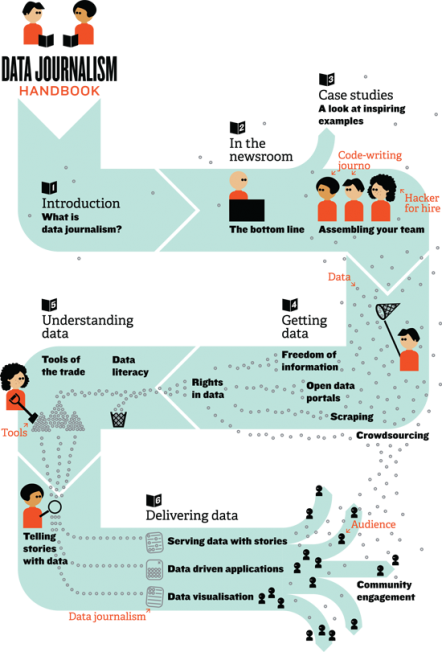

Click on Image to Enlarge

Michel Bauwens: Knowing Networks as an Alternative to Closed Networks

Advanced Cyber/IO, Civil Society, Collective Intelligence, Ethics
Michel Bauwens

Phi Beta Iota:  This is one of the most elegant trenchant discussions we have seen on the imperatives for arriving at collective intelligence through open methods.   The entire contribution is below the line.

Debating the Iron Law of Bureaucracy and the Power Law: Knowing Networks as an alternative to scale-free networks

Franco Iacomella, 2nd May 2012

These are further elements to the debate (between Zeynep Tufekci and others) as to whether and how the Iron Law of Bureaucracy, which affects initially egalitarian distributed networks, can be countered.

1. Clay Shirky: inequality is not always unfair

Classic discusion of how the power law operates in blogs, and why it is inevitable, by one of the most influential commentators, by Clay Shirky.

“A persistent theme among people writing about the social aspects of weblogging is to note (and usually lament) the rise of an A-list, a small set of webloggers who account for a majority of the traffic in the weblog world. This complaint follows a common pattern we’ve seen with MUDs, BBSes, and online communities like Echo and the WELL. A new social system starts, and seems delightfully free of the elitism and cliquishness of the existing systems. Then, as the new system grows, problems of scale set in. Not everyone can participate in every conversation. Not everyone gets to be heard. Some core group seems more connected than the rest of us, and so on.

Prior to recent theoretical work on social networks, the usual explanations invoked individual behaviors: some members of the community had sold out, the spirit of the early days was being diluted by the newcomers, et cetera. We now know that these explanations are wrong, or at least beside the point. What matters is this: Diversity plus freedom of choice creates inequality, and the greater the diversity, the more extreme the inequality.”

Continue reading “Michel Bauwens: Knowing Networks as an Alternative to Closed Networks”

David Isenberg: Private Military Corporations – Chapter Twelve

Commerce, Commercial Intelligence, Corruption, Government, Military
David Isenberg

Chapter 12

David Isenberg

Huffington Post, 29 April 2012

After ten years of operation by private military and security (PMSC) contractors in Afghanistan and Iraq, what ethical lessons should we draw from their use?

Namely, that private sector contracting has become an integral part of modern international operations, and in Afghanistan and Iraq contracting has been largely fruitful, despite some well-publicized problems and the enormous difficulties inherent to reconstructions in the midst of violent conflicts.

At least, that is the view of Doug Brooks and Mackenzie Duelge, who co-wrote Chapter 12 in the book Conflict Management and “Whole of Government”: Useful Tools for U.S. National Security Strategy? which was recently published by the U.S. Army War College's Strategic Studies Institute.

Considering that Chapter 12 is best known as a chapter of the U.S. Bankruptcy Code, the authors may have wished for another chapter number. On the other hand, considering the gap between some claims and evidence, perhaps it is appropriate.

Full article below the line.

Continue reading “David Isenberg: Private Military Corporations – Chapter Twelve”

Mini-Me: Goldman Sachs – the Corruption Machine…

Commerce, Commercial Intelligence, Corruption, Government
Who? Mini-Me?

Huh?

Exclusive: How Goldman Sachs Rigs the Game

Andy Rowell

SpinWatch, 20 March 2011

In light of Sunday Times’ revelations concerning MEPs being paid cash to place amendments on financial reform, a report published today by SpinWatch exposes financial lobbying in Brussels.

The report, entitled, Doing God’s Work: How Goldman Sachs Rigs the Game details Goldman Sachs’ secret lobbying activities in the UK and Brussels and links to politicians. It exposes:

The extensive links between Goldman Sachs and the Conservative Party;

* Political donations totalling £8.5million to British politicians in the past decade from Goldman and ex-Goldman people;

* Goldman Sachs’ immense lobbying machine in Brussels, including active membership of over a dozen financial sector lobby groups;

* Extensive meetings between Goldman Sachs and Conservative MEPs including: 9 meetings in six months with a key MEP on the Parliament’s Economics and Monetary Committee; and a total of 36 meetings between just four Tory MEPs and Goldman Sachs, its lobby groups or PR companies acting on their behalf;
* The bank’s lobbying campaign to undermine political reform on derivatives and alternative investment funds including: private dinners and unminuted “after office hours” meetings, high-level conferences and targeted campaigns to Commission officials, MEPs and their assistants;

* How Goldman Sach’s lobbyists tried to undermine amendments in a key report on derivatives, seen as “financial weapons of mass destruction”;

* The bank’s lobbying enabled them to gamble on food futures and drive up prices.

Report author, journalist Andy Rowell said: “A year ago, David Cameron said that lobbying was the next big scandal waiting to happen. This report shows that banks like Goldman Sachs – who are intricately connected to the Tories – continue to lobby to get what they want.”

Rowell continued: “The entire regulatory process – and the lobbying activity that surrounds it – has to become significantly more transparent and accountable. If it is allowed to be captured by bankers, the next financial crisis will only be a matter of time.”

The report is being published just as the debate on financial reform in Brussels reaches a crucial stage. The parliament and commission are finalising plans for reform of the OTC Derivatives market as well as Credit Default Swaps.

It also comes as the government  is due to launch a consultation on a statutory register of lobbying, for the UK.

The report can be downloaded here.

Safety copy:  How Goldman Sachs Rigs the Game (SpinWatch March 2011)

John Robb: Techcrunch Interview on Resilient Communities (Be Happy)

Articles & Chapters, Blog Wisdom, Civil Society, Counter-Oppression/Counter-Dictatorship Practices, Cultural Intelligence, Earth Intelligence, Ethics, Future-Oriented, Methods & Process, Policies, Resilience
John Robb

Techcrunch Interview

Posted: 28 Apr 2012 10:15 AM PDT

I did an interview the Jon Evans at Techcrunch (the social technology hub) earlier this week.  Here it is.

I'm spending most of my time writing and editing the Resilient Communities letter (it's free to subscribe).

As I said in the interview, the reason I started the letter was because I strongly believe that the most successful, happiest people on the planet in twenty years will be living in resilient communities.

Lots of good stuff in the RC letter —  from DiY sewage systems to how to power an entire neighborhood with solar energy.

Phi Beta Iota:  Creating resilient communities from the bottom up is what the federal government should be but is not facilitating.  We're on our own.

See Also:

Paul and Percival Goodman, Communitas: Means of Livelihood and Ways of Life (Columbia University Press, 1990)

Kirkpatrick Sale, Human Scale (New Catalyst Books, 2007)

E. F. Schumaker, Small Is Beautiful: Economics as if People Mattered (Hartley and Marks Publishers, 2000)

Owl: Pope Outraged Over Leaks on Vatican Corruption — Should He Adopt US Tactics?

Civil Society, Corruption, Cultural Intelligence
Who? Who?

No institution on planet Earth – no matter how allegedly “respectable” – seems exempt from lies, fraud, graft, corruption, and so on, and all of them are highly intent on exterminating the “whistleblowers” within them, even the Catholic Church:

Pope calls in Opus Dei troubleshooter to uncover source of Vatican leaks
Cardinal given ‘pontifical mandate' to hunt Holy See staffers releasing documents on corruption claims in ‘Vatileaks' scandal

“Vatican staffers who have been leaking embarrassing letters about corruption and nepotism inside the tiny city state are to be hunted down by a crack squad of cardinals led by a senior member of the religious group Opus Dei.

Irritated by the anonymous release of documents to the press this year, Pope Benedict has named Cardinal Julian Herranz, 82, to lead a three-man team which will haul in staffers for questioning and rifle through files until they catch the perpetrators of what has been dubbed “Vatileaks”.

A short statement printed on Thursday on the front page of the Vatican's daily newspaper warned the team had a full “pontifical mandate” to “shed complete light” on the whistle blowers, who have lifted the lid on alleged theft and false accounting.”

Phi Beta Iota:  First off, whistleblowers are becoming more active in t he 21st Century —  not only is a “public mind” coming alive with integral consciousness and integrity but the Internet is making it very very easy to do secure whistleblowing.  The Catholic Church — as with any “institution” that thinks it is above all evolved standards of human decency, has been corrupt since the myths took over.  Priests are required to be celibate for one reason and one reason only: to enable the Church to avoid family and survivor benefits.  Child molestation and other perversions are an “acceptable” alternative to this corrupt mind-set.  The Church has been financially corrupt since time immemorial.  We applaud the whistleblowers — they are doing God's work against venal betrayers of the public trust.

noble gold