Today (March 9, 2012) the Bureau of Labor Statistics (BLS) announced that 227,000 new nonfarm payroll jobs were created by the economy during February. Is the government’s claim true?
No. Statistician John Williams (shadowstats.com) reports that 44,000 of these jobs or 19% consist of an add-on factor derived from the BLS’s estimate that 44,000 more unreported jobs from new business start-ups were created than were lost by unreported business failures. The BLS’s estimate comes from the bureau’s “birth-death model,” which works better during normal times, but delivers erroneous results during troubled times such as the economy has been experiencing during the past four years.
Taking out the 44,000 added-on jobs reduces the February jobs number to 183,000, but does not provide a full correction. In an economy as troubled as the US economy is, most likely the deaths exceeded the births, but we don’t know what the number is. Was it 20,000? 50,000? What number do we deduct from the 183,000? We simply do not know.
Williams reports that seasonal adjustment factors do not work properly during troubled economic times and add their own overstatement to the jobs figure. If anyone could estimate the overestimate of new jobs that results from malfunctioning seasonal adjustments, it is John Williams, but he doesn’t provide an estimate.
Most likely, the new jobs did not exceed 150,000, a figure that would merely keep even with population growth and thus not reduce the rate of unemployment, which, consistent with this deduction, remained constant.
Let’s look now at the kind of jobs that were created. Of the new jobs reported by BLS,
92% are in services. Of this 92%, only 7% could possibly relate to exportable services–architectural, engineering, and computer systems services.
The American radical right grew explosively in 2011, a third consecutive year of extraordinary growth that has swelled the ranks of extremist groups to record levels, according to a report issued today by the Southern Poverty Law Center (SPLC). The rise was led by a stunning expansion of the antigovernment “Patriot” movement.
“The dramatic expansion of the radical right is the result of our country's changing racial demographics, the increased pace of globalization, and our economic woes,” said Mark Potok, senior fellow at the SPLC and editor of the new report.
“For many extremists, President Obama is the new symbol of all that's wrong with the country – the Kenyan president, the secret Muslim who is causing our country's decline,” Potok said. “The election season's overheated political rhetoric is adding fuel to the fire. The more polarized the political scene, the more people at the extremes.”
Many Americans are enraged by what they see as America's decline, and opportunistic politicians have done their best to stoke those fears and demonize President Obama in the process. For some, the prospect of four more years under the country's first black president also is an infuriating reminder that non-Hispanic whites will lose their majority in this country by 2050.
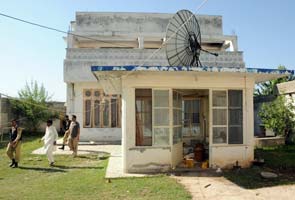
Rawalpindi (Pakistan): In his quest for the truth about his country's most notorious guest, Shaukat Qadir started where it all ended: the room where Osama bin Laden was killed.
Last August, Mr. Qadir, a retired Pakistani Army brigadier, retraced the steps of the American commandos who stormed through the corridors of Bin Laden's hide-out on May 2.
Climbing the stairs to the second floor, Mr. Qadir passed a body outline that marked the spot where Bin Laden's 22-year-old son, Khalid, was shot dead. Then he turned to a small room with a low ceiling, an empty wardrobe and a tight cluster of bullets holes in one wall, he said. Above that, on the ceiling, was a fading splash of blood that, his Pakistani intelligence escort told him, belonged to Bin Laden.
“As a former soldier, I was struck by how badly the house was defended,” Mr. Qadir said in an interview. “No proper security measures, nothing high-tech – in fact, nothing like you would expect.”
Paul Zak, a pioneer in the field of neuroeconomics, talks about the genes that can make or break a Wall Street trader, and about the chemical that helps us all get along.
Eryn Brown
Los Angeles Times, March 2, 2012
Neuroscience might seem to have little to do with economics, but over the last decade researchers have begun combining these disparate fields, mining the latest advances in brain imaging and genetics to get a better understanding of the biological basis for human behavior.
Paul Zak is a pioneer in this nascent field of neuroeconomics. In a recent paper published in the journal PLoS One, he examined genes that may predict success among traders on Wall Street. His forthcoming book, “The Moral Molecule,” will explore how a chemical in the brain called oxytocin compels cooperation in society.
Zak, director of the Center for Neuroeconomic Studies at Claremont Graduate University, discussed this work with The Times.
Phi Beta Iota: Convergence is upon us. Most universities do not get this, but a couple are struggling to change recalcitrant faculty and force the break-down of silos and the reconstitution of unified knowledge. We are at the very beginning of most interesting times.
Want to know what the future of digital activism looks like? Then follow the developments in Russia. I argued a few years back that the fields of digital activism and civil resistance were converging to a point I referred to as “digital resistance.” The pace of tactical innovation and counter-innovation in the Russia digital battlefield is stunning and rapidly converging to this notion of digital resistance.
“Crisis can be a fruitful time for innovation,” writes Gregory Asmolov. Contested elections are also ripe for innovation, which is why my dissertation case studies focused on elections. “In most cases,” says Asmolov, “innovations are created by the oppressed (the opposition, in Russia’s case), who try to challenge the existing balance of power by using new tools and technologies. But the state can also adapt and adopt some of these technologies to protect the status quo.” These innovations stem not only from the new technologies themselves but are embodied in the creative ways they are used. In other words, tactical innovation (and counter-innovation) is taking place alongside technological innovation. Indeed, “innovation can be seen not only in the new tools, but also in the new forms of protest enabled by the technology.”
While I normally don’t discuss two speakers at All School Meeting (ASM) within one month, the reality is that last week’s speaker was equally as provocative and exciting as the one two weeks before, so I will make this an “exception to the rule.”
Professor Loren J. Samons Jr. is the chair of BU’s Classics Department, a highly decorated teacher (both at BU and nationally), and a widely published scholar (his list of publications is several pages long). Perhaps most important for his impact at ASM, he has a drop-dead hilarious deadpan comic style (think “Saturday Night Life”), and he is able to bring ancient Greek topics vividly to life in terms of our own contemporary issues.
This week at ASM Professor Samons spoke to us about the ancient Greek definitions of “democracy” and “citizenship,” demonstrating how dramatically they differed from our own modern definitions. “Democracy” is the conjoined Greek words for “people power” – he joked that English speakers prefer to borrow prestigious sounding words from other languages, rather than using our own. But while we Americans tend to think of democracy as providing certain citizen “rights” by birth (voting, trial by jury), these were not at all what distinguished ancient Athens as the first city state in Greece to practice democracy; for instance, other city states allowed the vote, even if a king ruled. Rather, ancient Athenians assumed that being a citizen was a group-given privilege (not a natural right) that involved other group-expected duties. Privileges included being chosen by lottery to serve in the legislature (just think of the savings in campaign spending if that’s how Congress were selected!), and duties included serving in the army almost yearly from age 18 to 59, for instance. If you think about these two examples, you’ll notice that the very people voting to go to war were the ones having to serve in it. And since you served next to your friends and family (often a father, brother, and grandfather at your side), the realities of battle were both more personal and more demanding – flight was either not an option during battle (observed by those you loved), or once Uncle Georgios fled, you were right behind him.
While Professor Samons went on to detail the Hoplite army model of ancient Athens, his main points focused on citizenship, especially how our culture has lost its understanding of privileges combined with duties, and replaced that understanding with a sense of entitlement based on natural individual rights. Our “political will” as a society reflects this, as we see presidential debates from both parties pander to what each voter wants, rather than to the spirit of individual sacrifice for the common good. Ancient Athens might have had many troubling qualities, such as an annual draft, but its spirit of democracy is a virtue we would do well to revive. At the Academy, learning about the classics helps to do just that!
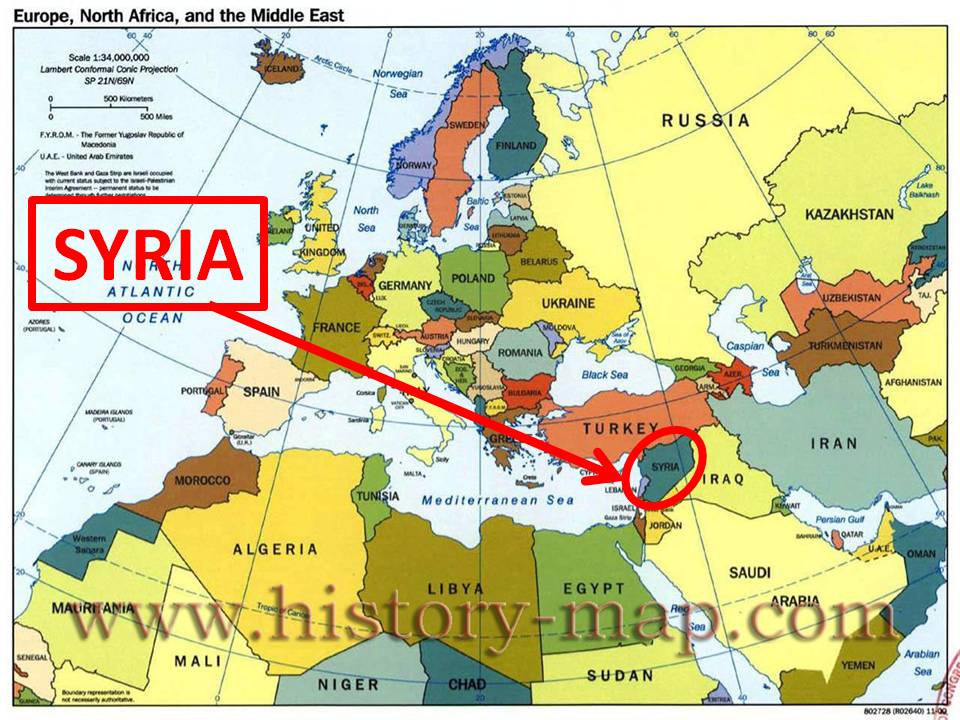
Syria: Deputy Oil Minister Abdo Hussameddin announced his resignation and departure from the Ba'ath Party to side with the opposition against President Al-Asad's regime. If confirmed, he would be the highest-ranking official to defect, and the third member of the administration to do so. A video of his declaration was posted on YouTube and repeated around the world.
Comment: Most news outlets reported this man as the highest-level official to defect, which means very little. A lengthy search showed the man was a Baath Party member for a long time, but failed to discover whether the defector was a Christian, Druze, Sunni, Alawite or member of another group. The implications of the defection hinge largely on details not available in the public domain.
Syria celebrated the 49th anniversary of the Syrian coup by Hafez al-Asad on 8 March 1963. Revolution Day is 8 March.
Correction: The place names cited by the Red Crescent official and reported in the 7 March edition of NightWatch are governates, not cities and towns. Syria has 14 governates – often translated as provinces – which administer 61 districts.
It is important to enter an instability problem at the right level, meaning at the level of political organization that provides diagnostic and prognostic results. The international press persists in describing unrest in terms of governates. Entering the instability problem at this level results in distorted narratives and exaggerated reports about the strength of the opposition and the weakness of the government.
Readers are justified in wondering why the government in Damascus has not collapsed. The reason is that the government is not now and has never been threatened by a governate-level insurrection. The fight is in local neighborhoods and most are on the political or geographic periphery of the governates, posing little threat to central authority.
Syria is about the size of North Dakota, according to the CIA World Factbook, with a few differences. Syria has 61 districts which more or less correspond to North Dakota's 53 counties. North Dakota's counties, however, are not organized into governates or provinces.
Syria supports more than 22.5 million people in the same space that North Dakota supports just under 700,000, but with a lot less water. North Dakota has no cities as populous as Syria's Homs which contains over a million people. North Dakota has no sea ports or borders with hostile enemy states.
NightWatch has sought to enter the Syrian instability problem at the district or sub-district level so as to guard against bias and get finer ground truth granularity about just what is happening in Syrian neighborhoods.
For example, a careful survey shows that today the Free Syrian Army and its supporting web sites posted situation reports indicating that this force engaged in six operations in five different governates on 7 March. Several were exchanges of gunfire in which no one was injured and one was erection of a roadblock, in a territory the size of North Dakota.
This data supports leaked information attributed to US intelligence persons that there isn't much of a Free Syrian Army. There is unrest in Syria, but there really isn't much of an insurgency. For the purposes of comparison, in Iraq in 2006, more than 300 firefights occurred daily. In Afghanistan last spring, there were around 50 firefights daily and hundreds of incidents involving makeshift explosives.
Syrian security forces were busy. Opposition sources reported dozens of activities in nine of the 14 governates. A closer look showed that the activities were concentrated in about a dozen of the 61 districts.
Nine governates sounds like a big insurrection. Unrest in 12 districts presents a far more manageable security problem than nine governates supposedly out of control, but in fact not. No governates are out of control and apparently neither are any of the 61 districts.
A still finer focus showed that most of the opposition activities were small, brief street demonstrations (which were not further defined), according to the opposition's own postings. There were no clashes except as noted above; no bombings and no terror attacks on 7 March.
Most of the government operations were local neighborhood sweeps that encountered no resistance. Other reported government actions included over flights of aircraft, some vague armor movements and shelling. The opposition sources that posted the reports were not careful to distinguish whether the operations were by law enforcement and police personnel, paramilitary militias or the Syrian armed forces. Most were attributed to “thugs,” which suggests the paramilitary militias.
Unfortunately the sources also were not specific about which sub-districts or neighborhoods were under stress from government operations. Each of the 61 Syrian districts has multiple sub-districts what are called, nawahi. It is not yet possible to track activity at the nawahi level, but it would show a more fine grained definition of the status of the instability problem in Syria.
Phi Beta Iota: CNN and BBC both appear to be taking direction from US covert operations / media influence staffs. Both appear unintelligent and dishonest. We hold NIGHTWATCH and its editor in the highest regard, consistently superior to the larger organizations that lack both intelligence and integrity. We note with interest that the Syrian Diaspora and the crisis mapping communities are relatively silent on this matter.