Winslow Wheeler: National Security Misrepresentation

Corruption, Cultural Intelligence, Government, IO Impotency, Non-Governmental

It's Not Just the Politicians Who Have Cheapened the Defense Debate

Winslow Wheeler

I recall from early in my career when Sen. Barry Goldwater (R-AZ) took to the floor of the Senate to attack the allegedly scurrilous report that the B-1 bomber would cost as much as $60 million a copy: in truth, it turned out to cost $200 million per copy.  I also remember when Sen. Dale Bumpers (D-AR) opposed keeping battleships in the Navy because of their “teak deck:”  In peacetime, the Iowa class battleships did lay wood on top of their 7.5 inch thick steel decks.  No one needs to be reminded that Congressman Buck McKeon (R-CA) and Leon Panetta (formerly D-CA) have termed any further cuts in the defense budget to be “catastrophic:” If returning to 2007 levels of defense spending is so terrible, why did Donald Rumsfeld and Robert Gates not tell us back then?
Such outrageous statements are so ignorant that you have to assume the politicians knew they were full of baloney when they made them.  They probably assumed no one would check up on them or that such bunkum “will go around the world while the truth is still pulling its boots on.”  (Thank you, Mark Twain.)
Think tanks have been a part of the Washington scene since at least the end of World War II.  People expect them to have competent research and logical analysis behind their comments.  That can be a perilous assumption.  A recent example occurred just after Christmas when the Director of the Heritage Foundation's Center for Foreign Policy Studies invoked the name of a chief architect of the F-15 and the F-16 (and more) in a commentary to promote the F-22 and the F-35.  The willfulness of the ignorance is something that senators Goldwater and Bumpers and today's Pentagon budget boosters would recognize.
There are other characteristics of the debate on the F-22 and the F-35 that need to be recognized as badly misinformed, especially that either one is an asset to our air forces.
Four of us worked with that genius who, among many other things, had a fundamental role in two of the most successful fighter designs in recent aviation history, Col. John Boyd.  We took profound offense at the ignorant and misleading assertion that he had anything but derision for the F-22 and the thinking behind the F-35.  In response, we wrote a commentary–not just on the aircraft but also on the depths to which the Washington debate on these subjects has sunk.
Find our comments at any of the websites that follow, and below:
Time magazine's Battleland blog at

Descent into Ignominy

The Heritage Foundation Then and Now

By Thomas Christie, Pierre Sprey, Chuck Spinney & Winslow Wheeler

Almost 30 years ago, in 1983, The Heritage Foundation stepped forward as a thoughtful, independent thinking participant in the then-raging debate over Ronald Reagan's defense budget increases. In one of its major policy publications, Heritage published an insightful analysis with an unambiguous conclusion: “The increased spending secured by President Reagan should afford significant improvements in force size. It does not.” (See Agenda '83: A Mandate for Leadership Report, Richard N. Holwill, ed., The Heritage Foundation, 1983; see chapter 4, p. 69 of “Defense” by George W.S. Kuhn.) The analysis was crammed with data and straightforward logic as it made the case for real reform in America's overpriced, underperforming defense budget.

Since then, Heritage has come a long way in defense policy analysis, all of it downward.

Read full indictment.

Phi Beta Iota:  The corrupt government is surrounded by thousands–perhaps tens of thousands–of corrupt second-string piglets.  While most people are good people trapped in a bad system, the net result is that everyone lies and the public trust is betrayed.  The truth at any cost lowers all others costs.  2012 is the year in which we battle for the soul of the Republic.

Marcus Aurelius: Paul Pillar on Intelligence & Policy

Corruption, Cultural Intelligence, Government, IO Deeds of War, Peace Intelligence
Marcus Aurelius

Think Again: Intelligence

I served in the CIA for 28 years and I can tell you: America's screw-ups come from bad leaders, not lousy spies.

Paul Pillar

Foreign Policy, Jan/Feb 2012

“Presidents Make Decisions Based on Intelligence.”

Not the big ones. From George W. Bush trumpeting WMD reports about Iraq to this year's Republican presidential candidates vowing to set policy in Afghanistan based on the dictates of the intelligence community, Americans often get the sense that their leaders' hands are guided abroad by their all-knowing spying apparatus. After all, the United States spends about $80 billion on intelligence each year, which provides a flood of important guidance every week on matters ranging from hunting terrorists to countering China's growing military capabilities. This analysis informs policymakers' day-to-day decision-making and sometimes gets them to look more closely at problems, such as the rising threat from al Qaeda in the late 1990s, than they otherwise would.

On major foreign-policy decisions, however, whether going to war or broadly rethinking U.S. strategy in the Arab world (as President Barack Obama is likely doing now), intelligence is not the decisive factor. The influences that really matter are the ones that leaders bring with them into office: their own strategic sense, the lessons they have drawn from history or personal experience, the imperatives of domestic politics, and their own neuroses. A memo or briefing emanating from some unfamiliar corner of the bureaucracy hardly stands a chance.

Read rest of article.

Phi Beta Iota:  Brother Pillar avoids the obvious – the excessive influence of the banks, military-industrial complex, and the Zionists, among others.  CORRUPTION is our greatest enemy.  Both parties are corrupt, and a third party (or Americans Elect) is not the answer–we need to restore the INTEGRITY of the entire process from election through governance through accountability.

See Also:

Review: Intelligence and U.S. Foreign Policy – Iraq, 9/11, and Misguided Reform

2010: Human Intelligence (HUMINT) Trilogy Updated

Journal: Politics & Intelligence–Partners Only When Integrity is Central to Both

Journal: Reflections on Integrity UPDATED + Integrity RECAP

Maarcus Aurelius: Bikers Response to PETA

Cultural Intelligence
Marcus Aurelius

As received from a third party via email:

Try to read this without laughing out loud . . ..

What a wonderful coming together of two diverse groups!

We need more gatherings where the idiot activists are given warm, moist, aromatic welcomes like this one. This is why PETA usually protests women wearing fur rather than bikers wearing leather.  Sounds to me like the old saying,  “you mess with the bull, and you get the horns”.

Gee, I guess these characters thought that Bikers were going to be politically correct like the rest of the wimpy world.

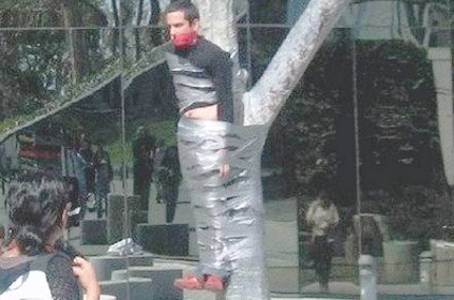
HERE'S HOW POLICE FOUND ONE OF THEM.

Click on Image to Enlarge

Phi Beta Iota:  We salute our biker colleagues for their self-restraint and epic sense of humor.  In the Marine Corps this is called non-judicial punishment (NJP).  These moronic protesters totally lacking in judgment or wisdom, are what happens when government tries to micro-manage everything and encourages loose bands of idiots to interfere with perfectly reasonable activities.

Penguin: Drums of War on Iran

04 Inter-State Conflict, 05 Iran, 07 Other Atrocities, 08 Wild Cards, 10 Security, Corruption, Government, Officers Call, Peace Intelligence
Who, Me?

And with the rise of oil prices by early Spring “caused by Iranian threats”, the Casus Belli will have been laid.

THE ROVING EYE
The US-Iran economic war
By Pepe Escobar

NEW YORK – Here's a crash course on how to further wreck the global economy.

A key amendment to the National Defense Authorization Act signed by United States President Barack Obama on the last day of 2011 – when no one was paying attention – imposes sanctions on any countries or companies that buy Iranian oil and pay for it through Iran's central bank. Starting this summer, anybody who does it is prevented from doing business with the US.

This amendment – for all practical purposes a declaration of economic war – was brought to you by the American Israel Public Affairs Committee (AIPAC), on direct orders of the Israeli government under Prime Minister Benjamin “Bibi” Netanyahu.

Read full article.

See Also:

Israeli and US troops gear up for major missile defense drill after Iran maneuvers

John Steiner: Mark Bitman on People Power – Beyond Elections

Collective Intelligence


John Steiner

Beyond Elections: People Power

By MARK BITTMAN

New York Times, 3 January 2012

The presidential election may be grabbing headlines, but the true rallying cry for 2012 is to struggle and organize around those issues that a president might take seriously, to stake out positions that would benefit what used to be called the working class (and now goes by “the 99 percent”) and to garner enough political will and power to pressure the president and Congress to move resolutely on the issues that matter.

. . . . . . .

Only if there is collective action by large numbers of citizens will politicians — even principled ones — have the support they need to resist the power of corporate lobbyists. It’s not an easy process, and it’s one that’s often met by violence.

Read full article.

Susan Lindauer: IRAQ – The Legacy of Deception and Its Costs

02 Diplomacy, 03 Economy, 09 Justice, 10 Security, 11 Society, Corruption, Cultural Intelligence, Ethics, Government, Military
Susan Linauer

IRAQ: THE LEGACY OF DECEPTION AND ITS COSTS

Susan Lindauer, Former CIA Back Channel to Iraq at the United Nations

Most Americans are astonished to discover that right up to 9/11, the CIA was developing a “Real Politik” vision of Iraq that recognized the fast approaching collapse of U.N. Sanctions. The CIA was preparing for Peace—with a ruthless determination that the United States would capture the lion's share of spoils from Iraqi Reconstruction contracts in any post-sanctions period.

German pilots transporting medical supplies and doctors into Baghdad International Airport at the end of the Clinton Administration had blasted the myth of invincibility surrounding sanctions. To this day, those pilots are anonymous—but they changed the equation in total. Their courage honoring the Berlin Airlifts in the Cold War was quickly copied. Across Europe and the Arab world, activists began to organize humanitarian flights into Baghdad. On the Security Council, France and Russia argued strenuously that the ban on air travel had been self imposed, and the no-fly zone could not prohibit humanitarian flights.

By this time, UN sanctions had killed over 1.7 million Iraqis; wiped out literacy in a single generation; and created artificial starvation in the world's second most oil-rich nation. Iraq's world class hospitals that once rivaled London and New York had been ravaged.  Sick of the misery, the global community refused to stay silent any longer.

The CIA saw the writing on the wall. International loathing for “genocide by sanctions” had reached such a peak of outrage that there was no possibility of re-crafting the hated policy. Secretary of State Colin Powell's vision of “smart sanctions” had come too late.

The CIA was determined to control the agenda for the advantage of the United States, however. And so quietly through my back channel, we undertook a proactive, covert dialogue over exactly what concessions Iraq would offer the United States, in exchange for lifting the sanctions. As a long-time opponent of sanctions myself, I was eager to get results.

Continue reading “Susan Lindauer: IRAQ – The Legacy of Deception and Its Costs”

Robert Steele: ON REVOLUTION

07 Other Atrocities, Civil Society, Corruption, Cultural Intelligence, IO Impotency, Methods & Process, Money, Banks & Concentrated Wealth, Movies, Officers Call, Policies, Reform, Resilience, YouTube

UPDATE:  I was not happy with these, the first one got a lot of views, the other two did not, so I have removed them.  Instead I recommend the below mid-1990's condensation of my 1976 thesis.

Learn more:

Download Single-Page Graphic

2011 Thinking About Revolution in the USA and Elsewhere

noble gold