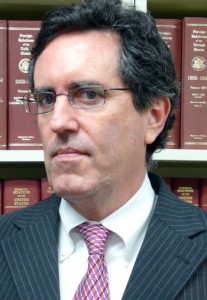
Very inspiring talk, i listened in silence to him and that doesn’t happen often.
As an ex VN soldier i fully support the generals opinion.
Even after losing his own son in Afghanistan he still firmly believes in his ideals and knows how to express them on a way that is understandable and inspiring to allot of people, i can only say general van Uhm made me proud to be Dutch today, and proud i served in the Dutch armed forces.
Stimulated by Occupy and an expanding inquiry into new forms of economics, combined with my ongoing interest in bringing wisdom to politics and governance, I've stumbled on a productive approach to pulling it all together: Start from an exploration of Power – particularly, but not only, social power. This brings both politics and economics under the same roof, and oddly integrates protest movements, alternative technologies and social forms, and the human potential movement. More on that later.
Right now, I want to share some notes on types of power. If you have thoughts about these lists, please share them on my blog so others can see them and all the comments will be gathered together in one place where it will be easier for me to review and learn from them all.
I hope you find these interesting and thought-provoking. I look forward to any comments you may have.
A collection of more than 1500 audiocassettes from Kandahar. The collection is central to understanding al-Qaida's emergence as an organisation before 9/11.
An analysis of Flag Miler can also be found in : J.Deol, Z. Kazmi (Eds) Contextualizing jihadi thought. New York: Horst & Company, Columbia University Press, 2012.
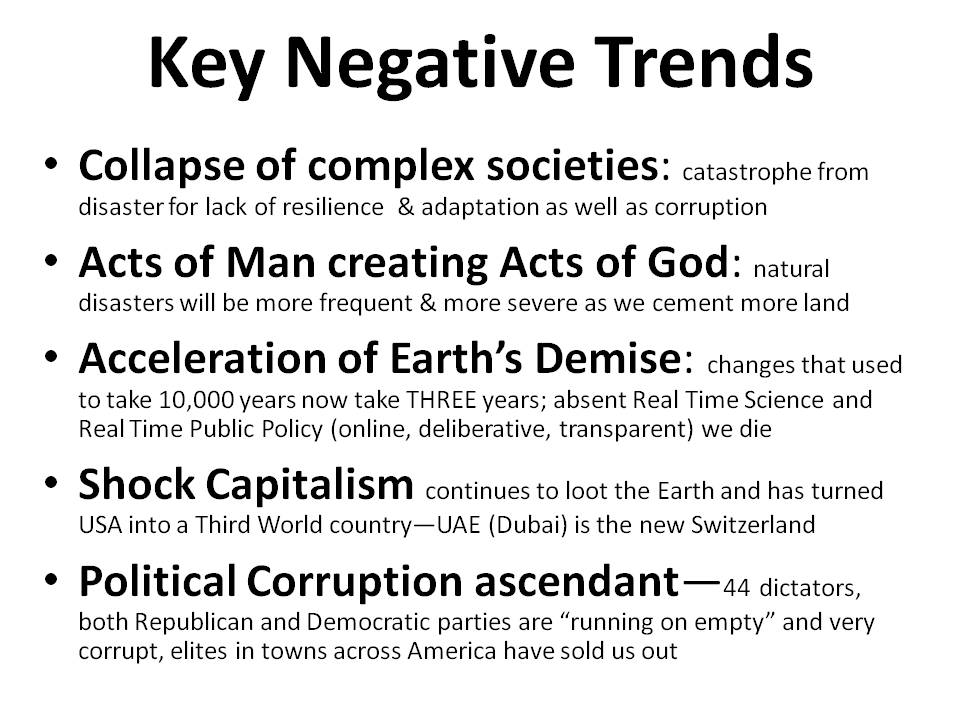
Although Global Trends 2030 will not be released by the US secret intelligence community until after the November 2012 election, minutes of the 22-24 May 2011 meeting are available and provide a useful panorama of what the group is and is not considering.
2. They are so beholden to status quo science they actually consider the exploitation of shale gas and oil to be a serious positive–lacking a strategic analytic model, it does not occur to them to examine the true cost of such initiatives, e.g. water, environmental degradation, etcetera. They do not “get” the fragmentation of knowledge as being among the chief obstacles to creating strategic intelligence.
3. They are oblivious to the “eight tribes“* while creeping up on government-business collaboration (and clearly also oblivious to the fact that this is actually plutocracy and corporate capture, not collaboration).
* Academia, Civil Society [inclusive of labor and religion], Commerce, Government [all levels], Law Enforcement, Media, Military, Non-Governmental / Non-Profit.
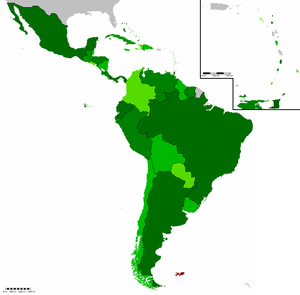
TheCommunity of Latin American and Caribbean States (Spanish: Comunidad de Estados Latinoamericanos y Caribeños, CELAC, Portuguese: Comunidade de Estados Latino-Americanos e Caribenhos, French: Communauté des États Latino-Américains et Caribéens, Dutch: Gemeenschap van de Latijns-Amerikaanse en Caribische landen) is the tentative name[1] of a regional bloc of Latin American and Caribbean nations created on February 23, 2010, at the Rio Group–Caribbean CommunityUnity Summit held in Playa del Carmen, Quintana Roo, Mexico.[2][3] It consists of all sovereign countries in the Americas, except for Canada, France, the Netherlands and the United States. British and Danish dependencies in the Americas are also not represented in CELAC.
CELAC is an example of a decade-long push for deeper integration within the Americas.[4] CELAC is being created to deepen Latin American integration and to reduce the once overwhelming influence of the United States on the politics and economics of Latin America, and is seen as an alternative to the Organization of American States (OAS), the regional body organized largely by Washington in 1948, ostensibly as a countermeasure to potential Soviet influence in the region.[4][5][6]
Feminist and anti-oppression activists, the human potential movement, and other ongoing organizers and movements for human betterment have played important roles in the emergence and nature of the Occupy movement. (The articles below are just a few examples.) Such movements have been organizing demonstrations, communities and networks and transforming people's consciousness and behavior in one form or another for hundreds of years. They've been training and empowering people and exposing them to the dark side of the social systems they live in and the possibilities for a better world, even as they themselves have become more experienced, aware, and skilled at new ways of living and being together.
Many people became leaders and practitioners of these organizing and transformational skills, forming a dispersed pool of resources for disparate transformational activities over the last many decades. The high purpose, tremendous passion, propitious timing, evocative non-specificity and intense community of OWS attracted a wide variety of these folks to its various centers of activity – the Occupations themselves – and into diverse support, leadership, and teaching roles. And then much was learned, experienced, created, modified… Had there been no past movement activities generating this pool of experience and skill, the Occupy movement would have looked very different indeed. And now the Occupy movement itself has become part of that ongoing learning, deepening, evolving collective experience…
As Occupy encampments are broken up by authorities, various commentators wonder if the movement is falling apart. They forget that through the activities of OWS in the last several months, tens of thousands of people have not only been inspired but have also taken leaps in awareness, experience and skill and that new leaders have emerged and new networks and groups have formed and new questions are being asked by newly focused and empowered citizens. The fact that this development is diffuse and nonlinear does not mean it does not exist. It only means that mainstream eyes will not necessarily recognize the new forms in which it will surface, over and over and over, expanding and adapting as it goes.
As one OWS sign insightfully said – in words whose significance not everyone will grasp – “This is a movement, not a protest.”
I have a feeling we ain't seen nothin' yet…
Blessings on the Journey. It has been a long time.
Open Source Works, which is the CIA’s in-house open source analysis component, is devoted to intelligence analysis of unclassified, open source information. Oddly, however, the directive that established Open Source Works is classified, as is the charter of the organization. In fact, CIA says the very existence of any such records is a classified fact.
“The CIA can neither confirm nor deny the existence or nonexistence of records responsive to your request,” wrote Susan Viscuso, CIA Information and Privacy Coordinator, in a November 29 response to a Freedom of Information Act request from Jeffrey Richelson of the National Security Archive for the Open Source Works directive and charter.
“The fact of the existence or nonexistence of requested records is currently and properly classified and is intelligence sources and methods information that is protected from disclosure,” Dr. Viscuso wrote.
This is a surprising development since Open Source Works — by definition — does not engage in clandestine collection of intelligence. Rather, it performs analysis based on unclassified, open source materials.
Thus, according to a November 2010 CIA report, Open Source Works “was charged by the [CIA] Director for Intelligence with drawing on language-trained analysts to mine open-source information for new or alternative insights on intelligence issues. Open Source Works’ products, based only on open source information, do not represent the coordinated views of the Central Intelligence Agency.”
As such, there is no basis for treating Open Source Works as a covert, unacknowledged intelligence organization. It isn’t one.