Infopolicy: There is a number of industries today that are already obsolete, kept alive by sheer inertia or by political subsidies. Many politicians, in an attempt to “save jobs”, are foolishly taking resources from new, viable industries and giving to these obsolete ones. “Saving jobs” in this context means that politicians are rejecting ways of producing the same level of output with a much more competitive and cost-efficient method, and is not to be applauded at all.
The first and most obvious victim industry of the internet was the postal industry, the kind that delivered physical letters. When people want to communicate today, they don’t put ink to paper. Out of sheer inertia, bills and governmental correspondence are still being delivered using this method, but everybody else has moved on. Parcel couriers that ship physical objects live on for the time being, but are threatened by 3D printing.
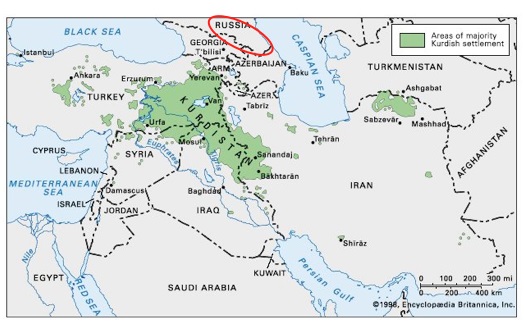
The Kurds are the world’s largest ethnic group (25-35 million) without a nation. As the graphic below shows, Kurds are widely distributed throughout the turbulent regions of Middle East and Central Asia. The green areas are the major areas of heavy Kurdish concentration — but small enclaves exist in areas not marked. (For example, I met many Kurdish Turks in western Anatolia in 2008-9 — my impression was that these urban Kurds were well integrated into Turkish society, unlike their brethren in the East.)
Click on Image to Enlarge
Below is a report analyzing a little known dimension to the Kurdish Question in the turbulent North Caucasus (i.e. the area of red ellipse), where a relatively small number (approximately 64,000) people of Kurdish origin now reside.
The author argues that Russia’s Kurds are sending humanitarian aid to anti-Jihadi Kurds in Syria while Jihadis from Russian Republics of Chechnya and Dagestan (also in the North Caucasus) are flowing into Syria, possibly setting the stage from some kind of blowback in the North Caucasus. (I have no idea of how accurate this report is — and can not vouch for it.)
But if true, Russia’s emerging Kurdish Question could be exceedingly complex, involving internal relations with its turbulent Caucasus Republics and external relations with Turkey, Syria, Azerbaijan, and possibly Iran, among others. These problems may have had something to do with Putin’s tamping down of Obama’s ill-considered efforts to intervene in the Syrian Civil war last August and September — an intervention that would have effectively placed the US on the side of Jihadis we claim to be fighting in the so-called Global War on Terror (GWOT) — and are enemies of the Russians as well.
Maxim A. Suchkov, Ph.D., a former Fulbright visiting fellow at Georgetown University (2010-11), is currently a fellow at the Institute for Strategic Studies at the North Caucasian city of Pyatigorsk, Russia and is a contributor to the Central Eurasian Studies Society Blog.
Yet another story of the failure of austerity policies. The dominant economic philosophy of the Theocratic Right since Ronald Reagan has repeatedly been shown to be a failure. Yet, so far as I can tell, none of these failures have had the slightest effect on wretched Rightist corrupt political prostitutes in the U.S. House of Representatives. We have become a fact-free culture.
This and the next story are so immoral they almost take one's breath away. One out of five children in the United States go to bed hungry. We do not have universal healthcare. Our schools are in shambles. But there are untold billions for war and “nation building” in nations other than our own. You'd think we would be ! ashamed, but shame about thoughtless callous programs that punish people already sorely reduced no longer seems to play any role in our society.
Syria: Syrian TV reported that on 9 December the Syrian army captured the town of al-Nabk in west-central Syria after days of fighting. This town was the last rebel strong point on the road that links Damascus to Homs and the coast.
Remember the thumping of Obama’s war drums for a US attack on Syria last August and September, including his spokesmen’s absurd invocations of Kosovo as a precedent for a limited cruise missile strike on Syria? The trigger for hyping that war fever was a sarin gas attack in Eastern Ghouta, a Damascus suburb, on August 21. Obama was quick to blame Syrian President Bashar al-Assad for crossing Obama’s bizarre Netanyahu-esque “red line.”


 The first and most obvious victim industry of the internet was the postal industry, the kind that delivered physical letters. When people want to communicate today, they don’t put ink to paper. Out of sheer inertia, bills and governmental correspondence are still being delivered using this method, but everybody else has moved on. Parcel couriers that ship physical objects live on for the time being, but are threatened by 3D printing.