I lived in Iraq during the 2003 Shock and Awe bombing. On April 1st, about two weeks into the aerial bombardment, a medical doctor who was one of my fellow peace team members urged me to go with her to the Al Kindi Hospital in Baghdad, where she knew she could be of some help. With no medical training, I tried to be unobtrusive, as families raced into the hospital carrying wounded loved ones.
Amazon Page
At one point, a woman sitting next to me began to weep uncontrollably. “How I tell him?” she asked, in broken English. “What I say?” She was Jamela Abbas, the aunt of a young man, named Ali. Early in the morning on March 31st, U.S. war planes had fired on her family home, while she alone of all her family was outside. Jamela wept as she searched for words to tell Ali that surgeons had amputated both of his badly damaged arms, close to his shoulders. What’s more, she would have to tell him that she was now his sole surviving relative.
I soon heard how that conversation had gone. It was reported to me that when Ali, aged 12, learned that he had lost both of his arms, he responded by asking “Will I always be this way?”
Returning to the Al Fanar hotel, I hid in my room. Furious tears flowed. I remember pounding my pillow and asking “Will we always be this way?”
David Swanson reminds me to look to humanity’s incredible achievements in resisting war, in choosing the alternatives which we have yet to show our full power to realize.
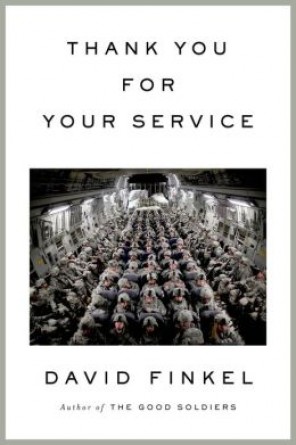
Nominally a sequel to The Good Soldiers, his 2009 account of an American infantry battalion at war in Iraq, David Finkel’s new book actually serves as a perfect companion to George Packer’s recent bestseller, The Unwinding. Like Packer, Finkel examines the human detritus left in the wake of fraudulent promises and collapsed illusions. In The Unwinding, Packer contemplates the fate of those victimized by cataclysmic economic change. In Thank You for Your Service, Finkel looks at those victimized by egregious military malpractice.
The post-industrial, high-tech, information-age economy unveiled near the end of the 20th century supposedly offered a template for permanent prosperity. The Great Recession upended such expectations. Although some Americans have gotten very rich indeed, far larger numbers of ordinary citizens find themselves unemployed and unemployable. With impressive sensitivity, Packer tells their story.
Amazon Page
Concocted at about the same time, a post-industrial, high-tech, information-age approach to waging war supposedly offered a template for assured victory. Iraq and Afghanistan have shredded such pretensions. Although some high-ranking military and civilian officials found ways to cash in, far larger numbers of ordinary soldiers (and their families) suffered, many of them grievously. In painful, intimate and at times almost voyeuristic detail, Finkel tells their story.
More specifically, Finkel, a reporter with The Washington Post, attends to what he calls the “after war.” His concern is with the soldiers who return from the war zone bearing wounds — and with the loved ones on whom those wounds also become imprinted. Above all, he is concerned with wounds that may not be fully visible: the post-traumatic stress disorder (PTSD), traumatic brain injury and related conditions that affect roughly a half-million younger veterans. Make that a half-million and counting.
To translate this disturbing statistic into flesh and blood, Finkel checks in on some of the soldiers featured in his previous book. What he finds is anger, anxiety, shame, depression, guilt, sleeplessness, self-abuse, spousal abuse, child abuse, alcohol abuse, drug abuse and suicidal tendencies, sometimes acted on, sometimes not. Shouting matches, crying jags and bizarre behavior along with guns and two-pack-a-day smoking habits abound, but not much in the way of useful therapy. Of one soldier, Finkel writes: “He began to take sleeping pills to fall asleep and another kind of pill to get back to sleep when he woke up. He took other pills, too, some for pain, others for anxiety. He began to drink so much vodka that his skin smelled of it, and then he started mentioning suicide.”
Western dialectics are beyond any doubt the pinnacle of human achievements. “Democracy” means “rule of corporations and oligarchs,”+ “Law” means “what civil servants need for their own profit”* while dictionaries define Ev·i·dence [noun] 1: False claim made by a government.
“Terrorists” are those fighting Western regimes; “freedom fighters” are those fighting for Western regimes. All others are slaves to be exploited by their governments.
The large image below belongs to the Ronald Reagan Library, where it is catalogued “President Reagan meeting with Afghan Freedom Fighters to discuss Soviet atrocities in Afghanistan. 2/2/83″ According to His Honorable Eminency, the President of the USA and its Colonies Reagan, the Afghani Mujahideen fighting against the illegitimate Soviet occupation were Freedom Fighters while their spinoff, the Taliban, were defined “terrorists” after they liberated their country.
WASHINGTON: As the United States prepares to withdraw its troops from Afghanistan, a top American Senator has said that the best way out of Kabul is through New Delhi and India offers the last opportunity to help make war-torn nation get rid of terrorist safe haven.
“I have long felt that the best way out of Afghanistan is through New Delhi, is to have a military alliance with India that we encourage India to roll into Afghanistan, to be a non-terrorist base,” Senator Mark Kirk said during a Congressional hearing.
Filtering—or the lack thereof—presented the single biggest challenge when we tested MicroMappers last week in response to the Pakistan Earthquake. As my colleague Clay Shirky notes, the challenge with “Big Data” is not information overload but rather filter failure. We need to make damned sure that we don’t experience filter failure again in future deployments. To ensure this, I’ve decided to launch a stand-alone and fully interoperable platform called MicroFilters. My colleague Andrew Ilyas will lead the technical development of the platform with support from Ji Lucas. Our plan is to launch the first version of MicroFilters before the CrisisMappers conference (ICCM 2013) in November.
A web-based solution, MicroFilters will allow users to upload their own Twitter data for automatic filtering purposes. Users will have the option of uploading this data using three different formats: text, CSV and JSON. Once uploaded, users can elect to perform one or more automatic filtering tasks from this menu of options:
Pulitzer-prize wining journalist slams “pathetic” US media for failing to challenge White House
Paul Joseph Watson
Infowars.com
September 27, 2013
Seymour Hersh
Pulitzer Prize-winning journalist Seymour Hersh says that the raid which killed Osama Bin Laden in 2011 is “one big lie” and that “not one word” of the Obama administration’s narrative on what happened is true.
In a wide-ranging interview published today by the Guardian, Hersh savages the US media for failing to challenge the White House on a whole host of issues, from NSA spying, to drone attacks, to aggression against Syria.
On the subject of the Navy Seal raid that supposedly resulted in the death of the Al-Qaeda terror leader, Hersh remarked, “Nothing’s been done about that story, it’s one big lie, not one word of it is true.”
Hersh added that the Obama administration habitually lies but they continue to do so because the press allows them to get away with it.
“It’s pathetic, they are more than obsequious, they are afraid to pick on this guy [Obama],” Hersh told the Guardian.