OpenBTS GSM Simplified — Freeing Humanity

Advanced Cyber/IO, Autonomous Internet, Civil Society, Counter-Oppression/Counter-Dictatorship Practices, Cultural Intelligence, Hacking, Mobile, Real Time, Tools
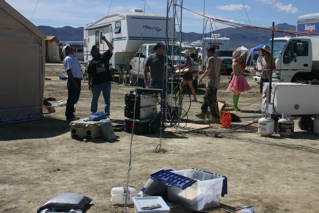
OpenBTS at BurningMan

OpenBTS is an open-source Unix application that uses the Universal Software Radio Peripheral (USRP) to present a GSM air interface (“Um”) to standard GSM handset and uses the Asterisk® software PBX to connect calls. The combination of the ubiquitous GSM air interface with VoIP backhaul could form the basis of a new type of cellular network that could be deployed and operated at substantially lower cost than existing technologies in greenfields in the developing world.

In plain language, we are working on a new kind of cellular network that can be installed and operated at about 1/10 the cost of current technologies, but that will still be compatible with most of the handsets that are already in the market. This technology can also be used in private network applications (wireless PBX, rapid deployment, etc.) at much lower cost and complexity than conventional cellular.
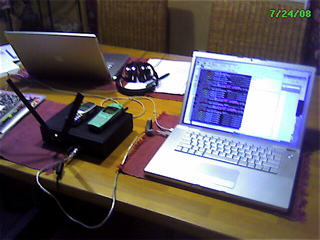
OpenBTS Official Photo

Project News (Last Updated 17 January 2011)

Kestrel Signal Processing OpenBTS Page with Links

OpenBTS YouTube Short Videos (Just Over 30)

Phi Beta Iota: This is as close to “world-changing” as it gets.  Neither Microsoft nor the cellular providers–nor the governments whose people stand to gain the most (but whose corrupt politicians prefer the status quo)–want to surf this wave, they would rather fight it.  If there were ONE social networking initiative that is guaranteed to change the world for the better, this is the one.  In our always humble opinion.

Disagree, but Engage–Free and Fair Elections in USA?

Civil Society, Cultural Intelligence

Disagree, but engage: That's civility

On issues ranging from abortion to guns, it is possible for adversaries to find common ground

February 10, 2011|By Robert Fersh and Andrew L. Yarrow

EXTRACT:  These processes are most successful when participants have strong, informed opinions and can make a difference if they reach agreement. This was the case in the U.S.-Muslim Engagement Project, where 34 diverse American leaders joined in an influential consensus report in 2008 to show a way forward for the United States in its relations with Muslim majority countries. The group included a former Clinton administration secretary of state, former Republican members of Congress, high-ranking former officials of the George W. Bush administration, 11 Muslim-American leaders, a former director of the American Israel Public Affairs Committee, clergy of differing faiths, and others. Vin Weber, a former Republican congressman from Minnesota, said: “This report provides clear-headed ideas and analysis that the American public and bipartisan leaders can get behind in working to improve U.S.-Muslim relations. The process by which the group reached consensus is a good model for dialogue for the tough issues our country faces.”

Continue reading “Disagree, but Engage–Free and Fair Elections in USA?”

Event: 20 Oct, NYC, Angel Orensanz Center, CONTACT

03 Economy, 11 Society, Civil Society, Collective Intelligence, Corporations, Counter-Oppression/Counter-Dictatorship Practices, History, Open Government, Technologies

UPDATED TO PROVIDE OPEN WIKI PAGE

Conceived and facilitated by Douglas Rushkoff, Contact seeks to explore and realize the greater promise of social media to promote new forms of culture, commerce, collective action, and creativity.

Bringing together technologists, artists, activists, businesspeople, funders, and other stakeholders in the networked future, this summit will hatch new ideas, connect collaborators, and forge an ongoing community for innovating social media and beyond. See the new event forums.

Phi Beta Iota: Whether or not Facebook and GroupOn are paying attention, this event has the potential to turn into the seed crystal for a self-organizing World Brain and Global Game.

event link

The Future of Journalism: A Conversation

Advanced Cyber/IO, Civil Society, Cultural Intelligence, Media
Jon Lebkowsky Bio

The Future of Journalism: a conversation

by jonl on February 7, 2011

With colleagues Pete Lewis, Tony Deifell, Kevin Anderson, Andrew Haeg, and Scott Rosenberg, I’m in a two week conversation about the future of journalism on the WELL. The WELL is the seminal online community; this conversation is in the Inkwell forums, where Bruce Sterling and I have our annual state of the world conversation. Inkwell usually has conversations with authors, but for this conversation we’re trying a panel format.

Here’s my latest contribution to the conversation:

Continue reading “The Future of Journalism: A Conversation”

Terror at Fort Hood? Or Terror from America?

07 Other Atrocities, 10 Security, 11 Society, Advanced Cyber/IO, Civil Society, Cultural Intelligence, Military
Marcus Aurelius Recommends

We Could Have Stopped The Terror At Fort Hood

Washington Post February 6, 2011 Pg. B1

By Sens. Joseph I. Lieberman and Susan M. Collins

Maj. Nidal Hasan, accused in the murders of 13 people and the attempted murders of 32 others in the shooting spree at Fort Hood, Tex., in November 2009, appears to be the toughest kind of terrorist to spot: a lone wolf who plots without the overt support of domestic cells or foreign sponsors.

Still, the attack did not come as a complete surprise to some in the Army and the FBI, and that makes this incident all the more tragic.  Our Senate committee's 14-month investigation of the Fort Hood killings has concluded that the Department of Defense and the FBI “collectively had sufficient information to have detected Hasan's radicalization to violent Islamist extremism but failed both to understand and to act on it.”

The deaths at Fort Hood could and should have been prevented. The Defense Department's failure to acknowledge the threat of violent Islamist extremism within its ranks, coupled with organizational and communication flaws in the FBI's counterterrorism operations, contributed to the tragedy.

Full Op-Ed….

Continue reading “Terror at Fort Hood? Or Terror from America?”

Tom Atlee on Congress 2.0: Empower the Public

About the Idea, Civil Society, Collective Intelligence, Commerce, Cultural Intelligence, Ethics, Open Government
Tom Atlee

YOU, TOO, CAN BE A CONGRESSPERSON

by Tom Atlee

Why would you want to become one?  Here are four very enticing reasons:

Read full posting….

The alternative approach:

*  You might have to advocate policies that would be hard on yourself, your constituents or your supporters — even temporarily.  You might become unpopular.  You might get assassinated or your plane might develop unexplained engine trouble and crash.  You might even not get re-elected!

*  You would actually have to face reality, get the facts, learn about complicated stuff like how complex systems work.  (It's really unfortunate, but most of our thorny problems are all tangled up with complex systems that are tangled up with other problems, too. Yuck!!)

*  You would have to listen to and work with people who see things differently from you.  After all, they may know something that's important to take into consideration.  That could be really unpleasant and take you far afield from your party line, out in the political boonies where the real danger lies.

*  You just wouldn't get the same adrenaline rush you get when you stick with oversimplifications, grandstanding, being loved by your supporters, and launching juicy attacks on your enemies.  There just aren't as many ego-strokes or perks available for working with others to deeply understand things and come up with what makes sense for the long haul.

Co-Intelligence Institute's Pledge for Politicians

Read full posting….

noble gold