To understand how far ordinary Chinese have been priced out of their country's property market, you need to look not upwards at the Beijing's shimmering high-rise skyline, but down, far below the bustling streets where nearly 20m people live and work.
There, in the city's vast network of unused air defence bunkers, as many as a million people live in small, windowless rooms that rent for £30 to £50 a month, which is as much as many of the city's army of migrant labourers can afford.
Historic events in the Arab world gripped the world's attention in January. In Tunisia weeks of escalating riots and demonstrations over dire economic conditions, corruption and government repression culminated in the ouster of President Zine al-Abidine Ben Ali on 14 January. He was replaced by an interim government which announced the country's first free elections since independence.
The direction of Tunisia's transition, and its significance for the region, are not yet clear. But, assuming a successful transition, this could mark the first genuine popular revolt leading to a democratic government in the Arab world.
Inspired by the Tunisian uprising yet fuelled by their own long-standing grievances, hundreds of thousands took to the streets across Egypt towards the end of the month, protesting against authoritarian rule and poor living standards, and calling for President Hosni Mubarak to step down. Over 135 people were killed and more than 2,000 injured during the initial police response. The army was deployed at the end of the month to curb increasing chaos and looting, but vowed not to use force against the protesters.
Seemingly somewhat similar approach to “monkeywrenching” ecotage (sabotage) of Earth Liberation Front originating in American Southwest…..not sure The Atlantic has done its homework–apart from the naivete of thinking that this would remain “controlled” it reads like a CIA-version of a faux activist plan.
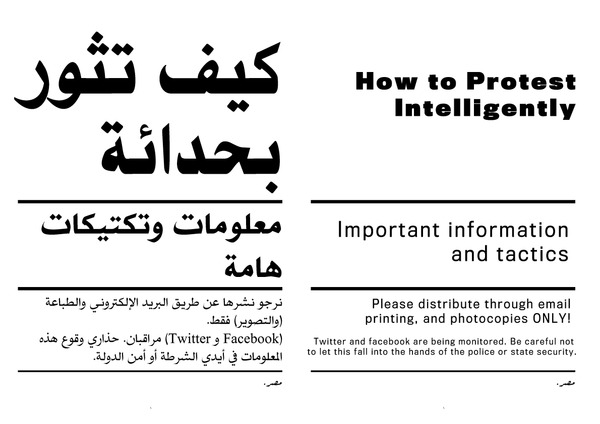
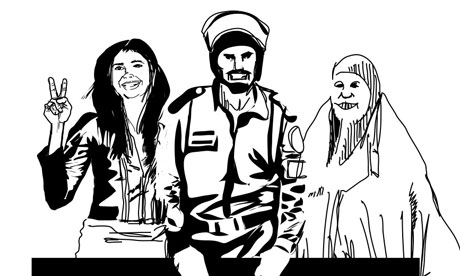
Anonymous flyers provide practical and tactical advice for confronting riot police, and besieging government offices
Phi Beta Iota: Agree with Marcus Aurelius. A simpler plan is “be on the street, be respectful and non-violent at all times, be patient.” This is a word of mouth revolution, 26 pages is suspect and we have to wait to see the entire product as well as verification that this has gone anywhere other than The Atlantic. This is the kind of thing CIA would do (violate the law, feed this to The Atlantic) to try to get on the boards “virtually.” Fairly stupid to want to occupy buildings, the key is public presence, non-violent, nothing more. V-sign? Is this a 1960's annuitant on modern drugs? We wait with bated breath to learn who is actually behind what the UK Guardian calls “the slickly produced 26-page document.”
US admiration for its soldiers may be deep and widespread, but interest in what they are doing is shallow and fleeting
article
by Gary Younge
Published on Monday, January 31, 2011 by The Guardian
Most of the stories told about Benjamin Moore, 23, at his funeral started in a bar and ended in a laugh. Invited to testify about his life from the pews, friend, relative, colleague and neighbour alike described a boisterous, gregarious, energetic young man they'd known in the small New Jersey town of Bordentown since he was born. “I'll love him 'til I go,” his granny said. “If I could go today and bring him back, I would.”
Grown men choked on their memories, under the gaze of swollen, reddened eyes, as they remembered a “snot-nosed kid” and a fidget who'd become a volunteer firefighter before enlisting in the military. Shortly before Benjamin left for Afghanistan, he sent a message to his cousin that began: “I'm about to go into another country where they hate me for everything I stand for.” Now he was back in a flag-draped box, killed by roadside bomb with two other soldiers in Ghazni province.
There is need for bright news on the democracy front — and, luckily, there is some. (I'm also working to create some in the background, but I've got nothing to announce yet. Cross your fingers.) So I thought I'd share a bit of it the good stuff I've seen.
The first article is an announcement that the Vermont legislature is planning to become the first state to ban corporate personhood statewide. This is a move in the right direction to balance social power — a topic specifically addressed by the most popular article on the Co-Intelligence Institute website, “Democracy: A Social Power Analysis“, written by my father, John Atlee. (Perhaps you'll get a sense of how my upbringing influenced my choice of career when you read it.)
The second article below is an interview with Frances Moore Lappé, one of my early mentors (see “Living Democracy“) exploring themes in her new book GET A GRIP 2. She invites us to both work wholeheartedly on the issues that concern us AND to work on changing the systems (such as money's influence in politics) that create the problems we are trying to solve.
It's not just bad harvests and climate change – it's also speculators that are behind record prices. And it's the planet's poorest who pay
John Vidal Sunday 23 January 2011
article
Just under three years ago, people in the village of Gumbi in western Malawi went unexpectedly hungry. Not like Europeans do if they miss a meal or two, but that deep, gnawing hunger that prevents sleep and dulls the senses when there has been no food for weeks.
Oddly, there had been no drought, the usual cause of malnutrition and hunger in southern Africa, and there was plenty of food in the markets. For no obvious reason the price of staple foods such as maize and rice nearly doubled in a few months. Unusually, too, there was no evidence that the local merchants were hoarding food. It was the same story in 100 other developing countries. There were food riots in more than 20 countries and governments had to ban food exports and subsidise staples heavily.
The explanation offered by the UN and food experts was that a “perfect storm” of natural and human factors had combined to hyper-inflate prices. US farmers, UN agencies said, had taken millions of acres of land out of production to grow biofuels for vehicles, oil and fertiliser prices had risen steeply, the Chinese were shifting to meat-eating from a vegetarian diet, and climate-change linked droughts were affecting major crop-growing areas. The UN said that an extra 75m people became malnourished because of the price rises.