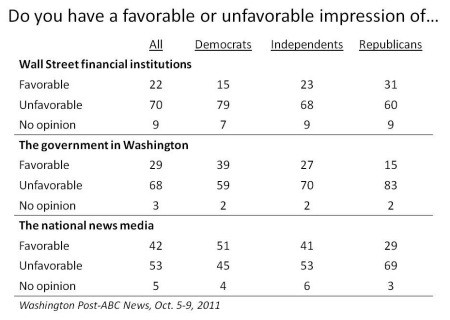
The fledgling Occupy Wall Street protests tap into a deep vein of public animosity toward the country’s major financial institutions, one that is on par with the deep negativity aimed at Washington, according to a new Washington Post-ABC News poll.
Public distrust of the federal government is growing, and well documented. In the new poll, more than two-thirds of Americans say they view Washington unfavorably, including nearly half who hold “strongly” unfavorable impressions. These sentiments spike higher among Republicans, and continue to fuel the tea party political movement.
Click on Image to Enlarge
But there’s just as much negativity directed at Wall Street financial institutions. Fully 70 percent of those polled view such firms unfavorably, with strongly unfavorable mentions outnumbering strongly favorable ones by 8 to 1.
For political independents, there’s little love for either one: similar proportions — around seven in 10 — view government and Wall Street unfavorably. Most, 55 percent view both negatively.
Yesterday, the Nieman Watchdog journalism group at Harvard asked me to evaluate how well the press is scrutinizing Secretary of Defense Leon Panetta. Basically, it's not; instead, Panetta seems to be free of informed, skeptical questioning; he must be absolutely delighted with the treatment he is receiving.
The defense secretary likens budget-cutters to Nazis and makes assertions that simply aren't true — but the media don't seem to care, writes Winslow Wheeler.
The silence in the press about the overheated rhetoric and dubious myths from Secretary of Defense Leon Panetta makes for a very unhappy comparison of today’s defense journalism compared to previous eras when, for example, SecDef Casper Weinberger was the subject of serious critical analysis.
Phi Beta Iota: Leon Panetta, like Bob Gates before him, is a posturing pimp for the military-industrial complex that pays 5% bribes to get 95% discounts on the taxpayers treasure. He could not stand up to fifteen minutes on the same stage with any one of us–Chuck Spinney, Winslow Wheeler, Ralph Peters, Bob Scales, etcetera.
The preposterous claim that deviations from market efficiency were not only irrelevant to the recent crisis but could never be relevant is the product of an environment in which deduction has driven out induction and ideology has taken over from observation. The belief that models are not just useful tools but also are capable of yielding comprehensive and universal descriptions of the world has blinded its proponents to realities that have been staring them in the face. That blindness was an element in our present crisis, and conditions our still ineffectual responses. Economists – in government agencies as well as universities – were obsessively playing Grand Theft Auto while the world around them was falling apart.
to which I responded
What we are up against
A refreshing reminder of the staid mechanistic approach of so-called market-efficient economics. Good for the status quo as used to explain to the world WHY the Masters of the universe are in charge. I'm not sure how many of the deans of business schools and Harvard economics professors are prime advocates. But I imagine a substantial amount remembering the interviews that Ferguson did in the documentary Inside Job. They get very well rewarded for being apologists for the current system.
But I would like to take off from this point and try 500,000 foot summary of some of the issues. I am not sure how many people really understand the nature and the reasons for our problems I have a stack of books on my porch more than 3 feet high that I've read since 2008 attempting to grasp it. It is only with the addition of the latest by Nicholas Shaxson called Treasure Islands Uncovering the Damage of Offshore Banking and Tax Havens that I feel I have made really significant progress.
Whether it is possible for the occupy movements to create among their followers and the wider public at large an understanding of the situation, I'm not sure. But I suspect that short of violent revolution which has never been a positive accomplishment–the only way forward is to formulate this broader understanding.
The first of a four-part investigation into a world of greed and recklessness that led to financial collapse.
In the first episode of Meltdown, we hear about four men who brought down the global economy: a billionaire mortgage-seller who fooled millions; a high-rolling banker with a fatal weakness; a ferocious Wall Street predator; and the power behind the thron
Meltdown examines how an epidemic of fear caused banks to stop lending, triggered protests and led to industrial action.
In the second episode of Meltdown, we look at how the financial tsunami swept the world. We hear about a renegade executive who nearly destroyed the global financial system and the US treasury secretary who bailed out his friends.
As the toll of the financial crisis continues to mount, many are looking for its true causes – and finding a crime.
The third episode of Meltdown looks at how the victims of the 2008 financial crash fight back. A protesting singer in Iceland brings down the government; in France a union leader oversees the kidnapping of his bosses; and thousands of families are made homeless in California.
Some responded with denial, others by re-thinking capitalism, but who is preparing for the next crisis?
In the final episode of Meltdown, we hear about the sheikh who says the crash never happened; a Wall Street king charged with fraud; a congresswoman who wants to jail the bankers; and the world leaders who want a re-think of capitalism.
Phi Beta Iota: This is a world-class series that misses just two things:
A. Goldman Sachs has owned the US Treasury–providing the Secretary of the Treasurer (and today also the National Security Advisor to the President–for three critical administrations, each of which willfully eradicated safeguards.
B. Senator Phil Graham (R-TX) and the other Senators who had and still have zero integrity, passing 200 pages of lobbyist written deregulation inserted into the bill five minutes before the vote.
Penguin adds:
C. The perfidy of Clinton in his Glass-Steagall sellout and his CONTINUED malignant hyping of its ethic through obfuscation and the pimping of what “reputable” analysts who want access to his solon. For him America was built on deal making and networking.
Earlier this week I attended a breakfast panel sponsored by Gensler (http://www.gensler.com), an architecture, design, planning and consultation firm that focuses (among other things) on effective workplace environments, consulting for companies like Google, HP, Yahoo and Facebook. The title of the panel was “Designing your workplace for a competitive edge.”
Here’s my set of notes from the panel:
Evolving workplace:
Version 1.0: Move fast and break things. Emerging culture. Workplaces built for speed, transparency, flexibility.
Version 2.0: 8×8, 1:1. Cubic farms on vast floor plates. Cube dwellers. Butts in seats. Embedded hierarchy.
Version 3.0: (Now). Activity-based era. Changing work process. Mobile, remote work. “We” spaces, not “me” spaces. Support for collaboration. Drivers: faster pace, distributed teams, lean and mean. Changing work processes (from waterfall to agile). Closed to open. Get products to market faster. Multiple space times for multiple work modes. Coworking. Workers not tethered to one company.
Panelists
Derek Woodgate, The Futures Lab: futurist perspective
Eden Bruckman, International Living Future Institute: sustainability perspective
David Bumgardner, HP: real estate acquisition and management perspective.
Bumgardner’s job is to maximize HP’s real estate portfolio. He has to consider how employees work and what kind of environment is conducive to productivity, at the same time maintaining standards across the global HP properties. He focuses on optimal use of all properties, noting that the workforce increasingly consists of mobile employees who require no office or desk. The need for consistent standards is so that wherever the mobile employee goes to an HP facility, the work environment is fairly consistent. Other factors: environmental sustainability, affordability.
A green and sustainable workplace environment can be a competitive edge: some of the most talented employees will factor environmental impact into their decisions about where to work.
Google is another company that focuses on sustainability. The focus is authentic, no greenwashing. Google wants to move beyond LEED, looking through the lens of the Living Building Challenge (https://ilbi.org/lbc).
The build environment is an extension of who we are. We see increasing interest in building bio measurement and feedback into environments. China is looking closely at metrics in building 20 megacities.
Community will no longer be a matter of who’s aggregated in any place, but also how they share and manage resources.
Health and well-being is the new perq for employees; it’s no longer about having a corner office or other sings of hierarchy.
At Zappos, the number 1 priority is company culture, feeling that if you get that right, the rest will happen naturally. How does the built environment impact that culture?
The contemporary work environment needs spaces for energizing and spaces for discharging that energy.
Technology is moving fast, but the build environment is inherently slow.
HP created the Halo Room (http://www.humanproductivitylab.com/archive_blogs/2007/08/28/hp_halo_releases_hp_meeting_ro.php), a set of global networked technology-mediated remote conferencing environments. As these kinds of environments proliferate, travel requirements will decrease. “You’re not going to see that people interaction go away. You’re going to see better ways to get it.”
Increasingly building sustainability into design standards, which may have to vary for different (non-U.S.) contexts. Striving for a zero effect (carbon neutral). Changing densities.
Currently workers don’t feel the same commitment from companies as before, and vice versa. Companies are reducing the numbers of employees and relying more on contractors. We’re creating a world of experts (consultants).
Future workers (currently under 25 years of age) are growing up with a different set of assumptions. Their world is a world of peer groups, not authoritarian hierarchies. It’s a world that’s saturated with technology, especially for communications. For the first time ever, we’re starting to see multiple generations of employees working together in the same office.
Phi Beta Iota: Notice the butts in seats model, which is where the US and most governments are today. OWS is already at the new model. All this was known in the 1980's, relearned in the 1990's, and is now being relearned a third time, but the lack of integrity in senior management–an inability to listen and adapt–has retarded both democracy and capitalism. See the list below for many new books, and the two books not on the old lists. The earliest book to “get it” that we know of was by Robert Carkhuff, The exemplar: The exemplary performer in the age of productivity (Human Resource Development Press, 1984).
Commentary: Structural woes in economy creating ‘permanent underclass’
Howard Gold
Wall Street Journal, 14 October 2011
The public knew this much earlier than economists or pundits did, and as for politicians — don’t ask!
. . . . .
Listen to Charles Plosser, president of the Federal Reserve Bank of Philadelphia, in a speech a couple of weeks ago.
“These numbers are troubling, especially when more than 40% of the unemployed, or some six million people, have been out of work for 27 weeks or longer,” he said.
“Millions of unemployed workers may take longer to find jobs because their skills have depreciated or they may need to seek employment in other sectors. These structural issues will take time to resolve. Jobs and workers will need to be reallocated across the economy, which is a long and slow process.”
Phi Beta Iota: The US Government is in grid-lock, with 1950's mind-sets, 1970's technologies, and 1990's spendthrift ways–in other words, it is completely out of touch with reality and has no idea how to cope with the need to retrain a quarter of the population across all age groups in a year or two. Hint: bail out the public, not the banks and certainly not the multiple complexes of corruption. Start by using military to ingest the entire unemployed population into receiving and retraining centers with full salary for each individual committing to retraining.