There are a few officers still serving that I hold in high regard. Below is a discussion I had with one such officer via email recently.
DNI Anon:
Current discussion about drones to kill “high-value targets” may miss the point, ethically and politically. Discussion has centered on the toll a drone exacts on nearby luckless individuals and the fact that some high value-targets can lay claim to being U.S. citizens.
The technology for remote killing has become increasingly precise—from carpet bombing to TLAMS to smart bombs, now hellfire missiles. Extrapolate forward to a remote controlled weapon that promptly and reliably impacts just a single, targeted individual, absolutely no collateral damage. Better, or worse? The catch is the targeting process itself. Our national mantra is “innocent until proven guilty”. How proven and, to what standard of proof? Do we abide the Blackstone ratio, “better that ten guilty persons escape than that one innocent suffer”?
The larger issue, however, is that as precision increases, the barriers to use drop. Previously, a more scatter-shot killing on another’s sovereign soil might occasion war. But, precision technology has lowered the profile for extra-territorial attack and war need not be the outcome. Good, so far as it goes, but less constrained technology can mean less restrained actors …and, technology proliferates.
Like the horsemeat scandal in Europe this report on fake pharmaceuticals shows what happens when appropriate regulation is not maintained, because industries capture the regulatory agencies that are supposed to protect us, and the Congress is in the pocket of those industries as well. Once again we face the bitter fruit produced by anti-regulations forces. The t! ruth is we have become a thoroughly corrupted nation and, until we find the strength to speak truth to power it will only continue.
The risks of fake and flawed medicines have leapt from developing nations to Western supply chains, thanks to gaps in oversight of drug wholesalers, lax law enforcement, and ineffective tactics for tracking drugs as they change hands, according to a report released Wednesday by the Institute of Medicine.
‘It’s distressing to see vividly just how huge a problem it is in the United States,” said Larry Gostin, a Georgetown University law professor and World Health Organization adviser who led the study. ‘It’s more lucrative to traffic in illegitimate drugs than cocaine or heroin,” he said.
The Russian system is beginning to decay. It cannot sustain the crumbling status quo, nor can it be certain of finding a new incarnation for itself. The only real questions are what stage of decay the system is in, whether the agony of its final demise has already started, and, if so, how long it will last.
To be sure, the system still has some resources, if not to revive itself, then to draw out its death, and that survival instinct could take a nasty, even bloody, form.
The Future of the Russian Matrix
The system can still reproduce itself through regime change and the emergence of a new Leader, who will personify authoritarian rule.
It can't be excluded that the forces who present themselves as “liberal,” declaring the need to “influence” the system from within and supporting “partial” changes, will try to highjack the protest movement and reestablish personalized power under liberal slogans.
Most certainly, any new attempt to breathe life into the rotting Matrix will necessarily involve coercion in order to preserve its power.
Prospects for Change
For the first time in its long history, Russian society is ready to free itself from the stifling embrace of the Russian system and of the political regime that is its engine, and to accept new rules of the game.
It is true that only a minority is ready to publicly stand up for a state based on the rule of law. It is more important, however, that the idea of the new order is not rejected by the vast majority of Russians, and they are ready to accept it, if it is offered to them.
At this point, however, the demoralized and corrupt Russian ruling elite is not ready for any change that will endanger its monopoly and its corporate and personal interests.
For its part, the Russian opposition, still weak and fragmented, has so far failed to present society with a viable agenda for an exit solution.
However, there is no doubt that Russia's moment of truth is fast approaching. The question is whether the confluence of several specific factors will occur in the same time frame and in the not too distant future. These factors include:
public pressure on the regime;
the consolidation of the non-system opposition;
the split of the ruling elite, with its pragmatic part joining the opposition;
the power structures' reluctance to defend the old order; and
the creation by the opposition of a “road map” for the transition to the new rules of the game that will include Constitutional reform and a new state structure.
Failure to reach these goals will deepen the rot and/or implosion of the system and the state.
Read rest of report.
Phi Beta Iota: Carnegie has written a perfect self-description of the USA. They will never admit this, and no one in a position of power is capable of actually connecting to the truth even if the US intelligence community were capable of presenting the truth — as Daniel Ellsberg lectured Henry Kissinger:
The danger is, you’ll become like a moron. You’ll become incapable of learning from most people in the world, no matter how much experience they have in their particular areas that may be much greater than yours” [because of your blind faith in the value of your narrow and often incorrect secret information].
The Subprime Mortgage Crisis: A Perfect Example of the Potential Benefits of Open-Source Governance in the Real World
The article: The Nature and Origin of the Subprime Mortgage Crisis, (San Jose State University Department of Economics) says,”The guilt for the subprime mortgage financial crisis lies both with the lenders who knowingly put borrowers into booby trapped mortgages and the management of Fannie Mae and Freddie Mac for making a market for such booby trapped mortgages thus giving the lenders the incentive for writing them.”
The article goes on to say, “It seems that everyone but the dimwits running Fannie Mae (into the ground) understood intuitively that a poor risk for a mortgage cannot be made a better risk by charging a higher interest rate.”
Of course its a complex problem, with many parties to blame (the article goes on to say). But if Fannie Mae and Freddie Mac had been required to post their data online where the general public could access it, some citizen would have seen the mortgage crisis coming. And if there had been an open-source forum where they could drawn attention to the problem, and an open-source vehicle for proposing a solution, or at least writing up some kind of formal complaint to the government, then the disaster might have been averted before it grew so immense.
1. Threat to This Idea. The Central Intelligence Agency (CIA) has fought against this idea, despite the fact that it originated within the CIA in 1969, and has been championed by multiple commissions including the 9/11 Commission (pages 23 and 413) and the WMD Commission. Both CIA and the Director of National Intelligence (DNI) appear to fear the impact on the secret world’s budget if an Open Source Agency (OSA), as a sister agency to the Broadcasting Board of Governors (BBG), were to demonstrate that 95% of what the Secretaries of State, Defense, and Homeland Security need to do strategy, policy, and acquisition, can be obtained ethically, legally, and inexpensively. This idea was sent to your predecessor via four separate channels, including from Lawrence Lessig to Alec Ross in the office for Public Diplomacy, and directly to a member of Hillary Clinton’s personal staff, and blocked all four times by INR acting on behalf of CIA. If is for this reason that I humbly and respectfully route this idea to you via your brother and my long-time colleague Jock Gill, a member of President Clinton’s communications staff.
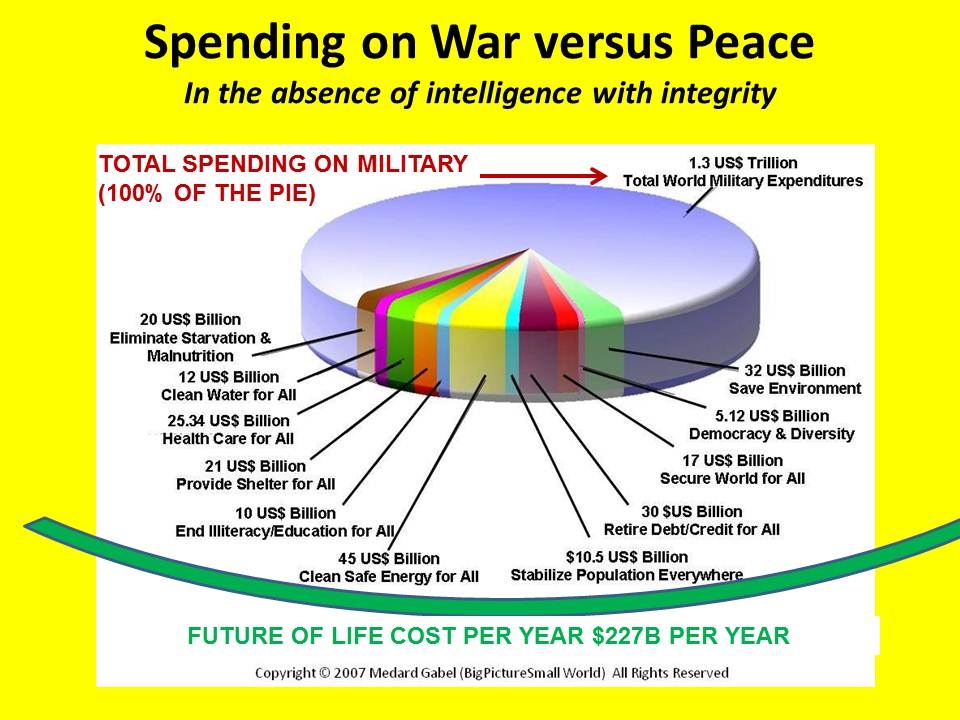
2. Essence of the Idea. The OSA would provide to the Secretary of State, the Secretary of Defense, the Secretary of Commerce – and to all their Assistant Secretaries and desk officers – completely unclassified Open Source Intelligence (OSINT) tailored to their needs in detail and in a timely fashion. Being unclassified, this intelligence (decision-support) could be provided at the same time to the Congressional committees, the media, the public, and foreign stake-holders. Stated in relation to the President’s needs at this time, the Open Source Agency would enable the Secretary of State to contribute immediately and forcefully to Open Government, Citizen Engagement, Participatory Budgeting, Global Engagement, and more tangibly, to the rapid creation of a Whole of Government planning, programming, and budgeting process that is rooted in ethical evidence-based decision-support that leverages unclassified decision-support such that the Secretary of State can lead a redirection of how the US Government spends money, toward peace and commerce instead of war.
Click on Image to Enlarge
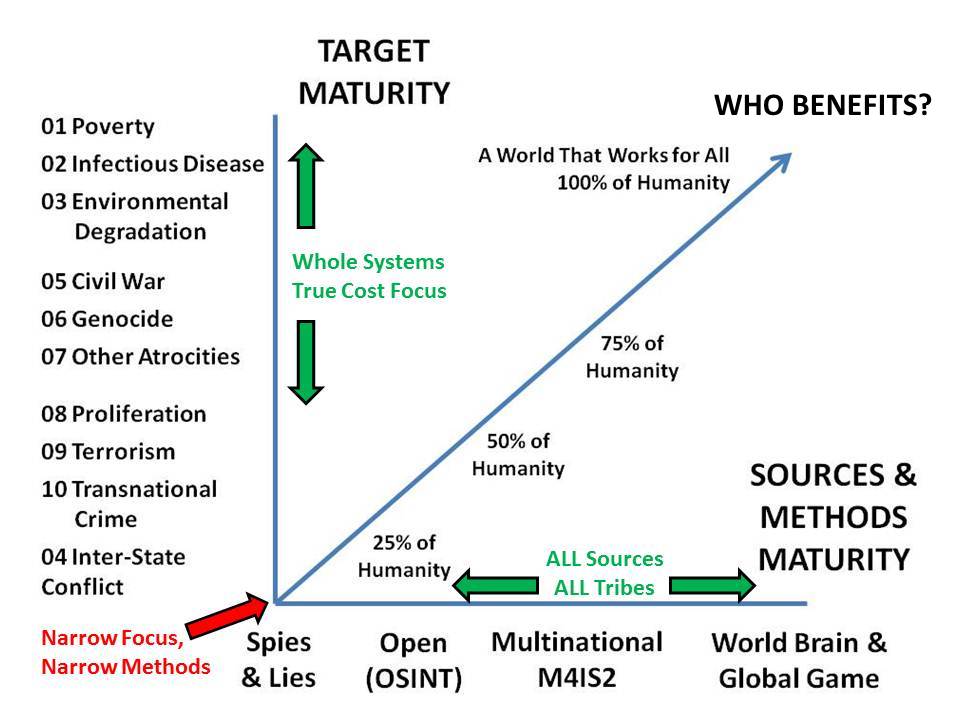
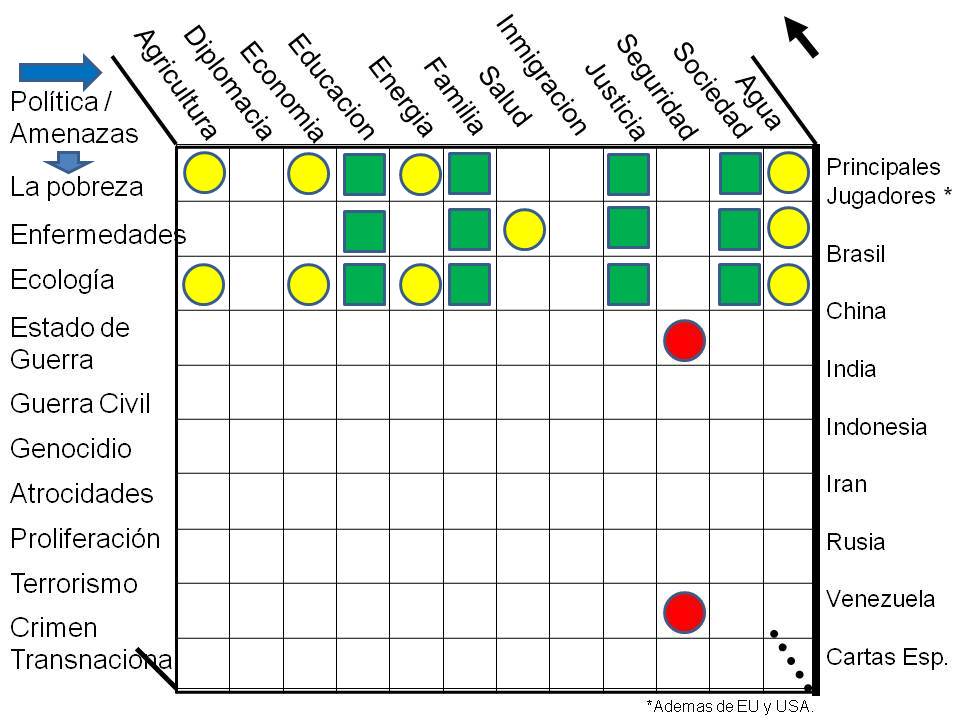
3. Harmful Gaps Today. At a time when LtGen Dr. Brent Scowcroft and other members of the UN High-Level Panel on Threats, Challenges, and Change have identified and prioritized the ten threats shown here, the USA and its military-industrial complex persist in obsessing on inter-conflict and terrorism, the latter a tactic, not a threat. Meanwhile the secret intelligence world is spending over $75 billion a year on secret collection, most of which is not processed, and producing what General Tony Zinni, USMC (Ret) has said is “at best” 4% of what a major commander or Cabinet official requires – to which I would add, “and nothing for everyone else.”
Click to Enlarge
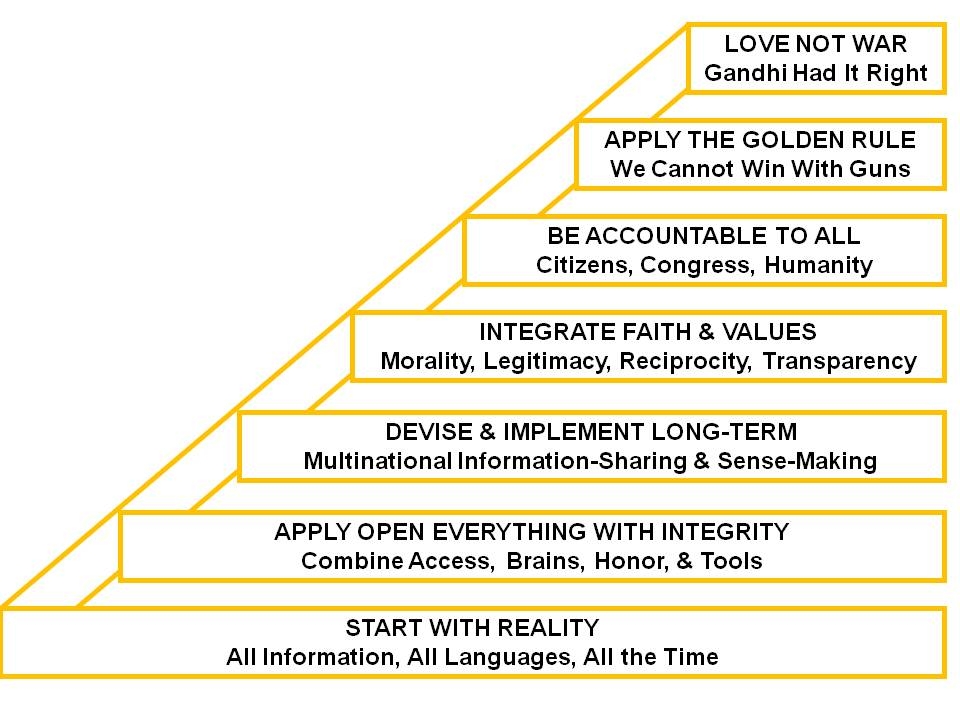
4. Strategic Value of the Idea. The greatest casualty of the Cold War and the Global War on Terror has been the truth. America has become morally and intellectually disengaged from reality.
The truth at any cost lowers all other costs.
The most advanced thinking – far beyond the current concepts of any element of the US Government or any think tank – has converged on the combination of two ideas: Open Source Everything (OSE), and Multinational, Multiagency, Multidisciplinary, Multidomain Information-Sharing and Sense-Making (M4IS2).
Click on Image to Enlarge
5. Operational Implementation of the Idea. The Office of Management and Budget (OMB) has twice before agreed that an OSA is needed, and also agreed that it should be under diplomatic auspices rather than an element of the secret world. The first time the idea was approved was in 2000 by Sean O’Keefe, then Deputy Director of OMB, who felt it appropriate as a Presidential Initiative to be funded at $125M Initial Operating Capability (IOC), toward $2B at Final Operating Capability (FOC). In 2010 Kathleen Peroff, the Associate Deputy Director for National Security, and her colleagues responsible for Program 50 (Military) and Program 150 (International Affairs) reiterated their agreement in principle with the idea, contingent on a Cabinet officer sponsoring the idea. Now we are in severely constrained budget circumstances, and it may be appropriate to start with a smaller pilot project, perhaps $25M for year one, but the idea is so powerful that it should quickly demonstrate that it merits funding as a means of helping the President decide of both cuts and redirections of funding.
Click on Image to Enlarge
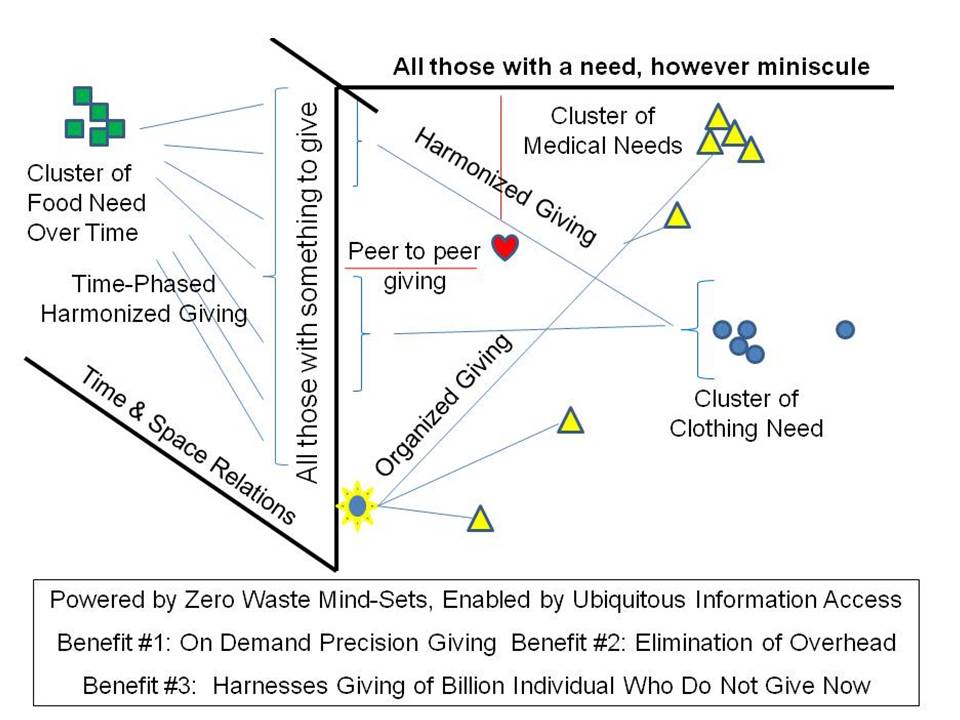
The OSA offers the additional advantage of being able to create a Global Range of Needs Table and a transparent fulfillment dashboard capable of both inspiring donations from the 80% of the one billion rich that do not contribute to charity today; and also capable of holding accountable the Specialized Agencies of the United Nations (UN), the International Committee of the Red Cross (ICRC), and all other non-governmental organizations – as the public “sees” that many of them deliver less than 20% of their total budget to those in need, the Secretary of State will have increased influence over funding from others.
6. Tactical Implementation of the Idea. The original budget, when the OSA was proposed as a Global Engagement capability, was suggested by Keith Hall, then Director of the National Reconnaissance Office (NRO), and former director of the budget staff for the Senate Select Committee on Intelligence. Mindful that the secret world does not do “Global Coverage,” Mr. Hall suggested $10M a year for each of 150 countries and topics not reliably covered – if at all – by the secret world. Congressman Rob Simmons (R-CT-02) and myself added $30M per year for each of the 50 states, to create Community Intelligence Networks that would also help integrate education, intelligence (decision-support) and research across America, creating a Smart Nation. A one-page summary of the Smart Nation Act is attached. At the tactical level we can address three distinct advantages for the Secretary of State of sponsoring the OSA.
Haga clic para ampliar
a. Whole of Government Planning, Programming, and Budgeting. OMB does not manage in the grand strategic sense. The OSA can restore the Secretary of State as the senior Cabinet officer with a mastery of decision support that is as valuable here at home as it is abroad. For the first time, the OSA will provide ethical evidence-based decision-support that treats poverty, infectious disease, and environmental degradation – as well as genocide, trade in women and children, proliferation, and all forms of organized crime – as legitimate intelligence challenges. Decision support that can be shared will mobilize consensus.
Click on Image to Enlarge
b. Common Technical Solutions – Open Source Everything (OSE). Open Government and Open Data are not achievable nationally – nor scalable globally – without an “all in” approach to all the opens. Especially important are Open Cloud, Open Hardware, Open Science, Open Software, Open Spectrum, and Open Standards. A prior endeavor funded by DARPA, STRONG ANGEL, created a suite of collaboration tools on a flash-drive that could be shared with anyone – called TOOZL, it is the first step toward being able to do secure collaboration world-wide with an infinite number of constantly changing information partners.
Click on Image to Enlarge
c. Real Estate – A Once In A Lifetime Opportunity. Congress approved a privately funded Potomac Plaza over the mess of roads between the South-Central Campus and the river. Lauded as a transformative project that would reconnect the city to the river in this sector, the project could be combined with a publicly funded endeavor on the South-Central Campus, putting the OSA there, and funded by the OSA, the other five national educational, intelligence (decision-support) and research endeavors. This will be a tangible manifestation of the Secretary of State’s legacy, a legacy certain to last over a 100 years.
7. Select Planning Group Available. A select group of independent minds are available to discuss this.
Proposed Legislation: The Smart Nation Act
• Within the Department of State, expands the capabilities for Open Government, Citizen Engagement, Participatory Budgeting, Global Engagement and Whole of Government planning, programming, and budgeting, by providing the Secretary of State with oversight authority of the Open Source Agency (OSA) and the Office of Information Sharing Treaties and Agreements.
• Creates an Open Source Agency (OSA), redirecting the necessary funds on a non-reimbursable basis from Program 50 to Program 150, as a sister-agency to the Broadcasting Board of Governors (BBG), with the same arms-length independence that Congress wisely mandated to assure journalist independence, but in this case, to assure the integrity of public intelligence in the public interest across Whole of Government and in all exchanges with foreign and non-governmental entities. The small Headquarters will be constructed on the South-Central Campus, adjacent to both the U.S. Institute of Peace (USIP), which could serve as a partner in global information peacekeeping, and to George Washington University as well as the John F. Kennedy Center conference and parking facilities. All information obtained by open means will be a public good and a copy also provided as acquired to the Director of National Intelligence (DNI), who shall make no claim on the disposition of original open sources and methods. The OSA will be the national proponent for Open Source Everything (OSE) across the education, intelligence (decision-support) and research sectors.
• Creates an Office of Information Sharing Treaties and Agreements, to negotiate no-cost information sharing treaties with Nations, and no-cost information sharing agreements with non-governmental and private sector organizations including universities world-wide, while also adopting OSE standards facilitating both sharing and semantic web sense-making across all languages (33 initially, 183 at full operating capability).
• Creates a Multinational Warning & Decision-Support Center (MWDC) and related global information-sharing and sense-making network.
• Creates a Multinational Multiagency Conference Center to serve as a foundation for local to global outreach and cross-fertilization across all education, intelligence, and research topics.
• In partnership with academic, civil society, and non-profit organizations, creates the World Brain Institute and the Global Game to foster whole systems true cost economics thinking.
• Creates, in partnership with a university providing accreditation and administrative services, a School of Future-Oriented Hybrid Governance, a Horizons College, and a Multidisciplinary Research Consortium.
• Support the Broadcasting Board of Governors (BBG) with an Internet dissemination capability that offers free universal access to all unclassified information acquired by the OSA, with a robust man-machine translation capability that offers free online education in at least 33 major languages and 12 dialects of Arabic as an important new foundation for public diplomacy and information peacekeeping.
• Supports the roles of the Office of Management and Budget (OMB) and the General Services Administration (GSA) as executive level partners of the Open Source Agency, with priority on decision-support from the OSA in support of all federal needs of common concern.
• Expands and enhances the role of the Congressional Research Service (CRS) and the General Accountability Office (GAO) with direct access to all available information, advanced analytic processing tools, and sufficient personnel to provide each jurisdiction of Congress with unclassified decision-support that can be shared with constituents and the media. –o–
By fall, according to the former intelligence official, the senior leadership of the C.I.A. had had enough. “They said, ‘No way. We signed up for the core program in Afghanistan—pre-approved for operations against high-value terrorist targets—and now you want to use it for cabdrivers, brothers-in-law, and people pulled off the streets’ ”—the sort of prisoners who populate the Iraqi jails. “The C.I.A.’s legal people objected,” and the agency ended its sap involvement in Abu Ghraib, the former official said.
The C.I.A.’s complaints were echoed throughout the intelligence community. There was fear that the situation at Abu Ghraib would lead to the exposure of the secret sap, and thereby bring an end to what had been, before Iraq, a valuable cover operation. “This was stupidity,” a government consultant told me. “You’re taking a program that was operating in the chaos of Afghanistan against Al Qaeda, a stateless terror group, and bringing it into a structured, traditional war zone. Sooner or later, the commandos would bump into the legal and moral procedures of a conventional war with an Army of a hundred and thirty-five thousand soldiers.”
The former senior intelligence official blamed hubris for the Abu Ghraib disaster. “There’s nothing more exhilarating for a pissant Pentagon civilian than dealing with an important national security issue without dealing with military planners, who are always worried about risk,” he told me. “What could be more boring than needing the coöperation of logistical planners?” The only difficulty, the former official added, is that, “as soon as you enlarge the secret program beyond the oversight capability of experienced people, you lose control. We’ve never had a case where a special-access program went sour—and this goes back to the Cold War.”
Mali: Special comment. Western news reporters have discovered in Timbuktu confidential guidance documents that the fleeing jihadists failed to destroy.
On the 13th The Telegraph reported that one of its reporters had discovered some confidential documents in the building used by the jihadists in Timbuktu as their command post. One was an account of a meeting in March 2012, but only the first page survived.
According to The Telegraph, the one page document confirmed that al Qaida in the Islamic Maghreb had decided to take command and control of all operations in the Sahara. The Telegraph reporter observed that al Qaida seemed to be very bureaucratic.