Phi Beta Iota: The naive and the unscrupulous emphasis external threats and internal vulnerabilities while glossing over the FACT that this threat was clearly articulated by Winn Schwartau, among others, in 1990, and clearly articulated, in a letter delivered in 1994 to Marty Harris at the National Information Infratructure (NII) reporting to Al Gore, that put together in one place the best possible starting point for securing the entire US cyber-infrastructure with a starting budget of $1 billion a year.
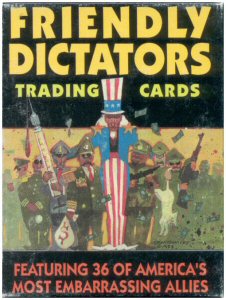
Back in 1989 Bill Sienkiewicz illustrated a deck of cards designed to bring to light some of the sleazier folks that the U.S. government had done deals with. The text on each card was written by Dennis Bernstein and Laura Sydell. I wish there was an updated version covering the last 17 years, but in the meantime I’ve prepared a giant post with the images and text from the pack of cards. (This is an egregious copyright violation, but since these cards have been out of print for more than 15 years, I’m hoping no one will call me on it. If they did, I would–of course–take this down.) This will be a very image-intensive post–as usual, the little pictures are links to the bigger versions.
Here’s the cover from the box:
And this is the “about the creators” text (looking at the current bios for the creators, there has been some interesting career progression since they did this):
DENNIS BERNSTEIN is the Executive Producer of “Undercurrents,” heard daily on WBAI in New York, and nationally on the Pacifica Radio Network. His articles have appeared in The New York Times, The Village Voice, New York Newsday, Spin Magazine, In These Times, Extra!, and others.
LAURA SYDELL has a law degree and is a phi beta kappa graduate of William Smith College. She has reported for National Public Radio’s “All Things Considered”, “Crossroads”, and for the Pacifica Radio Network.
BILL SIENKIEWICZ’s work in Brought to Light has garnered rave reviews from Publisher’s Weekly, The American Library Association Booklist, and The Village Voice. His award-winning artwork can be seen in such comics as Moon Knight, Elektra Assassin, Stray Toasters, and Real War Stories.
In a very oddly worded public response to a question posed to him during an online interview, Barack Obama dances around the topic of using military drones to kill Americans inside of the United States. Watch the following response and as you do, keeping in mind at no point does President Obama simply say NO we would never do that…
Phi Beta Iota: What is frightening is that Obama is incapable of saying, simply, “NO, we will not use drones to kill people inside the USA.” Taken in combination with the various “suicidings” across the USA, the “natural gas” explosions, and many unexplained “disappearances,” an outside observer would be hard-pressed to offer a vote of confidence for this Administration's grasp of the “rule of law.” John Brennan was told, in writing, to get the drones off the table in his opening remarks. He refused to do that. For that reason alone (the willful confirmation that he WANTS the drones unfettered), he should not be confirmed and Congress should mandate an end to the CIA drone program — transfer all of the drones to the military, and turn them into UNARMED organic reconnaissance assets within the Tactical Intelligence and Related Activities (TIARA) Program.
Both the critics and the admirers of the Central Intelligence Agency have tended to portray it as an all-knowing, all-powerful, invulnerable entity and to exaggerate the ability of America's spies to determine the outcome of developments around the world. An American reporter interviewing an ordinary citizen—or an official—in Cairo, Buenos Aires, or Seoul may hear that “everyone knows” that the CIA was behind the latest rise in the price of vegetables or the recent outbreak of flu among high-school kids. It’s like you Americans aren't aware of what's obvious (wink, wink).
New histories of the agency, drawing on recently released classified information and memoirs by retired spies, provide a more complex picture of the CIA, its effectiveness, and its overall power, suggesting that at times Langley was manned not by James Bond clones but by a bunch of keystone cops. My favorite clandestine CIA operation, recounted in Tim Weiner's Legacy of Ashes, involves its 1994 surveillance of the newly appointed American ambassador to Guatemala, Marilyn McAfee. When the agency bugged her bedroom, it picked up sounds that led agents to conclude that the ambassador was having a lesbian love affair with her secretary. Actually, she was petting her two-year-old black standard poodle.
I’ve identified 16 of these game-over situations facing America today, situations from which there is the possibility of no recovery — not the certainty, but the possibility. As I was working on that article though, looking especially what it would take to reverse each trend, I realized it’s really only one story writ 16 times on 16 separate canvasses.
It’s the story, in other words, of worldwide billionaires and the one thing they’re doing — monomaniacly making money while telling each other tales of their Randian goodness.
America’s 16 deadlines
As I said, I see 16 individual, though interlinked, processes in the country today that have potential game-over, irreversible end-points. You may think there are more, or you may think some could be merged, but I think that’s tweakage, “in the noise,” not a useful distinction. For our purposes, this list is good enough.
Here they are, numbered in no particular order, but grouped:
‘The damage we're doing to the Defense Department is enormous'
By Charlie Rose
Someone said to me that, since you received your heart transplant last year, you’re a new man. That you’re mellow, less strident. Is this true?
My family’s accused me of being downright chatty on occasion. I don’t sense that I’m a different personality. A lot of people want to know, “Did your new heart change your political views?” I went from end-stage heart failure, near death, to a new heart. I wake up every morning with a smile on my face in anticipation of a day I never expected to see.
You were in Wyoming last weekend, and you talked about Obama’s new team being “second-rate.” What issues stand out for you?
I’m very concerned about what I see happening in the national security arena. I think the administration’s policies are terribly flawed. I think the damage we’re doing to the Defense Department is enormous with the sequester. I think the president’s performance in the international arena, the Middle East and so forth, is worse than many of my friends and colleagues deem his domestic policies. I see him headed for the exits in the Middle East. We’re getting out of Iraq … getting out of Afghanistan as quickly as he can. We’re jawboning the Iranians on their nuclear program, but at the same time we withdraw one of our carriers from the Persian Gulf.
So you’ve got problems with Obama’s policies—and his nominations of Chuck Hagel and John Brennan.
With respect to Hagel and Brennan, just in the last week their performances in front of the committees that have to confirm them have been pretty poor. And that’s not my judgment. That’s the judgment of senators on both sides of the aisle. When I think of a secretary of defense for a Democratic administration … Sam Nunn. He’s a tremendous talent, enormous experience. Chuck doesn’t have those credentials. He doesn’t have that stature. I think [Obama] wants a Republican to be the foil, if you will, for what he wants to do to the Defense Department, which is to do serious damage to our military capabilities.