DefDog: Bruce Hoffman, the US IC, Bin Laden…Many Contradictions

07 Other Atrocities, 09 Terrorism, Articles & Chapters, Corruption, Government, IO Deeds of War, IO Impotency, Media, Military
DefDog

Bruce is bascially saying that the IC has failed completely…..which we know it has. This also supports my view that the folks who dreamed up the latest air attack are also out of touch with AQ reality. But the media has dumbed down the public enough that they believe almost anything….

The thing I find interesting is that Bruce has openly said that the IC is a failure.  He also raises some questions that would suggest bin Laden was not alive, i.e. the focus on the Arab Spring.  This does not fall into line with UBL as much as it does with Zawahiri….and his Muslim Brotherhood.

As I noted, the fact that someone with Hoffman's stature is questioning the IC should make people pause and reflect on the state of affairs within those halls….

Bruce Hoffman: What Osama Was Thinking at the End

Bin Laden was more fearful that his men might be affected by the weather than by any effort of the Pakistani government to apprehend them.

By releasing 17 documents seized last year from Osama bin Laden's compound in Abbottabad, Pakistan, the U.S. government has supplied a needed corrective to the bunkum that has passed for analysis throughout the war on terrorism's first decade.

For too long, government officials and pundits alike have made extravagant and incorrect claims about the weakness of al Qaeda and the irrelevance of its founding leader.

Continue reading “DefDog: Bruce Hoffman, the US IC, Bin Laden…Many Contradictions”

Robert Steele: Clandestine Operations 101 + Personal Comment

Advanced Cyber/IO, Ethics, Government, Intelligence (government)
Robert David STEELE Vivas

Clandestine Operations 101

Here's how to create a clandestine service that is not the laughing stock of the planet:

00  Stop confusing secure field operations with any need for access to official secrets.  The primary reason CIA is such a mess is the ascendance of security ignorance and myopia combined with sedentary overly fearful managers unable to do anything from outside an official cover safety net.

01  Recruit mid-career US citizens who have unwittingly created their own cover and access.  Do not assign them anything requiring more than 10% of their time.

02  Recruit mid-career non-US citizens, same as above, they never visit HQS or touch secrets not collected by themselves.

03  Get back in the business of Principal Agents (PA) from all countries, same selection concept as above (mid-career, have the cover and access desired).

04  Start doing multinational regional clandestine stations, using indigenous case officers (the Australians and Cambodians seem to have this down pat) while providing close-in technical, money, and leads from the constellation.

05  Be more aggressive (with appropriate caution) in doing what one of my mentors termed “it's just business.”  One time offers based on outcomes, no polygraphs, no approvals from HQS people  out of touch with reality, etcetera.

ON A PERSONAL NOTE

It has come to my attention that someone describing themselves as one of my classmates has said that I nearly killed people in El Salvador, had an accident, and was effectively non-operational from 1982 on.  Since half my class quit within five years, by my calculation there should be no more than one or two of my graduating class (I skipped interims and jumped one class, I remember no one from my EOD class.

Below are the facts, without any grudges.  What I learned from my experiences within CIA remains priceless and has informed my persistent efforts to reform US intelligence.

Continue reading “Robert Steele: Clandestine Operations 101 + Personal Comment”

DefDog: CIA Claims Double-Agent, New Set of Explosive Underpants

07 Other Atrocities, 09 Justice, 09 Terrorism, 10 Security, 11 Society, Corruption, Government
DefDog

Double agent infiltrated AQAP bomb plot?

This whole thing leaves me believing that something rotten is going on in Langley…..from my work I know the following:

AQ did not conduct operations based on historical dates.  Infiltrating AQ was the hardest task we faced. In fact, the CIA and other IC elements always preached that it was almost impossible to insert a double into the mix, it just required too much on our part. Now we have a success by a double agent?

Not sure, but to me it just doesn't add up..

Associated Press: CIA foils another Al Qaeda underwear bomb plot

The Central Intelligence Agency successfully thwarted an Al Qaeda plot to use a sophisticated underwear bomb to bring down a U.S. airliner around the one-year anniversary of Osama bin Laden’s death, the Associated Press reported yesterday.

. . . . . . .

According to the AP report, the Yemen-based suicide bomber had not selected a target or purchased purchase plane tickets when U.S. intelligence officials seized the device. It is unclear what happened to the would-be suicide bomber.

. . . . . . .

White House Press Secretary Jay Carney said that the President was aware of the plot since early April and “at no time were Americans in danger as a result of this.”

Read full article.

Al-Qaeda underwear bomber ‘was US double agent'

Reports from the US say the would-be suicide attacker in a foiled “underwear bomb” plot was in fact a double agent.

US officials are quoted as saying that the person dispatched by Yemen-based al-Qaeda to attack a US-bound plane had infiltrated the group.

In an apparent intelligence coup, the agent left Yemen with the device and delivered it to the CIA.

Read rest of article.

See Also:

Journal: National Counterterrorism Center (NCTC) Goes from Dumb to Dumber

Journal: Underpants Bomber Shines Light on Naked USG–Without Four Reforms, USA Locked in Place

Mini-Me: Every Terrrorist Either a CIA / FBI Patsy or Israeli False Flag? (Except Khost) + RECAP

WIkipedia / Umar Farouk Abdulmutallab

Reference: Defense and Energy Deficit Reduction: $688 Billion

03 Economy, 04 Inter-State Conflict, 05 Energy, 07 Other Atrocities, 08 Proliferation, 09 Justice, 10 Security, 11 Society, Budgets & Funding, Commercial Intelligence, Corruption, General Accountability Office, Government, Military, Office of Management and Budget, Officers Call

POGO Source Page, May 8, 2012

national security spending

Wasteful Spending in the Department of Defense Budget
Wasteful Spending on Nuclear Weapons Programs
Service Contracts
Conclusion
Endnotes

Americans are tightening their belts, and it’s time for the U.S. government to do the same. In light of the Budget Control Act of 2011 and the subsequent failure of the “Super Committee,” Congress is still desperately seeking ways to reduce spending. To this end, the Project On Government Oversight and Taxpayers for Common Sense have closely examined the proposed national security budget[1] and found plenty of wasteful spending. Adjusted for inflation, U.S. national security spending is higher than at any point during the Cold War and accounts for more than half of all discretionary spending.[2] However, the U.S. faces no existential threats as it did then, and U.S. defense needs are changing as the military draws down its presence in Iraq and Afghanistan.

Still, military spending at the Department of Defense (DoD) has increased by an astounding 95 percent from FY 2001 to the FY 2013 estimate, adjusted for inflation.[3] Nuclear weapons spending at the Department of Energy (DOE) is projected to grow by billions of dollars over the next decade.[4] And the federal government’s reliance on contractors, most of whom work on national security-related work and cost on average nearly twice as much as the federal workers who do the same job, is also driving budgets through the roof.[5] It’s clear that any serious proposal to shrink the U.S. deficit must include cuts to the national security budget.

The following list updates our recommendations from 2011[6] and details nearly $700 billion in savings over the next ten years, including cuts to wasteful weapons systems as well as limits on out-of-control contract spending. We found programs for which there are cheaper yet equally effective alternatives, and programs that can be cancelled or delayed without putting America’s security at risk.

The Project On Government Oversight is a nonpartisan independent watchdog that champions good government reforms. POGO’s investigations into corruption, misconduct, and conflicts of interest achieve a more effective, accountable, open, and ethical federal government.

Taxpayers for Common Sense is a nonpartisan budget watchdog serving as an independent voice for American taxpayers. Its mission is to achieve a government that spends taxpayer dollars responsibly and operates within its means. TCS works with individuals, policymakers, and the media to increase transparency, expose and eliminate wasteful and corrupt subsidies, earmarks, and corporate welfare, and hold decision makers accountable.

Wasteful Spending in the Department of Defense Budget

Continue reading “Reference: Defense and Energy Deficit Reduction: $688 Billion”

NIGHTWATCH: European Election Updates – Crowds Against Corruption

Civil Society, Collective Intelligence, Corruption, Government

Election Updates:

France: As expected, Francois Hollande is the new president of France. In his victory speech on 6 May, Hollande said “…austerity cannot be the only option.”

Greece: As expected, no party won a majority. The conservative New Democracy Party obtained the most votes, followed by a coalition of leftist parties and then the Socialists. Nevertheless, the New Democracy and Socialist Parties both sustained an enormous reduction in popular support. The magnitude of the anti-austerity vote was described as a volcanic eruption by Greek political analysts.

On 7 May the New Democracy Party failed in its attempt to form a coalition government. The second place party, the Coalition of the Radical Left rejected the New Democracy's offer. The leader of the Coalition, AlexisTsipras, said the parties that make up his coalition are in opposition and demand that the austerity measure be canceled.

The Greek President has asked the Coalition of the Radical Left to form a government. If it fails, the Socialists will be asked. coalition with the conservative New Democracy (ND) party, AP reported May 7. After talks with ND leader Antonis Samaras, Alexis Tsipras said the parties are in opposition and demanded that austerity measures be canceled.

Comment: The popular mood is dark. A neo-Nazi party won 7% of the vote which will entitle it to have representation in parliament for the first time. Expect street disorders.

German reaction also is as expected. Germany will not work to change Europe's compact on budget discipline and rejects growth measures that increase debt levels, government spokesman Steffen Seibert said on 7 May.

New negotiations of the fiscal compact are not possible, Seibert said, adding that growth should come through structural reforms, not through new debt. Greece must implement reforms it agreed to as part of its bailout package. The agreements represent Greece's best path forward and Athens must adhere to them, Seibert said.

Die Welt's editorial wrote,

“Both Hollande and the Greek opposition are serving people's desire for a fundamental change in political and social conditions, which are mainly attributed to the most powerful woman in Europe: Chancellor Angela Merkel.”

“They were voting against a tight rein on states by a central authority in Brussels, against the loss of democracy through ‘expert government'. These elections were a clear rejection of the Angela Merkel's system in Europe.”

Comment: Teutonic sternness is more likely to be incendiary than helpful. Die Welt has the right of it. The eurozone experiment is proving unsustainable against the sentiment for utopian and egalitarian solutions. The economies do not mesh. The regime of the bankers and bureaucrats in Brussels is under threat.

NIGHTWATCH KGS Home

Josh Kilbourn: US Disability & Food Stamp Welfare Skyrocketing

03 Economy, 11 Society, Corruption, Government
Josh Kilbourn

Two Charts Exposing America's Record Shadow Welfare State

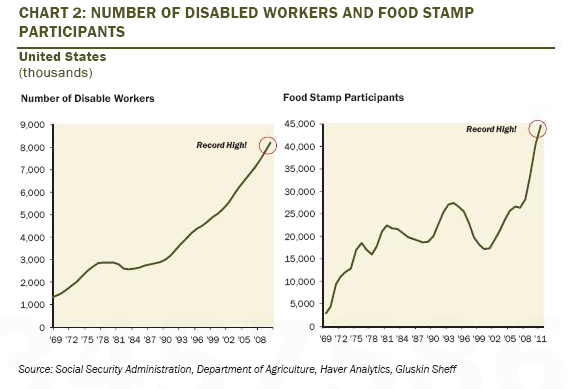
Here was a little mentioned tangent to last Friday's very disappointing NFP print of +115,000 (driven by a surge in temp jobs offsetting a collapse in full time positions): as David Rosenberg notes, the jobs number was about half of another far more important number – that of Americans applying for disability, which in April was +225,000. He continues: “this is the new stealth stimulus program – so far in 2011, nearly one million Americans have applied for disability and year-to-date, 333k have actually enrolled (covering 539k family members). In total, more than five million people have been added to disability coverage since President Obama took over three years ago.”

Click on Image to Enlarge

The punchline will make all those who adore (insolvent) welfare states shake with giddy delight: “So look – either safety standards at work have eroded dramatically or the “99%” have found a creative way to milk the system and turn the economy into a quasi welfare state“…. Yup. What he said. Because remember: the BLS assumes that any amount up to the total 53 million people, is not in the labor force as they have other “wefare” based forms of government handouts and see no need at all to look for a job. Is there any wonder why US unemployment is realistically 20% if not much higher? As for the other chart, food stamps, we know that story all too well.

See Also:

Paul Craig Roberts: December Net Jobs a 12,000 LOSS – Actual Unemployment 2.6 Times Official Rate or 22.4%

Chuck Spinney: Neo-Liberalism Actually Neo-Serfdom

Commerce, Corruption, Government
Chuck Spinney

One of the pillars of the neo-liberal economic policies adopted by Republicans and Democrats alike in the UK and the US is privatization of government services on the theory that free market pressures will generate greater economic efficiencies.  The UK is a case study of how neo-liberal privatization policies promoted by Thatcher, Blair, and Cameron, (and in the US by Reagan, Clinton, Bush II, and maybe Obama) are changing the distribution of economic power.  The attached article by James Meek, which was brought to my attention by my good friend Andrew Cockburn, is a short and not-so-sweet analysis of how the looters in the UK and the US are selling the people into a 21st Century variation of peonage.

Chuck Spinney

Human Revenue Stream 

James Meek, London Review of Books, 20 March 2012

The privatisations are joining up. First it was gas. Then telecoms, oil, electricity, public housing, water, the railways, the airports. There are moves afoot to obliterate the concept of the council house; NHS hospitals are to be privately run, built and managed; now David Cameron wants to get private companies and foreign governments to ‘invest’ in Britain’s roads. What does it all mean? The episodic character of privatisation – one sector being sold, then a pause, then another – has hidden a meta-privatisation that’s passed the halfway point. The essential public good that Margaret Thatcher, Tony Blair and now Cameron sell is not power stations, or trains, or hospitals. It’s the public itself. It’s us.

The commodity that makes water and roads and airports valuable to an investor, foreign or otherwise, is the people who have no choice but to use them. We have no choice but to pay the price the tollkeepers charge. We are a human revenue stream; we are being made tenants in our own land, defined by the string of private fees we pay to exist here. If it’s not obvious that we’re being sold to investors, it’s partly because the idea of privatisation is sold so hard to us, in a way that is hypnotically familiar.

  • First, the denigration of the existing service, as if a universally accepted truth is being voiced: the schools/hospitals/roads are crumbling/failing/ second-class.
  • Then, the rejection of government responsibility: we’ve no money/bureaucrats are incompetent.
  • Finally, the solution: private investment.

And that investment does come, and things get shinier. Surely if the private sector weren’t replacing our old sewers, and won’t replace our old motorways and power stations, we’d need to pay higher taxes instead? The truth is that we already do pay higher taxes. They just aren’t called taxes. Our water supply system is being upgraded because of a huge water tax increase. But it isn’t called that. It’s called ‘the water bill’. As Chris Giles explained yesterday in the FT, water bills have gone up by nearly twice as much as inflation since privatisation. We pay a rail tax: it’s called ‘fare increases’. We pay an energy tax in the form of higher electricity bills, and so on.

By packaging British citizens up and selling them, sector by sector, to investors, the government makes it possible to keep traditional taxes low or even cut them. 

By moving from a system where public services are supported by general taxation to a system where they are supported exclusively by the fees people pay to use them, they move from a system where the rich are obliged to help the poor to a system where the less well-off enable services, like a road network, that the rich get for what is, to them, a trifling sum.

Will there be a revolt?

There was one in the 1990s, on the Isle of Skye. Ostensibly, the private sector was going to build something the people of the island would not have had otherwise: a road bridge to the mainland, replacing the old ferry. The islanders understood what was actually happening. They were being sold as revenue stream. Instead of the bridge being built from a tiny fraction of the government budget, it was built by a private firm, which had been promised that it would be able to gouge the islanders with hefty tolls. Less general tax for British taxpayers: a huge private tax for Skye islanders.

A long campaign of civil disobedience ended in victory for the islanders when in 2004, against the tide of history, the bridge was nationalised. Skye is a small island. Britain is a big one. The plan’s the same. Let’s see what happens.

Phi Beta Iota:  Emphasis added above.

See Also:

We the People Reform Coalition

noble gold