Given Nato's political problems with Pakistan, the Brits have elected to leave Afghanistan along the so-called Northern route to the Baltic Sea (see my 27 November posting, Afghan Dunkirk for discussion of the selection). Now, as Bryan Brady and Jonathan Owen report in the Independent, the entirely predictable baksheesh game has begun.
Think of what the far larger, more logistics-intensive US forces might have pay to who ever guards our egress route. Historians will recall that egress problem is not a one new for foreign invaders of Afghanistan. Alexander the Great had to bribe a Pashtun tribe to clear guerrillas fighters( from another tribe) who were blocking his exit thru the Khyber Pass when he left Afghanistan to go to India. My guess — entirely speculative — is that they split the difference and had a good laugh after Alex departed — but we will never know.
Britain is bargaining with one of the world's most brutal dictators because we need to use his country as a transit route to bring thousands of tons of military equipment home from Afghanistan.
Senior officials admitted yesterday that Uzbekistan's President Islam Karimov had the UK “over a barrel”, after his country emerged as the favoured route home when British forces are withdrawn from Afghanistan by 2014.
The PR disasters over the last three months — including pictures of American troops urinating on Afghan corpses, the burning of Qurans, and the massacre of Afghan civilians, including women and children, by at least one deranged American soldier — have morphed into a grand strategic debacle. From the perspective of the Afghan insurgency, these are gifts that will keep on giving.
Why do I use the modifier grand strategic?
Because these incidents have (1) increased the moral strength of the Afghan insurgents by handing them a coup to rally supporters and attract the uncommitted to their cause. They also widen the existing rift between the United States military and the Karzai government, which in any case is viewed by many Afghans as a corrupt, illegitimate, quisling lapdog of the US. And (2), they are visibly weakening the rapidly crumbling solidarity at home. Recent polls in America, for example, suggest the already overwhelming majority of Americans who now think it is time to exit the Afghan enterprise is growing again. Moreover, an increasing number of politicians and editorial boards are now beginning to reflect the views of the majority of American people. These incidents have magnified the already widespread perceptions among Afghans of a grotesque mismatch between the ideals we profess uphold and what we do.
The politics of fear in insecurity are now the staple of American politics. They were used habitually during the Cold War to create powerful vested interests in a permanent war economy. These interests are clearly reflected in the pattern of political practices of the Military – Industrial – Congressional Complex (MICC) that maintains and increases the flux of money flowing through the MICC. It is this flux that gives the MICC its from and vitality.
By 1990, the MICC's political practices had been honed to the point that they became self-sustaining and the cold-war-level defense budget proved impossible to turn off when the Cold War ended and the grossly inflated Soviet threat evaporated in 1991. In the Pentagon, we sarcastically referred to the unstoppable budget steamroller as the Pentagon's self-licking ice cream cone.[1]
The self-licking ice cream cone was in place, morphed, and survived. An after some some fits and starts in alternative threat inflation options during the 90s (e.g., the wars of the Yugoslav Succession, theories of being a indispensable power and humanitarian intervention), 9-11 provided the MICC with a political cover to morph its marketing appeal into fighting what it called the long war on terror. But 9-11 was also exploited cynically as a justification to create another political cash cow, which can be though of as domestic spinoff to the MICC, since many of the same players are involved — the Department of Homeland Security (DHS), thus expanding the MICC's network of vested interests and bringing them more directly into the domestic arena. The attached op-ed in the Guardian by Naomi Wolf gives a hint of where this evolution is headed — and if you think she is being alarmist, note particularly her brief description of DHS's emerging self-licking ice cream cone (highlighted in yellow near the end of her essay).
The long war in terror may be winding down, and the alleged need for a DHS is evaporating, but like the MICC, the ‘DHS self licking ice cream cone' is likely to exhibit the kind of adaptability needed live on in a pathological mutation of its supposed intent. [2]
For those readers with a synthetic bent of mind, think about the implications of Wolf's op-ed in the context of the questions I will pose at the end of the next blaster.
————–
[1] New readers will find detailed albeit overlapping explanations of how the MICC's self-licking ice cream cone operates here, here, here, and here.
[2] There is another, more subtle dimension to the these political-economic evolutions: Over time, the economically pathological but politically expedient practices of the MICC undermined the commercial competitiveness of the manufacturing companies involved in weapons making. The employees and owners of these companies became ever more dependent on government money flows for their survival and growth. But, as Seymour Melman correctly predicted in his 1983 book Profits Without Production, the MICC's practices also contributed materially, together with deleterious effects of financialization, deregulation, speculation, and globalization, to deindustrialize and hollow out the high-income US economy. This political-economic evolution led directly to the Wall Street Casino that crashed in 2007-8. It is now clear that the pathological transformation of the great American economic engine took off in the late 70s, and it produced the stagnation of middle class wages and the grotesque inflation of the income disparity between and poor and rich, especially the super rich that lies at or very near root of our economic problems. So, the politics of fear are now melded seamlessly with the politics of economic insecurity (reflected in dependency, anger, and scapegoating) to shape the political discourse of the lower 80% (who are struggling to make ends meet and provide a future for their children while paying off a huge debt burden) as well as the super rich who fear the masses will rise up against them to take their wealth … it is this melding that is feeding the political and legal selection pressures underpinning the kind of evolution described by Ms. Wolf.
n a five-four ruling this week, the supreme court decided that anyone can be strip-searched upon arrest for any offense, however minor, at any time. This horror show ruling joins two recent horror show laws: the NDAA, which lets anyone be arrested forever at any time, and HR 347, the “trespass bill”, which gives you a 10-year sentence for protesting anywhere near someone with secret service protection. These criminalizations of being human follow, of course, the mini-uprising of the Occupy movement.
Is American strip-searching benign? The man who had brought the initial suit, Albert Florence, described having been told to “turn around. Squat and cough. Spread your cheeks.” He said he felt humiliated: “It made me feel like less of a man.”
In surreal reasoning, justice Anthony Kennedy explained that this ruling is necessary because the 9/11 bomber could have been stopped for speeding. How would strip searching him have prevented the attack? Did justice Kennedy imagine that plans to blow up the twin towers had been concealed in a body cavity? In still more bizarre non-logic, his and the other justices' decision rests on concerns about weapons and contraband in prison systems. But people under arrest – that is, who are not yet convicted – haven't been introduced into a prison population.
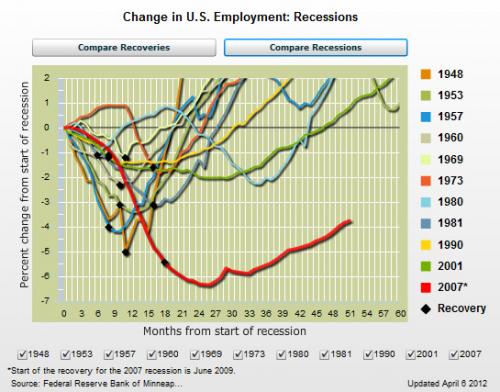
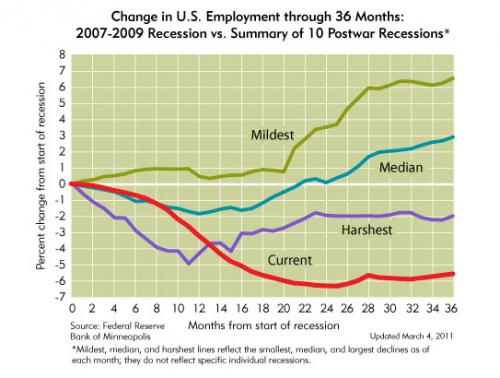
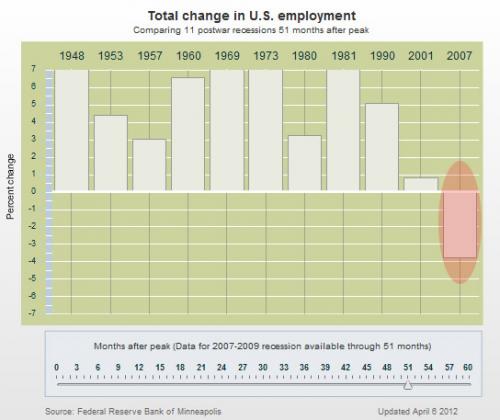
Recovery? What Recovery? 4 years after central banks have progressively injected over $7 trillion in liquidity into the global markets (and thus, by Fed logic, the economy), and who knows how many trillion in fiscal aid has been misallocated, to halt the Second Great Depression which officially started in December 2007, the US “recovery” is the weakest in modern US history! How many more trillions will have to be printed (and monetized) before the central planners realize that fighting mean reversion by using debt to defeat recore debt, just doesnt't work? Our guess – lots.
Incidentally, the US has now generated 3 million jobs since the trough of the recession in September 2010, until which point it had previously lost 8 million. Unfortunately, since the real labor force has grown by 4.6 million over the same period, or at the conventionally accepeted 90,000 labor pool entrants per month for 51 months, despite what the BLS may say, because America is after all growing, this means that the Obama administration has created a negative 1.6 million jobs net of demographics, which in turn have cost the US a modest $5.1 trillion in new debt, or an even modest $3.1 million in debt for every job lost.
Chart 1 – the current “recovery” in the context of all previous ones:
Click on Image to Enlarge
Chart 2 – Min, Max and Average… and now
Click on Image to Enlarge
Chart 3 – in bar chart format
Click on Image to Enlarge
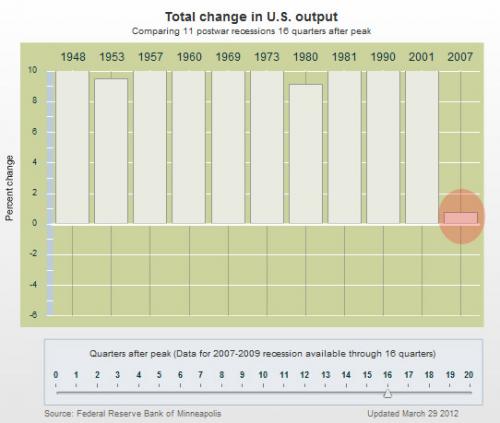
Chart 4 – There is good news: 16 quarters after the start of the recession, US output has turned positive. Just barely.
Click on Image to Enlarge
Phi Beta Iota: What is one to do when the government, with the full complicity of the two parties that monopolize power through various illegitimate means, the full complicity of the five major media corporations whose “mouthpieces” bury their intelligence along with their integrity, all lie to the public? Have we really become a nation of idiot sheep? At what point is the government impeachable for lies to the public?
Dale R. Corson, a nuclear physicist who died last week, is best remembered as the Cornell University President who peacefully led his campus through the turmoil and upheaval of the Vietnam era. But he also played an influential role in deliberations over the role of secrecy in scientific research.
Dr. Corson chaired a 1982 committee of the National Academy of Sciences that produced a landmark study entitled “Scientific Communication and National Security,” which became known as the Corson Report.
In sober and measured tones, the Corson Report pushed back against calls for increased secrecy in government-funded science:
“Current proponents of stricter controls advocate a strategy of security through secrecy. In the view of the Panel security by accomplishment may have more to offer as a general national strategy. The long-term security of the United States depends in large part on its economic, technical, scientific, and intellectual vitality, which in turn depends on the vigorous research and development effort that openness helps to nurture… Controls on scientific communication could adversely affect U.S. research institutions and could be inconsistent with both the utilitarian and philosophical values of an open society.”
President Reagan cited Dr. Corson in National Security Decision Directive 189, “National Policy on the Transfer of Scientific, Technical and Engineering Information,” which seemed to affirm that fundamental research should remain unrestricted to the maximum extent possible. In fact, however, that directive imperfectly reflected the input of the Corson Report, noted Harold C. Relyea in his book “Silencing Science: National Security Controls and Scientific Communication.”
Still, many of the issues identified by Dr. Corson and his colleagues, and the concerns they expressed, remain current today and have not reached an unequivocal resolution, as evidenced most recently by the latest U.S. government policy on dual use biological research.
The US State Department has become the world’s leading user of ediplomacy. Ediplomacy now employs over 150 full-time personnel working in 25 different ediplomacy nodes at Headquarters. More than 900 people use it at US missions abroad.
Ediplomacy is now used across eight different program areas at State: Knowledge Management, Public Diplomacy and Internet Freedom dominate in terms of staffing and resources. However, it is also being used for Information Management, Consular, Disaster Response, harnessing External Resources and Policy Planning.
In some areas ediplomacy is changing the way State does business. In Public Diplomacy, State now operates what is effectively a global media empire, reaching a larger direct audience than the paid circulation of the ten largest US dailies and employing an army of diplomat-journalists to feed its 600-plus platforms. In other areas, like Knowledge Management, ediplomacy is finding solutions to problems that have plagued foreign ministries for centuries.
The slow pace of adaptation to ediplomacy by many foreign ministries suggests there is a degree of uncertainty over what ediplomacy is all about, what it can do and how pervasive its influence is going to be. This report – the result of a four-month research project in Washington DC – should help provide those answers.
ROBERT STEELE: Fergus Hanson of Australia has done a truly superb job of describing the considerable efforts within the Department of State to achieve some semblance of electronic coherence and capacity. What he misses–and this does not reduce the value of his effort in the slightest–is the complete absence of strategy or substance within State, or legitimacy in the eyes of those being addressed. If the Department of State were to demand the pre-approved Open Source Agency for the South-Central Campus, and get serious about being the lead agency for public intelligence in the public interest, ediplomacy could become something more than lipstick on the pig. The money is available. What is lacking right now is intelligence with integrity in support of global Whole of Government strategy, operations, tactics, and technical advancement (i.e. Open Source Everything).