
Joshua Kilbourn: ShadowStats Truth on Unemployment versus USG Lies

03 Economy, Corruption, Government
Josh Kilbourn

John Williams – Unemployment Rate at a Staggering 22.2%

John Williams, of Shadowstats, notes that manipulated government statistics are not changing the fact that the true SGS Unemployment Measure now sits at a staggering 22.2%.  Williams also demonstrates that despite the hype from Wall Street about a recovery, parts of the economy remain collapsed.  Here is what Williams had to say about the situation:  “Adding the SGS estimate of excluded long-term discouraged workers back into the total unemployed and labor force, unemployment—more in line with common experience as estimated by the SGS-Alternate Unemployment Measure—notched lower to 22.2% in March from 22.4% in February.”
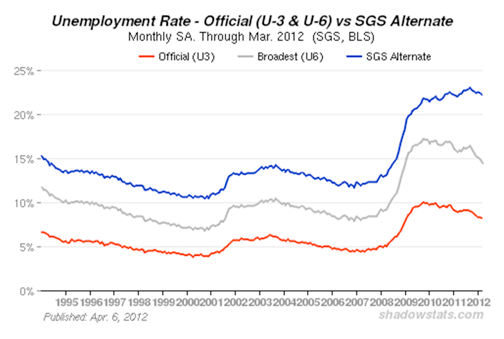
Click on Image to Enlarge

John Williams continues:

“The SGS estimate generally is built on top of the official U.6 reporting, and tends to follow its relative monthly movements. Accordingly, the SGS measure will suffer some of the current seasonal-adjustment woes afflicting the base series, such as recent distortions in adjusted reporting of part-time employment for economic reasons.  Nonetheless, there continues to be a noticeable divergence in the SGS series versus U.6.  The reason for this is that U.6, again, only includes discouraged workers who have been discouraged for less than a year.


As the discouraged-worker status ages, those that go beyond one year, fall off the government counting, and new workers enter “discouraged” status.  Accordingly, with the continual rollover, the headline workers flow into the short-term discouraged workers counted in U.6 continue, and from U.6 into long-term discouraged worker status (SGS Measure) at what appears to be an accelerating pace.

Continue reading “Joshua Kilbourn: ShadowStats Truth on Unemployment versus USG Lies”

Winston Wheeler: Lies, Damn Lies, & Panetta-Pentagon Criminal Insanity

Budgets & Funding, Corruption, DoD, Government, Military
Winslow Wheeler

Cost growth in the last year in DOD's acquisition system was $74 billion, 34 percent more than the $55 billion presumed to occur in the sequester in January; while the time frames are different (see discussion below), so much for Secretary of Defense Panetta's asinine rhetoric that sequester would be a “Doomsday.”

Analysis of two recent acquisition reports is available at Time's Battleland blog at http://battleland.blogs.time.com/2012/04/09/lies-damn-lies-and-pentagon-budget-numbers/

and below.

Cost growth in the last year in DOD's acquisition system was $74 billion, 34 percent more than the $55 billion presumed to occur in the sequester in January; while the time frames are different (see discussion below), so much for Secretary of Defense Analysis of two recent acquisition reports is available at Time's Battleland blog at http://battleland.blogs.time.com/2012/04/09/lies-damn-lies-and-pentagon-budget-numbers/ and below.

Lies, Damn Lies, and The Pentagon's Latest Budget Numbers

By Winslow Wheeler | April 9, 2012 | +
Leon Panetta in Drag

There's a pair of must-reads just out for anyone paying attention to the Pentagon's acquisition nightmare: one is a routinely scheduled, but important, report from the Defense Department; the other comes from one of the very few entities doing even minimal oversight of the Department of Defense these days, the Government Accountability Office.

Reviewing the reports separately results in a muddled picture of how the Pentagon buys its weapons. Happily, each report fills some of the data missing in the other. But, the two reports still leave some gaping holes, while providing a false impression of progress in the way the Defense Department buys weapons.

The two reports are GAO's annual review of major hardware acquisition, Defense Acquisitions: Assessments of Selected Weapon Programs, and DoD's new Selected Acquisition Report (SAR), both released March 30. What follows is my own After-Action Report – including the gaps, contradictions, and false assurances – after studying the data they do – and don't – contain.

The Death Spiral is Alive and Well

Continue reading “Winston Wheeler: Lies, Damn Lies, & Panetta-Pentagon Criminal Insanity”

Patrick Meier: Does the Humanitarian Industry Have a Future in The Digital Age?

Blog Wisdom, Civil Society, Collective Intelligence, Commerce, Commercial Intelligence, Cultural Intelligence, Earth Intelligence, Geospatial, Gift Intelligence, Government, info-graphics/data-visualization, InfoOps (IO), International Aid, IO Impotency, Methods & Process, microfinancing, Mobile, Non-Governmental, Peace Intelligence, Threats
Patrick Meier

Does the Humanitarian Industry Have a Future in The Digital Age?

I recently had the distinct honor of being on the opening plenary of the 2012 Skoll World Forum in Oxford. The panel, “Innovation in Times of Flux: Opportunities on the Heels of Crisis” was moderated by Judith Rodin, CEO of the Rockefeller Foundation. I've spent the past six years creating linkages between the humanitarian space and technology community, so the conversations we began during the panel prompted me to think more deeply about innovation in the humanitarian space. Clearly, humanitarian crises have catalyzed a number of important innovations in recent years. At the same time, however, these crises extend the cracks that ultimately reveal the inadequacies of existing humanita-rian organizations, particularly those resistant to change; and “any organization that is not changing is a battle-field monument” (While 1992).

These cracks, or gaps, are increasingly filled by disaster-affected communities themselves thanks in part to the rapid commercialization of communication technology. Question is: will the multi-billion dollar humanitarian industry change rapidly enough to avoid being left in the dustbin of history?

Crises often reveal that “existing routines are inadequate or even counter-productive [since] response will necessarily operate beyond the boundary of planned and resourced capabilities” (Leonard and Howitt 2007). More formally, “the ‘symmetry-breaking' effects of disasters undermine linearly designed and centralized administrative activities” (Corbacioglu 2006). This may explain why “increasing attention is now paid to the capacity of disaster-affected communities to ‘bounce back' or to recover with little or no external assistance following a disaster” (Manyena 2006).

Continue reading “Patrick Meier: Does the Humanitarian Industry Have a Future in The Digital Age?”

Yoda: When Intelligence Loses It’s Integrity, It Is Not Intelligence

Commerce, Corruption, Government, IO Impotency, Military
Got Crowd? BE the Force!

Peak Intel: How So-Called Strategic Intelligence Actually Makes Us Dumber

An industry that once told hard truths to corporate and government clients now mostly just tells them what they want to hear, making it harder for us all to adapt to a changing world — and that's why I'm leaving it.

Eric Garland

The Atlantic, 5 April 2012

I recently quit my job as a “futurist” and “strategic intelligence analyst” after a successful 15-year career of writing books and consulting to corporations and governments around the world. I spent a decade and a half analyzing disruptive new technologies, predicting the effects of the Internet on the international construction industry, helping executives decide whether to spend billions in the nuclear power market, profiling the customer of the future — and training thousands of executives to do likewise for their own companies. It was exciting and fulfilling, but this is the end of the road.  My employment status is interesting to nobody except my wife and I, but why I am leaving the business of intelligence is important to everybody, because it stems from the endemic corruption of how decisions are made in our most critical institutions.

I am not quitting this industry for lack of passion, as I still believe — more than ever — in using good information and sophisticated analytical techniques to decode the future and make decisions. The problem is, the market for intelligence is now largely about providing information that makes decision makers feel better, rather than bringing true insights about risk and opportunity. Our future is now being planned by people who seem to put their emotional comfort ahead of making decisions based on real — and often uncomfortable — information. Perhaps one day, the discipline of real intelligence will return triumphantly to the world's executive suites. Until then, high-priced providers of “strategic intelligence” are only making it harder for their clients — for all of us — to adapt by shielding them from painful truths.

Continue reading “Yoda: When Intelligence Loses It's Integrity, It Is Not Intelligence”

Richard Wright: Washington Post – No Memory on Iraq & No Integrity on Iran

05 Iran, 08 Wild Cards, 10 Security, Government, IO Impotency, Media
Richard Wright

An Mini-Me would say, “Huh”?

US intelligence gains in Iran seen as boost to confidence

By Joby Warrick and Greg Miller

The Washington Post
Published: April 8, 2012

More than three years ago, the CIA dispatched a stealth surveillance drone into the skies over Iran.

The bat-winged aircraft penetrated more than 600 miles inside the country, captured images of Iran’s secret nuclear facility at Qom and then flew home. All the while, analysts at the CIA and other agencies watched carefully for any sign that the craft, dubbed the RQ-170 Sentinel, had been detected by Tehran’s air defenses on its maiden voyage.

“There was never even a ripple,” said a former senior U.S. intelligence official involved in the previously undisclosed mission.

CIA stealth drones scoured dozens of sites throughout Iran, making hundreds of passes over suspicious facilities, before a version of the RQ-170 crashed inside Iran’s borders in December. The surveillance has been part of what current and former U.S. officials describe as an intelligence surge that is aimed at Iran’s nuclear program and that has been gaining momentum since the final years of George W. Bush’s administration.

Continue reading “Richard Wright: Washington Post – No Memory on Iraq & No Integrity on Iran”

John Steiner: Young Americans Sue US Government Over Environment

03 Environmental Degradation, Corruption, Government
John Steiner

Subject: S.O.S. from the youngest generation

³Industry has a legally protected cognizable interest to freely emit CO2.²  Fossil Fuel Industry Intervenors in the Kids vs Global Warming lawsuit against the US Government to protect the atmosphere as a public trust, April
2, 2012

This is what one of the attorneys for the National Association for Manufacturers said at the hearing this week when they were allowed to join the US Government in defending their so-called ³right² to continue emitting as much CO2 as they please.  Alec Loorz and the other youth plaintiffs, are challenging that right with their own right, one they share with their entire generation, to simply survive on this planet.

http://www.imattermarch.org/#!lawsuit

The judge and all attorneys agreed on one thing:  this is a case of national significance.  We are facing a historic moment.  This lawsuit is a critical and unprecedented opportunity to break the impasse in Congress and force federal emission reduction plans.

Continue reading “John Steiner: Young Americans Sue US Government Over Environment”

Marcus Aurelius: Defense Spending Contradictions – Panetta’s Week-Ends versus TRICARE Cuts

Corruption, Government, Media
Marcus Aurelius

So, proposed TRICARE fee increases are intended to cover costs of SECDEF's weekend trips home?  Would not be surprised.

CNN
April 6, 2012

A $32,000 Trip Every Weekend

The Situation Room (CNN), 5:00 P.M.

JOE JOHNS: Imagine working in Washington Monday through Friday then flying home almost every weekend to California. That’s a weekly ritual for Defense Secretary Leon Panetta, and get this, he does it for the most part on the taxpayers’ dime.

CNN Pentagon correspondent Barbara Starr is back with that story.

Double duty for you today, Barbara.

BARBARA STARR: Indeed, Joe. Well, you know, look, here at the Pentagon it’s all about cutting the budget, trying to save billions of dollars, so why are taxpayers paying nearly $1 million for Defense Secretary Leon Panetta to fly home on the weekends?

Continue reading “Marcus Aurelius: Defense Spending Contradictions – Panetta's Week-Ends versus TRICARE Cuts”

noble gold