What is the one thing?
L. Shaw Mitchell, Occupy South Carolina
Full text below the line for ease of online translation.
Continue reading “Reference: What Is the One Thing? On Democracy”

The truth at any cost lowers all other costs — curated by former US spy Robert David Steele.
What is the one thing?
L. Shaw Mitchell, Occupy South Carolina
Full text below the line for ease of online translation.
Continue reading “Reference: What Is the One Thing? On Democracy”

How can you help your community build a resilient energy system? One of the first steps is to buy back the energy system from the regional power company by condemning it and then municipalizing it (it can be run as a power co-op or as a standard company … The structure really depends on the community.). This moves provides you with the control of the local grid so that your community can:
All of the benefits listed above will double or treble in importance as the global economy nose dives into depression over the next couple of years. So, it's better to get started early than later.
Here's a few links from the Boulder Colorado effort to condemn and municipalize it's power. A combo of bad service and a low level of renewables use prompted the effort (use whatever hooks you need to get it done, but get it done):
NOTE: Great article in the NYTimes today on how the big regional companies are so focused on acquisitions, regulatory gaming, and extractative finance; they are delivering terrible service.
NOTE: Great pushback in the comments on how tough it is to do this. Basically, crony capitalism (revolving door, bribes, etc.) + regulatory capture (same mindset) + gov't granted monopoly = lots of opposition.

We Need the Money and we Need It Now [email]
he Military – Industrial – Congressional Complex (MICC) is in panic city over what promises to be cosmetic cutbacks in the growth of the defense budget. The courtiers in Versailles on the Potomac, like the obedient editors of the Washington Post, are dutifully pumping out baloney about how dangerous it will be to cut the defense budget. The fact that the Pentagon cannot even account for all the money it receives is unimportant; after all, cutbacks in social security and medicare will pony up enough money to keep the MICC's party going, while the so-called deficit hawks impose austerity economics on the people (in the name of reducing federal debt — think of this as ‘not letting them eat cake') so the Federal Reserve can continue propping up the toxic private debt of the insolvent financial sector. And besides the Post needs the advertisement money from Boeing, Lockheed-Martin, and Northrup-Grumman.
My good buddy Mike Lofgren, who just retired with his sanity intact after working on Capital Hill as a Republican staffer for 28 years — no small achievement I might add — does not think much of whining in the Georgetown salons. Here's why (see CP op-ed below):
Chuck Spinney
BTW … the war between the MICC and Social Security and Medicare that is now being joined has very little to do with the so-called War on Terror — In fact, it is occurring right on schedule, if you doubt this, read this Op-Ed I wrote on this subject, in Sept 2000, one year before 9-11.
Over the last five years, we’ve spent money on the military – in real, inflation adjusted dollars – at a higher rate than at any other time since World War II. That includes the late 1960s, when the United States simultaneously faced a competitor with 10,000 nuclear weapons and sent a half million troops to Vietnam. The Pentagon is spending recklessly at a time of fiscal crisis when America’s debt has been downgraded for the first time since formal credit ratings began in 1917.
Yet the Washington Post has joined the hucksters of the military-industrial complex in forecasting imminent doom if one cent is cut from Pentagon budgets. Supposedly, the Defense Department has already cut $465 billion from its budget, and further cuts would be ruinous. But those $465 billion in cuts are fake, mostly paper “savings” pocketed by the president from adjustments to unrealistic past projections of the cost of the wars in Iraq and Afghanistan and from other baseline manipulations.

Washington Post Joins Hysterical Defense Budget Rhetoric
Center for Defense Information, 7 November 2011
Monday, November 7, the Washington Post editorial board published its take on the extreme rhetoric the country has been hearing on the defense budget since Secretary of Defense Leon Panetta starting talking about the “doomsday mechanism” that would reduce defense spending. Quoting the newer extreme rhetoric of several members of the Joint Chiefs of Staff defending their budget ambitions to the eager-to-listen House Armed services Committee, the Washington Post positioned itself foursquare in favor of hysterics. It was with an editorial titled “Defense on the Rocks: Mandated spending cuts could decimate U.S. military might.” Find it here (although at the web link they toned down the title with the more sympathetic “US Defense on the defensive.”)
Continue reading “Winslow Wheeler: Military Spending versus Competence”

Worth a close reading. The revealed conflicts of interest and probably high crimes and misdemeanors and nothing less than expected, but astonishing all the same.
The Veil of Secrecy at the Fed Has Been Lifted, Now It's Time for Change
By Sen. Bernie Sanders
Huffington Post, November 4, 2011
As a result of the greed, recklessness, and illegal behavior on Wall Street, the American people have experienced the worst economic crisis since the Great Depression. Millions of Americans, through no fault of their own, have lost their jobs, homes, life savings, and ability to send their kids to college. Small businesses have been unable to get the credit they need to expand their businesses, and credit is still extremely tight. Wages as a share of national income are now at the lowest level since the Great Depression, and the number of Americans living in poverty is at an all-time high.
Continue reading “Koko: Bernie Sanders on Time to Change Fed”

What If Government Were More Like an iPod?
Dilbert's Scott Adams on bringing democracy out of the age of wax candles and into the age of touch screens
Scott Adams
Wall Street Journal, 5 November 2011
If Congress had a 9% approval rating while George Washington was still alive, he would have shoved his wooden dentures in his mouth, assembled a militia and marched on the Capitol. The nation's founders weren't big fans of dysfunctional governments. I'll bet we could solve our energy problem by connecting a generator to John Adams's corpse, which I assume is spinning in its grave.
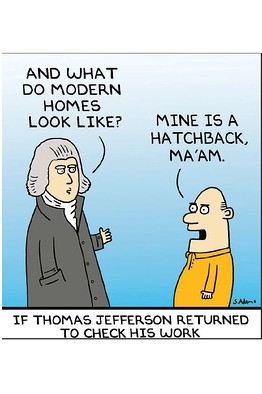
I've heard people say the United States no longer has the caliber of intellectual giants that authored the Declaration of Independence, defeated a superior British military, crafted the Constitution and built a robot butler that would eventually run away and change its name to Mitt Romney. But that's OK, because individuals are not the primary vehicles for genius. When it comes to the larger matters of civilization, group intelligence is more important than individual genius. To put it another way: Do you know who is smarter than the entire senior class at MIT? Answer: no one.
Today, thanks to the Internet, we can summon the collective intelligence of millions.
Tip of the Hat to Damien Morton via IndieGoGo.
Phi Beta Iota: Mr. Adams provides a very thoughtful overview of the possibilities, while avoiding any mention of the corruption that is pervasive in today's top-down elite control “rule by secrecy” environment. The Electoral Reform Act of 2012 is intended to eradicate corruption, assure transparency, restore the Republic, and make direct democracy such as Mr. Adams envisions a reality before 2016. The next President should be of, by, and for We the People, tested in the fires of the Occupy Wall Street kiln.
