Global Hawk (Block 30), one of the more obvious vampires sucking money out of the defense budget, has been disinterred from its coffin by corporate go-fers in Congress. The story of this high cost, low performance drone makes obvious that filibuster abuse and political dogmatism are not the only problems in Congress. Two really excellent pieces of work explain the gruesome details.
Aram Roston at the Defense News series of publications published on July 15 an excellent summary of the issues. Find the article and some useful side box material at http://www.airforcetimes.com/article/20130715/NEWS04/307150015/The-battle-over-Global-Hawk. Kudos to the editors at Defense News for allowing their corporate-ad-populated publication to release this excellent example of highly independent journalistic professionalism.
Richard Sia and Alexander Cohen at the Center for Public Integrity released on July 16 their own analysis, also truly excellent, that dives deep into the issues, especially the corruption surrounding Congress' action on Global Hawk/Block 30. Find it, also with important side-material and links, at http://www.publicintegrity.org/2013/07/16/12969/huge-drone-could-not-be-grounded.
As an aside, I note that the CPI piece briefly cites Rep. Roscoe Bartlett (R-MD), my representative in Congress last year, who “played a key role in blocking the retirement of Block 30 [Global Hawk].” Bartlett is also quoted in the CPI piece lecturing Members of Congress for putting pork above the national interest. Bartlett somehow forgot to mention that there is a significant Northrop-Grumman facility in his district, just a few miles from my house in Hagerstown, MD. But surely, that had nothing to do with his support for their product. Right.
An embodiment of all that is wrong with institutions like the House Armed Services Committee, where he presided over a major subcommittee, Bartlett was involuntarily retired in the 2012 elections.
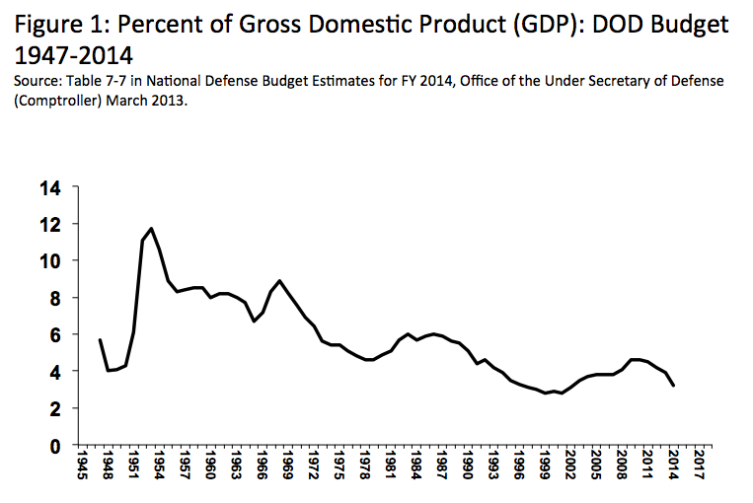
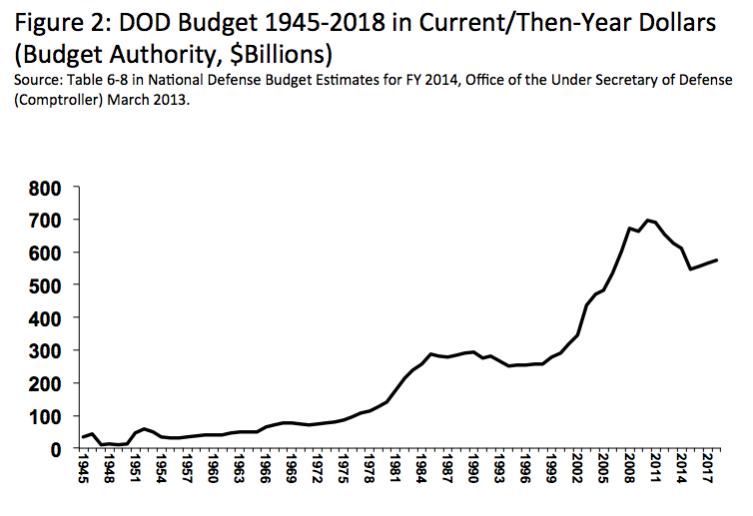
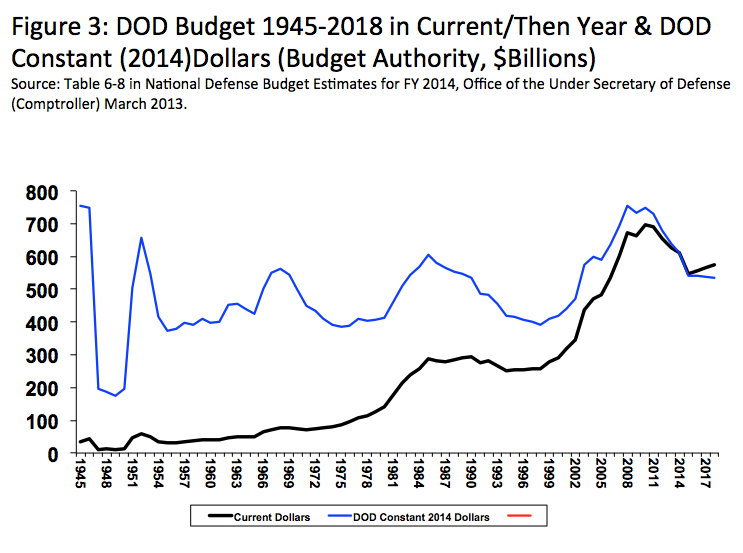
“If Congress goes along [by approving President Obama's 2014 DOD budget request], Pentagon spending levels will exceed any previous high by any other president in any year in peace or in war since the death of President Roosevelt in 1945, except for President George W. Bush from 2006 to 2008.”
“…current military spending is lapping at historic highs, not lows.”
The Defense Budget Is Even Larger Than You Think: part two of two
Given the warped measures that high-spending advocates and the Defense Department use to calibrate past, present and future defense spending (described here Monday), it is important to find an independent, objective yardstick to measure Pentagon spending trends accurately.
Unfortunately, there isn't one.
If there were, this debate would be over, and I could retire.
Click on Image to Enlarge
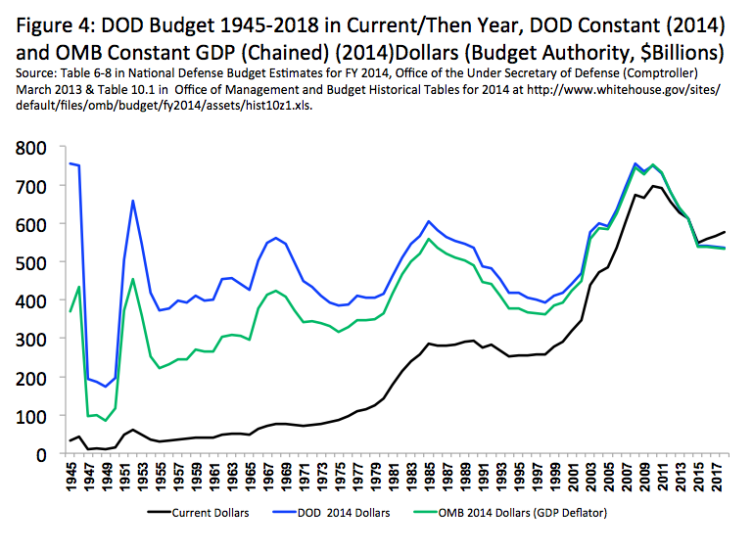
The Bureau of Economic Analysis in the Commerce Department might be tasked with the job of finding one, but it actually plays a major role in devising the Pentagon's self-serving measures of inflation. The Office of Management and Budget has its own deflators that are only slightly different.
Both embrace the proposition that a large portion of cost growth in Pentagon spending should be counted as inflation: the Pentagon experiences more inflation than other agencies and should get more money-the argument goes.
In the 1980s, the Congressional Military Reform Caucus argued that the Pentagon should be held to an independent but analogous measure of inflation, and identified the Producer Price Index as most appropriate. Others, especially the Defense Department, disagreed.
The differences will not be resolved here, but the question remains: what would the Pentagon's budget history look like if it lived by the rules followed by most everyone else – especially the rest of the federal government, and the American economy?
I received a cryptic note from a colleague earlier tonight:
“This one has time AND location data.”
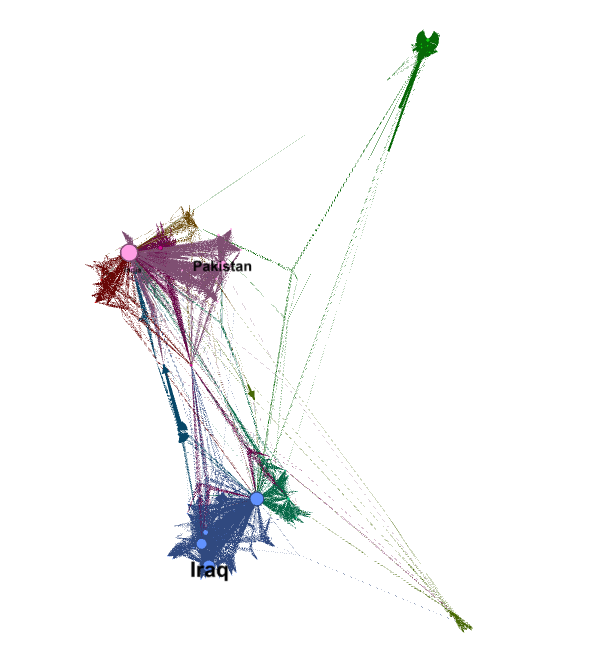
The email contained a link to the Global Terrorism Database, which is maintained at the University of Maryland at College Park, which is an easy walk from a green line stop on the D.C. Metro. I poked around the site a bit and discovered that everything from 1970 through 2011 is available for download if you just fill out a form.
Click on Image to Enlarge
The total content is large so I pulled out the 5,066 events from 2011. There are an amazing 127 attributes for each event, but it’s a sparse row setup, very easy to process. I unrolled just a few key items – city, country, and region. This resulted in over 15,000 lines indexed with their twelve digit event IDs. The first rough visualization I did was immediately exciting in terms of what was visible.
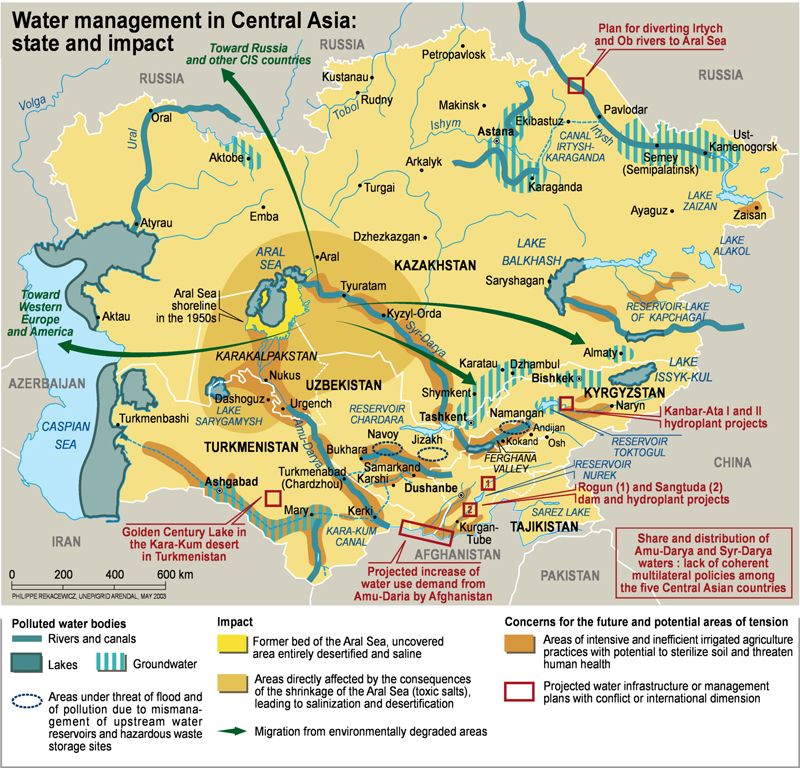
A recent piece in Uzbekistan's state-sanctioned media has advocated joining NATO and taking over the territory of Tajikistan, Kyrgyzstan, and most of the rest of Eurasia. The piece, published on 12news.uz, was taken down shortly after being published, but was preserved on inoSMI.ru. [PBI: English translation below the line.]
The piece, at nearly 9,000 words, offers a number of controversial (to put it kindly) claims: that Tajiks are merely Persian-speaking Uzbeks, that Uzbekistan is the successor state to the Mongol Golden Horde, that the agreement between Russia and Kyrgyzstan to develop hydropower plants is invalid because it misspells “Kyrgyzstan,” among many others. Its main thesis, however, is that the “threats of a natural-technical character” — namely proposed hydropower plants in Tajikistan and Kyrgyzstan — are the gravest security threats facing Uzbekistan, comparable to a nuclear bomb. And the solution is that Uzbekistan should join NATO.
The piece is a bit out there, but Uzbek analysts point out that it must have been officially sanctioned. “This site [12news.uz] is not just semi-official, it’s official,” dissident political analyst Tashpulat Yuldashev told uznews.net. “It's curated by Dilshod Nurullaev, former Security Commission chairman and advisor to the President,” he said. “There is total censorship in Uzbekistan, and such a politically charged article would not have been allowed to be published without permission from the very top.” That assertion was backed up by another Uzbek analyst to The Bug Pit.
More secrets, more water? The NSA data center in Bluffdale could require as many as 1.7 million gallons of water per day to operate and keep computers cool.
Initial reported estimates suggested the center would use 1,200 gallons per minute, but more recent estimates suggest the usage could be closer to half that amount.
“Our planning is anywhere from 1,000 acre-feet per year to 2,000 acre-feet per year, and that represents – if it was 1,000 acre-feet per year, that would be about 1 percent of our total demand,” said Jordan Valley River Conservancy District assistant general manager and chief engineer Alan Packard.
. . . . . . . .
Reid said Bluffdale otherwise wouldn't have had the resources to improve the land all the way to the south end of the city limits. Instead, the government funded $7 million in infrastructure to the data center, and an additional $5 million in infrastructure back from the site that will allow a third of the water used at the facility to be recycled.
The water would be used at the city park and on some of the city's lawns, Reid said.
Reid said the city was now pursuing other technology business to relocate to the south end of Bluffdale.
“We're looking to try and combine with Salt Lake County to make that a jobs area,” Reid said.
Phi Beta Iota: This is amusing in part because CIA has supposedly been getting a grip on water for the Department of State, and its obvious that NSA does not read CIA reports and does not care about little things like being in the middle of nowhere with vanishing aquifers.
In a two part series (titled “The Defense Budget Is Even Larger than You Think”) at Time magazine's Battleland blog, I attempt to explain how high spending advocates and even the Department of Defense misuse and manipulate budget data to alter public and congressional perceptions of the contemporary size of DOD spending. The differences between what the Pentagon's self-serving data present to the public and what is shown by generally used measures of the American economy amounts to hundreds of billions of dollars in some cases. The generally accepted, non-DOD budget history data I use for this analysis (described in more detail in tomorrow's Part II) put the current defense budget debate and assertions that Pentagon spending is shrinking to “dangerously low” levels in an entirely new perspective.
Part I, “Cooked Books Tell Tall Tales,” describes the subtle, and not so subtle, ways that the Pentagon and other high spending advocates distort DOD's budget history to make the public and Congress think they need to cough up more money. Find this first installment at
This is the new warfare. It is the obvious next step in asymmetrical conflict. Lower risk for Americans, and probably cheaper. But, I wonder, is it making more enemies than it is eliminating? If I lived in a little village in the Afghan mountains and, in the middle of night, a drone strike blew up one of the houses, killing a neighbor family, I might have some serous attitude about it.
There is a growing anti-American attitude taking root in Europe, one already well-established in the Islamic world, and parts of Asia. The long term consequences of this are not going to be happy. But our foreign policy barely deals with it.
More and more judicial decisions, particularly those of Republican appointed judges, overwhelmingly favor corporations over people. These decisions get almost no coverage in the media, but they have real and far-reaching consequences. Here's an example of what I mean.