I travel enough to have a solid view of the Transportation Security Agency (TSA). They are good people trapped in a bad system. The article below is completely wrong in pressing forward with the meme of TSA as molestors of children and old people. TSA has a good heart, it just lacks a brain. TSA is a classic — utterly classic — example of doing the wrong thing righter instead of doing the right thing. The Department of Homeland Security (DHS) may be — I dare to hope — the last primal scream of Industrial Era government in which the delusion persists that micro-management of chaos is possible, and that money can be substituted for intelligence and integrity. Not so.
Click on Image to Enlarge
I have NEVER had a bad experience or witnessed a bad experience with TSA, with the following three observations: losing my after shave, losing the last inch of a toothpaste tube, and having my thin wallet with license and three credit cards run back through the scanner. In all three cases, human brains on the scene were over-ridden by micro-regulation from above. Lack of a brain is the sucking chest wound in TSA, not lack of a heart. Good people, bad system — a terminally bad, unaffordable unsustainable bad system.
(NaturalNews) The Obama Administration has proposed significantly hiking air travel fees to cover the costs associated with the U.S. Transportation Security Administration's (TSA) molestation of air travelers. Under the new plan, which would garner a whopping $32 billion in ten years, ticket fees that cover the costs of TSA security screenings would more than double for passengers, costing them at least $5 per one-way trip.
As the TSA continues installing naked body scanners at U.S. airports and hiring hordes of new agents to grope travelers at airports, bus stations, trains stations, and even sports stadiums, the agency's more than $8 billion annual budget is rapidly ballooning. And rather than continue to siphon the cash to pay for this unconstitutional nightmare of tyranny directly from taxpayers, Obama and Co. wants to make airlines, airports, and air travelers foot the bill. Read more of this post
Documented in the 488 pages and 1,500 footnotes of Suicide of a Superpower is my thesis that America is Balkanizing, breaking down along the lines of religion, race, ethnicity, culture and ideology, and that Western peoples are facing demographic death by century's end.
. . . . . .
Let error be tolerated, said Thomas Jefferson, “so long as reason is left free to combat it.” What Foxman and ADL are about in demanding that my voice be silenced is, in the Jeffersonian sense, intrinsically un-American.
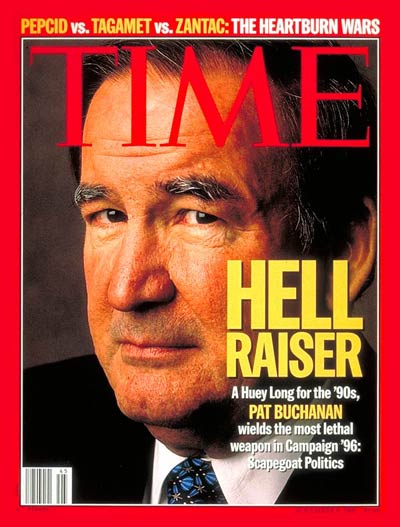
Phi Beta Iota: Below the line is the complete essay by Buchanan with points that we find compelling. He is articulate, and however much some may dislike delivery, he represents a point of view — and a demographic — whose silence spells death to the Republic as we know it. What is really at issue here is the legitimacy of the two-party bi-opoly and the various levels of government — they have substituted ideology for intelligence, corruption for integrity. Under such a system, the Constitution has been trashed and the Republic dismembered.
– – – – – – –
My days as a political analyst at MSNBC have come to an end.
After 10 enjoyable years, I am departing, after an incessant clamor from the left that to permit me continued access to the microphones of MSNBC would be an outrage against decency, and dangerous.
What was surely meant to be a clever display of media-friendly visuals to illustrate Syrian regime violence in Homs, has instead raised more questions than answers.
US State Department satellite images of the embattled city were posted on Facebook last Friday by US Ambassador to Syria Robert Ford, who complains: “A terrible and tragic development in Syria is the use of heavy weaponry by the Assad regime against residential neighborhoods.”
The “satellite photos,” says Ford, “have captured both the carnage and those causing it — the artillery is clearly there, it is clearly bombing entire neighborhoods…We are intent on exposing the regime’s brutal tactics for the world to see.”
But within 24 hours, the blog Moon of Alabama had taken a hammer to the ambassador’s claims. A detailed examination of satellite imagery by the bloggers revealed numerous discrepancies in Washington’s allegations. Mainly, their investigations point to the fact that Ford’s satellite images were “of guns training within military barracks or well known training areas and not in active deployment.”
Moon of Alabama posts its own satellite images, graphics and diagrams to bolster its argument – and these are well worth a look.
The US envoy’s questionable claims don’t stop at satellite images, however. In his Facebook post, Ford insists: “There is no evidence that the opposition — even those opposition members who have defected from the military — has access to or has employed such heavy weapons. “ By this, he means the “artillery” used “to pound civilian apartment buildings and homes from a distance.”
Then why is there satellite photo evidence of destruction in pro-regime Alawi areas?
Fast-forward to CNN’s very own Jonathan King, who broadcast satellite images of Homs on February 9, the day before the State Department loaded their photos on the web. King’s images of Homs are dated February 5, two days after violence erupted in the city, focusing heavily in the Baba Amr neighborhood where opposition gunmen are allegedly present:
In my opinion, one of the most important books written in recent years on the subject of the global arms trade and its corrupting effects is Andrew Feinstein's, The Shadow World, Inside the Global Arms Trade. This voluminous book is mind numbing in its detail, but it is thoroughly sourced and, I believe, it will become a standard reference over time. Anyone trying to understand the dark and dangerous corner of the global economy and its politics must read this book. (To be sure, I am biased because I was a minor source in this book and I consider Andrew a good friend.)
Naturally, the arms makers are not too happy with the Shadow World and want to keep it hidden in the musty stacks of your local library. I am attaching two recent essays to help you determine if this book should be forgotten. They were published on the Lexington Institute' Early Warning Blog. Lexington is funded in large part by defense contractors and is hardly impartial on all matters regarding defense spending, so the first essay is quite expected; the second, however, comes as a surprise, to Lexington's credit.
The first essay is a predictable critique of Andrew's book by Robert Trice, a retired Senior Vice President of Lockheed Martin. Think of his effort as an attempt to move Andrew's book to a forgotten corner in the back room.
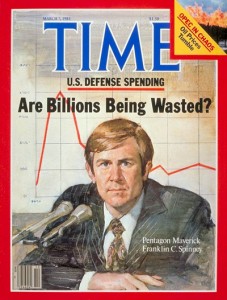
To understand the saliency of Trice's effort, consider his career. Robert Trice is a case study in the quintessential pattern of gorging oneself on cash flow pumped out by the Military – Industrial – Congressional Complex's big green spending machine. Holding a PhD in political science, he began his defense career in the Office of the Secretary of Defense in the Pentagon, where he eventually became Director for Technology and Arms Transfer Policy — or in plain english, a resident shill in the Pentagon for promoting international arms sales — the subject painted in not so flattering terms by Feinstein. Trice then moved to Capital Hill and worked as the defense Legislative Assistant to Senator Dale Bumpers (D-AR) for about three years. I met him in this position because Bumpers was interested in the military reform work my colleagues (Pierre Sprey and John Boyd) and I were doing in the Pentagon. But Trice, as Bumpers' advisor, was clearly a reluctant reformer. (Although Bumpers showed initial and enthusiastic interest in our work, nothing came of it.) In the essay below Trice now slings a little mud, saying the three of us are not just wrong but wrongly motivated, because we are “anti-defense.” Soon thereafter, the presumably pro-defense Trice cashed out of Bumpers office to work in the Defense industry, serving first as a Vice President for Business Development at McDonnel Douglas (in plain english this is a marketing job and in the MICC, marketing, or business development, means greasing the skids in Congress and the Pentagon for your firm's tinker toys — which is a good position for a poly sci type, because he couldn't design airplanes at McAir or Lockheed). Trice then moved to Lockheed Martin where his business development portfolio including shaping L-M's new business strategies and operations for the global market, which of course is the subject of Andrew's book. Obviously a person with his background of bottom feeding so successfully in the MICC's money machine, especially in the international arms trade arena, comes to the reviewing table with … shall we say … a certain amount of bias.
The second essay is Andrew Feinstein's polite repost to Trice's bucket of grease. Andrew's background could not be more different than that of Trice. Whereas Trice gorged himself and became a wealthy ‘pillar of the establishment' by slopping in America's defense trough, Andrew put his ass on the line trying to rein in the excesses of that trough's South African equivalent. In the late 1980s, Andrew, a young white South African, joined Nelson Mandella's African National Congress (ANC), because he opposed Apartheid. In 1994, after the fall of Apartheid, he was elected in South Africa's first democratic election to be an ANC member of parliament. But Andrew took his parliamentary oversight responsibilities seriously, and while in parliament, he set up a kind of one man Truman Committee to investigate allegations of ANC corruption in some international weapons deals. And he hit pay dirt, but rather than shutting up when he was pressured by party elders to close down his investigation into a £5bn arms deal that was tainted by allegations of high-level corruption, he resigned in protest from Parliament. His political memoir, After the Party: A Personal and Political Journey Inside the ANC, was published in 2007 and became a bestseller in South Africa.
With the backgrounds of these two protagonists in mind, I urge you to read Trice's critique of Andrew's latest book first (Attachment 1 below) and then Andrew's repost (Attachment 2 below) and judge for yourself who is closer to being a straight shooter — and read The Shadow World.
Special Operations forces have long enjoyed an elite position in the United States military, and achieved something like folk-hero status when Navy Seals killed Osama bin Laden in Pakistan last May. The admiration is well-deserved, but an article in Monday’s Times drew attention to the power they’ve accrued of late, and raised questions about just how much independence they should have.
Carol Giacomo, who covers foreign affairs for the editorial board, says that the Obama administration has increasingly made Special Operations Forces its military tool of choice to handle threats overseas. It plans to rely on them even more widely as it draws down conventional troops from Afghanistan.
Eventually, Special Ops Forces will make up the bulk of any residual force left in Afghanistan, hunting down militants and helping train Afghan security forces. Administration and military officials are also talking about using them in regions where they have not operated in large numbers for the past decade, including Asia (the Philippines, specifically), Africa and Latin America.
The article on the front page of Monday’s Times reported that the top Special Operations officer, Adm. William H. McRaven, is now seeking authority to move his forces faster and outside of normal Pentagon deployment channels. The proposal has not been fully explained publicly but The Times reported that it would give him more autonomy to position his forces and their equipment where intelligence and global events indicate they are most needed.
Among congressional, staff—who have not yet been briefed on the proposal—there are questions about how such new authority might affect operations. “What problem are they trying to solve?” one aide asked. A Pentagon official, who spoke on background, insisted that Admiral McRaven “is not trying to fix something that’s broken. The proposal is anticipating what the future will be for these guys and getting ahead of it.”
The Pentagon official stressed that Admiral McRaven “is not looking for complete autonomy unanswerable to anybody” and that Special Operations Forces would still be ordered on specific missions by the regional four-star commander. But one concern is that the new plan would cut out the State Department. In the past, some ambassadors in crisis zones have opposed increased deployments of Special Operations teams, and they have demanded assurances that diplomatic chiefs of missions will be fully involved in their plans and missions.
The “global war on terror” has been used to justify a lot of things. But not everything changed on Sept. 11, 2001. Civilian control of the military is one thing that did not change. I can’t imagine a circumstance under which it should.
The same has been said about the War on Drugs, the War on Terrorism, et al…..and nothing seems to back up the dire rhetoric, but the spending of tax dollars rolls on just the same.
In last month’s State of the Union address, President Obama called on Congress to pass “legislation that will secure our country from the growing dangers of cyber threats.” The Hill was way ahead of him, with over 50 cybersecurity bills introduced this Congress. This week, both the House and Senate are moving on their versions of consolidated, comprehensive legislation.
The reason cybersecurity legislation is so pressing, proponents say, is that we face an immediate risk of national disaster.
“Today’s cyber criminals have the ability to interrupt life-sustaining services, cause catastrophic economic damage, or severely degrade the networks our defense and intelligence agencies rely on,” Senate Commerce Committee Chairman Jay Rockefeller (D-W.Va.) said at a hearing last week. “Congress needs to act on comprehensive cybersecurity legislation immediately.”
Yet evidence to sustain such dire warnings is conspicuously absent. In many respects, rhetoric about cyber catastrophe resembles threat inflation we saw in the run-up to the Iraq War. And while Congress’ passing of comprehensive cybersecurity legislation wouldn’t lead to war, it could saddle us with an expensive and overreaching cyber-industrial complex.
For almost 5 years I've been involved with envisioning and creating a “pattern language” for group process. (A pattern language is a set of design factors to guide people in creating things that are wholesome and life-giving – vibrant communities, effective curricula, engaging software… and great conversations.) That process has now come to fruition.
In 2008 Peggy Holman and I did an all day workshop on “A Pattern Language for Conversations that Matter” to introduce the idea of pattern languages to professionals in the National Coalition for Dialogue and Deliberation (NCDD). That winter, Tree Bressen invited me to a multi-day gathering at her home to actually construct a pattern language on group process. That session began what proved to be a profoundly complex and challenging task facilitated by Tree and her tiny core team of volunteers – all pieced together on a gigantic wiki and Google docs and dozens of meetings. I participated in a few more of their multi-day work sessions over the years, but about a dozen other volunteers did far more work than I did. Last year I wrote a blog post on the project for NCDD – http://ncdd.org/4535 – and a couple of weeks ago wrote a personal blog post – http://post.ly/534Wr – on the transformational potential of pattern languages of all kinds – and why I consider them profoundly important. But the big news now is that the pattern language so many of us labored for so many hours to produce has now been released as a gorgeous card deck.
I can't recommend this resource highly enough for anyone seeking to create high quality conversations of any kind for any purpose. This card deck is THE premier navigational tool for powerful conversations. It goes deeper than methodology and is more practical than theory. It is designed to help us understand what is going on and how to make it better. It offers greater flexibility and power to our practices of dialogue, deliberation, mediation, choice creating, and conversation of all types. It is available electronically FREE for the taking – and only costs $25 if you want a physical printed boxed deck.
And to top it all off – it is beautiful.
So I hereby invite you into a new world of conversational adventure and insight, available to you right now.