Phi Beta Iota: This is interesting at multiple levels. It demonstrates that the Office of Management and Budget (OMB) endeavor to achieve common solutions is not only not working, but does not properly integrate industry. It demonstrates that Cyber-Command is off on its own warpath, and not thinking deeply about the issues that this White Paper raises. Finally, it is a perfect display of the tail end of Industrial Era thinking, assuming that top down coordination of anything is going to be effective in a bottom-up world. The Autonomous Internet is NOT something these people are even aware of….
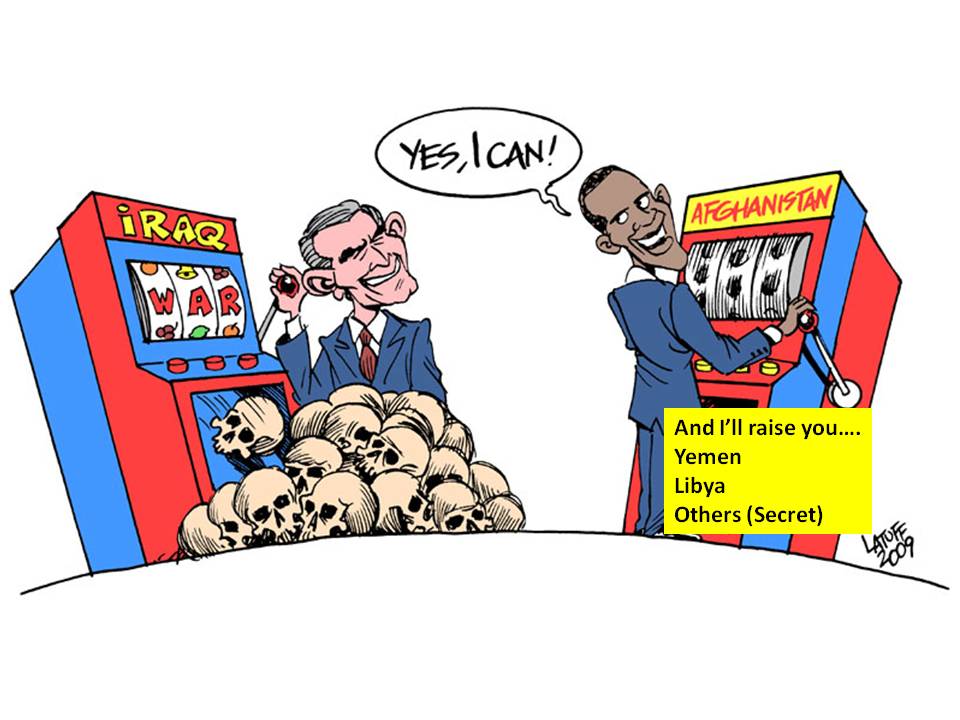
“I see Obama's visiting the United States,” said Rush Limbaugh on
Thursday, the president's first full day back in Washington after a spring
break diplomatic tour of Latin America….
. . . . . . .
After ordering troops into action, the president headed off to South
America with his wife, daughters, mother-in-law, and mother-in-law's
friend in tow. There was no solemn, reasoned speech to explain why the
U.S. was going to war…..
Click on Image to Enlarge
Meanwhile, the White House is at times having difficulty simply making
sense. The president talked about an “exit strategy” in which American forces would not exit at all. And administration officials are going out of their way to deny that the Libyan fighting, which involves a significant fleet of U.S. warships and U.S. warplanes, is a “war.” Deputy National Security Adviser Ben Rhodes told reporters Wednesday that Libya
wasn't a war, describing it instead as a “kinetic military action.”
OpenBSC is the current name for a software program that started with the name bs11-abis.
Learn More....
What is OpenBSC
It is a BSC (Base Station Controller) side implementation of the A-bis protocol, as implemented in the GSM Technical Specification 08.5x and 12.21. It implements a minimal subset of the BSC, MSC and HLR. It does not implement ant of the interfaces (like the A and B interfaces) between the higher-order GSM network components.
The goal of the project is to
provide a basis for experimentation and security research with GSM from the network side
document, publicized and point out any security related issues that we find as part of that
learn more about GSM networks on a lower level, particularly the practical aspects with real-world equipment
We are not primarily interested in
building a stable/reliable BSC/MSC for deployment in networks requiring high-9 (99.999….) availability
building something that follows the GSM spec to the last detail
Phi Beta Iota: We have learned that the OpenBTS pioneers are working with and admire OpenBSC–the latter has different goals and the architecture is traditional.
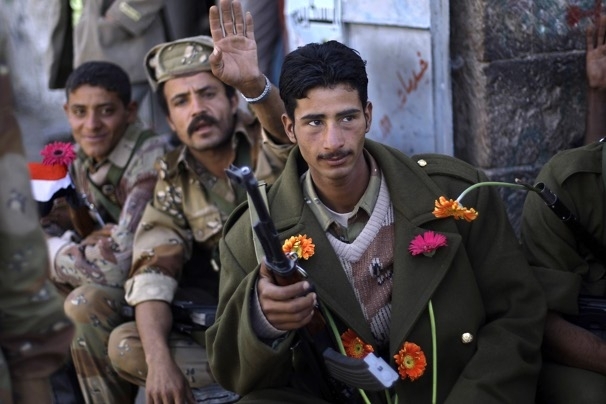
Syrian President Bashar al-Assad was facing the most serious unrest of his 11-year tenure Thursday as anti-government protests in a southwestern city threatened to escalate after a deadly crackdown.
. . . . . . .
On Wednesday, security forces launched a pre-dawn raid in the city in which dozens of people were killed, according to witnesses and activists. Precise estimates of the death toll range from 15 to 51.
On Thursday, witnesses said, thousands of people gathered in the city to bury the dead, chanting, “Syria! Freedom!”
Click on Image to Enlarge
Phi Beta Iota: “Freedom” is neither a partisan term, nor one that can be bought by Lockheed Martin or discounted by Goldman Sachs. Young, freedom, and the autonomous Internet. Not at all what the “elite” had planned. Most interestingly, the dominos falling to non-violent public will are in sharp contrast to the published plan of the neo-conservatives to take down the Middle East by force–nuclear if necessary.
Media: At War (NY Times)
Byline: RAY RIVERA
Date: 24 March 2011
KABUL, Afghanistan — President Hamid Karzai surprised some people this week when he announced that his forces would take over security responsibilities from international forces in the city of Lashkar Gah, capital of the volatile southern province of Helmand, this summer.
But if the news spread quickly, it did not travel by cellphone. That’s because mobile phone networks throughout the province have been silenced for nearly a week now under orders of the Taliban, according to company officials.
Time does not permit the detailed study a topic of this importance merits (it would be an excellent PhD project for a bi-lingual Japanese-English speaking PhD candidate) but here is what we do know:
1. The risks were known.
2. A tsunami risk was specificially brought up and dismissed at a critical juncture.
3. There was no “what if” planning or critical supply chain planning for contaminated water and food.
We speculate that an intense look at the information terrain surrounded Japan's nuclear and global warming and related environmental degradation and energy-commercial competitiveness discussions will yield an almost perfect understanding of where the data asymmetries and information pathologies were that allowed Industrial Era decision systems (inherently secret and corrupt) to ignore open source information on risk.
This is also a good place to study how disasters turn into catastrophes instead of remaining disasters, for lack of the proper political-legal, socio-economic, and ideo-cultural mindsets.
Fifty years from today, the catastrophe in Japan may be regarded as the moment of awakening for the global mind.