If you were going to pick an epicenter for mainstream media, The Washington Post’s Howard Kurtz would not be a bad place to land. With his running scorecard on Beltway journalists, his interviews of other scorekeepers on his “Reliable Sources” show on CNN, and his ceaseless fascination with network news, Mr. Kurtz embodied the folkways of the traditional press.
Until last week, when he announced he was leaving his privileged perch to become the Washington bureau chief for The Daily Beast, a two-year-old toddler of the new digital press conceived by Tina Brown and owned by IAC, run by Barry Diller. Mr. Kurtz’s lane change evinced gasps reminiscent of when Dylan went electric at the Newport Folk Festival in 1965.
On the heels of decisions by Howard Fineman of Newsweek and Peter Goodman of The New York Times to go to The Huffington Post, it would seem like a bit of a tipping point.
Phi Beta Iota: Robert has it half right–news you can use. The value has shifted from the T in IT to the I in IT. We told NSA this in Las Vegas in 2000, but the money is in the T not the I, so they ignored us. Public Intelligence about everything is about to emerge as the new arbiter of value. True cost will be known, transparency will expose corruption as well as waste, and there will be, as our friend and mentor Alvin Toffler has written, a PowerShift.
1. Invite your attention the video at the YouTube link in the message below.
2. Just to be clear:
a. I cannot tell you precisely who made the video.
b. I cannot tell definitively whether or not it is true in whole or in part..
c. To me, it looks like it ((COULD)) be a product of selective editing with individual items extracted from multiple source and reassembled, without context, to suggest conclusions supporting somebody's predetermined viewpoint. But that does not necessarily mean that it is not wholly or partially true.
d. Invite your special attention to the credits at the very end — about 13:06 and beyond. If Steven Emerson and the Investigativer Project are involved with this video, that would increase its credibility in my eyes.
e. All foregoing said, I am inclined to believe video and message are more true than not.
3. For some of you addees, I think this is relatively local for if I understand east Florida geography.
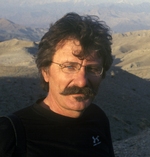
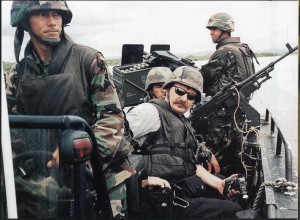
Robert Young Pelton, along with Stephen E. Arnold, was the only “repeat” speaker year after year at the multinational open source intelligence event that ran from 1992-2006. Here is a photo of RYP that just came to our attention while discussing how to fish for drug dealers crossing border lakes.
Arianna visited Mike Huckabee's eponymous show this weekend, finding plenty of common ground with the Fox News host and former Republican governor from Arkansas.
“Basically we went from a country that made things to a country that made things up: CDOs, credit default swaps, toxic derivatives,” said Arianna. “Wall Street became a casino. And we the taxpayers bailed them out. That's where you and I agree.”
The pair also agreed on the problems with Fannie and Freddie, the need to improve America's crumbling infrastructure, and even shared some quips about their accents.
Phi Beta Iota: This is the first sign we have seen of intelligent life in broadcasting–if these two decent people can extend the dialog and maintain the focus on reality-based affordable holistic policy, they could be game-changers.
Many Americans view their country and its soldiers as the “good guys” spreading “democracy” and “liberty” around the world. It just ain't so.
October 8, 2010
Peter Dale Scott, Robert Parry / Consortium News
Alter.Net Editor's Note: Many Americans view their country and its soldiers as the “good guys” spreading “democracy” and “liberty” around the world. When the United States inflicts unnecessary death and destruction, it's viewed as a mistake or an aberration.
In the following article Peter Dale Scott and Robert Parry examine the long history of these acts of brutality, a record that suggests they are neither a “mistake” nor an “aberration” but rather conscious counterinsurgency doctrine on the “dark side.”
For a number of years I reported on the monthly nonfarm payroll jobs data. The data did not support the praises economists were singing to the “New Economy.” The “New Economy” consisted, allegedly, of financial services, innovation, and high-tech services.
This economy was taking the place of the old “dirty fingernail” economy of industry and manufacturing. Education would retrain the workforce, and we would move on to a higher level of prosperity.
Time after time I reported that there was no sign of the “New Economy” jobs, but that the old economy jobs were disappearing. The only net new jobs were in lowly paid domestic services such as waitresses and bartenders, retail clerks, health care and social assistance (mainly ambulatory health care services), and, before the bubble burst, construction.
The facts, issued monthly by the US Bureau of Labor Statistics, had no impact on the ”New Economy” propaganda. Economists continued to wax eloquently about how globalism was a boon for our future.
. . . . . .
The wage and salary cost savings obtained by giving Americans’ jobs to Chinese and Indians have enriched corporate CEOs, shareholders, and Wall Street at the expense of the middle class and America’s consumer economy.
Paul Craig Roberts was an editor of the Wall Street Journal and an Assistant Secretary of the U.S. Treasury. His latest book, HOW THE ECONOMY WAS LOST, has just been published by CounterPunch/AK Press.
New US Tactics in Afghanistan Unrelated to Europe Terror Alert
A strong strategic rationale actuated Washington's blanket terror warning to Europe of Sunday, Oct. 3. But the way it evolved reflected the current interplay among the leading American personalities who devised it.
Phi Beta Iota: We do not normally point to anything that requires registration or payment, but in this instance, since it specifically supports our own skepticism about the recent terror alert (see Journal: US Travel Alert–Political and Fraudulent?, we agree with our contributor who suggested the pointer. Below are a few of the headlines internal to the Debka article, and three key sentences.
Angry Pakistani reaction was no surprise
Now to build a cover story
In North Waziristan, Petraeus said, smashing Taliban and local allied forces on the Pakistan side of the border is the key to success in Afghanistan, particularly in the south which has a common border with North Waziristan.
The imprecise, unspecific US terror scare did not impress Europe
Brennan's personal ambition gingered up the publicity
While Petraeus and Panetta kept their uncertainties under their hats and cooperated with one another, John Brennan went off on an aggressive tangent. He issued a welter of leaks to the media without coordinating them with either partner.
France settles scores with Britain
Two days later, France exhibited its fine sense of irony by issuing a travel advisory warning French citizens to be vigilant for terrorists while traveling in… London.
Phi Beta Iota: Just after this story, which has rich detail on Brennan and Panetta lusting for Jones' job, the vacancy was announced and filled. This may be one of the weakest national security teams since the end of WWII.
The argument that social media fosters feel-good clicking rather than actual change, began long before Malcolm Gladwell brought it up in the New Yorker — long enough to generate its own derogatory term. “Slacktivism,” as defined by Urban Dictionary, is “the act of participating in obviously pointless activities as an expedient alternative to actually expending effort to fix a problem.”
If you only measure donations, social media is no champion. The national chapter of the Red Cross, for instance, has 208,500 “likes” on Facebook, more than 200,000 followers on Twitter, and a thriving blog. But according to the Chronicle of Philanthropy, online donations accounted for just 3.6% of private donations made to the organization in 2009.
But social good is a movement still in its infancy. Facebook launched in 2004, YouTube in 2005 and Twitter in 2006. Let’s give the tools a little while to grow up before we start judging them.
All of that virtual liking, following, joining, signing, forwarding, and, yes, clicking, has a lot of potential to grow into big change. Here’s why: