3) Underpants Bomber very likely to have been a US-Israeli deception operation against the US public and Congress (never mind the Constitution, Bush-Cheney buried it, Obama-Biden have carried on in that tradition).
Our group bottom line: Not even close. This is very likely a fraud, most certainly over-reaction hyped for political purposes, and the evidence has not been collected, processed, analyzed, and presented properly. This is bogus. What is really scary is that in order to “prove” it, a crime against humanity may be ordered, a bombing or shooting spree of sorts using either a false flag recruit set in motion by covert action operators, or a bombing by a contractor such as Xe/Blackwater.
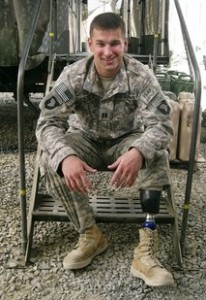
ASHOQEH, Afghanistan – When a bomb exploded under Dan Luckett's Army Humvee in Iraq two years ago — blowing off one of his legs and part of his foot — the first thing he thought was: “That's it. You're done. No more Army for you.”
But two years later, the 27-year-old Norcross, Georgia, native is back on duty — a double-amputee fighting on the front lines of America's Afghan surge in one of the most dangerous parts of this volatile country.
Luckett's remarkable recovery can be attributed in part to dogged self-determination. But technological advances have been crucial: Artificial limbs today are so effective, some war-wounded like Luckett are not only able to do intensive sports like snow skiing, they can return to active duty as fully operational soldiers. The Pentagon says 41 American amputee veterans are now serving in combat zones worldwide.
Phi Beta Iota: This is inspirational, plain and simple. Our objective, within the Earth Intelligence Network (EIN), is to eventually build the Open Source Center, the Multinational Decision Support Centre, and the global multinational information sharing and sense-making grid, around war veterans who have lost a limb or two.
Such deep-pocketed mystery benefactors — not O’Donnell, whose reported income for this year and last is $5,800 — are the real indicators of what’s going on under the broad Tea Party rubric. Big money rains down on the “bottom up” Tea Party insurgency through phantom front organizations (Americans for Prosperity, Americans for Job Security) that exploit legal loopholes to keep their sugar daddies’ names secret. Reporters at The Times and The Washington Post, among others, have lately made real strides in explaining how the game works. But we still don’t know the identities of most of those anonymous donors.
From what we do know, it’s clear that some Tea Party groups and candidates like Sharron Angle, Paul and O’Donnell are being financed directly or indirectly not just by the Kochs (who share the No. 5 spot on the new Forbes 400) but by a remarkable coterie of fellow billionaires, led by oil barons like Robert Rowling (Forbes No. 69) and Trevor Rees-Jones (No. 110). Even their largess may be dwarfed by Rupert Murdoch (No. 38) and his News Corporation, whose known cash contributions ($2 million to Republican and Republican-tilting campaign groups) are dwarfed by the avalanche of free promotion they provide Tea Party causes and personalities daily at Fox and The Wall Street Journal.
Phi Beta Iota: The author provides a long and compelling description of how the Tea Party is a front for big money; most Tea Party candidates are not what they claim to be, and the public–the ignorant, angry, naive public–is falling for the shell game.
Howard Rheingold, then editor of the Whole Earth Review (WER) gave us access to all past issues of WER, and permission to select and print this special collection of authors and idea relevant to the Revolution in Intelligence Affairs (RIA). All of it remains relevant because both government and industry have chosen to remain on an industrial-era path that over-stresses centralized control, corporate copyright, and technology instead of thinking.
Here is a tiny sampling from that collection, all 75 items free online.
The below linked article in the 2 October 2010 edition of the New York Times [Attachment 1] is a good example of the pro-Israeli bias in the US mainstream media when it comes to portraying Israel's relations with the Palestinians.
Note the paragraph I marked in bold which says unequivocally that “Israel halted most settlement construction for 10 months last November …” This statement is clearly central to the reader's understanding of the questions of whether or not Israel has been negotiating with good will and who is responsible for the crisis in the peace talks. It is also outrageously wrong, and that crucial fact was known at least five days before it was written. That this is indisputably true can be seen in Attachment 2 beneath it, a 28 September 2010 report in Ha'aretz, perhaps Israel's most prestigious newpaper — ironically, Ha'aretz is often referred as the New York Times of Israel. Ha'aretz tells the reader that the Israeli government's own official statistics show that the settlement freeze was barely a slowdown.
There is no way the author of the NYT report, Ethan Bonner, the senior New York Times reporter based in Israel, could have been unaware of the Ha'aretz report, and his (or his editor's) countenancing such an unequivocal statement, without at least a caveat, can only be construed to be a deliberate attempt to mislead the reader with respect to the nature of the settlement freeze, and by extension, the good will in Israel's negotiating stance vis a vis that of the Palestinians. His biased outlook becomes transparently clear when one compares the tone and context to the two reports.
To those readers, who think I am nitpicking, I would urge them to think about the wisdom embodied in the following two quotes: The first is by James Madison, the father of the US Constitution, describing the importance of popular information to effective functioning of a representative democracy. The second is Edward Gibbon's assessment of how ignorance and fanaticism sapped the cognitive faculties of the Roman peoople:
“A popular government without popular information, or the means of acquiring it, is but a prologue to a farce or a tragedy, or perhaps both. Knowledge will forever govern ignorance, and a people who mean to be their own governors must arm themselves with the power which knowledge gives.” – James Madison, from a letter to W.T. Barry, August 4, 1822
”Their credulity debased and vitiated the faculties of the mind: they corrupted the evidence of history; and superstition gradually extinguished the hostile light of philosophy and science.” – Edward Gibbon, Decline and Fall of the Roman Empire
RAMALLAH, West Bank — The Palestinian leadership said Saturday that four-week-old direct talks with Israel should be suspended if Jewish settlement construction resumed in the West Bank. It called on the international community to pressure Israel to stop the building but withheld a final decision on the talks until an Arab League meeting on Friday.
What took place in the past few months is, in the best case scenario, not more than a negligible decrease in the number of housing units that were built in settlements.
By Dror Etkes, Ha’aretz, 28 Sept 2010
The official statistics supplied by the Central Bureau of Statistics describe the story behind the 10-month construction moratorium in the West Bank. The story can be called many things but “freeze” is certainly not one of them. What took place in the past few months is, in the best case scenario, not more than a negligible decrease in the number of housing units that were built in settlements.
Phi Beta Iota: Apart from facts in isolation, context matters. The Israeli settlements are unsustainabile in relation to available water and the continuing atrocities against the Palestinian people on their own land is an ongoing crime against humanity that is easily, in today's context, as terrible as the Holocaust was in Hitler's time. None of this has entered the human consciousness of the US public because their leaders lack integrity, as do the corporate media led by the New York Times.
Dr. Steve MetzAmerica's Flawed Afghanistan Strategy
Added August 09, 2010 Op-Ed 2 Pages
The concluding paragraph:
Ultimately, then, the basic rationale of American strategy in Afghanistan is questionable. Certainly America cannot ignore that country as it did before September 11, 2001, and should continue supporting the national government and other Afghans opposed to the Taliban. But in strategy, balance is the key—the expected security benefits of any action must justify the costs and risks. Today, America's Afghanistan strategy, with its flawed assumptions, is badly out of balance.