Aaron Swartz, a wizardly programmer who as a teenager helped to develop a computer code that provided a format for delivering regularly changing Web content and in later life became an unwavering crusader to make that information free of charge, died in New York on Friday, a family member said.
Click on Image to Enlarge
Mr. Swartz was 26, and his death was due to suicide. His body was found by his girlfriend in his apartment in New York, his uncle, Michael Wolf, said on Saturday. He had apparently hanged himself, Mr. Wolf said.
As a 14-year-old, Mr. Swartz helped create RSS, the nearly ubiquitous software that allows people to subscribe to information from the Internet. But as he reached adulthood, Mr. Swartz became even more of an Internet folk hero to many because of his online activism to make many Internet files open to the public for free.
Phi Beta Iota: It has come to Phi Beta Iota's attention that too many people are searching for Mini-Me daily, rather than reading that day's postings.
Mini-Me is just one of over 25 contributing editors, each committed to the truth — public intelligence in the public interest.
Below are a couple of posts not by Mini-Mi that are Mini-Me-esque in nature. Bottom line: Mini-Me is one of many important contributors, do not neglect the others, please. We will no longer use Mini-Me to improve dissemination of Mongoose, Owl, or others, they are each a “brand” in their own right.
A shocking new Federal Security Services (FSB) report on the Obama regimes accelerated plan to disarm his countries citizens, claims that the US President is being supported in his efforts by the Mexican Sinaloa Cartel, both of whose “main target” is the powerful and feared Jewish-American billionaire Steve Feinberg [photo 2nd left], who controls nearly 85% of all private weapons manufacturing in the United States.
This sinister organization is a drug-trafficking and organized crime syndicate based in the city of Culiacán, Sinaloa, with operations in the Mexican states of Baja California, Durango, Sonora and Chihuahua, and with thousands of guns provided to them by the Obama regime, in an operation called “Fast and Furious,” unleashed a war upon rival gangs that, to date, has killed over 60,000.
Even worse, this report continues, under both the Bush and Obama regimes, the Sinaloa Cartel was allowed to transport tonnes of drugs to Chicago for distribution throughout the United States, while at the same time being protected by both the Central Intelligence Agency (CIA) and the Drug Enforcement Administration (DEA).
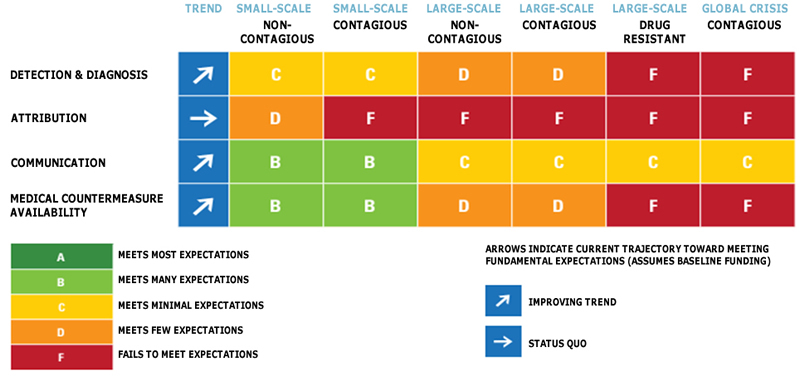
The US Bipartisan Bio-Detection 2011 Report Card Status Evaluation (Source: The US Bipartisan WMD Terrorism Research Center, October 2011 Bio Response Report Card)
Events of the recent decade confirm that the threats of bio-terrorism and infectious disease outbreaks are real. Attacks such as the 2001 Anthrax scare, the 2004 Ricin letters, the 2003 SARS and 2009 H1N1 outbreaks have driven governments to increase their bio-surveillance budgets. Public healthcare and HLS agencies' urgent need to establish an early and reliable bio-surveillance detection infrastructure will drive the market onto a much higher trajectory than ever before. We forecast that the cumulative 2012-2016 market (including: systems sale, consumables, upgrades and service) will reach $22.8 billion.
Click on Image to Enlarge
The recent year that saw the seventh review round of the Biological and Toxic Weapons Convention, demonstrated that demand for biosecurity remains high. As developed countries continue to refine their organizational and technological approach to potential bio-terror and disease outbreak threats, many key emerging markets are also ramping up programs to acquire solutions that provide early outbreak-attack detection. These will require the shortening of bio-attack alarm response time and the proliferation of 3rd generation cost-effective bio-detection technologies and reagent-less detection assays.
In contrast to the US colossal spending of $67 billion on biodefense programs during the 2001-2011 period, the US bipartisan WMD Terror Response Center report card (September 2011) graded the world's leading “US bio-detection and attribution programs” as the Achilles heel of the US BioWatch program. It received a score ranging from “meets minimal expectations” to a catastrophic “fails to meet expectations” (see table above). It stated that “Although naturally occurring disease remains a serious threat, a thinking enemy armed with these same pathogens, or with multi–drug resistant or synthetically engineered pathogens could produce catastrophic consequences“.
Over the next five years, we forecast that, led by the US, Germany, France, China, Japan and India, the global bio-detection market (including systems sale, service, upgrades and consumables) will reach $5.6 billion by 2016.
The US Department of Energy is giving $120m (£75m) to set up a new research centre charged with developing new methods of rare earth production.
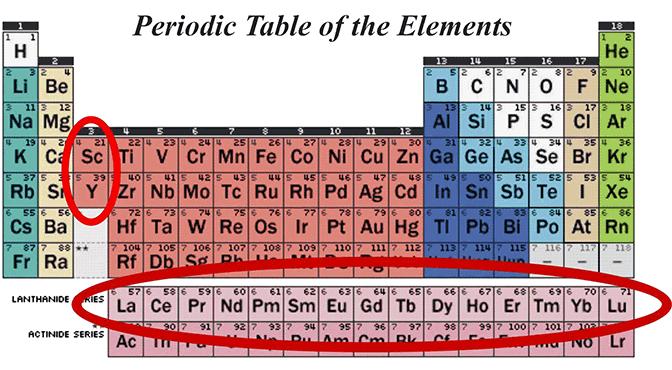
Rare earths are 17 chemically similar elements crucial to making many hi-tech products, such as phones and PCs.
Click on Image to Enlarge
The Critical Materials Institute will be located in Ames, Iowa.
The US wants to reduce its dependency on China, which produces more than 95% of the world's rare earth elements, and address local shortages.
According to the US Geological Survey, there may be deposits of rare earths in 14 US states.
Besides being used for hi-tech gadgets, the elements are also crucial for manufacturing low-carbon resources such as wind turbines, solar panels and electric cars, said David Danielson, the US assistant secretary for renewable energy.
“The Critical Materials Institute will bring together the best and brightest research minds from universities, national laboratories and the private sector to find innovative technology solutions that will help us avoid a supply shortage that would threaten our clean energy industry as well as our security interests,” he said in a statement.
Rare earth elements are also used for military applications, such as advanced optics technologies, radar and radiation detection equipment, and advanced communications systems, according to a 2011 research report by the US Government Accountability Office.
Phi Beta Iota: An Open Source Agency (OSA) at IOC $125M and FOC $3B, would be a vastly better investment. Once again pork finds a home and a new stove-pipe is being built.
By Graham Greenleaf, Whon-il Park (Privacy Laws & Business International Report, Issue 119: 22-25, October 2012)
Abstract:
The first decision of Korea’s Personal Information Protection Commission (PIPC) has borne out the perception that Korea’s new Personal Information Protection Act (PIP Act) is ‘Asia’s toughest data privacy law’ (Greenleaf and Park, Privacy Laws & Business International Report, Issue 117: 1, available at http://ssrn.com/abstract=2120983). The PIPC has decided that Google’s changes to the Terms of Service (TOS) of over 60 of its services, unifying them in a single TOS, may be in breach of various provisions of the Act.
Google’s TOS changes are considered by the Commission to likely to breach these laws in three ways: (i) they do not specify the purpose of collection clearly enough, and cannot comply with the requirement that personal information may only be collected and used to the minimum extent necessary for the purpose for which it is collected; (ii) they do not comply with the requirement that where personal information is to be used for purposes other than the purpose for which it was collected, it is necessary to obtain additional consents for such uses; and (iii) they do not specify that that personal information will be erased immediately upon the expiration of its retention period or on request from a data subject.
This article analyses this decision, considering the PIPC’s reasoning, and the terms of the Korean legislation, in order to determine whether the PIPC’s findings (and the potential remedial action) are a result of features which are unique to the Korean law, or are they features which are common to at least some other countries’ data privacy laws.