DefDog: Russian Fleet Enters Mediterranean, Parks at Cyprus

04 Inter-State Conflict, 05 Civil War, 06 Russia, 08 Wild Cards, Ethics, Government, IO Deeds of Peace, Military, Officers Call
DefDog
DefDog

Ho ho ho….

Russian Pacific Fleet Warships Enter Mediterranean For First Time In Decades, To Park In Cyprus

Zero Hedge, 16 May 2013

Earlier we reported that the US has now officially landed a Marine force in Israel as well as an assault ship, in a visit that the US Navy promptly assured “is not associated with, nor a reaction to, any world events.” It seems we were not the only ones who read this justification somewhat skeptically: so did Russia.

And in a historic event, the Russian Pacific fleet, for the first time in decades, crossed the Suez Canal and entered the Mediterranean, direction Cyprus' port of Limasol (hi Cyprus – Russia will be arriving shortly) in what is now the loudest implied warning to the US and Israel amassing military units across Syria's border that Russia will not stand idly by as Syria is used by the Israeli “Defense” Forces for target practice.
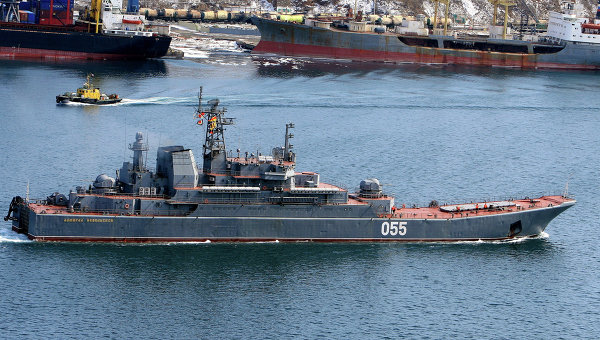
Russian Amphibious Ship Admiral Nevelskoi - Click on Image to Enlarge
Russian Amphibious Ship Admiral Nevelskoi – Click on Image to Enlarge

The task force has successfully passed through the Suez Channel and entered the Mediterranean. It is the first time in decades that Pacific Fleet warships enter this region,” Capt. First Rank Roman Martov said. This is what is also known as dropping hints, loud and clear.
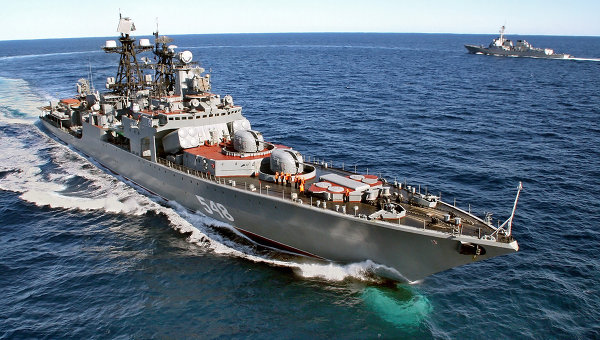
Admiral Panteleyev destroyer - Click on Image to Enlarge
Admiral Panteleyev destroyer – Click on Image to Enlarge

The group, including the destroyer Admiral Panteleyev, the amphibious warfare ships Peresvet and Admiral Nevelskoi, the tanker Pechenga and the salvage/rescue tug Fotiy Krylov left the port of Vladivostok on March 19 to join Russia’s Mediterranean task force.

The task force currently includes the large anti-submarine ship Severomorsk, the frigate Yaroslav Mudry, the salvage/rescue tugs Altai and SB-921 and the tanker Lena from the Northern and Baltic Fleets, as well as the Ropucha-II Class landing ship Azov from the Black Sea Fleet. The task force may be enlarged to include nuclear submarines, Navy Commander Admiral Viktor Chirkov said last Sunday.
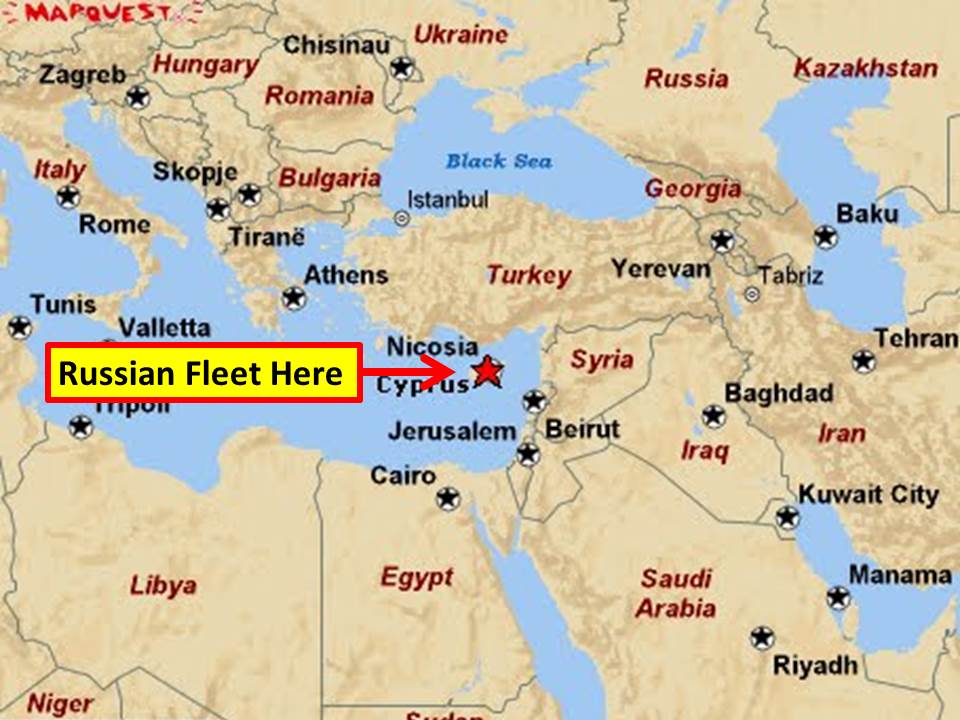
Click on Image to Enlarge

Shore leave for a whole lot of submarines just a few hundred kilometers from Syria? Surely. From Rian.

The Defense Ministry said in April Russia has begun setting up a naval task force in the Mediterranean, sending several warships from the Pacific Fleet to the region. Russian Defense Minister Sergei Shoigu said in March a permanent naval task force in the Mediterranean was needed to defend Russia’s interests in the region.

A senior Defense Ministry official said the Mediterranean task force's command and control agencies will be based either in Novorossiysk, Russia, or in Sevastopol, Ukraine.

Admiral Vladimir Komoyedov, head of the parliamentary defense committee, previously told RIA Novosti that the Mediterranean task force should be comprised of 10 warships and support vessels as part of several tactical groups tasked with attack, antisubmarine warfare and minesweeping.

The Soviet Union maintained its 5th Mediterranean Squadron from 1967 until 1992. It was formed to counter the US Navy's 6th Fleet during the Cold War, and consisted of 30-50 warships and auxiliary vessels

It appears that the squadron is being reincarnated and quite rapidly at that.

It also appears that the two key naval forces in the Mediterranean are finally starting to position themselves for what may soon be a face off.

Hopefully Europe's “anti-manipulation” task force can spook enough majors to push the price of Brent much lower before the moment such an escalation becomes reality.
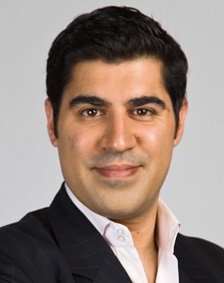

Parag Khanna: Rise of the Info-States

Advanced Cyber/IO, Communities of Practice, Ethics
Parag Khanna
Parag Khanna

Edging toward the sweet spot of new-century governance

Enter the info-state. The info-state – today one of a growing number of dynamic and entrepreneurial cities, city-states or small nations scattered around the world – governs as much through data as via democracy.

Scholars have for decades appreciated political mutations that drive international competition and result in new forms of governance. In 1941, Harold Lasswell emphasized the rise of politico-military elites, such as in Imperial Japan, that shaped the ideology of ‘garrison states.’ In 1996, Richard Rosecrance forecasted a transition toward ‘virtual states’ that downsized geography and outsourced production, while investing more in human and portfolio capital than territorial expansion. Building on this logic of the economic over the political, Philip Bobbitt’s Shield of Achilles (2002) traced the advent of the ‘market state’ era, in which the maximization of individual commercial opportunity defines national power and success. Japanese business strategist Kenichi Ohmae then set the stage for the info-state era in The Next Global Stage (2005), which argued that urban agglomerations of city-states resembling the medieval Hanseatic League would become the world’s power centres.

The info-state draws on numerous important attributes of these previous – and still co-existing – units. The economic footprint supersedes the territorial, the urban industrial core and its human capital pool are the locus of value, and diplomacy is exercised by commercial and knowledge centres as much as by national capitals.

But the info-state also presents new mutations that were not conceivable in previous technological periods – a peculiar convergence of the Information Age and the devolved authority of city units and clusters. The critical shift lies in the manner of policy-making enabled by new technologies: governance is practiced in ‘real-time’ – through constant consultation, rather than through traditional, staggered democratic deliberation. In a sense, this is a post-modern democracy – or even ‘post-democracy’ – that combines popular priorities with rationalist or technocratic management. On this logic, data-driven policy might mean more objective measurement of progress, more evidence-based policy, and more accountability of leadership.

In order to thrive, an info-state must provide both the security of the garrison state model and the connectedness of the virtual state. In other words, the essence of the info-state is secure connectedness. And, to be sure, this existential reliance on secure connectedness is potentially the info-state’s most prominent vulnerability.

Continue reading “Parag Khanna: Rise of the Info-States”

SchwartzReport: Solar Traps Game Changer — and US Allows Seven Toxic Food Practices Banned in Europe

01 Agriculture, 03 Economy, 05 Energy, 07 Health, Civil Society, Commerce, Corruption, Ethics, Government

schwartz reportHere is another potential game changer in the transition to non-carbon energy. More and more breakthroughs are popping up. One can only wonder what it would have been like if we had put the trillions we have spent on war into eliminating carbon energy, and transitioning to energy technologies that were non-polluting.

Inventor Claims Solar Energy Discovery That Is Game-changer
GREG GORDON – Idaho Statesman

This is the difference between the U.S. and European food systems. It is not a pretty picture.

Seven Dangerous Food Practices Banned in Europe But Just Fine in America
TOM PHILPOTT – AlterNet (U.S.)/Mother Jones

NATO Innovation Hub: Communication on Social Media Next Steps

Advanced Cyber/IO, Communities of Practice, Crowd-Sourcing, Ethics
Click on Image to Enlarge

Entering the Solution Design Phase
Social Media Event – May update

Dear Innovation Hub members,

“How should NATO use Social Media?” is the question you have been discussing for six weeks.  This online brainstorming was fruitful beyond all expectations!  Your motivation to engage in an expert level exploration of the topic has generated a broad understanding that is now shared among the community.  All the ideas produced have been carefully collected and presented to Allied Command Transformation hierarchy.  They fall under three categories,

-­‐ Opportunity areas : The effects NATO could achieve thanks to Social Media
-­‐ Enablers : What NATO should develop as a result of the Social Media
-­‐ Concerns : What NATO should pay attention to as a result of the Social Media

(You can find a list of these ideas here below)

From this list, the topics deserving immediate further exploration have been identified.  They are :

-­‐ Education and Training through New Media
-­‐ Alternative Command and Control
-­‐ Social Media Users Training

These topics enter now their Solution Design Phase. It means that they will be further explored up to the drafting of focused concept papers. Like the brainstorming, this work will be collaborative and conducted online. The online platform has been adapted for this phase. When you visit it you will easily identify the newly created topic groups. They include the new collaborative document editing function. Feel free to join them at NATO Innovation Hub.

Continue reading “NATO Innovation Hub: Communication on Social Media Next Steps”

Chuck Spinney: Understanding the Arab Transformation — Political & Economic Harmonization, Not Democratization, Is Core First Step

01 Poverty, 03 Economy, 08 Wild Cards, 09 Justice, 11 Society, Articles & Chapters, Civil Society, Cultural Intelligence, Ethics, IO Deeds of Peace, Peace Intelligence
Chuck Spinney
Chuck Spinney

Below is a very interesting summary of the political tensions among secularism and religion and modernism and tradition in Tunisia.  I think the author, who I do not know but whose writings I have followed, is one of the most knowledgeable observers of the Arab Spring.

Chuck Spinney

Washington Report on Middle East Affairs

April 2013, Pages 41-42

Tunisia in Turmoil:What Next?

By Esam Al-Amin

THE SPARK THAT ignited the Arab Spring over two years ago came from Sidi Bouzid in Tunisia. For 28 days people across the country revolted against the repression and corruption of the 23-year authoritarian regime of Zine El Abidine Ben Ali. Finally, on Jan. 14, 2011 Tunisians celebrated their victory and resilience over tyranny and oppression when Ben Ali fled the country. But if getting rid of the dictator was relatively short and easy, the dismantling of his regime and its corrosive effects on society has proven to be very challenging indeed.

Continue reading “Chuck Spinney: Understanding the Arab Transformation — Political & Economic Harmonization, Not Democratization, Is Core First Step”

Robert Steele: Going Dark, Anyone Wants to Talk Future of Intelligence, Seeking ONE Audience

Advanced Cyber/IO, Ethics, Lessons, Liberation Technology, Officers Call
Robert David STEELE Vivas

My Body Mass Index (BMI) is where it needs to be, hoping to go dark in near term (30-45 days).  Anyone that wants to talk new and evolving craft of intelligence, Open Source Everything (OSE), and M4IS2, now is the time.  Particularly interested in engaging on the below new briefing that was developed as combined keynote (45 min) and workshop (2 hrs), would like to refine it with a firm eye on the subordinate nature of intelligence within the larger Information Operations (IO) landscape that has been totally hosed by NSA and the obsession on cyber-bucks instead of cyber-brains.  Meanwhile, until I am on payroll, donations are gratefully received and individually acknowledged, and I would absolutely love to present both of these once, on video, as a milestone that can be placed into the public domain as with my M4IS2 presentation in Chile.

2013 Robert Steele Intelligence Future Overview & Workshop

See Also:

Game Plan & Logo

Manifesto Extracts

NATO OSE/M4IS2

Public Intelligence 3.2

Penguin: General James “Mad Dog” Mattis, USMC, on Why “Too Busy to Read” Is a Moron’s Cop-Out on Leadership Responsibility

04 Education, Ethics, History, Military, Officers Call, Strategy, Teaching, Threats
Who, Me?
Who, Me?

A model for all of us.

General James ‘Mad Dog' Mattis Email About Being ‘Too Busy To Read' Is A Must-Read

Geoffrey Ingersoll

In the run up to Marine Gen. James Mattis‘ deployment to Iraq in 2004, a colleague wrote to him asking about the “importance of reading and military history for officers,” many of whom found themselves “too busy to read.”His response went viral over email.

Security Blog “Strife” out of Kings College in London recently published Mattis' words with a short description from the person who found it in her email.

General James "Mad Dog" Mattis, USMC (Ret)
General James “Mad Dog” Mattis, USMC (Ret)

Their title for the post:

With Rifle and Bibliography: General Mattis on Professional Reading

[Dear, “Bill”]

The problem with being too busy to read is that you learn by experience (or by your men’s experience), i.e. the hard way. By reading, you learn through others’ experiences, generally a better way to do business, especially in our line of work where the consequences of incompetence are so final for young men.

Thanks to my reading, I have never been caught flat-footed by any situation, never at a loss for how any problem has been addressed (successfully or unsuccessfully) before. It doesn’t give me all the answers, but it lights what is often a dark path ahead.

Continue reading “Penguin: General James “Mad Dog” Mattis, USMC, on Why “Too Busy to Read” Is a Moron's Cop-Out on Leadership Responsibility”