Dilbert's Scott Adams on bringing democracy out of the age of wax candles and into the age of touch screens
Scott Adams
Wall Street Journal, 5 November 2011
If Congress had a 9% approval rating while George Washington was still alive, he would have shoved his wooden dentures in his mouth, assembled a militia and marched on the Capitol. The nation's founders weren't big fans of dysfunctional governments. I'll bet we could solve our energy problem by connecting a generator to John Adams's corpse, which I assume is spinning in its grave.
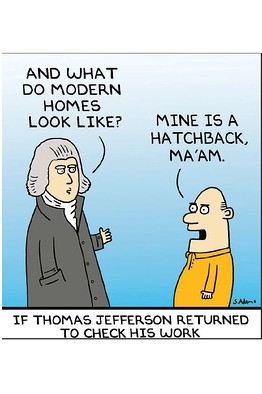
Click on Image to Enlarge
I've heard people say the United States no longer has the caliber of intellectual giants that authored the Declaration of Independence, defeated a superior British military, crafted the Constitution and built a robot butler that would eventually run away and change its name to Mitt Romney. But that's OK, because individuals are not the primary vehicles for genius. When it comes to the larger matters of civilization, group intelligence is more important than individual genius. To put it another way: Do you know who is smarter than the entire senior class at MIT? Answer: no one.
Today, thanks to the Internet, we can summon the collective intelligence of millions.
Phi Beta Iota: Mr. Adams provides a very thoughtful overview of the possibilities, while avoiding any mention of the corruption that is pervasive in today's top-down elite control “rule by secrecy” environment. The Electoral Reform Act of 2012 is intended to eradicate corruption, assure transparency, restore the Republic, and make direct democracy such as Mr. Adams envisions a reality before 2016. The next President should be of, by, and for We the People, tested in the fires of the Occupy Wall Street kiln.
The below link goes to Matt Ridley's excellent lecture analyzing the importance of heresy in science; and by extension, the danger to science posed by an Authority that dictates what is acceptable and what is unacceptable. The oppression of authority is a subject Galileo learned to his chagrin, and a central theme of Jacob Bronoski's brilliant Ascent of Man, in my opinion, the finest television series ever produced. (Bronoski's subject was the growth of knowledge and its central role in the cultural evolution of mankind. To appreciate the squandered potential of television and the mass media, one need only to watch Bronoski's series of programs.)
Ridley gave the Angus Millar Lecture of the Royal Society of the Arts in Edinburgh a few days ago 31 October 2011. Ridley is trained in evolutionary biology — he has a PhD in Zoology from Oxford. His libertarian philosophy makes him controversial in some quarters, but he one of the best science writers out there, particularly on the subject of evolution. Like Darwin, he thinks and writes from the point view of the bottom-up empiricist (which is my favorite point of view).
Ridley's specific subject is pseudo-science: its temptations, its fallacies, and its dangers: his case study is the theory of anthropogenic global warming–a theme about which he says: “When a study was published recently saying that 98% of scientists ‘believe’ in global warming, I looked at the questions they had been asked and realized I was in the 98%, too, by that definition, though I never use the word ‘believe’ about myself.”
Chuck Spinney
Alexandria, Virginia
Below the Line: PDF Link and Also Full Text Online
More than 150 house parties are being planned, and Sen. Bernie Sanders (I-Vt.) will join the parties by phone and webcast. For those in Manhattan, believe it or not, but there is only ONE event listed (60 Wall St, “the Atrium” which is also accessible from Pine St).
The Road to Twenty One Presidential Debates in 2012
11/2/11
What people would not want Presidential Debates in multiple cities all over America in September and October 2012? Why, the people at the Commission on Presidential Debates (CPD). CPD is a private corporation created in 1987. It is controlled by the Republican and Democratic Parties and acts as the iron gatekeeper regarding the number of debates, who is chosen to ask the questions and who is excluded from most important forums for reaching millions of people interested in the presidential elections.
Powered by the television networks that transmit the debates to the public, the CPD is set in concrete when it comes to entrenching the status quo for the two party dictatorship’s orchestrated bubble of exclusion and manipulation.
Occupy Wall Street is an exceptional sociocultural hack. Grabbing eyes & hearts, they’re making it OK to protest again in America. After 911 the normative pressure around dissent & protest shifted, making it very un-American to disagree with and or show criticism of The U S of A. Occupy is quickly becoming view-fodder for the mainstream media. Spin it any way you like but OWS is grabbing the spotlight globally. Expect the election cycle to raise it as a common talking point – a good reason Occupy can safely find heat indoors for the Winter, come back swinging in Spring. This normative shift allows the many many folks who aren’t yet willing or simply can’t come sleep in the streets to be active & connected sympathizers helping spread the word, defend the narrative, and get downtown at 2am on a Thursday to stand against an expected police action. Social media invites participation at all scales.
Much has been said about the Occupy movement's lack of demands and vision. Some say it will have no impact unless it makes demands and organizes to make sure those demands are met.
Others respond that the People should just take charge of their democracy rather than petitioning official powers-that-be to do this and that. Still others say that any list of demands – any effort to focus OWS more narrowly and explicitly – could weaken the movement because Occupy Together is a broadly inclusive initiative that's about (a)changing whole systems and/or (b)creating microcosms of a better society in the occupation zones and/or (c) stimulating transformational conversations out in society at large and/or (d) passionately building and forcefully demonstrating the Power of the People to resist illegitimate, corrupt authority.
Others note that the disturbing lack of demands spreads OWS' surprising impact through a “blank slate effect” – OWS becomes a mystery or a mirror into which diverse individuals and groups project their various desires, hopes, frustrations, and agendas. Furthermore, that mystery helps by enhancing the movement's uncommon anarchic power that makes it so hard for authorities and others to figure out how to control, undermine or use it. Others insist that a shared vision – articulating what the 99% actually want – would be much more powerful than focusing on a laundry list of demands that many 99%ers might well disagree with. Simultaneously, many Occupiers are chronically frustrated with all this talk and want Action!! Their more thoughtful colleagues reply that pulling so many diverse people together in consensus requires taking the time to hear each other and generate collective wisdom.
Phi Beta Iota: Keep an open mind. This is deeply serious and directly relevant to understanding the convergence of the honest right, the honest left, and OccupyWallStreet.
What Lenin meant to convey was that the Soviets were not the ordinary class organisation, whose purpose, according to the Mensheviks and Social-Revolutionists, was to fight only for the economic demands of the working class within the framework of bourgeois society. In his opinion such Soviets would be doomed in advance. In fact, no Soviets were needed for such a purpose. In his view, the Soviets were organisations for the seizure of state power, and for transforming the workers into the ruling class. That is why he again and again told the Petrograd workers in the course of 1916: ‘Ask yourselves a thousand times whether you are prepared, whether you are strong enough; measure your cloth nine times before you cut. To organise Soviets means to declare a war to a finish, to declare civil war upon the bourgeoisie, to begin the proletarian revolution.’
The OWS formations carry such potential, albeit (likewise) in an embryonic state. Their internal democratic structures are the key to this, and that is the part that should be replicated. As assemblies of people are constituted among more and more communities (and the accomplishment of this is extremely important to insuring that the internal democracy of each group is replicated in the aggregation of all such groups, in whatever form that ultimately takes, should it develop that far), both the possibility of coordinate mass action and the potentiality of an alternative political structure that represents all segments of the population emerges. The lesson from Lenin as applied to OWS is to recognize both the positive and negative potential that it represents and to both engage it and shape it to fit the needs of all communities. In the United States in particular, given the historically dominant role of racism in the social order, that means ensuring that the construct that is springing into existence before our eyes is made to become responsive to the direction of the traditionally oppressed communities, particularly communities of color.
Assuming that the most important task is to address the racist nature of this society and to prevent this from being replicated in whatever emerges from the present activities, it would seem that, as the best defense is a good offense, the oppressed communities here (and elsewhere, as this is becoming a global phenomenon) must organize as never before, and in a way that is compatible – in form and substance – with the present model, and which will thus insure that the voices and self-determined interests of these communities will find full expression.
More from Dan DeBar: My thinking on this is not fully developed, but, if you can spare 58 minutes and suffer some of the fits-and-starts of my thought process in the process, I did go into some depth in this video – – which starts off a bit slow, but eventually gets across a good picture of my thinking on the matter. As I felt I got deflected somewhat by the host from my main point – that of the centrality of the issue of racism to any solution of the problems being articulated by, or serving as the catalyst for, the OWS “movement” – I fleshed that out a bit more in this video.