Journal: White House Nightmare, Insanity, or Ignorance?

Collaboration Zones, Communities of Practice, Ethics, Key Players, Methods & Process, Policies, Policy, Reform, Strategy, Threats
Full Story Online

White House nightmare persists

At the end of Barack Obama’s worst week since taking power a year ago, the US president’s fortunes look set only to deteriorate over the coming days.

Phi Beta Iota: We find it quite remarkable that there is absolutely no “intelligence” in the sense of decision-support anywhere in this story.  The last two Administrations (Bush-Cheney and now Obama-Biden) have been noteworthy for the completely absence of strategy, intelligence, Whole of Government management, balanced budget–just about everything a public has a right to expect from its elected and appointed and paid government.

Nightmare is the wrong word–this is self-imposed insanity based on willful ignorance and the absence of a national Open Source Agency (OSA) with a degree of independence equal to that of the Judiciary.  In the Age of Information, information itself has become the Fourth Estate, and the Administration either needs to get a grip on reality and start governing with informed maturity, or watch as others pass them by–Brazil, China, India, Iran, Russia, and Venezuela, for example.

See also:

Election 2008 Chapter: The Substance of Governance

Search: smart nation intelligence reform electoral reform national security reform

Journal: Chavez versus CIA–No Contest

07 Venezuela, Cultural Intelligence, Ethics, Government

Chavez Calls Sentence in CIA's Online Almanac “A Declaration of War” Against Venezuela

If you've ever been curious to know any country's GDP, literacy rate, languages, etc., at a glance, the CIA's online World Factbook is the place to start.

And evidently Venezuelan President Hugo Chavez has been Googling his own country lately, because he's taken serious issue with the sort of government-issue Wikipedia's summary description of the South American nation.

From the CIA World Factbook:

“…For most of the first half of the 20th century, Venezuela was ruled by generally benevolent military strongmen, who promoted the oil industry and allowed for some social reforms. Democratically elected governments have held sway since 1959. Hugo CHAVEZ, president since 1999, seeks to implement his “21st Century Socialism,” which purports to alleviate social ills while at the same time attacking globalization and undermining regional stability. Current concerns include: a weakening of democratic institutions, political polarization, a politicized military, drug-related violence along the Colombian border, increasing internal drug consumption, overdependence on the petroleum industry with its price fluctuations, and irresponsible mining operations that are endangering the rain forest and indigenous peoples.”

The text above constitutes, according to Chavez this past week, “a declaration of war.”

Phi Beta Iota: Chavez is right, CIA is wrong.  A World Factbook is not the place for subjective politicized “judgments,” and if one wishes to speak about the Open Veins of Latin America–Five Centuries of the Pillage of a Continent, the CIA should cut its own throat first or to use another metaphor, not throw stones when it lives in a glass house.    CIA is no longer the destructive monster it used to be, but perhaps worse, Clowns in Action or Contractors in Action, take your pick.  CIA should remove the offending words and surprise Venezuela with a printed corrected copy of the book, and a letter of apology–and it can apologize for its last bungled coup attempt while its at it.  Newsflash for CIA:  imperial globalization bad, indigenous self-determination good.  Duh.

See also:

Continue reading “Journal: Chavez versus CIA–No Contest”

Journal: In Search for Truth….Maybe Not

Civil Society, Cultural Intelligence, Ethics, Government, Media, Military
Story with Many Links

Pentagon’s Gitmo Recidivism Claims Don’t Add Up

Researchers at Seton Hall and New America Foundation track the Pentagon's claims that released Guantanamo detainees ‘returned to battle.'

Phi Beta Iota: Government claims 1 in 5 and counts those who speak to the press against USG and Guantanamo.  Researcers find 1 in 25 at best and observe that the USG is simply not able to get the same story told in the same way more than once.

Appeal Hearing on Guantanamo: Main Issues

On January 26, 2010, a panel of military officers will hear the historic first direct appeal from the military commissions at Guantanamo Bay.  Oral argument in the case of United States v. al Bahlul will focus on three constitutional issues that reach beyond military commissions and terrorism trials.    The main issue in the case asks whether the war on terrorism justifies the censorship of foreign media. [Emphasis added.]

My Truth & Only My Truth

The Age of Affirmation: A new study finds that TV viewers watch the news more for affirmation than for information.

A new study suggests that viewers worldwide turn to particular broadcasters to affirm — rather than inform — their opinions. It's a notion familiar to those dismayed by the paths blazed by cable news networks FOX and MSNBC — although the study finds one (perhaps unlikely) network may actually foster greater intellectual openness.

The study in the December issue of Media, War & Conflict by Shawn Powers, a fellow at the USC Center on Public Diplomacy, and Mohammed el-Nawawy, an assistant professor in the department of communication at Queens University of Charlotte, found that the longer viewers had been watching Al Jazeera English, the less dogmatic they were in their opinions and therefore more open to considering alternative and clashing opinions.

Journal: Haiti–Perspective of Georgie Anne Geyer

08 Wild Cards, Cultural Intelligence, Earth Intelligence, Ethics, Government, Non-Governmental, Peace Intelligence

CAN HAITI SURVIVE?

The United States and many other nations across the globe are sending water, food and troops to benighted Haiti. Charity groups and NGOs from New York to San Francisco are collecting money. The French are calling for a “conference on Haiti's reconstruction and development.” At least in these first few weeks following the horrific earthquake that shook the once-beautiful Caribbean isle, it seems that the world wants to give Haiti everything — except the truth.

Safety Copy of Entire Opinion Below the Line  +  Full Story Online (While It Lasts)
Continue reading “Journal: Haiti–Perspective of Georgie Anne Geyer”

Journal: Haiti History, Interim Report, Prognosis

01 Poverty, 07 Other Atrocities, Communities of Practice, Ethics, Key Players, Methods & Process, Peace Intelligence

To Heal Haiti, Look to History, Not Nature (New York Times)

On Jan. 1, 1804, when Dessalines created the Haitian flag by tearing the white middle from the French tricolor, he achieved what even Spartacus could not: he had led to triumph the only successful slave revolt in history. Haiti became the world’s first independent black republic and the second independent nation in the Western Hemisphere.

Alas, the first such republic, the United States, despite its revolutionary creed that “all men are created equal,” looked upon these self-freed men with shock, contempt and fear. Indeed, to all the great Western trading powers of the day — much of whose wealth was built on the labor of enslaved Africans — Haiti stood as a frightful example of freedom carried too far. American slaveholders desperately feared that Haiti’s fires of revolt would overleap those few hundred miles of sea and inflame their own human chattel.

Haiti Numbers (Daily Gleaner Canada)

* Number of homeless in Haiti: 2 million, European Commission estimate.

* Total death toll roughly 200,000, estimate by the European Union, quoting Haitian officials.

* Other aid: UN World Food Programme has distributed 1.4 million ready-to-eat food rations, says 100 million will be needed over next 30 days to reach three million people in desperate need.

Major aftershock hits Haiti; assessment team making contact (Baptist Press)

The team arrived in Port-au-Prince Wednesday (Jan. 20) after a 17-hour, 160-mile trip in a four-vehicle caravan from Santo Domingo, Dominican Republic.

More than 40 significant aftershocks have hit since the Jan. 12 quake killed an estimated 200,000 people, injured 250,000 and left 1.5 million homeless.

The truck drivers are less and less willing to [drive into the city] as the situation in Port deteriorates.

Officials are concerned that the desperation people feel will boil over into violence. Looters by the hundreds have been fighting each other with broken bottles, clubs and other weapons over whatever goods they can still find in damaged stores.

Haiti DR planning slated Jan. 26 in Miami (Baptist Press)

Another assessment team member, Don Gann, disaster relief director for the Mississippi Baptist Convention, said the situation in Haiti remains fluid, chaotic and difficult. “[T]he traffic in Port-au-Prince is unbelievable,” Gann said. “Today, it took us three hours to go seven miles.

“There are security issues the teams need to be aware of. The situation is still precarious. A medical team or a feeding team could be overrun just because the people here have such great needs.”

Another assessment team member, Don Gann, disaster relief director for the Mississippi Baptist Convention, said the situation in Haiti remains fluid, chaotic and difficult. “[T]he traffic in Port-au-Prince is unbelievable,” Gann said. “Today, it took us three hours to go seven miles. ”

Haiti Earthquake update: cardboard communities

In this Haiti Earthquake update, The Christian Science Monitor reports that Haitians are building new homes after the earthquake with little more than cardboard and plastic in refugee camps. It's estimated that there are 250 such camps in existence.

The rich have left Haiti's capital city of Port-Au-Prince, leaving the poor to fend for themselves. Haiti Earthquake relief efforts are building, but with 3 million people in need of aide and a crumbled infrastructure, it's a challenge.

Update From Haiti: A Little Hope Today

Today felt like we made more progress and were able to create a little hope. We received some food from the United Nations and the Sisters of Charity, but most isn't getting to the people. Most is still in warehouses

Updates on the Crisis in Haiti

The volume of cases was truly overwhelming. We ran 2-3 operating rooms for 12-14 hours at a time, and didn’t even make a dent in the case load.

He added that “it was somewhat unclear” who was in charge of bringing patients injured to the hospital from hte earthquake zone. “

Update on the Progress of the US “Invasion”

Members of the 22nd Marine Expeditionary Unit launched two helicopters to resupply a U.N. distribution site with water.

Then came the earthquake victims, injured one week ago, ferried onboard by several helicopters. In all, the ship took in 19 patients after getting three Tuesday.
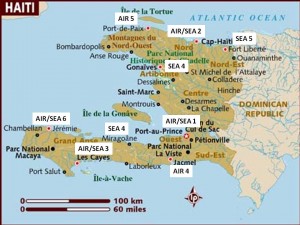
Phi Beta Iota Prognosis: In our over-all experience, absent a sea change in how the world community is approaching this, at least half the aid will be stolen or misappropriated; half the remaining aid dollars and materials will never get to the Hiatians at all.  The prospects of a plague, riots, and other human break-downs increase every day.  At this point in time neither the US nor Brazil nor the Cubans appear to have any of the following:

1.  Multinational Information-Sharing and Sense-Making Center

2.  Multinational Strategy, Operations Plan, or Tactical Lines of Engagement

3.  Phase Plan for leveraging every air and sea entry point that makes sense

4.  Phase Plan for actually getting minimal water and food to each of three million people for each of the next 30, 60, 90 days
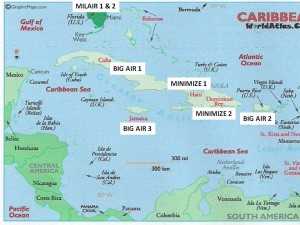
5.  Strategy, Campaign Plan, or Logistics for applying aid dollars to the bottom-up reconstruction of Haiti in a manner that aggressively relocates 400,000 people not to temporary camps but to permanent opportunities with a virtually infinite supply of building materials aided by every Red Hat, See Bee and Army Engineer unit we can muster.  This needs a Berlin Airlift degree of seriousness, a Marine Expeditionary Force level of complex simultaneous attention to detail, and a Whole of Government Multinational Engagement mind-set that we are simply not seeing.

6.  We know that the US Government is trying to share imagery and other information with selected partners both national and non-governmental but we don't see a coherent island-wide Information Operations (IO)  endeavor, and we see ZERO in the way of “Strategic Communications” outlining in militarily precise terms where the bodies are, what percentage have been fed, etcetera.  The absence of this information causes us great sadness, for it suggests that in all probability the US military is not treating this matter with the deep seriousness that it merits from a multinational public information-sharing and sense-making point of view.


Journal: Haiti Rolling Directory from 12 January 2010

Journal: Freedom of Speech, Personhood, & Corporations Ubber Alles–You Will Be Assimilated

Civil Society, Ethics, Government, Law Enforcement
Chuck Spinney

After reading this report by my good friend Werther, I would urge you to compare Werther's analysis to the “inside the beltway,” K Street analyses published in today's Washington Post — then decide which you like better.

Chuck Spinney

High Court Decrees Existence of Corporate Übermensch

By Werther (Pseudonym) Electric Politics January 22, 2010

The Supreme Court's wholesale rejection of a century of statutes regulating corporate contributions to political campaigns is a breath of fresh air in a hypocrisy-ridden political process. It certainly ought to sweep away the tendency of timid rationalizers to deny the existence of corporate domination and control of every aspect of governance in the United States — a fact which should have already been made abundantly clear by the terms of the bank bailout and the health care travesty.

It is not inconceivable, using the Court's logic, that antitrust laws could be thrown out as well. Since natural persons have freedom of association, why should not artificial persons have a similar freedom of association? The Court has in fact created a species of Nietzschean Übermensch: a non-human human endowed with the strength of many people and theoretically immortal.

Now that our Supreme Court, with the assistance of a little medieval alchemy, has ruled that property can be transmuted into persons, is it conceivable that it could do the opposite? Before one dismisses the thought, the executive branch, with the connivance of lower federal courts, has already been busy establishing the precedent that persons held at Guantanamo prison and other facilities can be converted into the property of the United States Government, to be held indefinitely.

Who is helped, or hurt, by the Citizens United decision? (Washington Post)

CLETA MITCHELL : The Supreme Court has correctly eliminated a constitutionally flawed system that allowed media corporations (e.g., The Washington Post Co.) to freely disseminate their opinions about candidates using corporate treasury funds, while denying that constitutional privilege to Susie's Flower Shop Inc

ROBERT LENHARD:   The balance of power in political contests has shifted dramatically away from candidates running for office and toward corporations and unions seeking to advance their policy agendas.

KENNETH GROSS:  Contrary to popular reports, the sky is not falling.

ANNA BURGER:  There can be no doubt: The voice of everyday working Americans in the political process will be muted.

BEN GINSBERG:   The voices of candidates and political parties just got much quieter.

MARK ELIAS:  While few individuals exercise their right to fund multimillion-dollar advertising campaigns, we should expect that corporations will eagerly do so. Given corporate wealth and the legislative stakes, in many elections corporations will dominate paid campaign communications — leaving candidates and political parties as secondary actors.

KAREN FINNEY: At the very moment Americans' mistrust of big corporations, big government and large institutions has reached a fever pitch, the Supreme Court moved to replace a government of, for and by the people with a government that can be bought and paid for by just about any major corporation — from Exxon to Russian-owned Lukoil to China's CPC Corp.

Journal: MILNET–Loss of Rule of Law, Aviation Insecurity

Ethics, Government, Law Enforcement, Military

Judge Tosses NSA Spy Cases

U.S. District Judge Vaughn Walker’s decision was a major blow to the  two suits testing warrantless eavesdropping and executive branch  powers implemented following the 2001 terror attacks. The San  Francisco judge said the courts are not available to the public to  mount that challenge.

“A citizen may not gain standing by claiming a right to have the  government follow the law,” (.pdf) Walker ruled late Thursday.

Cindy Cohn, the legal director of the Electronic Frontier Foundation that brought one of the cases, said the decision means “when you’re trying to stop the government from doing something illegal, and if the government does it to enough people, the courts can’t fix it.”

The Rule of Law Has Been Lost: Security Fools

The greatest human achievement is the subordination of government to law. This was an English achievement that required eight centuries of struggle, beginning in the ninth century when King Alfred the Great codified the common law, moving forward with the Magna Carta in the thirteenth century and culminating with the Glorious Revolution in the late seventeenth century.

The success of this long struggle made law a shield of the people. As an English colony, America inherited this unique achievement that made English speaking peoples the most free in the world.

As Lawrence Stratton and I show in our book, The Tyranny of Good Intentions (2000), the protective features of law in the U.S. were eroded in the twentieth century by prosecutorial abuse and by setting aside law in order to better pursue criminals. By the time of our second edition (2008), law as a shield of the people no longer existed. Respect for the Constitution and rule of law had given way to executive branch claims that during time of war government is not constrained by law or Constitution.

Emergency doors, karaoke bombers and other false alarms: When did we become such a nation of scaredy-cats?

This country needs to get a grip. We need a slap in the face, a splash of cold water.

On Saturday, 57-year-old Jules Paul Bouloute opened an emergency exit inside the American Airlines terminal at Kennedy airport. Alarms blared and sirens flashed. Bouloute later told police that he'd opened the door by accident.

Which is what you'd assume. Sure, the exit was clearly marked, but it happens all the time, does it not?

All of Terminal 8 was evacuated for more than two hours. Police then swept through the building with dogs and SWAT teams (because, you see, a terrorist wouldn't quietly drop an explosive device into a trash barrel; he would first set off alarms, in order to…?). Before being allowed back in, thousands of travelers were forced to undergo rescreening at the Transportation Security Administration checkpoints, giving guards a chance to snag any butter knives or 4-ounce shampoo bottles they might have missed the first time. Inbound planes were stranded on the tarmac and departures were delayed for several hours.

Continue reading “Journal: MILNET–Loss of Rule of Law, Aviation Insecurity”

noble gold