Robert Steele: Going Dark, Anyone Wants to Talk Future of Intelligence, Seeking ONE Audience

Advanced Cyber/IO, Ethics, Lessons, Liberation Technology, Officers Call
Robert David STEELE Vivas

My Body Mass Index (BMI) is where it needs to be, hoping to go dark in near term (30-45 days).  Anyone that wants to talk new and evolving craft of intelligence, Open Source Everything (OSE), and M4IS2, now is the time.  Particularly interested in engaging on the below new briefing that was developed as combined keynote (45 min) and workshop (2 hrs), would like to refine it with a firm eye on the subordinate nature of intelligence within the larger Information Operations (IO) landscape that has been totally hosed by NSA and the obsession on cyber-bucks instead of cyber-brains.  Meanwhile, until I am on payroll, donations are gratefully received and individually acknowledged, and I would absolutely love to present both of these once, on video, as a milestone that can be placed into the public domain as with my M4IS2 presentation in Chile.

2013 Robert Steele Intelligence Future Overview & Workshop

See Also:

Game Plan & Logo

Manifesto Extracts

NATO OSE/M4IS2

Public Intelligence 3.2

22-23 May 2013 University of Maryland Human-Computer Interaction Lab-Conference

Advanced Cyber/IO

The University of Maryland's Human-Computer Interaction Lab's 30th Annual Symposium:
Wednesday, May 22, 2013
Thursday, May 23, 2013
www.cs.umd.edu/hcil/soh

HCIL's 30th Annual Symposium will consider the future of social media, networks, medical informatics, information visualization, interaction design, children, games, education, HCI design methods, tangible computing, accessibility, and MORE! Learn more about the HCIL's research at the UNIVERSITY OF MARYLAND through talks, tutorials, workshops, demos and posters.

Program:
Wednesday, May 22: Keynotes, talks in parallel with workshops and tutorials
Thursday, May 23: Demos, talks in parallel with workshops and tutorials

Attendees can focus on suggested tracks or sample talks from all topics. Sample tracks include:

* Education & Games
* HCI & Design
* Medical Informatics & Visualization
* Social Media & Networks

Please see below for suggested tracks:

Continue reading “22-23 May 2013 University of Maryland Human-Computer Interaction Lab-Conference”

Stephen E. Arnold: A Fresh Look at Big Data & Big Data (-) Human Factor (+) Transformation (+) RECAP

Access, Advanced Cyber/IO, Architecture, Collective Intelligence, Communities of Practice, Cultural Intelligence, Design, Earth Intelligence, Ethics, Key Players, Peace Intelligence, Policies, Strategy, Threats
Stephen E. Arnold
Stephen E. Arnold

A Fresh Look at Big Data

May 8, 2013

Next week I am doing an invited talk in London. My subject is search and Big Data. I will be digging into this notion in this month’s Honk newsletter and adding some business intelligence related comments at an Information Today conference in New York later this month. (I have chopped the number of talks I am giving this year because at my age air travel and the number of 20 somethings at certain programs makes me jumpy.)

I want to highlight one point in my upcoming London talk; namely, the financial challenge which companies face when they embrace Big Data and then want to search the information in the system and search the Big Data system’s outputs.

Click on Image to Enlarge

Notice that precision and recall has not improved significantly over the last 30 years. I anticipate that many search vendors will tell me that their systems deliver excellent precision and recall. I am not convinced. The data which I have reviewed show that over a period of 10 years most systems hit the 80 to 85 percent precision and recall level for content which is about a topic. Content collections composed of scientific, technical, and medical information where the terminology is reasonably constrained can do better. I have seen scores above 90 percent. However, for general collections, precision and recall has not been improving relative to the advances in other disciplines; for example, converting structured data outputs to fancy graphics.


I don’t want to squabble about precision and recall. The main point is that when an organization mashes Big Data with search, two curves must be considered. The first is the complexity curve. The idea is that search is a reasonably difficult system to implement in an effective manner. The addition of a Big Data system adds another complex task. When two complex tasks are undertaken at the same time, the costs go up.

Continue reading “Stephen E. Arnold: A Fresh Look at Big Data & Big Data (-) Human Factor (+) Transformation (+) RECAP”

Michael Kearns: Mapping the World with Tweets

Advanced Cyber/IO
Michael S. Kearns
Michael S. Kearns

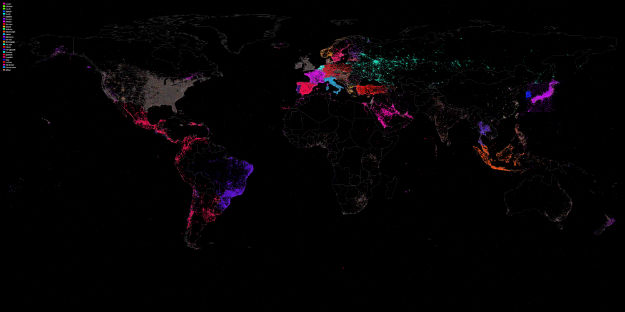
Mapping the world with Tweets

Posted By Joshua Keating Share

A new paper on the peer-reviewed online journal First Monday summarizes the results of a project to use geographic data gathered from Tweets to create a picture of the world according to Twitter.

Click on Image to Enlarge

The researches, led by GDELT co-creator Kalev Leetaru, used the Twitter decahose, a massive feed of 10 percent of all tweets, access to which is normally sold at high price to marketers. The project covers the period of the Oct. 23, 2102, to November 30, 2012. During this time, 1,535,929,521 tweets were streamed from 71,273,997 unique users — about 2.8 terabytes worth of data. But only about 3.04 percent of those contained geolocation data — either exact coordinates from mobile phones or user-selected locations. All the same, that's an awful lot of geographical information, and allowed the authors to create this map of a month in the life of Twitter (Bigger, high-resolution version here):

. . . . . . . . .

The plenty more in the paper itself, including list of the world's most retweeted cities. Not surprisingly, New York City is number one, but I was surprised to see that my current hometown, Washington D.C., didn't even crack the top 20, which includes some seemingly unlikely places as Riyadh, Porto Allegre, and San Antonio. Guess we're not the center of the world after all.

Read full article with additional graphics.

Berto Jongman: Global Spying on Social Media and Mobile Phones

Advanced Cyber/IO, Government, Law Enforcement
Berto Jongman
Berto Jongman

This Powerful Spy Software Is Being Abused By Governments Around The World

Michael Kelley

Business Insider | May 2, 2013

A new report presents overwhelming evidence that sophisticated spying software is being abused by governments around the world.

The findings by The Citizen Lab, a digital research laboratory at the University of Toronto, detail how the software marketed to track criminals is being used against dissidents and human rights activists.

Titled “For Their Eyes Only: The Commercialization of Digital Spying,” the report focuses on a type of surveillance software called FinSpy that can remotely monitor webmail and social networks in real time as well as collect encrypted data and communications of unsuspecting targets.

Neal Rauhauser: Benchmarking Analytic Bridge vs. Data Central

Advanced Cyber/IO
Neal Rauhauser
Neal Rauhauser

Analytic Bridge vs. Data Science Central

I recently spent some time digging into Data Science Central membership, gathering information on about 12,000 members of the site. I started having some profile editing deja vu, went through my bookmarks and unsorted PDFs, and discovered an interesting competition.

. . . . . . . . .

So these two data science oriented sites are using the same strategy to build audience by outreach on LinkedIn, and they appear to be using the same software for their web sites. Both sites are career SEO oriented, with member posts, top content, and other features tuned to drive recognition and traffic. Having just sorted out what is happening I am wondering how effective each one is. Data Science Central has 12,000 members, Analytics Bridge has 27,000, but …

Read full post with graphics.

Rickard Falkvinge: Swarmwise – The Tactical Manual to Changing the World Chapter Four

Advanced Cyber/IO, Civil Society, Cultural Intelligence, Earth Intelligence, Ethics

Rickard Falkvinge
Rickard Falkvinge

Swarmwise – The Tactical Manual To Changing The World. Chapter Four.

Swarm Management:  People’s friends are better marketers toward those people than you, for the simple reason that they are those people’s friends, and you are not.

Swarmwise chapters – one chapter per month
1. Understanding The Swarm
2. Launching Your Swarm
3. Getting Your Swarm Organized: Herding Cats
4. Control The Vision, But Never The Message (this chapter)
5. Keep Everybody’s Eyes On Target, And Paint It Red Daily (Jun 1)
6. Screw Democracy, We’re On A Mission From God (July 1)
7. Surviving Growth Unlike Anything The MBAs Have Seen (Aug 1)
8. Using Social Dynamics To Their Potential (Sep 1)
9. Managing Oldmedia (Oct 1)
10. Beyond Success (Nov 1)The actual book is expected to be available by June 1, 2013.

Continue reading “Rickard Falkvinge: Swarmwise – The Tactical Manual to Changing the World Chapter Four”

noble gold