Patrick Meier: How to Crowdsource Better Governance in Authoritarian States

Advanced Cyber/IO, Collective Intelligence, Government
Patrick Meier

How to Crowdsource Better Governance in Authoritarian States

I was recently asked to review this World Bank publication entitled: “The Role of Crowdsourcing for Better Governance in Fragile States Contexts.” I had been looking for just this type of research on crowdsourcing for a long time and was therefore well pleased to read this publication. This blog posts focuses more on the theoretical foundations of the report, i.e., Part 1. I highly recommend reading the full study given the real-world case studies that are included.

“[The report serves] as a primer on crowdsourcing as an information resource for development, crisis response, and post-conflict recovery, with a specific focus on governance in fragile states. Inherent in the theoretical approach is that broader, unencumbered participation in governance is an objectively positive and democratic aim, and that governments’ accountability to its citizens can be increased and poor-performance corrected, through openness and empowerment of citizens. Whether for tracking aid flows, reporting on poor government performance, or helping to organize grassroots movements, crowdsourcing has potential to change the reality of civic participation in many developing countries. The objective of this paper is to outline the theoretical justifications, key features and governance structures of crowdsourcing systems, and examine several cases in which crowdsourcing has been applied to complex issues in the developing world.”

The research is grounded in the philosophy of Open-Source Governance, “which advocates an intellectual link between the principles of open-source and open-content movements, and basic democratic principles.” The report argues that “open-source governance theoretically provides more direct means to affect change than do periodic elections,” for example. According to the authors of the study, “crowdsourcing is increasingly seen as a core mechanism of a new systemic approach of governance to address the highly complex, globally interconnected and dynamic challenges of climate change, poverty, armed conflict, and other crises, in view of the frequent failures of traditional mechanisms of democracy and international diplomacy with respect to fragile state contexts.”

Read full article.

David Isenberg: Open Access to Scientific Information

Advanced Cyber/IO, Communities of Practice, Cultural Intelligence, Earth Intelligence, Ethics, InfoOps (IO), Methods & Process, Open Government, Policies, Politics of Science & Science of Politics, Reform
David Isenberg

Open Access to Scientific Information

By Adrian Janes

Source: House of Commons Library (UK)

Overview:

Open Access (OA) to scientific publications could provide more effective dissemination of research and thus increase its impact.

The costs and benefits of different models of providing OA to publications need to be considered if a comprehensive shift to OA is to be financially sustainable.

OA to research data could enable others to validate findings and re-use data to advance knowledge and promote innovation.

Sharing data openly requires effective data management and archiving. It also presents challenges relating to protecting intellectual property and privacy.

Expanding access to scientific information requires researchers, librarians, higher education institutions, funding agencies and publishers, to continue to work together.

+ Direct link to document from this page (PDF; 351 KB)

See Also:

1992 E3i: Ethics, Ecology, Evolution, & intelligence (An Alternative Paradigm)

1992 AIJ Fall ‘New Paradigm” and Avoiding Future Failures

1992 Steele (US) From School House to White House

Pierre Levy: Open-Science Movement Catches Fire

Advanced Cyber/IO, Collective Intelligence, Cultural Intelligence
Pierre Levy

Researchers revolt against Elsiever

Testify: The Open-Science Movement Catches Fire

David Dobbs

WIRED, 30 January 2012

For years, the open science movement has sought to light a fire about the “closed” journal-publication system. In the last few weeks their efforts seemed to have ignited a broader flame, driven mainly, it seems, by the revelation that one of the most resented publishers, Elsevier, was backing the Research Works Act — some tomfoolery I noted in Congress Considers Paywalling Science You Already Paid For, on January 6. Now, 24 days later, scientists are pledging by the hundred to not cooperate with Elsevier in any way — refusing to publish in its journals,  referee its papers, or do the editorial work that researchers have been supplying to journals without charge for decades — and the rebellion is repeatedly reaching the pages of the New York Times and Forbes.

In my feature I speculated whether librarians who would eventually lead the charge. But Jason Hoyt, then of Mendeley and now of OpenRePub, seemed to have it closer: the revolution awaited only the researchers. In what is easily the biggest surge the open-science movement has ever put on, a growing list of researchers is publicly pledging against Elsevier. At The Cost of Knowledge, a site created this purpose, there were 1400 signatories last night, and when I woke today at 5 a.m., over 1600. The thing seems to be snowballing. Some have ached to take action for years. Others are newly radicalized. Together, their stated reasons form a sort of first-person dramatization of the issues I explored in “Free Science.” A skim through their testiomony (below the jump here) is an education in why the call for open science is going mainstream:

Read full article.

Phi Beta Iota:  This is of course the whole point of creating the World Brain and Global Game, to achieve precisely the efficiencies and zero resistance to multinational information-sharing and sense-making that we have been advocating since 1988 in various forms, since 1995 in Smart Nation and World Brain forms.  Open Government, Open Economy, Open Society — it is all coming as a tsunami of cultural change.

See Also:

The Open Source Everything Manifesto: Transparency, Truth, & Trust (Evolver Editions, June 2012)

Venessa Miemis: Postmodern Report on Knowledge

Advanced Cyber/IO, Collective Intelligence, Cultural Intelligence, Ethics
Venessa Miemis

Reflection: The Postmodern Condition: A Report on Knowledge

musings on Jean-François Lyotard’s The Postmodern Condition: A Report on Knowledge
.
NOTE:  This is a book review, extraction from the work above, not personal reflections inspired by the book, and is offered as such–a gleaning from Lyotard's 1979 work.
.
How do we define ‘knowledge’ in a postindustrial society equipped with new media, instantaneous communication technologies and universal access to information? Who controls its transmission? How can scientific knowledge be legitimated?These are the questions Lyotard asks in The Postmodern Condition. He believes that the method of legitimation traditionally used by science, a philosophical discourse that references a metanarrative, becomes obsolete in a postmodern society. Instead, he explores whether paralogy may be the new path to legitimation.
Click on Image to Enlarge

I. The Field: Knowledge in Computerized Societies

.

The nature of knowledge itself is shifting from being an end in itself to a commodity meant to be repackaged and redistributed. In order to be valuable, learning must be able to be reformatted into these packets of information in computer language, so that they can be sent through that channel of communication. Today, we increasingly hear the words “knowledge economy” and “information society” to describe the era we are entering. As was always the case, knowledge is power. Now, in an increasingly complex world, those with the ability to sort through the vast amounts of information and repackage it to give it meaning will be the winners. Technologies continue to solve problems that were formerly the source of power struggles between nations (i.e. the need for cheap labor is diminished by the mechanization of industry, the need for raw materials is reduced by advances in alternative energy solutions), and so control of information is most likely to become the 21st century’s definition of power.

.

2. The Problem: Legitimation

.

The definition of knowledge is determined by intertwining forces of power, authority, and government. Leotard draws a parallel between the process of legitimation in politics and of those in science: both require an authority figure or “legislator” to determine whether a statement is acceptable to enter the round of discourse for consideration. In an increasingly transparent society, this leads to new questions:

Who is authorizing the authority figure? Who is watching the watchers?

Berto Jongman: Russian Sixth Generation Warfare and Role of Openness

Advanced Cyber/IO, Commerce, Commercial Intelligence, Earth Intelligence, Government, Military
Berto Jongman

Russian Sixth Generation Warfare And Recent Developments

Eurasia Daily Monitor Volume: 9 Issue: 17

While press attention on developments in Russia focused on the disputed parliamentary elections and the following protests, which seemed to revive political activism in Moscow and other urban centers, there have been some military developments that deserve some attention. One such theme is an old topic, sixth generation warfare and its impact upon the nuclear threshold – do advanced conventional systems, which approach nuclear effects, blur the line on nuclear deterrence? The Russian press has had several recent articles that suggest this issue is becoming more acute.

In the aftermath of Desert Storm in 1991, the late Major-General Vladimir Slipchenko coined the phrase “sixth generation warfare” to refer to the “informatization” of conventional warfare and the development of precision strike systems which could make the massing of forces in the conventional sense an invitation to disaster and demand the development of the means to mass effects through depth to fight systems versus systems warfare. Slipchenko looked back at Ogarkov’s “revolution in military affairs” with “weapons based on new physical principles” and saw “Desert Storm” as a first indication of the appearance of such capabilities. He did not believe that sixth generation warfare had yet manifested its full implications (Vladimir Slipchenko, Voina budushchego. Moscow: Moskovskii Obshchestvennyi Nauchnyi Fond, 1999).

Click on Image to Enlarge

However, Slipchenko did believe that sixth generation warfare would replace fifth generation warfare, which he identified as thermonuclear war, and had evolved into a strategic stalemate, making nuclear first use an inevitable road to destruction (from the end of the Soviet Union until his death in 2005, he had analyzed combat experience abroad to further refine his conception until he began to speak of the emergence of “no-contact warfare” as the optimal form for sixth generation warfare; Vladimir Slipchenko, Beskontaktnye voiny. Moscow: Izdatel’skii dom: Gran-Press,” 2001). In his final volume, Slipchenko redefined sixth generation warfare as involving the capacity to conduct distant, no-contact operations and suggested that such conflict would demand major military reforms. Slipchenko made a compelling case for the enhanced role of C4ISR in conducting such operations (Vladimir Slipchenko,Voina novogo pokoleniia: Distantsionnye i beskontaktaktnye, Moscow: OLMA-Press, 2004).

Continue reading “Berto Jongman: Russian Sixth Generation Warfare and Role of Openness”

Robert Capps: System D – Informal Economy Ignores Government

03 Economy, 09 Justice, 10 Security, Advanced Cyber/IO, Articles & Chapters, Civil Society, Commerce, Commercial Intelligence, Cultural Intelligence, Government, Law Enforcement, Methods & Process, microfinancing
Robert Capps

Why Black Market Entrepreneurs Matter to the World Economy

Robert Capps

WIRED, 16 December 2011

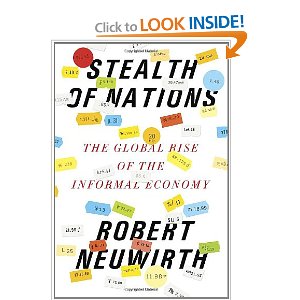
Not many people think of shantytowns, illegal street vendors, and unlicensed roadside hawkers as major economic players. But according to journalist Robert Neuwirth, that’s exactly what they’ve become. In his new book, Stealth of Nations: The Global Rise of the Informal Economy, Neuwirth points out that small, illegal, off-the-books businesses collectively account for trillions of dollars in commerce and employ fully half the world’s workers.

Amazon Page

Further, he says, these enterprises are critical sources of entrepreneurialism, innovation, and self-reliance. And the globe’s gray and black markets have grown during the international recession, adding jobs, increasing sales, and improving the lives of hundreds of millions. It’s time, Neuwirth says, for the developed world to wake up to what those who are working in the shadows of globalization have to offer. We asked him how these tiny enterprises got to be such big business.

Wired: You refer to the untaxed, unlicensed, and unregulated economies of the world as System D. What does that mean?

Robert Neuwirth:There’s a French word for someone who’s self-reliant or ingenious: débrouillard. This got sort of mutated in the postcolonial areas of Africa and the Caribbean to refer to the street economy, which is called l’économie de la débrouillardise—the self-reliance economy, or the DIY economy, if you will. I decided to use this term myself—shortening it to System D—because it’s a less pejorative way of referring to what has traditionally been called the informal economy or black market or even underground economy. I’m basically using the term to refer to all the economic activity that flies under the radar of government. So, unregistered, unregulated, untaxed, but not outright criminal—I don’t include gun-running, drugs, human trafficking, or things like that.

Click on Image to Enlarge

Wired: Certainly the people who make their living from illegal street stalls don’t see themselves as criminals.

Neuwirth: Not at all. They see themselves as supporting their family, hiring people, and putting their relatives through school—all without any help from the government or aid networks.

Wired: The sheer scale of System D is mind-blowing.

Neuwirth: Yeah. If you think of System D as having a collective GDP, it would be on the order of $10 trillion a year. That’s a very rough calculation, which is almost certainly on the low side. If System D were a country, it would have the second-largest economy on earth, after the United States.

Read a SUPERB interview.

Tip of the Hat to Berto Jongman.

Phi Beta Iota:  System D is completely separate from straight forward black crime (organized crime) or white crime (Goldman Sachs et al).  What this really means is that governments have lost all legitimacy and two thirds of the global economy now considers governments to be at best a meddling (and costly) nuisance and at worst the enemy to be defeated by any means necessary.   Governments brought this on themselves.

See Also:

Critical Choices. The United Nations, Networks, and the Future of Global Governance

Global Public Policy: Governing Without Government?

High Noon: 20 Global Problems, 20 Years to Solve Them

Illicit: How Smugglers, Traffickers, and Copycats are Hijacking the Global Economy

Intelligence for Earth: Clarity, Diversity, Integrity, & Sustainability

The Open-Source Everything Manifesto: Transparency, Truth, and Trust

Howard Rheingold: Critical Thinking vs. Information Literacy

Advanced Cyber/IO
Howard Rheingold

Is There a Difference Between Critical Thinking and Information Literacy?

John M Weiner

Abstract

This paper investigates the similarities and differences between two important ideas in information processing and knowledge utilisation. Those ideas are [critical thinking] and [information literacy].  The two phrases are shown in brackets to indicate that the two words involved in each idea are not arbitrarily combined but have been coupled by authors to represent a single entity or a focus for development of concepts describing the characteristics involved. By exploring terms related to this couplet from the same sentence, the meaning of each of the central ideas can be expanded.  The education, library science, and health science literature were used in this study, which analysed 8745 articles dealing with [critical thinking] and 8201 reports dealing with [information literacy] included in either ERIC or PubMed from 2000-2009.

The findings showed that combinations of terms (i.e. ideas) such as [information & literacy & related term] or [critical & thinking & related term], when organised based on Bloom’s Taxonomy of Learning (Bloom 1956), clarified the similarities and differences between the two central ideas. [Information literacy] was involved in all of the cognitive functions suggested by Bloom. This finding is consistent with the definitions of [information literacy] that relate it to lifelong learning and effective decision-making. In addition, the ideas describing [information literacy] were consistent with actions and perceptions that were more public and standardised than those associated with [critical thinking].

This suggests that [information literacy] and its associated procedures could significantly augment current instruction in [critical thinking] and indeed, the possibility has been explored by some authors in the current literature. A merging of the two ideas would involve [information literacy] providing tools and techniques in the processing and utilisation of knowledge and [critical thinking] supplying the particulars and interpretations associated with a specific discipline. This type of integration could lead to instructional programs similar in concept and application to those in research methodology where methods from statistics are integrated with the techniques and skills associated with a specific discipline. The development of a curriculum of this type would change functions and perceptions from private, individualised mentation, now associated with [critical thinking], to a more easily learned and practiced process suitable across the breadth of disciplines.

Keywords

critical thinking; information literacy; idea analysis

Full Text: PDF

noble gold