Seth Godin: Creativity Demands Deep Understanding

Advanced Cyber/IO, Blog Wisdom, Collective Intelligence, Ethics, Hacking
Seth Godin

Bypassing the leap

Every now and then, a creative act comes out of nowhere, a giant leap, a new way of thinking apparently woven out of a brand new material.

Most of the the time, though, creativity is the act of reassembling many elements that are already known. That's why domain knowledge is so critical.

The screenwriter who understands how to take the build that went into the classic Greg Morris episode of the Dick Van Dyke show and integrate it with the Maurce Chevalier riff from the Marx Bros… Or the way Moby took his encyclopedic knowledge of music and turned into a record that sold millions… if you don't have awareness and an analytical understanding of what worked before, you can't build on it.

That's one of the reasons that the recent incarnation of the Palm failed. The fact that the president of the company had never used an iPhone left them only one out: to make a magical leap.

It's not enough to be aware of the domain you're working in, you need to understand it. Noticing things and being curious about how they work is the single most common trait I see in creative people. Once you can break the components down, you can put them back together into something brand new.


Steve Denning: Reinventing Education

04 Education, 11 Society, Advanced Cyber/IO, Blog Wisdom, Civil Society, Ethics
Steve Denning

Leadership

What’s Involved In Reinventing Education?

Steve Denning

Forbes ASAP 4 August 2011

The significant problems we have cannot be solved at the same level of thinking with which we created them.

Albert Einstein

The US education system is in crisis, putting the long-term future of the economy in question. The evidence is well-known. A root cause of the crisis is the application of the factory model of management to education, where everything is arranged for the scalability and efficiency of “the system”, to which the students, the teachers and the parents have to adjust. “The system” grinds forward, at ever increasing cost and declining efficiency, dispiriting students, teachers and parents alike.

Read full article with new graphic….

Jason Silva: Creativity, Marijuana, & Butterfly Effect

09 Justice, 11 Society, Advanced Cyber/IO, Blog Wisdom, Civil Society, Collective Intelligence, Cultural Intelligence
Click on Image to Enlarge

On Creativity, Marijuana and “a Butterfly Effect in Thought”

Jason Silva

Reality Sandwich

“The truly creative mind in any field is no more than this: A human creature born abnormally, inhumanly sensitive.” […] “…by some strange, unknown, inward urgency they are not really alive unless they are creating.” — Pearl Buck, Winner of a Nobel Prize in Literature in 1938.

In a blog post last year entitled “Marijuana and Divergent Thinking”, Jonah Lehrer explains that many creative
tasks require the cultivation of an “expansive associative net, or what psychologists refer to as a “flat associative hierarchy.” What this essentially suggests is that creative people should be able to make far-reaching connections among all sorts of seemingly unrelated ideas, and to not dismiss one possible connection just because it seems far-fetched.

Creativity and insight almost always involve an experience of acute pattern recognition: the eureka moment in whicwe perceive the interconnection between disparate concepts or ideas to reveal something new.

The Imaginary Foundation says that “to understand is to perceive patterns” and this is exactly what all great thinkers have done throughout the ages: they have provided a larger, dot-connecting, aerial view of things that subsumes the previous paradigm. As Richard Metzger has written:

What great minds have done throughout history is provide an aerial view of things. A larger more encompassing view that often subsumes the previous paradigm and then surpasses it in completeness with the vividness of its metaphors. Consider now how the evolving notions of a flat earth, Copernican astronomy and Einsteinian physics have subsequently changed how mankind sees its place in the cosmos, continuously updating the past explanations with something superior.

Read more….

DefDog: Inexpensive Drone Do It Yourself Cyber-War

Advanced Cyber/IO, Computer/online security, Hacking
DefDog Recommends....

Wardriving Evolves Into Warflying

Researchers release specs for a DIY radio-controlled plane that hacks systems by air

By Ericka Chickowski, Contributing Editor

Dark Reading, 4 August 2011

BLACK HAT USA 2011 — Las Vegas — Yesterday at Black Hat, two security researchers demonstrated how a radio-controlled model airplane outfitted with a computer and 4G connectivity could be used to create a nearly undetectable aerial hacking device that could perpetrate aerial attacks on targets otherwise unreachable by land.

Created completely with off-the-shelf equipment and open-source software — and with a budget of only about $6,100 — the demo plane they brought on stage with them was capable of wireless network sniffing and cracking, cell tower spoofing, cell phone tracking and call interception, data exfiltration, and video surveillance.

Read more….

Phi Beta Iota:  Until integrity in all senses of the word is “root,” society will continue to be vulnerable to all forms of corruption including low-bidder unethical cyber-systems, and high-bidder unethical cyber-attack.

See Also:

2010: OPINION–America’s Cyber Scam

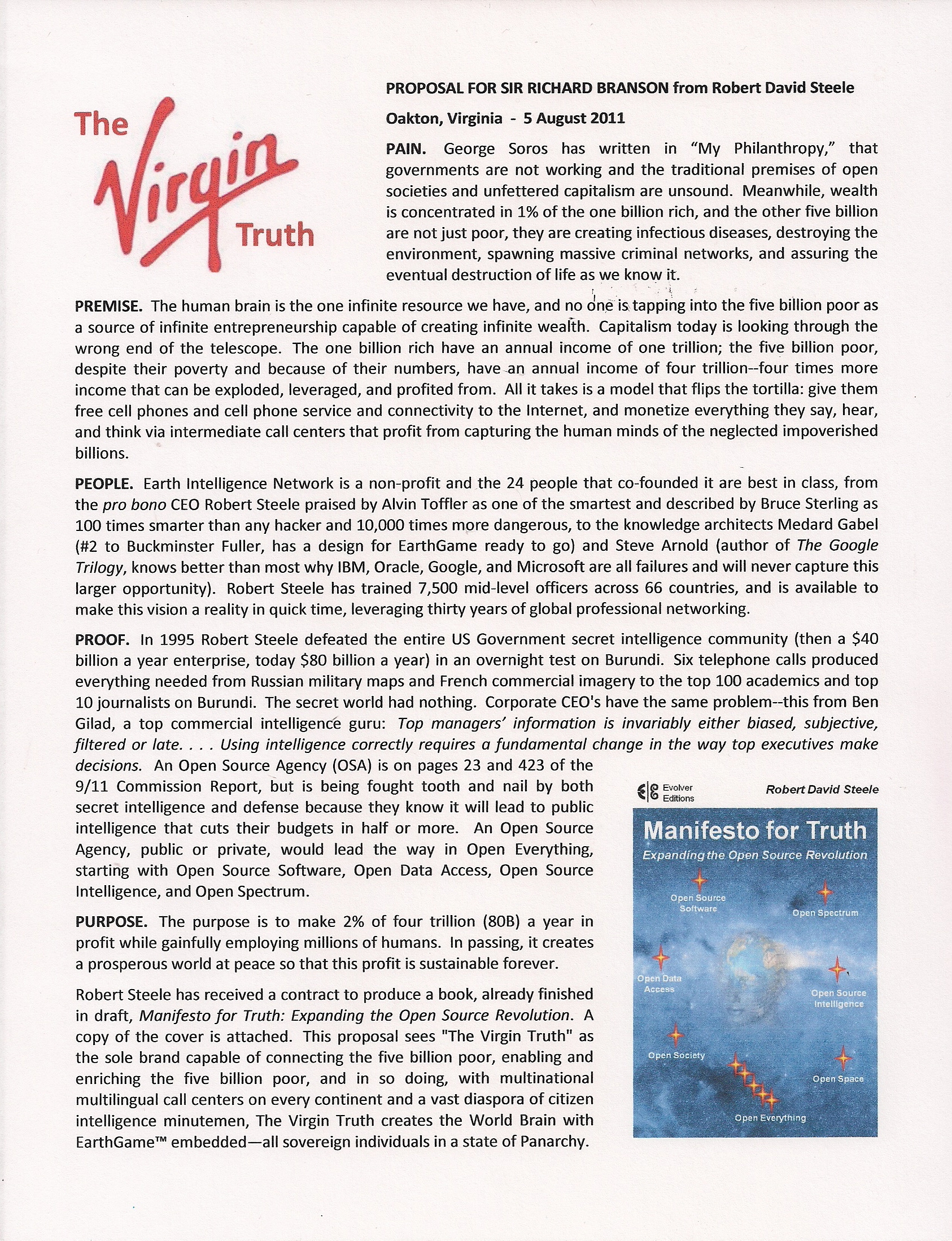
Robert Steele: The Virgin Truth (Old)

Advanced Cyber/IO, Commerce, Earth Intelligence, Ethics, Fact Sheets, Hacking, InfoOps (IO), Key Players, Methods & Process, Mobile, Policies, Real Time, Reform, Strategy, Threats

OBE See Instead: 2012 Robert Steele for Richard Branson: The Virgin Truth 2.6

Robert David STEELE Vivas

There is a very talented author, journalist, and speaker, Mike Southon, who publishes in the Financial Times.  One of his articles, “Perfect Pitch,” 7 March 2009 was instrumental in crafting the below one-page “pitch.”  Mike's four web sites:

www.ft.com/mikesouthon
www.yoodoo.biz
www.mikesouthon.com
www.beermat.biz

Short Persistent URL for this post (The Virgin Truth):

http://tinyurl.com/Steele4Branson


Click on Image to Enlarge

One-Pager Online Updated

Serious Games for Serious Civic Engagement

Advanced Cyber/IO, Civil Society, Collective Intelligence, Government, Policies, Serious Games, Threats

   Serious Games for Serious Civic Engagement

Use The Power of Collaborative, Serious Games to Engage Citizens and  

  Resolve Our Budget Crises


It’s no secret. We’re broke. Local governments, state governments, the U.S. Federal Government and many international governments are all facing budget shortfalls, spending cuts and reduced services. All of us — ordinary citizens, elected officials, civic and community leaders — know that we must make dramatic changes and tough choices to solve this crisis. But how do we engage our communities in identifying and prioritizing the best possible solutions? How do we create more engaged and informed citizens?

Our Answer?  Fix Broke(n) Governments through Serious Games

On January 29, 2011, The Innovation Games® Company designed and produced an in-person serious game to help more than 100 citizens, community leaders and city officials in San Jose, CA collaboratively prioritize possible cuts to the city budget.

Instead of polling residents individually, our specially designed Innovation Game®, the San Jose Budget Games, created an opportunity for ordinary citizens to negotiate with one another, listen to their neighbors and create budgets that reflected not only their own but others viewpoints. Civic leaders left the San Jose Budget Games with both a clear and actionable list of the proposals citizens could compromise on and also a record of why they had found common ground—and the game results have impacted the actual city budget.

Our experience with the city of San Jose has convinced us that games are a powerful tool for civic engagement: Thus we’re seeking funds to extend our existing in-person version of Budget Games into an online version.  Instead of engaging hundreds of citizens, we want to powerfully connect tens of thousands or even millions of motivated citizens with their elected officials—and we need your help to get this done.

Read more….

UN + Start-Up Seek to Get Poor Online with Cell Numbers

01 Poverty, 03 Economy, 04 Education, 06 Family, 07 Health, 09 Justice, 11 Society, Advanced Cyber/IO, Civil Society, Collective Intelligence, Ethics, Gift Intelligence, Hacking, Key Players, Mobile, Non-Governmental, Real Time

Startup Aims to Get the Poor Online With Phone Numbers

By Stephen Lawson, IDG News

U.K. startup Movirtu plans to help 3 million or more people in poor countries use mobile services by giving them personal phone numbers, not phones.

Working with a U.N.-affiliated initiative called Business Call to Action (BCtA), Movirtu will offer the numbers, which it calls mobile identities, through commercial carriers in developing countries in Africa and South Asia. People in those countries who typically borrow phones from others will be able to log into the carrier's network and use their own prepaid minutes and bits of data.

The service is called Cloud Phone, though it operates within a carrier's own infrastructure rather than on the Internet as a classic cloud service would. Having a personal mobile identity can save users money in two ways, according to Ramona Liberoff, executive vice president of marketing, strategy and planning at Movirtu. First, they can use mobile services without buying a phone, which is a luxury even at US$15 or $20 for people making $1 or $2 per day.

Second, the cost of prepaid service from a carrier typically is less than what consumers in those countries pay someone to borrow a phone, she said. Though it's customary in many of these countries to lend a phone to someone in need, the borrower is also expected to pay the lender for the usage. The average savings from using regular prepaid service instead is estimated at about $60 per year, Liberoff said.

The service will help people to use mobile banking, insurance and farming assistance services as well as make phone calls, Liberoff said. Some of these services currently can only be delivered to individuals and not to someone sharing a phone. Personal mobile identities could be a boon to NGOs (non-governmental organizations) that want to use mobile technology.

Read more….

See Also:

Continue reading “UN + Start-Up Seek to Get Poor Online with Cell Numbers”

noble gold