Steven Aftergood: US Intelligence Budget Data — PBI: Understated but on the Record

03 Economy, 04 Inter-State Conflict, 05 Civil War, 07 Other Atrocities, 09 Terrorism, 10 Security, 10 Transnational Crime, 11 Society, Corruption, Director of National Intelligence et al (IC), DoD, Government, Ineptitude, IO Deeds of War, IO Impotency, Military, Office of Management and Budget, Officers Call, Peace Intelligence
Steven Aftergood
Steven Aftergood

Intelligence Budget Data

On March 4, 2014, the Administration submitted its Fiscal Year 2015 budget request, including a base funding request of $45.6 billion for the National Intelligence Program (NIP), and a base funding request of $13.3 billion for the Military Intelligence Program (MIP). On June 30, the DNI submitted an updated FY2015 budget request of $49.4 billion for the NIP including funding for overseas contingency operations. An updated budget request figure for the MIP has not yet been disclosed.

Phi Beta Iota: We consider these figures to be severely deceptive and roughly 70% of the actual combined total budget for green and black intelligence capabilities that are secret, toxic, and a mix of benignly worthless (standing armies of ignorant analysts, collection that is not processed) and pathologically dangerous (drones, renditions, covert operations, subsidies to foreign intelligence services). Our best guess of the actual total US secret intelligence budget remains US$100 billion per year, inclusive of thousands of private sector “intelligence” capabilities (many of them “open source” and extremely mediocre) that are embedded within acquisition and other contracts, all out of control and of dubious value.
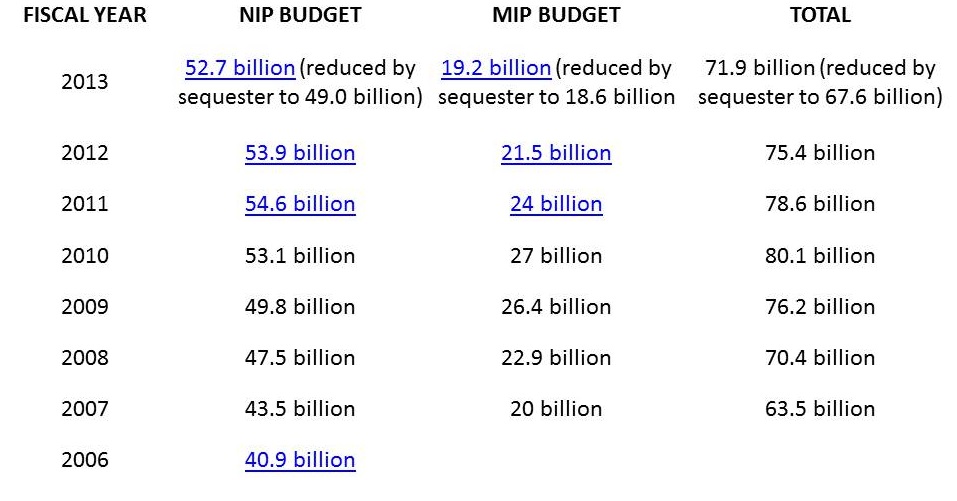
IC Budget Table Cropped
Click on Table to Enlarge

Click to access Office of the Director of National Intelligence Budget Justifications

Berto Jongman: Pfaff on US Doing Stupid Stuff in Ukraine Plus Chuck Spinney & Pat Buchanan on Bluster, Bluff, Corruption and More Stupidity in Estonia…

02 Diplomacy, 06 Russia, 08 Wild Cards, Corruption, Government, Idiocy, Ineptitude, IO Deeds of War, Officers Call, Peace Intelligence
Berto Jongman
Berto Jongman

Doing Stupid Stuff in the Ukraine

William Pfaff

EXTRACT

President Obama said not long ago that his foreign policy principle was “not doing stupid stuff.” At about the same time his State Department and CIA were conspicuously guiding and supporting a coup d'etat in Ukraine that was the exact contradiction to the Obama policy statement. The Ukrainian Parliament's first post-coup act was to pass a resolution outlawing the use of the Russian language in the Ukraine, which is the native language of more than a fifth of the population of a country that has always been intimately involved in the history, religion and culture of the Russian nation. Nothing could have been more stupid.

[Until Obama's next move…]

Read full post.

Chuck Spinney and Pat Buchanan below the fold.

Continue reading “Berto Jongman: Pfaff on US Doing Stupid Stuff in Ukraine Plus Chuck Spinney & Pat Buchanan on Bluster, Bluff, Corruption and More Stupidity in Estonia…”

Stephen E. Arnold: Bilingual Search Engine YaSabe Sets a New Gold Standard — Will Baidu and Yandex Notice and Further Bury Google’s Shallow Sponsored English Search?

Advanced Cyber/IO, IO Tools
Stephen E. Arnold
Stephen E. Arnold

Bilingual Search Engine YaSabe Sees Growth through Word of Mouth and Media Partnerships

The article on Elevation DC titled Herndon-Based Bilingual Search Engine Expands Reach covers the growth of YaSabe, the Spanish and English search engine helping Spanish-speaking Americans find the information they need. The search engine actually finds data that is English and translates it into Spanish before tagging it. The article states,

“Its categories are geared toward the information Spanish speakers might need: bilingual service providers, jobs for people fluent in more than one language, 18 different types of Latin cuisine. Azim Tejani, the company’s executive vice president, says that 20 percent of YaSabe’s traffic comes directly to the site, 50 percent comes from search engines where users search for terms like “pedicura” instead of “pedicure” and the remaining traffic comes from its partnerships with media companies serving Spanish-speaking Ameri[cans].”

Tejani is also quoted in the article as saying that YaSabe is mobile-centered as opposed to web-centered. According to Tejani, some 30% of YaSabe users rely mainly on their mobile phones to access the internet. He credits the growth of YaSabe both with community guides as well as strengthened relationships with Spanish-language media partners such as Univision and Mundo Hispanico. Univision in particular has seen great success since YaSabe began running the TV network’s search engines in 2013.

Chelsea Kerwin, September 11, 2014

Sponsored by ArnoldIT.com, developer of Augmentext

Berto Jongman: Greenwald on ISIS, Rothkopf on National Insecurity Plus Spinney, Polk, Cockburn, and Steele on How ISIS and Hamas Have Won and Everything We Plan to Do Will Deepen Our Losses

08 Wild Cards, Corruption, Government, Ineptitude, IO Deeds of War, Media, Military, Officers Call, Peace Intelligence
Berto Jongman
Berto Jongman

Americans Now Fear ISIS Sleeper Cells Are Living in the U.S., Overwhelmingly Support Military Action

Glenn Greenwald

The Intercept, 8 September 2014

EXTRACTS

What kind of country goes around bombing people with no strategic purpose and with little motive other than to “flex muscles” and “show toughness”? This answer also seems clear: one that is deeply insecure about its ongoing ability to project strength (and one whose elites benefit in terms of power and profit from endless war).   …   Is it even possible to imagine more potent evidence of systemic media failure than that (or systemic success, depending on what you think the media’s goal is)? But in terms of crazed irrationality, how far away from that false belief is the current fear on the part of Americans that there are ISIS sleeper cells “living in the United States”?   …   For those who keep running around beating their chests talking about the imperative to “destroy ISIS”: will that take more or less time than it’s taken to “destroy the Taliban”?

Read full article.

National Insecurity: Can Obama's foreign policy be saved?

David Rothkopf

Foreign Policy, 9 September 2014

“You're still a superpower,” a top diplomat from one of America's most dependable Middle Eastern allies said to me in July of this year, “but you no longer know how to act like one.” He was reflecting on America's position in the world almost halfway into President Barack Obama's second term. Fresh in his mind was the extraordinary string of errors (schizophrenic Egypt policy, bipolar Syria policy), missteps (zero Libya post-intervention strategy, alienation of allies in the Middle East and elsewhere), scandals (spying on Americans, spying on friends), halfway measures (pinprick sanctions against Russia, lecture series to Central Americans on the border crisis), unfulfilled promises (Cairo speech, pivot to Asia), and outright policy failures (the double-down then get-out approach in Afghanistan, the shortsighted Iraq exit strategy).

Read full article.

Continue reading “Berto Jongman: Greenwald on ISIS, Rothkopf on National Insecurity Plus Spinney, Polk, Cockburn, and Steele on How ISIS and Hamas Have Won and Everything We Plan to Do Will Deepen Our Losses”

Michel Bauwens: Information Asymmetry and Power in a Surveillance Society

IO Impotency
Michel Bauwens
Michel Bauwens

“In this paper we look at how information in societies is organized and how power relationships arise as a consequence of this organization. We argue that many of the observed information asymmetries are not happenstance and, drawing from a wealth of scholarship from the economics and finance literature, we posit that outcomes are inevitably detrimental. The paper concentrates on the techniques that foster information imbalances, such as media and propaganda, knowledge production, educational systems, legal and organizational structures, exclusive information networks, and surveillance. We conclude that in the absence of greater transparency, the deleterious effects of unequal access to information will continue and deepen.”

* Article: Information Asymmetry and Power in a Surveillance Society. Lightfoot, Geoffrey and Wisniewski, Tomasz (2014). Munich Personal RePEc Archive.

Tip of the Hat to Jean Lievens for the pointer.

Rick Robinson: 11 Reasons Computers Fail Without Humans

IO Impotency
Rick Robinson
Rick Robinson

11 reasons computers can’t understand or solve our problems without human judgement

Why data is uncertain, cities are not programmable, and the world is not “algorithmic”.

Many people are not convinced that the Smart Cities movement will result in the use of technology to make places, communities and businesses in cities better. Outside their consumer enjoyment of smartphones, social media and online entertainment – to the degree that they have access to them – they don’t believe that technology or the companies that sell it will improve their lives.

The technology industry itself contributes significantly to this lack of trust. Too often we overstate the benefits of technology, or play down its limitations and the challenges involved in using it well.

Most recently, the idea that traditional processes of government should be replaced by “algorithmic regulation” – the comparison of the outcomes of public systems to desired objectives through the measurement of data, and the automatic adjustment of those systems by algorithms in order to achieve them – has been proposed by Tim O’Reilly and other prominent technologists.

Read full post with eleven reasons and many links.

noble gold