Marcus Aurelius: Ground Truth from an “Average” Lieutenant in Afghanistan

Cultural Intelligence
Marcus Aurelius
Marcus Aurelius

Below is one of the better pieces of its type that I've read.  While it refers several times to USMA, the majority of it is, IMHO, applicable to new officers from all commissioning sources. I think the most important point author makes comes at the end where he emphasizes the reality of a platoon leader's job.  Some context is in order.  Author is among the tail end of a cohort of officers and Soldiers who are/were, essentially, either deployed or preparing for deployment.  As we withdraw from Afghanistan, that reality will change sharply.  Junior officers such as the author will now have to lead units through a new regimen where the order of the day will, at HQDA direction, be a return to the “basics” of garrison soldiering, where area beautification, brilliance of bootshines, and scuff-free floors will supplant marksmanship, tactical proficiency, and ability of junior soldiers to perform as “strategic corporals.”  Efficiency and asking permission will displace effectiveness and initiative.  Army senior leaders, notably the Sergeant Major of the Army, feel strongly that this change in focus is the solution to the Army's social and disciplinary problems.  New officers will be challenged to lead combat veteran Soldiers under those circumstances.

What I Wish I Knew: From Cadet to Lieutenant in Afghanistan

By First Lieutenant Scott Ginther

FOB SHANK, LOGAR PROVINCE, AFGHANISTAN

After ardently attempting once to write an essay on “what I know now that I wish I knew then,” I realized that writing even just a two or three paged paper is something cadets do not want to read.  This being said, when I was posed with this task I swore I would do three things: 1) provide an honest answer, 2) express the truth in the most unvarnished way possible, and 3) keep things short.  Therefore, I have decided to make a list that cadets can squeeze in between their class and sports demands, and their beloved naps and “Not Being At West Point” time.

Continue reading “Marcus Aurelius: Ground Truth from an “Average” Lieutenant in Afghanistan”

Berto Jongman: Frederick Kagan on Why US Has Failed to Defeat Al Qaeda

01 Poverty, 02 Infectious Disease, 03 Environmental Degradation, 04 Inter-State Conflict, 05 Civil War, 06 Genocide, 07 Other Atrocities, 08 Proliferation, 09 Terrorism, 10 Transnational Crime, Corruption, Government, Military, Peace Intelligence
Berto Jongman
Berto Jongman

Missing the Target: Why the US Has Not Defeated al Qaeda

Frederick W. Kagan, TESTIMONY

American Enterprise Institute, 8 April 2014

All conditions are set for a series of significant terrorist attacks against the US and its allies over the next few years. But that's not the worst news. Conditions are also set for state collapse in Iraq, Syria, Lebanon, Yemen, and possibly Jordan. Saudi Arabia, facing a complex succession soon, is likely to acquire nuclear weapons shortly, if it has not already done so. Turkey and Egypt confront major crises. Almost all of Northern and Equatorial Africa is violent, unstable, and facing a growing al Qaeda threat. And Vladimir Putin's assault on Ukraine is likely to empower al Qaeda-aligned jihadists in Crimea and in Russia itself. That eventuality is, of course, less worrisome than the prospect of conventional and partisan war on the European continent, likely threatening NATO allies. The international order and global stability are collapsing in a way we have not seen since the 1930s. There is little prospect of this trend reversing of its own accord, and managing it will require massive efforts by the US and its allies over a generation or more.

This distressing context is essential for considering the al Qaeda threat today. On the one hand, it makes that threat look small. The long – term effects of global chaos and conflict among hundreds of millions of people across Europe, Africa, and the Middle East on US security, interests, and way of life are surely greater than any damage al Qaeda is likely to do to us in the immediate future. Yet the two threats feed each other powerfully. Disorder and conflict in the Muslim world breed support for al Qaeda, which is starting to look like the strong horse in Iraq and even in Syria. Al Qaeda groups and their allies, on the other hand, powerfully contribute to the collapse of state structures and the emergence of horrific violence and Hobbesian chaos wherever they operate. They are benefiting greatly from the regional sectarian war they intentionally triggered (the destruction of the Samarra Mosque in 2006 was only the most spectacular of a long series of efforts by al Qaeda in Iraq to goad Iraq’s Shi’a into sectarian conflict , for which some Shi’a militants, to be sure, were already preparing) — and have been continuing to fuel.

Al Qaeda is like a virulent pathogen that opportunistically attacks bodies weakened by internal strife and poor governance, but that further weakens those bodies and infects others that would not otherwise have been susceptible to the disease. The problem of al Qaeda cannot be separated from the other crises of our age, nor can it be quarantined or rendered harmless through targeted therapies that ignore the larger problems.

Yet that is precisely how the Obama administration has been trying to deal with al Qaeda.

PDF (6 Pages): 20140408 Kagan on Why US Has Not Defeated Al Qaeda

Continue reading “Berto Jongman: Frederick Kagan on Why US Has Failed to Defeat Al Qaeda”

Berto Jongman: 7 armed conflicts world failed to stop

04 Inter-State Conflict, 05 Civil War, 06 Genocide, 07 Other Atrocities
Berto Jongman
Berto Jongman

7 armed conflicts the world failed to stop, proving we learned little from the Rwanda genocide

For 20 years, the world has been promising “never again.” It's been an empty promise.

Timothy McGrath

Global Post, 8 April 2014

For those who lived through the genocide in Rwanda, the mass killings were an indescribable horror. For those who watched from afar, it was an international shame. The world stood idle as an estimated 800,000 men, women, and children were slaughtered in the course of 100 days in 1994. After, hanging its collective head, the world promised that “never again” would it allow such a horrifying conflict to unfold.

But even while making that promise, the world watched as people in Liberia and the Democratic Republic of Congo killed and displaced each other by the millions. Conflicts in Darfur and Syria would also later test the world's “never again” resolve. The US invasion of Iraq and Mexico's drug war created new armed conflicts that also failed to live up to the lofty promise.

“Never again,” it seems, was an empty promise. The world of international actors capable of preventing or intervening in such conflicts has over and over again avoided doing so, even when there was the political and public will to do so.

Here are just seven examples:

LIST ONLY:

1) Democratic Republic of Congo: First & Second Congo Wars, aftermath (1996 – present)

2) First and Second Liberian Civil Wars (1989-2003)

3) Eritrean – Ethiopian War (1998-2000)

4) Darfur conflict (2003 – present)

5) Iraq: US invasion, insurgency, civil war (2003 – present)

6) Mexican Drug War (2006 – present)

7) Syrian conflict (2011 – present)

Read full article with photos, death tolls, and descriptive text.

SchwartzReport: Obesity in Kids Costs Billions – Combination of Corporate & Government Corruption with Social & Cultural Malaise

03 Economy, 06 Family, 07 Health, 11 Society, Civil Society, Commerce, Corruption, Government
Stephan A. Schwartz
Stephan A. Schwartz

We reap what we sow as a country. Much of this child obesity arises from toxins and pollutants in the environment. Whatever the source when one tracks it back to fundamentals it always gets down to profit for the few, at the risk of wellness for the many.

Obesity in Kids Costs Billions
SALYNN BOYLES – MedPage Today

Berto Jongman: Eight (Nine!) Problems with Big Data

IO Impotency
Berto Jongman
Berto Jongman

Eight (No, Nine!) Problems With Big Data

By and

BIG data is suddenly everywhere. Everyone seems to be collecting it, analyzing it, making money from it and celebrating (or fearing) its powers. Whether we’re talking about analyzing zillions of Google search queries to predict flu outbreaks, or zillions of phone records to detect signs of terrorist activity, or zillions of airline stats to find the best time to buy plane tickets, big data is on the case. By combining the power of modern computing with the plentiful data of the digital era, it promises to solve virtually any problem — crime, public health, the evolution of grammar, the perils of dating — just by crunching the numbers.

Or so its champions allege. “In the next two decades,” the journalist Patrick Tucker writes in the latest big data manifesto, “The Naked Future,” “we will be able to predict huge areas of the future with far greater accuracy than ever before in human history, including events long thought to be beyond the realm of human inference.” Statistical correlations have never sounded so good.

Is big data really all it’s cracked up to be? There is no doubt that big data is a valuable tool that has already had a critical impact in certain areas. For instance, almost every successful artificial intelligence computer program in the last 20 years, from Google’s search engine to the I.B.M. “Jeopardy!” champion Watson, has involved the substantial crunching of large bodies of data. But precisely because of its newfound popularity and growing use, we need to be levelheaded about what big data can — and can’t — do.

LIST ONLY:

Continue reading “Berto Jongman: Eight (Nine!) Problems with Big Data”

Worth a Look: Books on War and Torture Victims, Asylum and Refugee Trauma

Cultural Intelligence, Peace Intelligence, Worth A Look
Amazon Page
Amazon Page

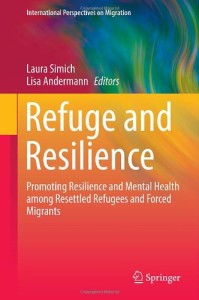
2014 Refuge and Resilience: Promoting Resilience and Mental Health among Resettled Refugees and Forced Migrants

Taking an interdisciplinary approach and focusing on the social and psychological resources that promote resilience among forced migrants, this book presents theory and evidence about what keeps refugees healthy during resettlement. The book draws on contributions from cultural psychiatry, anthropology, ethics, nursing, psychiatric epidemiology, sociology and social work. Concern about immigrant mental health and social integration in resettlement countries has given rise to public debates that challenge scientists and policy makers to assemble facts and solutions to perceived problems. Since the 1980s, refugee mental health research has been productive but arguably overly-focused on mental disorders and problems rather than solutions. Social science perspectives are not well integrated with medical science and treatment, which is at odds with social reality and underlies inadequacy and fragmentation in policy and service delivery. Research and practice that contribute to positive refugee mental health from Canada and the U.S. show that refugee mental health promotion must take into account social and policy contexts of immigration and health care in addition to medical issues. Despite traumatic experiences, most refugees are not mentally ill in a clinical sense and those who do need medical attention often do not receive appropriate care. As recent studies show, social and cultural determinants of health may play a larger role in refugee health and adaptation outcomes than do biological factors or pre-migration experiences. This book’s goal therefore is to broaden the refugee mental health field with social and cultural perspectives on resilience and mental health.

Amazon Page
Amazon Page

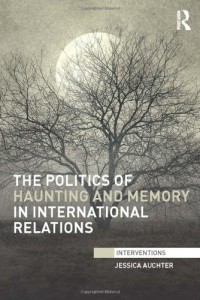
2014 The Politics of Haunting and Memory in International Relations

International Relations has traditionally focused on conflict and war, but the effects of violence including dead bodies and memorialization practices have largely been considered beyond the purview of the field. Drawing on Jacques Derrida’s notion of hauntology to consider the politics of life and death, Auchter traces the story of how life and death and a clear division between the two is summoned in the project of statecraft. She argues that by letting ourselves be haunted, or looking for ghosts, it is possible to trace how statecraft relies on the construction of such a dichotomy. Three empirical cases offer fertile ground for complicating the picture often painted of memorialization: Rwandan genocide memorials, the underexplored case of undocumented immigrants who die crossing the US-Mexico border, and the body/ruins nexus in 9/11 memorialization. Focusing on the role of dead bodies and the construction of particular spaces as the appropriate sites for memory to be situated, it offers an alternative take on the new materialisms movement in international relations by asking after the questions that arise from an ethnographic approach to the subject: viewing things from the perspective of dead bodies, who occupy the shadowy world of post-conflict international politics. This work will be of great interest to students and scholars of critical international relations, security studies, statecraft and memory studies.

Continue reading “Worth a Look: Books on War and Torture Victims, Asylum and Refugee Trauma”

Chris Hedge: The Crucible of Iraq – Best Book from Worst War

04 Inter-State Conflict, 05 Civil War, 07 Other Atrocities, 08 Wild Cards, 11 Society, Corruption, Cultural Intelligence, Government, Idiocy, Military, Officers Call, Peace Intelligence
Chris Hedges
Chris Hedges

The Crucible of Iraq

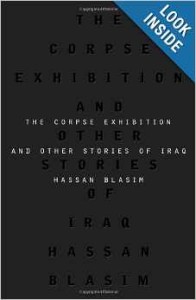
The Corpse Exhibition: And Other Stories of Iraq, by Hassan Blasim, is the most important book to come out of the Iraq War. Blasim, whom I met with last week in Princeton, N.J., has a faultless eye for revealing detail, a ribald black humor and a psychological brilliance that makes every story in his book a depth charge. In this collection of short stories he explores through fiction the culture of violence unleashed under the bloody dictatorship of Saddam Hussein and exacerbated by an American occupation that has destroyed the damaged social cohesion and civil life that survived Saddam's regime. His prose, courtesy of a brilliant translation by  Jonathan Wright, is lyrical, taut, and riveting.

Amazon Page
Amazon Page

Militarism and violence are diseases. It does not matter under what guise they appear. Renegade jihadists, Shiite death squads, Sunni militias, Saddam's Baathists and secret police, Kurdish Peshmerga rebels, al-Qaida cells, gangs of kidnappers and the U.S. Army 101st Airborne are all infected with the same virus. And it is a virus Blasim fearlessly inspects. By the end of this short-story collection the reader grasps, in a way no soldier's memoir or journalistic account from Iraq can explicate, the crucible of war and the unmitigated horror of violence itself. The book is a masterpiece.

“When I was 6, during my first year at school, the Iran-Iraq War erupted,” Blasim told me in a mixture of English and Arabic. “We were living in Kirkuk. We were taught in school to draw tanks or the face of Ayatollah Khomeini as the enemy. The city of Kirkuk was beautiful. There were flowers everywhere. But we were never taught the names of the flowers. Even today I do not know the names of these flowers. I tried to learn their names as an adult.”

“There was a culture of violence that predated the occupation,” he said…

Continue reading “Chris Hedge: The Crucible of Iraq – Best Book from Worst War”

noble gold