David Isenberg: Private Military Contractors — Foxes in the Henhouse

09 Justice, 10 Security, Corruption, Government, Ineptitude, Military, Officers Call
David Isenberg
David Isenberg

The PMSC fox in the government henhouse

Although he may not have intended it as such, all the publicity surrounding the recent published book by Erik Prince, founder of the private security firm once known as Blackwater, has actually served a useful public policy purpose; namely, highlighting the near ubiquitous presence of private military and security contractors (PMSC), as well as other types of private contractors, and the cost and benefits of using them.

When it comes to the costs of outsourcing formerly inherently governmental functions there are many different ways to calculate them but one relatively under-examined way is to consider the dangers of allowing what in almost any other industry would be considered a conflict of interest.  Or. To put it more colorfully, does it really serve the public interest to allow a PMSC fox guard the government hen house?

Specifically, does anyone really think it is reasonable to assume that placing personal services contractors (Note: “personal services” is the umbrella category that all PMSC contracts fall under) in government procurement offices will produce dispassionate, objective assessments of the pros and cons of using PMSC?

Does anyone think that is a good idea; anyone, anyone at all?  Hmmm, your silence is deafening.

Well, if you think this is an absurd idea rest assured you are not alone. William Charles Moorhouse is in the house. Major Moorhouse serves in the U.S. Army Judge Advocate General’s Corps and is currently the Chief of Contract and Fiscal Law for the U.S. Army Expeditionary Contracting Command.


Read full article with additional quotes.

Preston James: Why Didn’t We Learn from Vietnam?

03 Economy, 09 Justice, 11 Society, Commerce, Corruption, Government, IO Deeds of War, Officers Call, Threats
Preston James
Preston James

Why Didn’t We Learn From Vietnam?

Individual soldiers deserted in huge numbers, whole units refused to fight, there was rebellion in some Barracks, and numerous incidents of fragging, some preceded by warnings to officers and non-coms to back off, others not.

There were large mass demonstrations at home in America and the situation became so dire, that President Lyndon Johnson was told by his advisers and the Ruling Cabal that he must step aside and could not run for a second term.

Most of this was kept from the American public by a Controlled Major Mass Media (CMMM) which served in most cases as official USG propaganda dispensers.

Henry Kissinger was the interface between the Ruling Cabal, the Secret Shadow Government (SSG) and President Nixon and basically ran Nixon’s foreign policy.

Nixon was elected and seemed to be led around by the nose by his National Security Adviser Henry Kissinger who is now viewed by many as a hardened war criminal for his many dealings in Vietnam, Myanmar and other places which directly resulted in mass death. He is also blamed for his manipulative, botched negotiations and recommendation to leave so many American POW/MIAs behind with secret plans to have them assassinated in jungle prison camps by special Observation Groups (SOGs), actually Special Operations Groups and aircraft dispensed poisonous VX gas when that failed.

It’s important to note that because JFK was Assassinated by a high military Cabal including LBJ, J. Edgar Hoover, GHWB, Dulles, Lansdale, Lemnitzer, etc. that Vietnam became possible as an illegal perpetual, un-winnable war for profits in the first place. Once JFK was out of the way, the US Military and the defense industry and banks surrounding became the Secret Shadow Government, and began ruling the visible, ceremonial government which actually became a hired prostitute of the SSG.

It takes creative Psyops by the top Policy-Makers to elicit a nation’s support for any new war.

No nation’s citizens are eager to send their children to war to be maimed and die in mass, and it take special high level psychological operations (Psyops) to process the society’s group mind to motivate them adequately to want revenge against another nation or group.

OPTION A: Read full post with photos at host site.

OPTION B: Read full post without photos, and Phi Beta Iota comment with additional links, below the line.

Continue reading “Preston James: Why Didn't We Learn from Vietnam?”

Eagle: Charles Hugh Smith on Bubble Economy – Starting with the Assassination of JFK

01 Poverty, 03 Economy, 07 Other Atrocities, 10 Transnational Crime, 11 Society, Civil Society, Commerce, Corruption, Government
300 Million Talons...
300 Million Talons…

Why We're Stuck with a Bubble Economy   (December 9, 2013)

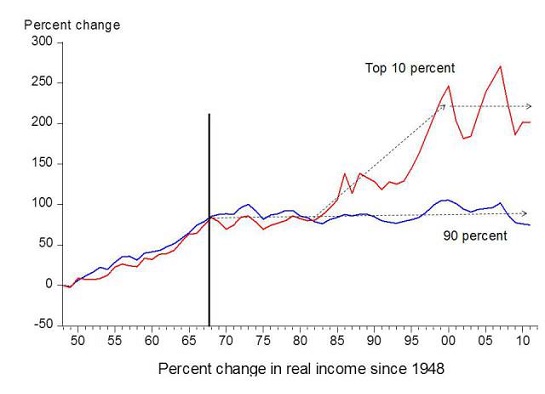
Inflating serial asset bubbles is no substitute for rising real incomes.

Why are we stuck with an economy that only generates serial credit/asset bubbles that crash with catastrophic consequences? Ths answer is actually fairly straightforward.

Click on Image to Enlarge

Let's start with the ideal conditions for an economy that depends on consumer spending.


1. Rising real income, i.e. after adjusting for inflation/currency depreciation, wages/salaries have more purchasing power every year.


2. An expanding pool of new households, i.e. young people who move away from home or graduate from college, get a job and start their own household. New households buy homes, vehicles, furniture, appliances, kitchenware, tools, etc., driving consumption far more than established households.


Neither of these conditions apply to today's economy. Income for the bottom 90% has been stagnant for forty years, and has declined 7% in real terms since 2000.

Read full article with more graphics.

Continue reading “Eagle: Charles Hugh Smith on Bubble Economy – Starting with the Assassination of JFK”

Jon Rappaport: Art, imagination, and magic

Cultural Intelligence
Jon Rappoport
Jon Rappoport

Art, imagination, and magic

Logic applies to the physical universe.

It applies to statements made about that universe. It applies to factual language.

Many wonderful things can be done with logic. Don’t leave home without it. Don’t analyze information without it.

But art and imagination are of another universe(s). They can deploy logic, but they can also invent in any direction without limit, and they can embrace contradiction. They can build worlds in which space and time and energy are quite different.

Magic is nothing more and nothing less than imagination superseding this universe. People have all sorts of crazy ideas about it, mostly prompted by organized religion, but magic occurs when imagination takes this reality for a ride.

Continue reading “Jon Rappaport: Art, imagination, and magic”

4th Media: Group of Thirty created in 1913 as a response to “the Populist assault on the massive concentration of wealth in the hands of few.”

03 Economy, 11 Society, Commerce, Corruption

4th media croppedGlobal Power Project: The Group of Thirty and the “Good Discussion” They’re Still Having

Dec 9th, 2013 @ 12:57 pm › Kiyul Chung

The Group of Thirty (or G-30) describes itself as “a private, nonprofit, international body composed of very senior representatives of the private and public sectors and academia,” which “aims to deepen understanding of international economic and financial issues, to explore the international repercussions of decisions taken in the public and private sectors, and to examine the choices available to market practitioners and policymakers.”

Its membership consists of roughly thirty major figures in the global financial world, from central banks, academia, international institutions and major private financial institutions. These figures hold regular meetings, conduct research and produce highly-influential reports through various “working groups,” providing a forum for top policy makers and private sector market “actors” to meet and hold discussions, while helping shape consensus and give recommendations to policy makers on issues of finance and governance.

This institution, though not widely discussed, is enormously influential. And here’s why.

The history of the Group of Thirty goes back to the Rockefeller Foundation, which provided the organization’s initial funding. In its 1978 annual report, the Rockefeller Foundation – which represents the interests of highly centralized corporate and financial power – recalled that it was created in 1913 as a response to “the Populist assault on the massive concentration of wealth in the hands of few.” (Annual Report, 1978, Rockefeller Foundation.)

Continue reading “4th Media: Group of Thirty created in 1913 as a response to “the Populist assault on the massive concentration of wealth in the hands of few.””

SchwartzReport: Truths That Matter

Commercial Intelligence, Earth Intelligence
Stephan A. Schwartz
Stephan A. Schwartz

This, more than any story I have read in years, shows the absolute corruption and immorality of American healthcare. The ACA does very little to change this. It is simply not possible to have a genuine healthcare system when profit is more important tha! n health. Until we acknowledge that America will always be second class when it comes to the wellness of its people.

An Effective Eye Drug Is Available for $50. But Many Doctors Choose a $2,000 Alternative
PETER WHORISKEY and DAN KEATING – The Washington Post

Continue reading “SchwartzReport: Truths That Matter”

Jean Lievens: The New Social Leadership – Moving from Fear to Freedom

Commercial Intelligence, Cultural Intelligence
Jean Lievens
Jean Lievens

The New Social Leadership – Moving from Fear to Freedom

Christine Comaford

Forbes, 28 October 2012

When driven by fear, human beings generally go to one of three places:

1)      They get stuck.

2)      They solve problems that don’t exist.

3)      They focus on the wrong problem—which is low leverage and doesn’t deliver the result they want.

In the Industrial Revolution, scientific management principles emerged to cope with the need to produce more, better, faster. And it worked.

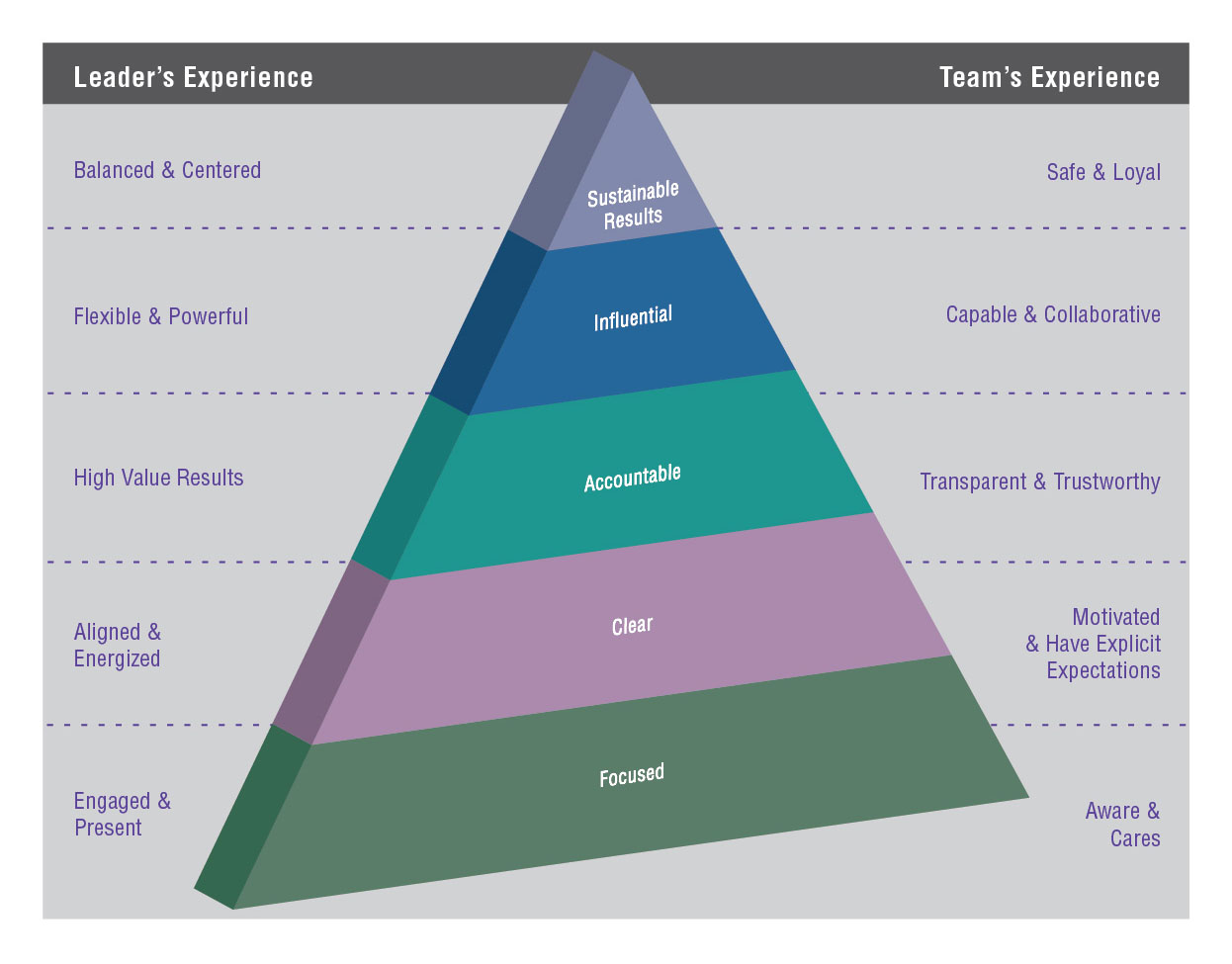
Click on Image to Enlarge

But not anymore.

This “Old School” management style is synonymous with what many people think is leadership. This model operates on fear—the team member must perform or we’ll remove their ability to pay their mortgage, kids’ educational expenses, etc. Fear pushes people to take action.

In the Information Age, some of these principles and practices are still sound–hey, let’s not throw the baby out with the bathwater–but some feel as obsolete as the Ford Edsel they were designed to produce. I have noticed that leaders who are able to grow their organizations rapidly in the face of accelerating technological and societal change—the people who create and foster innovation—exhibit certain characteristics. I call these characteristics “SmartTribe Accelerators.”

Read full article.

noble gold