Since the end of Cold War, the United States has exercised neither coherent nor strategically minded communication with overseas populations.
The New Public Diplomacy Imperative takes a look at the strategic necessity for strong American public diplomacy. Policy analyst Matthew Wallin examines many of the issues in contemporary public diplomacy, and recommends best practices for policy makers and public diplomacy practitioners.
This white paper provides case studies, insight and guidance to strengthen the effectiveness of American messaging overseas.
On December 5, Mandela died peacefully at home in Johannesburg. Cause of death was respiratory failure. He was 95.
Supporters called him a dreamer of big dreams. His legacy fell woefully short. More on that below.
“The ANC has never at any period of its history advocated a revolutionary change in the economic structure of the country, nor has it, to the best of my recollection, ever condemned capitalist society.”
In 1964, he was sentenced to life in prison. He was mostly incarcerated on Robben Island. It’s in Table Bay. It’s around 7km offshore from Cape Town.
In February 1990, he was released. In 1993, he received the Nobel Peace Prize jointly with South African President FW de Klerk.
Nobel Committee members said it was “for their work for the peaceful termination of the apartheid regime, and for laying the foundations for a new democratic South Africa.”
De Klerk enforced the worst of apartheid ruthlessness. In 1994, Mandela was elected president. He served from May 1994 – June 1999.
He exacerbated longstanding economic unfairness. He deserves condemnation, not praise.
John Pilger’s work exposed South African apartheid harshness. Doing so got him banned. Thirty years later he returned.
He wanted to see firsthand what changed. He interviewed Mandela in retirement. His “Apartheid Did Not Die” documentary followed.
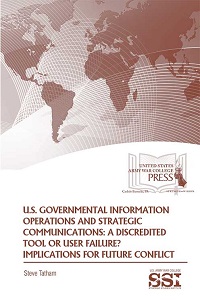
Through the prism of operations in Afghanistan, the author examines how the U.S. Government’s Strategic Communication (SC) and, in particular, the Department of Defense’s (DoD) Information Operations (IO) and Military Information Support to Operations (MISO) programs, have contributed to U.S. strategic and foreign policy objectives. It assesses whether current practice, which is largely predicated on ideas of positively shaping audiences perceptions and attitudes towards the United States, is actually fit for purpose. Indeed, it finds that the United States has for many years now been encouraged by large contractors to approach communications objectives through techniques heavily influenced by civilian advertising and marketing, which attempt to change hostile attitudes to the United States and its foreign policy in the belief that this will subsequently reduce hostile behavior. While an attitudinal approach may work in convincing U.S. citizens to buy consumer products, it does not easily translate to the conflict- and crisis-riven societies to which it has been routinely applied since September 11, 2001.
In article below, Ricks is oversimplistic. Quality may be more important than quantity, but a certain amount of quantity is essential. We may not have months available for a buildup as in ODS/S and OIF. Capability and capacity are both required.)
Thomas E. Ricks is an adviser on national security at the New America Foundation, where he participates in its “Future of War” project. A former Post reporter, he has written five books about the U.S. military, most recently “The Generals: American Military Command From World War II to Today.”
Want a better U.S. military? Make it smaller. The bigger the military, the more time it must spend taking care of itself and maintaining its structure as it is, instead of changing with the times. And changing is what the U.S. military must begin to do as it recovers from the past decade’s two wars.
For example, the Navy recently christened the USS Gerald R. Ford , an aircraft carrier that cost perhaps $13.5 billion. Its modern aspects include a smaller crew, better radar and a different means of launching aircraft, but it basically looks like the carriers the United States has built for the past half-century. And that means it has a huge “radar signature,” making it highly visible. That could be dangerous in an era of global satellite imagery and long-range precision missiles, neither of which existed when the Ford’s first predecessors were built. As Capt. Henry Hendrix, a naval historian and aviator, wrote this year, today’s carrier, like the massive battleships that preceded it, is “big, expensive, vulnerable — and surprisingly irrelevant to the conflicts of the time.” What use is a carrier if the missiles that can hit it have a range twice as long as that of the carrier’s aircraft?
Donors in Saudi Arabia have notoriously played a pivotal role in creating and maintaining Sunni jihadist groups over the past 30 years. But, for all the supposed determination of the United States and its allies since 9/11 to fight “the war on terror”, they have showed astonishing restraint when it comes to pressuring Saudi Arabia and the Gulf monarchies to turn off the financial tap that keeps the jihadists in business.
The chairs of the House and Senate intelligence committees stated last weekend that the world was getting more unsafe. A few days later, the Pew Research Center reported that 52 percent of Americans think the U.S. should “mind its own business internationally,” the highest such total in the nearly 50-year history of that query. Taken together, these two items symbolize a serious emerging national problem. The crackup ahead lies in the mismatch between the challenges facing America and the public’s willingness to support activist foreign policy to deal with them. Simply put: There is a splintering of the traditional consensus for global engagement at the very time that some big new problems are emerging
. . . . . . . .
A modest proposal is that Obama should convene a younger group of American leaders: strategists, technologists, professors. It would be a learning exercise — to understand how the country should deal with the problems of the next 10 years without making the mistakes of the past 10. What has America learned from its struggles with Islamic extremism? What lessons do we take from our painful expeditionary wars? How can Americans too young to remember the Iranian revolution of 1979 engage that country, but also set clear limits on its behavior?
Happily, a new generation of thinkers could form the bipartisan group I’m imagining. If you don’t know their names yet, you should: Marc Lynch of George Washington University, known to his online fans as “Abu Aardvark”; David Kilcullen, one of the architects of counterinsurgency success in Iraq and author of “Out of the Mountains,” an iconoclastic new book on future urban conflicts; Michèle Flournoy, a clear-eyed former undersecretary of defense; and Jared Cohen and Alec Ross, two technological wizards who advised the State Department under Hillary Clinton and are now with Google and Johns Hopkins University, respectively. I’d add the administration’s own Salman Ahmed , Tony Blinken , Ben Rhodes , Wendy Sherman and Jake Sullivan .
What encourages me is that the same American public that wants the United States to mind its own business internationally also registers a two-thirds majority in favor of greater U.S. involvement in the global economy, according to the Pew poll. Young respondents were even more internationalist on this issue than their elders.
Summary: We were ejected from Iraq, gaining nothing we sought. No oil, no ally against Iran, no unsinkable aircraft carrier in the Middle East. All but the mad hawks realize we gained nothing in Afghanistan. Now comes the post-game show, as our military’s boosters attempt to fog our vision and erase our memories, preparing us for more wars. The truth is out there, if only we would make an effort to see.
Contents
We lose because we’re ignorant of history and refuse to learn
Bitter fruit from our failure to learn
The history of counterinsurgency by foreign armies, a history of failure
A more detailed explanation of why foreign armies fail at COIN
Summary: Today we examine yet another example of agitprop by well-funded organizations inciting hatred of Muslims in America. Will we fall for this, again? A divided and fearful people are an easily led flock, a gift to their rulers. Please push back against this propaganda, and those that believe it. Being sheep is a choice.