Five Profound Choices Special Ops Face Next Year (RAND)
1. Does size matter?
2. Tactical frittering or strategic enduring impact?
3. Fix the theater special operations commands.
4. Special operators' rhetoric and intent must become consistent and convincing.
5. Finally, fix leadership succession and institutionalization
1. People. The safety of people is threatened by a) vulnerable cyber infrastructure. See the National Geographic video American Blackout; and b) inequality leading to lower standards of living for the middle class. See the recent books by Hedrick Smith, Joseph Stiglitz, and Jeffrey Sachs.
2. Profits. See the various films and books on the financial crisis. For example, in the book Thirteen Bankers Simon Johnson, former chief economist at the IMF, and James Kwak say that “too big to fail is too big.” Yet the banks are getting bigger and they have great influence in writing the laws on banking regulation.
3. Planet. I had heard that sea level might rise by 3 feet by the end of the century. The National Geographic program Earth Under Water suggests perhaps as much as 16 feet in 100 years and another 16 feet in the next 100 years. See .
These numbers may be high. However, what actions should we be taking in order to minimize the problem and to prepare for whatever sea level rise occurs?
I think systems science, and reflexivity theory, would be helpful in understanding these phenomena.
Nobel physicist: Thorium trumps all fuels as energy source
GENEVA – It’s high time for the nuclear industry to overhaul its conventional technology and shift to radically different reactor designs based on thorium fuel, a Nobel Prize winning physicist said.
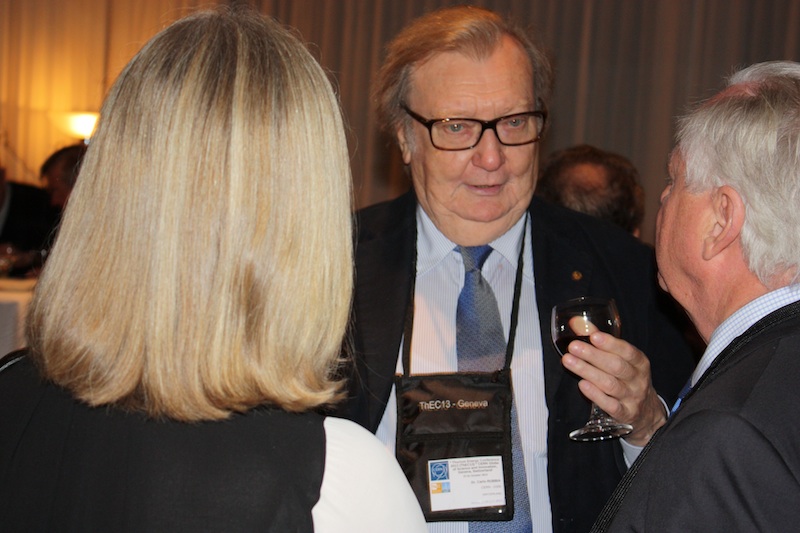
Carlo Rubbia
Carlo Rubbia, a former director of the CERN laboratory who shared the 1984 Nobel Prize in Physics, described thorium as having “absolute pre-eminence” over all other fuels including fossil fuels and uranium, the metallic element that has driven reactors since nuclear first started powering public grids in 1956.
“In order to be vigorously continued, nuclear power must be profoundly modified,” Rubbia said at the Thorium Energy Conference 2013, held on the CERN campus here last week.
Rubbia pointed out that thorium leaves less long-lived waste than uranium, is far more plentiful and is resistant to weapons proliferation, as I reported on my Weinberg blog. He also noted that thorium is effective at safely breeding more fuel, and that it has a much higher energy content than uranium or fossil fuels (see chart below), a characteristic that he said gives it “absolute pre-eminence…as a source of energy.”
Proponents of thorium disagree over the reactor technology that is best suited to optimize its characteristics. Unlike uranium, thorium is not “fissile,” so it needs to be coaxed into a reaction.
From: Kevin Kelley <kwk@thehomegalaxy.com> Date: Sat, 2 Nov 2013 10:31:11 -0700 Subject: NSA Files: Decoded – Truly Stunning! & ESSENTIAL! (From The Guardian)
This is truly stunning in many ways! Not in order:
It's stunningly beautiful as a graphic piece and typography
It's a stunning cutting edge of digital reporting converging interactive media
It stunning in it's brilliant and cogent making of it's case
It's stunning in the story it tells and conveys and in it's impact.
A collection of videos, text snap-shots, and images, across many authoritative personalities. This is a MAJOR contribution to the public dialog about mass surveillance and out of control government agencies.
Baker, Stewart (former NSA general counsel)
Drake, Thomas (former senior executive, NSA)
Greenwald, Glenn (Journalist)
Jaffer, Jameel (Deputy legal director, ACLU)
Levison, Ladar (Founder of Lavabit)
Lofgren, Zoe (US congresswoman)
Scalhill, Jeremy (National security journalist)
Soghoian, Chris (Principal technologies, ACLU)
Stepanovich, Amie (Lawyer, Electronic Privacy Information Center)
Wyden, Ron (US senator)
Below is a full text reproduction of the above letter from Gary Hart. The above also contains a letter to John Kerry from Art Goodtimes then of the Telleride Times-Journal. The Hart letter was written a year and a month after Col James Sabow, USMC (Aviation) was murdered, possibly by Marines acting on the orders of General Al Gray, then Commandant of the Marine Corps and long-timer special operations and counter-terrorism enabler for CIA operations outside the legal channels established by Congress. (For more information see Col James Sabow USMC Murder Book).
GARY HART
Davis, Graham & Stubbs
Suite 4700
370 Seventeenth Street
Post Office Box 185
Denver, Colorado 80201-0185
February 14, 1991
The Honorable John Kerry
Chairman
Subcommittee on Terrorism, Narcotics and International Communications
222 R.S.O.B.
Washington, D.C. 201510
Hon Gary Hart
Dear Senator Kerry,
The following information is provided at the request of Mr. Tosh Plumlee and is to document specific contacts he made with my Senate Office during the years of 1983-1985.
In March of 1983, Plumlee contacts my Denver Senate Office and met with Mr. Bill Holen of my Senate Staff. During the initial meeting, Mr. Plumlee raised certain allegation concerning U.S. foreign and military policy toward Nicaragua and the use of covert activities by U.S. intelligence agencies. He indicated that he was personally involved in covert military intelligence activities in Central and South America beginning in Feburary 1978. He stated that he had grave concerns that certain intelligence information about illegal arms and narcotic shipments were not being appropriately acted upon by U.S. intelligence and law enforcement agencies. Mr. Plumlee's stated purpose in contacting my office was to attempt to initiate a congressional investigation of these allegations. Mr. Plumlee stated that he had personally flown U.S.-sponsored covert missions into Nicaragua. He stated that Nicaragua was receiving assistance from Cuba with nearly 6,000 Cuban military advisors and large quantities of military supplies were being stockpiled at various staging areas inside Nicaragua and the Costa Rica border.
Mr. Plumlee also stated that Mexico, Costa Rica, Guatemala and El Salvador were providing U.S. military personnel access to secret landing field (sic) and various staging areas scattered throughout Central America.
The Honorable John Kerry
Washington, D.C.
February 14, 1991
Page 2
He specifically states the Mexican government's direct knowledge of illegal arms shipments and narcotic smuggling activities that were taking place out of a civilian ranch in the Veracruz area which were under the control and sponsorship of the Rafael Car-Quintero and the Luis Jorge Ochoa branch of the Medellin Escobar Cartel.
Mr. Plumlee states that the U.S. military and intelligence agencies had been otified through proper channels of these allegations.
During the next three months, Mr. Bill Holen of my staff met with Mr. Plumlee on several occasions allowing him to further elaborate on his experiences and concerns with U.S military operations in the region. In those later meetings, Mr. Plumlee raised several issues including that covert U.S. intelligence agencies were directly involved in the smuggling and distribution of drugs to raise funds for covert military operations against the government of Nicaragua. He provided my staff with detailed maps and names of alleged covert landing strips in Mexico, Costa Rica, Louisiana, Arizona, Florida, and California where he alleged aircraft cargoes of drugs were off-loaded and replaced with Contra military supplies. He also tates that these operations were not CIA operations but rather under the direction of the White House, Pentagon, and NSC personnel.
My staff brought these allegations to the attention of the Senate Armed Services Committee and the Senate Intelligence Committee at the time but no action was initiated by either committee.
In 1973, the Director of Central Intelligence ordered CIA officials to prepare a descriptive account of all CIA activities that were “outside the legislative charter of this Agency,” which is to say unauthorized or illegal. The purpose of the exercise was to identify operations that had “flap potential,” meaning that they could embarrass the Agency or embroil it in controversy.
The resulting 700-page CIA compendium of unlawful domestic surveillance, wiretapping, mail opening and detention actions became known as “the family jewels.” It helped to inform and to substantiate the investigations of intelligence in the 1970s. The document was finally declassified (with some redactions) in 2007 and was released to the National Security Archive, which has posted it here.
Amazon Page
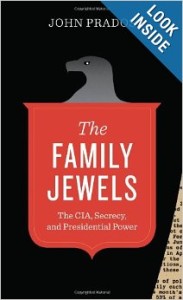
In a new book entitled The Family Jewels: The CIA, Secrecy, and Presidential Power (University of Texas Press, 2013), historian John Prados reviews the origins and consequences of the family jewels document and the operations described in it.
The thrust of Prados’ book is that the CIA family jewels are not simply relics of a discrete historical period, but rather that they are exemplars of a recurring pattern of intelligence misconduct. Many of the specific abuses of the 1970s, he argues, can be understood as archetypes that have been manifested repeatedly, up to the present day.
As DNI James Clapper said at a hearing of the House Intelligence Committee last week, “there are many things we do in intelligence that, if revealed, would have the potential for all kinds of blowback…. the conduct of intelligence is premised on the notion that we can do it secretly and we don’t count on it being revealed in the newspaper.”
“The intelligence community must acknowledge how difficult it is to keep secrets today,” said ODNI General Counsel Robert Litt in a speech last week.
The notion of creating and incrementally expanding “no spy” zones has some history. In a 1996 op-ed, for example, former U.S. Ambassador Robert E. White proposed that the U.S. explore the possibility on a trial basis:
“One reform might be to select a specific region of the world — for example, Central America — as a testing place. Withdraw all CIA staff from these countries. Let the National Security Council charge our career diplomats with fulfilling Washington’s intelligence requirements. Should Foreign Service officers prove capable of meeting all intelligence needs, then gradually extend this beneficial practice to other countries through pacts of reciprocal restraint by which signatories agree not to spy on or engage in covert action against the other. In order to be eligible to sign such a pact with the United States, the other nation would have to meet minimal standards of openness.” (“Call Off The Spies,” Washington Post, February 7, 1996).