This is Episode 5 of the critically feared Moment of Clarity SHOW by Lee Camp and Coalition Films. This episode also features creator of the Zeitgeist Movement Peter Joseph! This week we discuss money – what is it really? Why does it seem we never have enough? How do we rethink it? (And Henry does not have a Twitter account.)
1) For more on Coalition Films go to www.CoalitionFilms.com
2) The MOC rants and podcast come out twice a week. Go to LeeCamp.net for more.
In June 1967, it took Israeli forces only six hours to rout the Egyptian military and devastate its air force, inflicting the most humiliating defeat on the Arab world in the last half century. In the 1973 October war, the Egyptian army killed 2600 Israeli soldiers in 20 days of combat. Nearly forty years later, the Egyptian military turned its guns on its own citizens to much devastation: on August 14, it took the combined forces of Egypt’s army and police twelve hours to disperse tense of thousands of unarmed peaceful protesters in two sit-in camps in the eastern and western suburbs of Cairo. It was a determined effort by the July 3 coup leaders to not only defeat their political opponents, but also to strike a decisive blow to democracy and the rule of law in Egypt and across the Arab world.
Since June 28, Islamists led by the Muslim Brotherhood (MB) have been camped out at these two sites, initially as a show of support to President Mohammad Morsi as he was being challenged by the opposition. But since he was deposed on July 3, the protesters have been demanding his return, the restoration of the suspended constitution, and the reinstatement of the dissolved parliament. For 48 days, the sit-ins and demonstrations across Egypt attracted millions of Morsi supporters as well as pro-democracy groups, who protested the coup’s nullification of their presidential and parliamentary votes and their ratification of the referendum on the new constitution.
An Obstinate Military Enabled by Liberal and Secular Forces and Western Powers
My new Press TV article, published Monday, is looking prophetic – or as we Muslims prefer to say “precognitive.”
When the US sends a “death squad ambassador” to Egypt, you can figure that the big slaughter is about to begin. As of today, it has begun. Just as I predicted, the mass slaughter of Morsi/democracy supporters was triggered by false-flag terror.
Yahoo News reports: “Live (Egyptian) television footage on several channels appeared to show hooded Brotherhood (sic) gunmen brandishing what appeared to be small automatic rifles and firing them in the direction of soldiers.”
In fact, the “hooded gunmen” – like those who set off the Sunni-Shia violence in Iraq in Iraq and Syria – are professional killers working for the Empire and its current Egyptian stooge, el-Sisi. The purpose: To demonize Islam, destroy democracy, and perpetrate a genocide in Egypt.
-KB
Is the US government targeting Egypt for destabilization – and eventual destruction?
The recent appointment of death squad organizer Robert Ford as US Ambassador to Egypt suggests as much.
Ford’s appointment sends a clear message: US policymakers want to destroy Egypt in the same way they have destroyed Iraq and Syria – by using death squads and false-flag terror to incite civil war.
Former head of the Central Intelligence Agency’s (CIA) Counterterrorism Center and its former Deputy Director of Operations Jose Rodriguez appeared on CBS’ “60 Minutes” to flaunt his new book Hard Measures, which details how he came to be in charge of CIA torture against terror suspects at “black site” prisons, why he believes torture was effective and why it should not be vilified.
The segment with Lesley Stahl has the same title as Rodriguez’s book. The title sounds like the name of a film starring an action movie star like Chuck Norris or Steven Seagal, which makes it appropriate because each answer from Rodriguez is dripping with bravado. From Rodriguez’s first answer to the last, one cannot help but realize he believes it is somehow unmanly to be concerned that torture of terror suspects violates the rule of law. He appears in his sleek white Camaro rolling down the highway to the CIA. And he says at one point, “We needed to get everyone in government to put their big boy pants on and give us the authorities we needed.”
Of course, like most establishment media interviews, the torture is not called torture. It is called “harsh techniques.” Or the official term Cheney coined for it—“enhanced interrogation techniques.”
*Here are both parts of the interview: Part 1 / Part 2
The first words in the segment are, “After the attacks of 9/11…” That phrase is all one needs to hear to know that this is going to be a tireless exercise in explaining away acts that historically have been considered war crimes when carried out.
There is No Way to Stop Fukushima Radioactive Water Leaking into the Pacific
The rate at which contaminated water has been pouring into the Pacific Ocean from the disabled Fukushima nuclear plant is worse than previously thought, an Industry Ministry official said Wednesday as PM Shinzo Abe pledged to step up efforts to halt the crisis. The Voice of Russia contacted Arnold Gundersen, founder and president of Fairewinds Associates, to discuss the crisis and its possible solutions. The expert suggests radioactive material will continue to leak into the global seas unless the plant is surrounded with a trench filled with zeolite. Even then however, toxic material will still flow into the Pacific through underwater routes.
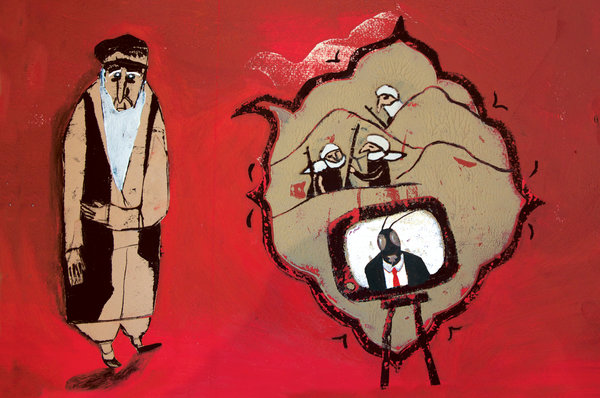
ON a sunny, crisp November day in 2008, three American civilians joined a platoon of United States soldiers on a foot patrol in Maiwand District, a flat, yellow patch of earth crowned by black-rock mountains in southern Afghanistan. The civilians were part of the Human Terrain System, an ambitious, troubled Army program that sends social scientists into conflict zones to help soldiers understand local culture, politics and economics.
Click on Image to Enlarge
That day, the team planned to interview shoppers coming and going from a nearby bazaar. Afghans had complained about the high price of flour, so the Human Terrain Team members were creating a consumer price index. They also wanted to find out whether Afghan officials were asking shopkeepers for bribes, and how merchants protected themselves and their goods in a place where insurgents and local security forces threatened civilians in equal measure.
The team’s social scientist that day was Paula Loyd, a 36-year-old Wellesley graduate and Army veteran with degrees in anthropology and diplomacy and years of experience as a development worker in Afghanistan. Through her interpreter, she struck up a conversation with an Afghan man who was carrying a jug of fuel, asking how much he had paid for it. They talked genially until her interpreter was called away. Suddenly, the man doused Ms. Loyd with gas from his jug and lit her on fire.
It was one stunning act of violence in a conflict that has killed more than 2,100 American troops and wounded more than 19,000. As the United States drawdown approaches, stalled peace talks with the Taliban, Afghan political maneuvering and the waste of billions in taxpayer dollars dominate headlines. Each new attack stokes our yearning for a quick exit. But the more assiduously we seek to put the pain and hard-won lessons of this conflict behind us, the more likely we will be to repeat the same mistakes in the next war.
Paula Loyd died of her injuries a few months after the attack, in January 2009. Soon after, I flew to Kandahar to try to figure out who had set her on fire, and why. It seemed obvious that the Taliban were behind it, but the assault was unusual, to say the least. She was unarmed, interviewing people and taking notes, something I’d often done in villages around Afghanistan. I couldn’t remember a Taliban attack that resembled it. Neither, it turned out, could anyone else.
Have you heard ….. big data relies on a very big assumption: that having more data gives organisations better understanding of their environment. The apostles of big data preach that it will make organisations smarter. In fact, the opposite is true: big data dulls an organisation's strategic senses. Here's how…
1. Much of the quantifiable data is not strategically useful: Today we accumulate extraordinary amounts of quantified data, but how much of that data helps us understand a complex and rapidly changing environment, where by definition data is always ambiguous and lagging? During the Cold War, the US Government looked at USSR military capability as a signal of economic success. When the USSR economy collapsed, they realised that the number of missiles was not a true reflection of the strength of their economy at all, it was a huge drain on their financial resources. The US realised they were making strategic decisions based on the wrong data.