(Reuters) – Moderate cleric Hassan Rohani won Iran's presidential election on Saturday with a resounding defeat of conservative hardliners, calling it a victory of moderation over extremism and pledging a new tone of respect in international affairs.
Offering praise for Iranians and reproaching their government, the Obama administration said Saturday it respected the results of a presidential election conducted under restrictive conditions.
By STEPHEN BRAUN, ANNE FLAHERTY, JACK GILLUM and MATT APUZZO
WASHINGTON (AP) — In the months and early years after 9/11, FBI agents began showing up at Microsoft Corp. more frequently than before, armed with court orders demanding information on customers.
Around the world, government spies and eavesdroppers were tracking the email and Internet addresses used by suspected terrorists. Often, those trails led to the world's largest software company and, at the time, largest email provider.
The agents wanted email archives, account information, practically everything, and quickly. Engineers compiled the data, sometimes by hand, and delivered it to the government.
Often there was no easy way to tell if the information belonged to foreigners or Americans. So much data was changing hands that one former Microsoft employee recalls that the engineers were anxious about whether the company should cooperate.
Inside Microsoft, some called it “Hoovering” — not after the vacuum cleaner, but after J. Edgar Hoover, the first FBI director, who gathered dirt on countless Americans.
(Beirut) – The short answer is Iran and Hezbollah according to Congressional sources. “The Syrian army’s victory at al-Qusayr was more than the administration could accept given that town’s strategic position in the region. Its capture by the Assad forces has essentially added Syria to Iran’s list of victories starting with Afghanistan, Lebanon, Iraq, as well as its growing influence in the Gulf.”
Other sources are asserting that Obama actually did not want to invoke direct military aid the rebels fighting to topple the Assad government or even to make use of American military power in Syria for several reasons. Among these are the lack of American public support for yet another American war in the Middle East, the fact that there appears to be no acceptable alternative to the Assad government on the horizon, the position of the US intelligence community and the State Department and Pentagon that intervention in Syria would potentially turn out very badly for the US and gut what’s left of its influence in the region. It short, that the US getting involved in Syria could turn out even worse than Iraq, by intensifying a regional sectarian war without any positive outcome in sight.
John Sifton is an attorney at Human Rights Watch. He worked in Afghanistan and Pakistan from 2001 to 2004 and was senior researcher on terrorism and counterterrorism from 2005 to 2007. He is currently the Asia Advocacy Director.
The first thing I did after I heard about the highly classified NSA PRISM program two years ago was set up a proxy server in Peshawar to email me passages from Joyce’s Finnegans Wake. A literary flight of fancy. I started sending back excerpts from Gerard Manley Hopkins poems.
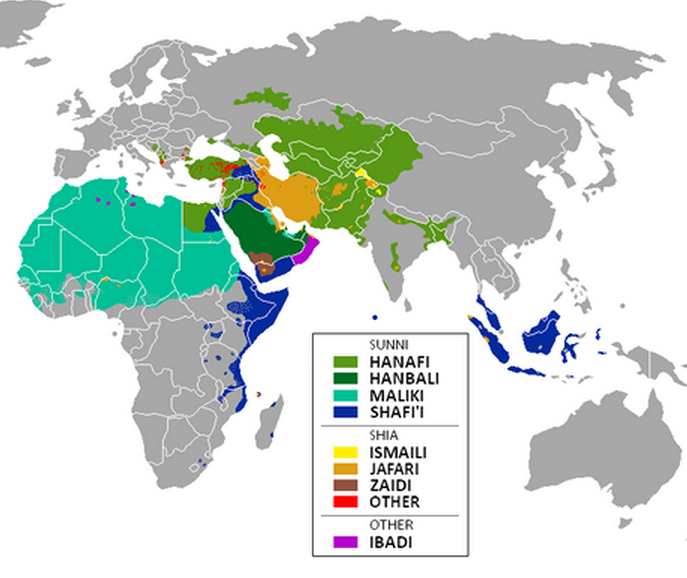
Americans were largely ignorant of the Muslim faith prior to 9/11, but in the years since we have at least learned that there are two major branches and that not all Muslims are Arab. I came across this graphic of global Muslim sects in other reading a few days ago and saved it for an opportune moment, not realizing how quickly I would need it.
The geographic display of the divide between Sunni and Shia is a fair match for the count of adherents – about 85% of all Muslims are Sunni. There are several conflicts where the sectarian differences are important. These include:
Alawite Syrians on the coast, terrified of the coming Sunni majority government
Majority Shia Bahrain chafing under a Sunni monarchy
Yemeni Shia fighting to restore the North/South Yemen divide
Click on Image to Enlarge
One bright spot has been NATO relations with the ethnic Hazara minority in Afghanistan. They are clearly visible in the global sects map as a yellow Jafari Shia donut hole in the middle of what is otherwise Hanafi Sunni territory.
Nick Ilyadis, CTO of Broadcom, discussed his company’s long lasting relationship with HP, security trends, and the big trend of Internet of Things with theCube co-hosts John Furrier and Dave Vellante, live at the HP Discover 2013 conference.
“We’re on our 13th generation of Ethernet controllers and HP has been a customer of ours for most of those generations,” Ilyadis said, adding that the quality of the software Broadcom provided was key to the relationship. Asked to detail the quality of the controller they provide, Ilyadis said that “quality has many facets”, and one key point is hardening – the software is field tested over several generations, it is feature rich, and features are incorporated based on feedback from customers. “We’re very responsive to go out and fix” issues, he added. “The fact that they are using it as a default adapter speaks of that.”
Broadcom was also named partner of the year for security by HP. Ilyadis said that the “controller products don’t really have a security aspect, but in broader Broadcom portfolio, we have encryption /crypto capabilities that are best in class.” Broadcom has recently announced a a multi-core processor that provide a hundred gigabytes of crypto in line. What that means it has the ability to encrypt multiple enterprises in terms of their traffic – such as banks – “without breaking a sweat.” The product is “the highest performing multi-core processor in the industry.”
In 1984 — the year not the book, but it was fitting — and five years before she died, Barbara Tuchman published a book called The March of Folly: From Troy to Vietnam. In one part of the book she looked at the destructive work of a series of a half-dozen popes, work destructive of the papacy, work that brought into being the protestant secession from the Catholic church. This was offered as an example of folly, of rulers acting against the interest of their own institution. It was also an example of what we so casually label “the imperial presidency.” That is, in these popes we watched the mad and cumulative concentration of power and normalization of abuses that Tuchman almost certainly was aware she was living through again — along with the debasement of an institution previously imagined to embody certain principles and integrity.
Does history repeat itself?
Is the Pope Catholic?
. . . . . . . . .
Clement VII, Pope from 1523 to 1534 / Barack Obama, President since 2009
“The new Clement's reign proved to be a pyramid of catastrophes. Protestantism continued its advance. . . . Supreme office, like sudden disaster, often reveals the man, and revealed Clement as less adequate than expected. Knowledgeable and effective as a subordinate, Guicciardini writes, he fell victim when in charge to timidity, perplexity, and habitual irresolution. . . . By 1527, hardly a part of Italy had escaped violence to life and land, plunder, destruction, misery, and famines. Clement's misjudgments having prepared the way, Rome itself was now to be engulfed by war.”
“The folly of the popes was not pursuit of counter-productive policy so much as rejection of any steady or coherent policy either political or religious that would have improved their situation or arrested the rising discontent. Disregard of the movements and sentiments developing around them was the primary folly. . . . When private interest is placed before public interests, and private ambition, greed, and the bewitchment of exercising power determine policy, the public interest necessarily loses, never more conspicuously than under the continuing madness from Sixtus to Clement. The succession from Pope to Pope multiplied the harm. Each of the six handed on his conception of the Papacy unchanged. . . . St. Peter's See was the ultimate pork barrel. Their three outstanding attitudes — obliviousness to the growing disaffection of constituents, primacy of self-aggrandizement, illusion of invulnerable status — are persistent aspects of folly. While in the case of the Renaissance popes, these were bred in and exaggerated by the surrounding culture, all are independent of time and recurrent in governorship.”