‘The welfare state has done to black Americans what slavery couldn't do. . . . And that is to destroy the black family.'
Even in the antebellum era, when slaves often weren't permitted to wed, most black children lived with a biological mother and father. During Reconstruction and up until the 1940s, 75% to 85% of black children lived in two-parent families. Today, more than 70% of black children are born to single women. “The welfare state has done to black Americans what slavery couldn't do, what Jim Crow couldn't do, what the harshest racism couldn't do,” Mr. Williams says. “And that is to destroy the black family.”
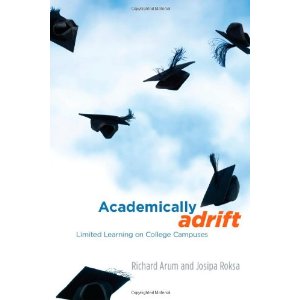
Drawing on survey responses, transcript data, and results from the Collegiate Learning Assessment (a standardized test taken by students in their first semester and at the end of their second year), Richard Arum and Josipa Roksa concluded that a significant percentage of undergraduates are failing to develop the broad-based skills and knowledge they should be expected to master. Here is an excerpt from Academically Adrift: Limited Learning on College Campuses (University of Chicago Press), theirnew book based on those findings.
“With regard to the quality of research, we tend to evaluate faculty the way the Michelin guide evaluates restaurants,” Lee Shulman, former president of the Carnegie Foundation for the Advancement of Teaching, recently noted. “We ask, ‘How high is the quality of this cuisine relative to the genre of food? How excellent is it?' With regard to teaching, the evaluation is done more in the style of the Board of Health. The question is, ‘Is it safe to eat here?'” Our research suggests that for many students currently enrolled in higher education, the answer is: not particularly. Growing numbers of students are sent to college at increasingly higher costs, but for a large proportion of them the gains in critical thinking, complex reasoning, and written communication are either exceedingly small or empirically nonexistent. At least 45 percent of students in our sample did not demonstrate any statistically significant improvement in Collegiate Learning Assessment [CLA] performance during the first two years of college. [Further study has indicated that 36 percent of students did not show any significant improvement over four years.]
Lester Brown — founder of both the Worldwatch Institute and the Earth Policy Institute, author of over 50 books on environmental issues, recipient of 26 honorary degrees and a MacArthur Fellowship, and (according to the Washington Post) “one of the world's most influential thinkers” — has just published a cogent article on the rapidly emerging global food crisis in Foreign Policy magazine. He clearly outlines the problem and where attention and resources must be put to ameliorate it.
I knew such a crisis was emerging. I hadn't realized it was emerging so rapidly.
I offer Brown's article here with no further commentary beyond this: His essay — like most other insightful, data-filled articles of its type — omits the key fact that the political and economic systems that generate such situations are not built to respond to them in a truly life-affirming way. “Issues” and “crises” are symptoms of those dysfunctional systems. If social critics and activists spent half the attention and resources on actually transforming those systems that we expend on “issues” and “crises”, we would soon see those “issues” and “crises” being replaced by “solutions” and “creative initiatives”. This is a supreme example of the kind of thing that a wiser democracy — if we had one — would start to address immediately, if it hadn't already done so decades ago.
While many of us work to transform our political and economic systems, we need also to consider what to do in the meantime as these issues and crises continue to grow. So I also offer below two delightful articles on something that we can all do to ameliorate the impact of the food crisis on our own lives and communities. The articles describe not only the functionality of urban gardening but also its enjoyment — and its spread in the face of rising food prices. Significantly, such gardening is a key element in one of the more co-intelligent initiatives I've seen in recent years, the Transition Towns movement http://en.wikipedia.org/wiki/Transition_Towns.
This conference will be one of the big International meetings exclusively dedicated to Recycling and Reuse of Materials and their Products. The conference will be extremely useful in the sense that it will be attended by hundreds of Chemists, Physicists, Technologists and Engineers, making it a truly interdisciplinary conference. The goal of the conference emphasizes interdisciplinary research on processing, morphology, structure, properties and applications of recycling and reuse of materials and their products and their applications in automotive, civil, chemical, aerospace, computer and marine engineering.
This symposium will bring together a panel of highly-accomplished experts in the field of Recycling and Reuse of Materials and their Products. Talks will encompass basic studies and applications and will address topics of novel issues. During the three-day conference, we will listen to recognized authorities in the field as they discuss recent advances, difficulties, and breakthroughs in the field of recycling and reuse of materials and their products. The conference will feature keynote addresses, a number of plenary sessions, invited talks and contributed lectures focusing on specific tenets of recycling and reuse of materials and their products additionally, there will be several poster sessions, and four best poster presentations will be selected for the award. The conference is to be held on 5th, 6th and 7th, August 2011. Continue reading “Event: 5-7 Aug 2011, Kottayam, Kerala, India; Conf on Recycling & Reuse of Materials (Polymers, Wood, Leather, Glass, Metals, Ceramics, Semi Conductors, Water etc) and their products”