Journal: Get America Working–A Conversation

Analysis, Budgets & Funding, Collaboration Zones, Collective Intelligence, Communities of Practice, Corporations, Ethics, InfoOps (IO), Intelligence (government), International Aid, IO Sense-Making, Key Players, Methods & Process, Money, Banks & Concentrated Wealth, Officers Call, Open Government, Policies, Policy, Power Behind-the-Scenes/Special Interests, Real Time, Strategy, Threats
Open Everything

PART I: The Only Way to Fix the Deficit–Multiply Jobs (William Drayton)

PART II: Nice Ideas But So Is Icing Cover Feces (Robert Steele)

PART III:  Create Jobs?  As an End In Themselves?  To Do What?  Why? (Alexander Carpenter)

PART IV:  Related Recommended Reading (Robert Steele)

The core take-away (from PART III)

Beyond its inherent merit and explicit substance, William Drayton: The Only Way to Fix the Deficit: Multiply Jobs is a great example of unconscious status-seeking righteousness – well-meaning ineptitude and irrelevance, trapped in the old paradigm of debt-money, growth, and social conditioning. This kind of thinking is exemplary of people who are focused on the superficial “economic crisis,” not going deeper to see that we have a political (and even a social) crisis with, of course, an economic manifestation. This represents the success of the pseudo-science of “economics,” originally created with the intention to get most people to believe that objective “natural” forces are running their lives, not other people, classes, and institutions (Thurmond Arnold, 1937). Good problem-solvers always begin with as much accurate information about the overall problem as possible. It's incompetent – or unconscious self-deception – to assume human nature isn't the core and essence of the problem, and Bill Drayton isn't necessarily incompetent…

Perspective (from PART III Reference):

“By providing the funding and the policy framework to many concerned and dedicated people working within the non-profit sector, the ruling class is able to co-opt leadership from grassroots communities, … and is able to make the funding, accounting, and evaluation components of the work so time consuming and onerous that social justice work is virtually impossible under these conditions” (Paul Kivel, You Call this Democracy, Who Benefits, Who Pays and Who Really Decides, 2004, p. 122 )

Phi Beta Iota: In Advanced Information Operations (IO) terms, we cannot fix the military until we fix government, we cannot fix government until we fix Wall Street and Main Street,  we cannot fix the economy until we fix the society, and all of that requires a firm focus on human nature and the relations among humans.  We live is a “whole system” and are mis-managing it by being ignorant and delusional about root causes and actual relationships.  Until we get the truth on the table, we cannot deal with it.  Good news:  all it takes is ONE node able to blend intelligence & integrity, that “spike” will proliferate.  The bottom line is that DEMAND creates jobs, and EDUCATION creates the demand for the RIGHT jobs.  Taking one example, the US Army, it could apply Advanced Information Operations to create a 180 degree maturation of the mind-set of its personnel, and use that to “eat the old” and create the new.  The US Army is going to suffer a nose dive in financial resources (as will the other services); the US Army is the ONLY service that must might be capable of “beating the dive” by re-inventing itself from inside out–starting with Advanced IO being about minds, not technology.  Similarly, a single multinational could “get a grip” and re-invent itself overnight–the example will proliferate.

Continue reading “Journal: Get America Working–A Conversation”
Journal: Robert Smith on Education

04 Education

There are some other things that negatively influence the quality of American public education.

(1) A fair performance evaluation system based on teacher behavior must be implemented. I used to think that such a system must focus upon student outcomes, but, teachers seldom have more than 10% influence over the variance in student outcomes.

(2) Centralized, uniform, bureaucratized instructional directives are often issued by non-educators and they tie the hands of teachers and reduce incentive and creativity.

(3) Resources in the public schools are sparse. The wealthy so often do not wish to share wealth with the public education system that would provide them with educated employees. Everyone from all sectors of our society have an interest in our operating an excellent public educational system. Colleges can't teach if freshmen can't study. Employers need workers who can read, write, calculate, speak … The criminal justice system is used less often by moderately educated persons. People with a higher education are more likely to research health issues, live healthier lives, and have fewer medical ailments (with usually later onset). Our military must have an educated pool of service men and women.

(4) Smart resource allocation is essential. Charles Darwin proposed not the survival of the fittest but rather the survival of the most adaptive. Adaptation to the newest technologies is essential for students to be able to make later contributions to employers or military … All elements of society have a vested interest in quality educational outcomes. All elements must come together with resources, needs / goals for public schools to lead students toward. Perhaps most importantly, the use of the newest technologies in the public schools can alter the entire teaching experience, bringing problems and test questions and personalized instructional techniques and instructional topics to each student so as to maximize his / her education in the most efficient manner. I would guess that this will reduce the cost of education per student over the next decade. The current system is designed, well, somewhat for the convenience of the educators. The children most difficult to “control” (like Thomas Edison would be today) would be provided individualized instruction that is designed to engage each individual student.

(5) Society must embrace education. If the public education system is the thrive and its graduates are to make significant contributions, then the cultures from which students come must be not just education accepting but rather education embracing. How can a child really enjoy and learn if they are malnourished? neglected at home? in need of health care? worry about their mother engaging in dangerous behaviors to satisfy a fix? Why would students who use sound linear short-term reasoning conclude that attendance at school is worthwhile when they can earn twice what a physician earns, at 16, selling drugs, and they don't have to invest an additional 15 years. …

From Robert Smith at Facebook.

See Also:

Journal: 1 in 4 Fail US Army Extrance Exam

Journal: Future Hotspots?

04 Inter-State Conflict, 05 Civil War, 06 Russia, 07 Other Atrocities, 08 Wild Cards, Military
DefDog Recommends...

Forecast 2011: Conflict Hotspots

23 December 2010

Protestor with face mask walks past street fire and crowds of other protestors, courtesy of Faramarz Hashemi/flickrPolitical hotzones 2011?

Where in the world will conflict flare in the new year? This special, expanded edition of ISN Insights examines three hotzones beyond the headlines: Pakistan, Tajikistan and the Northern Caucasus.


This special ISN Insights package contains the following content, easily navigated along the tab structure above – or via the hyperlinks below:

A 2011 Pakistani political forecast by Gregory Copley, President of the International Strategic Studies Association, who predicts a watershed year ahead for the Islamic Republic.

A look forward to the potential for further proliferation of terrorist activity in the North Caucasus – and how Russia should address it by Simon Saradzhyan, research fellow at the Harvard Kennedy School's Belfer Center.

A close examination of Tajikistan's make-or-break year ahead by John CK Daly, non-resident fellow at the Johns Hopkins Central Asia-Caucasus Institute.

See Also:

Review: Zones of Conflict–An Atlas of Future Wars

Review: The Water Atlas–A Unique Visual Analysis of the World’s Most Critical Resource

Journal: Learning Styles Concepts and Evidence

04 Education, IO Mapping, IO Multinational, IO Sense-Making

Learning Styles:Concepts and Evidence

Psychological Science in the Public Interest

Abstract

The term “learning styles” refers to the concept that individuals differ in regard to what mode of instruction or study is most effective for them. Proponents of learning-style assessment contend that optimal instruction requires diagnosing individuals' learning style and tailoring instruction accordingly. Assessments of learning style typically ask people to evaluate what sort of information presentation they prefer (e.g., words versus pictures versus speech) and/or what kind of mental activity they find most engaging or congenial (e.g., analysis versus listening), although assessment instruments are extremely diverse. The most common—but not the only—hypothesis about the instructional relevance of learning styles is the meshing hypothesis, according to which instruction is best provided in a format that matches the preferences of the learner (e.g., for a “visual learner,” emphasizing visual presentation of information).

Read rest of Abstract

Phi Beta Iota: Advanced Information Operations (IO) will see the blending of Cognitive Science with Collective Intelligence inside the IO Cube.  While the World Brain and Global are the final outcome, Advanced IO concepts and doctrine are possible now–they merely require the robust integration of intelligence and integrity in tandem, leading to the identification and pursuit of the right things–and recognize that information is a substitute for time, space, capital, labor, and violence.  Sun Tzu meets John Boyd.  Arugah.

Journal: Covert War in Pakistan–Lessons Not Learned

04 Inter-State Conflict, 05 Civil War, 07 Other Atrocities, 08 Wild Cards, 10 Security, 11 Society, Cultural Intelligence, Government, IO Multinational, IO Sense-Making, Military
Thomas Leo Briggs

Something caught my eye while reading a Slate item written by Tom Scocca and posted on December 20, 2010, “Two Ways of Looking at Our Covert War in Pakistan.”

Mr. Scocca wrote:

“There are diplomatic tensions because we are fighting a full-on undeclared war on the territory of a country with which we are an ally, using covert agents as the commanding officers”.

So what’s new?  Didn’t we fight a full-on undeclared war on the territory of Laos from about 1961 to 1973?  Wasn’t Laos an ally while trying to maintain the fig-leaf of neutrality?  Wasn’t the United States government using ‘covert agents as commanding officers’?

Moreover the New York Times published an article by Mark Mazzetti and Dexter Filkins the same day titled “U.S. Military Seeks to Expand Raids in Pakistan”.

In particular I noticed the following that Mazzetti and Filkins attributed to senior military commanders in Afghanistan.

Continue reading “Journal: Covert War in Pakistan–Lessons Not Learned”

Journal: Can the US Economy Recover?

03 Economy
Chuck Spinney Sounds Off...

DECEMBER 23, 2010

Seeds of Destruction: Why the Path to Economic Ruin Runs Through Washington, and How to Reclaim American Prosperity
by Glenn Hubbard and Peter Navarro
FT Press, 266 pp., $26.99

Capitalism 4.0: The Birth of a New Economy in the Aftermath of Crisis
by Anatole Kaletsky
PublicAffairs, 396 pp., $28.95

Aftershock: The Next Economy and America’s Future
by Robert B. Reich
Knopf, 174 pp., $25.00

EXTRACT:

What is rarely recognized is that even if the US can emerge from a weak economy within a few years, the economic foundation that existed before the cataclysm of 2007 and 2008 may not be adequate to restore the widely shared prosperity the US needs. For more than three decades, economic growth had been largely dependent on rapidly rising levels of debt and on two major speculative bubbles, first in high technology and dot-com stocks in the late 1990s, then in housing in the 2000s. What will now replace them?

Income inequality widened sharply in these years and average wages stagnated for the many while record high fortunes were made by the few. The financial security and access to adequate health care and education for children that had defined the middle class since World War II have eroded rapidly. Meanwhile, investments in infrastructure such as transportation, as well as clean energy and education, have been badly neglected. All this raises doubts about America’s future economic vitality whether or not it balances its budget, and it does so at a time when international competition from Asia and the Southern Hemisphere will pose serious challenges during this century. How will Americans live a decade from now?

Read entire review….

CHUCK SPINNEY: The budget/tax compromise just agreed to by President Obama and the Republicans blew a hole in the out-year deficits by continuing for two years the Bush 2001 tax cuts to the wealthy in the hope that a stimulative effect will trickle down to grow the economy before the 2012 election.  That the economy grew sluggishly after 2001, that federal deficits exploded after 2001, that the economy continued to hemorrhage manufacturing jobs after 2001, that income inequality continued to increase after 2001, that middle class wages continued to stagnate after 2001, and that the first decade of the 21st Century ended in the worst economic crisis since the 1930s do not seem to affected the political calculus in 2010 to increase these tax cuts to 2012.

Continue reading “Journal: Can the US Economy Recover?”

Worth a Look: Education and Our Divided World

04 Education, Worth A Look
Michael Ostrolenk Recommends...

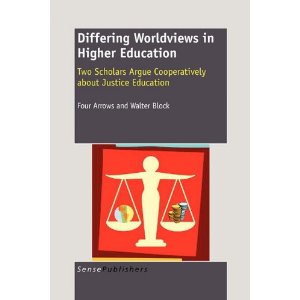
DIFFERING WORLDVIEWS IN HIGHER EDUCATION
Two Scholars Argue Cooperatively about Justice Education

Four Arrows
Fielding Graduate University, Santa Barbara, USA

and

Walter Block
Loyola University, New Orleans, USA

Publisher's Summary:

Amazon Page

Two noted professors on opposite sides of the cultural wars come together and engage in “cooperative argumentation.” One, a “Jewish, atheist libertarian” and the other a “mixed blood American Indian” bring to the table two radically different worldviews to bear on the role of colleges and universities in studying social and ecological justice. The result is an entertaining and enlightening journey that reveals surprising connections and previously misunderstood rationales that may be at the root of a world too polarized to function sanely.


noble gold